↓
 

Suzi Love

Making history fun, one year at a time.

Header_
  • Home
  • Newsletter
  • Pre order form
  • Shop
    • Cart
    • Checkout
    • My account
    • Refund and Returns Policy
  • Blog
  • BOOKS
    • History Events
    • Kelly’s Justice
    • Outback Arrival
    • Irresistible Aristocrats
    • History Notes
    • Scandalous Siblings
    • Love After Waterloo
    • Regency Life Series
  • Privacy Policy
  • EVENTS
Home » Regency London » Page 8 << 1 2 … 6 7 8 9 10 >>

Tag Archives: Regency London

Post navigation

← Previous Post
Next Post→
1820 1. London, the English Metropolis. via The English Metropolis By John Corry. via google books.

London in Bridgerton and Jane Austen Years. via 1820 The English Metropolis By John Corry. #Bridgerton #JaneAusten #RegencyEra #London #GoogleBooks

Suzi Love Posted on May 10, 2025 by Suzi LoveMay 10, 2025

Regency London 1820 The English Metropolis By John Corry Via Google Books (PD-180)

This great metropolis is sixty miles distant from the sea; it is built on the banks of the river Thames; is about seven miles in length, from east to west, but of an irregular breadth, being in some parts two miles, in others three, and at the broadest part four miles. Its three distinct and municipal divisions are, the city of London, the city of Westminster, and the borough of Southwark, which, with their extensive suburbs, cover a space of more than twenty miles in circumference.  According to the Population Return of 1811, this metropolis then contained 149,430 houses, including those building and uninhabited; and since that period there have been but few new houses built, so that the real number is probably not more than 150,000.

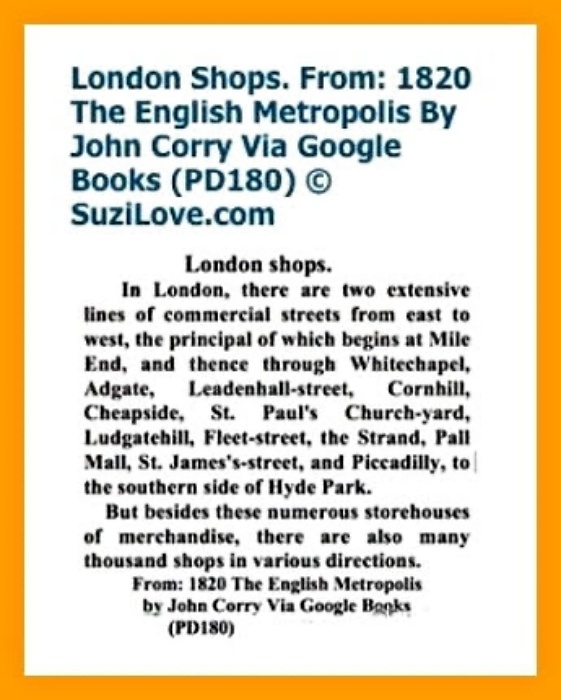
In the year 1801, the population of London was ascertained to be 900,000.  The number in 1811, amounted to 1,009,546. Beneath the pavement large arched sewers communicate with the houses by smaller ones, with the street by small openings covered with iron grating, and with the Thames, which contributes much to the cleanliness and health of the inhabitants of this populous place. Houses on each side of these streets are lofty, spacious, and commodious, generally four stories high, and chiefly occupied by tradesmen, whose shops present the most beautiful and perfect productions of nature and art for the general accommodation of man, There are two extensive lines of commercial streets from east to west, the principal of which begins at Mile End, and thence through Whitechapel, Aldgate,Leadenhall-street, Cornhill, Cheapside, St. Paul’s Church-yard,Ludgatehill, Fleet-street, the Strand, Pall Mall, St. James’s-street, and’ Piccadilly, to the southern side of Hyde Park. But besides these numerous storehouses of merchandise, there are also many thousand shops in various directions. Ample supplies of water afforded by the Thames And New River Water-works, are essentially conducive to the health and comfort of the inhabitants.

St. Paul’s Church is the most magnificent. It is situated near the northern bank of the Thames, and when viewed from Blackfriar’s Bridge in the vicinity, presents one of the noblest ornaments of superb architecture ever beheld by the human eye. This beautiful cathedral is built of Portland stone, in the form of a. cross, adorned in the central part by a lofty dome, on the summit of which is a light and elegant lantern, ornamented with Corinthian columns, and surrounded by a balcony. Next to St. Paul’s cathedral for magnificence, and even greater in extent, is that fine monument of gothic architecture Westminster Abbey, or the collegiate church of St. Peter.Among the modern churches that of St. Mary-le-Bone is remarkable for a spacious and stately portico composed of eight columns and two pilasters of Portland stone, in the Corinthian order. This church is built north and south, and the northern front, which is opposite the Regent’s Park.

 The Tower of London, which has been the scene of many a tragic and affecting event, is the only fortress in the city. It is situated on the northern bank of the Thames, eastward of London Bridge, contains the Jewel Office, Mint, three armouries, and the royal train of artillery. The menagerie, near the west entrance, has for ages been a principal object of attraction to rustic visitors, who on their arrival considered it indispensable to see the lions.

1820 11. London Houses. via The English Metropolis By John Corry. via google books.
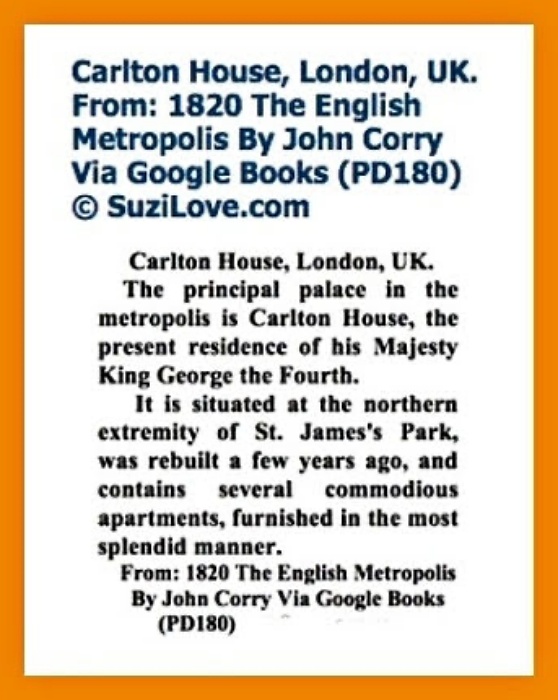
1820 10 Carlton House. via The English Metropolis By John Corry. via google books.
1820 9. Regency Criminals. via The English Metropolis By John Corry. via google books.
1820 8. Four In Hand Club. via The English Metropolis By John Corry. via google books.
1820 7 London Shops. via The English Metropolis By John Corry. via google books.
1820 6. Sudden Disappearance Of A Man Of Fashion. via The English Metropolis By John Corry. via google books.
1820 5. Moral Corruption. via The English Metropolis By John Corry. via google books.
1820 4. Bond Street. via The English Metropolis By John Corry. via google books.
1820 London Morality. via The English Metropolis By John Corry. via google books.
1820 3. Population Of Regency London. via The English Metropolis By John Corry. via google books.
1820 2. London In 1820. via The English Metropolis By John Corry. via google books.
RL_1_D2D_Regency Overview RetailerLinks
https://books2read.com/suziloveROver
RL_1_D2D_Regency Overview RetailerLinks https://books2read.com/suziloveROver
Posted in 1800s, Bridgerton, Customs & Manners, Google Books, History, Jane Austen, Legal, London, Quotations, Regency Era, Suzi Love Images | Tagged Bridgerton, England, Jane Austen, London, Regency Era, Regency London

1818 November Fashionable Couple By George Cruikshank. #Regency #Cartoon #JaneAusten

Suzi Love Posted on January 10, 2025 by Suzi LoveJanuary 8, 2025

1818 November ‘Fashionables Of 1818’ By George Cruikshank.Couple walk arm-in-arm with the man wearing Dandy costume of bell-shaped top-hat, trousers strapped under high-heeled boots without spurs and jauntily carried cane. Much shorter lady wears enormously high bonnet, striped over-dress over frilled white muslin, skirt above ankles, and carries a large ermine muff. Via British Museum, London, UK. britishmuseum.org (PD-Art)

These are the sort of outfits a couple would wear in Jane Austen’s times although these are exaggerated in caricatures to poke fun at the extremes of Regency fashion when women’s hats were so large and high that a lady was dwarfed by her devotion to fashion and a gentleman’s collar and neckcloth were so high he couldn’t turn his head to speak to the lady.

1818 November 'Fashionables Of 1818' By George Cruikshank.Couple walk arm-in-arm with the man wearing Dandy costume of bell-shaped top-hat, trousers strapped under high-heeled boots without spurs and jauntily carried cane.Much shorter lady wear enormously high bonnet, striped over-dress over frilled white muslin, skirt above ankles, and carries a large ermine muff. Via British Museum, London, UK. britishmuseum.org (PD-Art)
1818 November ‘Fashionables Of 1818’ By George Cruikshank.Couple walk arm-in-arm with the man wearing Dandy costume of bell-shaped top-hat, trousers strapped under high-heeled boots without spurs and jauntily carried cane.Much shorter lady wear enormously high bonnet, striped over-dress over frilled white muslin, skirt above ankles, and carries a large ermine muff. Via British Museum, London, UK. britishmuseum.org (PD-Art)
HN_23_D2D_https://books2read.com/SuziLoveFashionMen1800-1819
23_d2d_fashionmen1800-1819https://books2read.com/SuziLoveFashionMen1800-1819
Posted in 1800s, 1800s Mens Fashions, 1800s women's fashion, Bridgerton, cartoon, Coat or Pelisse Or Redingote, Customs & Manners, Dress Or Robe, England, fashion accessories, hats, Jane Austen, London, pants, Pastimes, Regency Era, Regency Fashion, shoes, Suit, Suzi Love Images, Vest or Waistcoat | Tagged 1800s men fashion, 1800s women's fashion, Bridgerton, British history, British Museum, Cartoons, Dress Or Gown, fashion accessories, Fashion Plate, gloves, Hats And Hair, Jane Austen, muff, pants, Redingote Or Pelisse Or Coat, Regency Fashion, Regency London, Shoes

1804 September Exhibition of Water Coloured Drawings, Old Bond Street, London By Thomas Rowlandson. #Regency #London #Art

Suzi Love Posted on November 26, 2024 by Suzi LoveNovember 16, 2024

1804 September Exhibition of Water Coloured Drawings, Old Bond Street, London, U.K. Designed and etched by Thomas Rowlandson. Via Wikimedia Commons commons.wikimedia.org (PD-ART)

1804 September Exhibition of Water Coloured Drawings, Old Bond Street, London, U.K. Designed and etched by Thomas Rowlandson. Via Suzi Love suzilove.com & Wikimedia Commons commons.wikimedia.org (PD-ART)
RL_1_D2D_Regency Overview RetailerLinks
https://books2read.com/suziloveROver
RL_1_D2D_Regency Overview RetailerLinks https://books2read.com/suziloveROver
Posted in 1800s, art, cartoon, England, History, Jane Austen, London, Pastimes, Regency Era, Regency Fashion, Suzi Love Images | Tagged art, Cartoons, Regency Life, Regency London

1800 Pantheon, London. via Ackermann’s Repository. #RegencyEra #London #RudolphAckermann

Suzi Love Posted on November 19, 2024 by Suzi LoveNovember 4, 2024

On January 27th, 1772, The Pantheon opened on Oxford Street, London. Designed by James Wyatt, The Pantheon featured a rotunda which was one of the largest rooms in England at the time. The Pantheon was intended as London’s answer to Ranelagh Gardens for winter entertainment and opened to a crush when nearly “two thousand persons of rank and fashion assembled.” The Pantheon officially closed for public entertainments in 1814, after Lord Chamberlain restrictions on the building’s use as a theatre made the final venture unprofitable. It was converted to a bazaar in 1833 and in 1867 became a winemakers office and showrooms until being demolished in 1937.

From 1819 Ackermann: The Pantheon was built “for the purpose of public evening entertainments” and was a “superb and beautiful structure” with elegant interiors furnished with fine paitnings, gilt vases, and statues depicting gods and goddesses.  The building consisted of a suite of fourteen rooms, and between 1789-1792 (until a fire) was used as an exhibition space for Italian operas after the destruction by fire of the King’s Theatre in Haymarket.

1814 January The Pantheon  via Ackermann’s Repository : This once noble structure, situated on the south side of Oxford-street, was originally built by Mr. James Wyatt, for the purpose of public evening entertainments. It was a most superb and beautiful structure, the admiration of all connoisseurs, foreigners as well as natives. The interior was fitted up in such a magnificent style, that it is scarcely possible for those who never saw it to conceive the elegance and grandeur of the apartments, the boldness of the paintings, or the effect produced by the disposition of the lights, which were reflected from gilt vases. Below the dome were a number of statues, representing most of the heathen gods and goddesses, supposed to be the ancient Pantheon at Rome, from which it derived its name. To these were added three beautiful statues of white porphyry, representing the King and Queen and Britannia.

The whole building formed a suite of fourteen rooms, each affording a striking specimen of taste and splendor. After the destruction of the King’s Theatre in the Haymarket by fire in June 1789, the Pantheon was used for the exhibition of Italian operas, and was frequently honored with the presence of their Majesties; till on the 14th of January, 1792, this beautiful structure also fell a prey to the same devouring element.

The fire broke out in the new buildings which had been added for the most convenient performance of operas; and before any engine reached the spot, the flames had gained such a height, that all attempts to save the building were in vain. Owing to the scenery, oil, paint and other combustible materials in the house, the conflagration was so rapid that not a single article could be saved. Persons who witnessed the progress of this tremendous fire, declare that the appearances exhibited through the windows, the lofty pillars enveloped in flames and smoke, the costly damask curtains waving from the rarefaction of the air, and the superb chandeliers turning round from the same circumstance, together with the successive crashing and falling of different portions of the building, furnished to their minds a more lively representation of Pandemonium than the imagination alone cam possibly supply.

The effects, too, of the intense frost which then prevailed, upon the water poured from the engines upon the blazing pile, are described as equally singular and magnificent. The loss occasioned by this catastrophe amounted to £60,000; only one fourth of which sum was insured. The height of the walls fortunately prevented the conflagration from spreading to the contiguous houses.

The Pantheon has been rebuilt; the original elegant front and portico still remain, but the rest of the edifice exhibits not eve a shadow of its former magnificence. Since its re-edification, it has been used principally for exhibitions, and occasionally for masquerades. Various plans have at different times been brought forward for opening it for dramatic representations; and this was actually done a few months since under a license from the magistrates, by a Mr. Condy, who is understood to have embarked a considerable fortune in the concern; but whose right has been contested by the winter theatres, and is likely to become a subject of legal discussion.

1800 Pantheon Masquerade, London, U.K. via Rudolph Ackermann’s Microcosm of London. Engraved by John Bluck. (1791-1831)

1800 Pantheon Masquerade, London, U.K. Ackermann's Microcosm of London. Engraved by John Bluck. (1791-1831)
RL_1_D2D_Regency Overview RetailerLinks
https://books2read.com/suziloveROver
RL_1_D2D_Regency Overview RetailerLinks https://books2read.com/suziloveROver

Posted in 1800s, art, Customs & Manners, Google Books, Jane Austen, London, Regency Era, Suzi Love Images | Tagged art, Jane Austen, London, Regency Era, Regency London, Rudolph Ackermann, shopping | Leave a reply

1818 May Caricature Of Three Fashionable Dandies As Worn by Men in Bridgerton and Jane Austen Years. #Bridgerton #Regency #Cartoon #JaneAusten

Suzi Love Posted on November 18, 2024 by Suzi LoveNovember 16, 2024

1818 May ‘Beau’s of 1818’ By George Cruikshank. Two Dandies shake hands while third watches. All wearing bell-shaped top-hats, extra high collars, short waists, long spurs and yellow gloves. One with moustache wears wide and short white trousers, one wears top-boots and riding-breeches and has monocle in his eye and third has very full trousers gathered above ankle. These are the sort of outfits that the Bridgerton men and Jane Austen’s male contemporaries would have worn. Hand colored etching. Via British Museum, London, UK. britishmuseum.org (PD-Art)

1818 May 'Beau's of 1818' By George Cruikshank. Two Dandies shake hands while third watches. All wearing bell-shaped top-hats, extra high collars, short waists, long spurs and yellow gloves. One with moustache wears wide and short white trousers, one wears top-boots and riding-breeches and has monocle in his eye and third has very full trousers gathered above ankle. Hand colored etching. Via British Museum, London, UK. britishmuseum.org (PD-Art)
1818 May ‘Beau’s of 1818’ By George Cruikshank. Two Dandies shake hands while third watches. All wearing bell-shaped top-hats, extra high collars, short waists, long spurs and yellow gloves. One with moustache wears wide and short white trousers, one wears top-boots and riding-breeches and has monocle in his eye and third has very full trousers gathered above ankle. Hand colored etching. Via British Museum, London, UK. britishmuseum.org (PD-Art)
Posted in 1800s, 1800s Mens Fashions, Bridgerton, cartoon, England, fashion accessories, Jane Austen, London, pants, Regency Era, Regency Fashion, shoes, Suit, Suzi Love Images, Vest or Waistcoat | Tagged 1800s men fashion, Bridgerton, British history, British Museum, Cartoons, cravat, fashion accessories, Hats And Hair, Jane Austen, Regency Fashion, Regency London, Shoes

1819 January Dandy Gentleman ‘Going to White’s’ Club In London By Richard Dighton. #RegencyEra #JaneAusten #London

Suzi Love Posted on November 16, 2024 by Suzi LoveNovember 13, 2024

1819 January ‘Going to White’s’. By Richard Dighton. Lord Alvanley walks on the pavement going to White’s Club for gentlemen in London wearing a top-hat, double-breasted coat, strapped trousers, and the high collar of a dandy. Via British Museum, London, UK. britishmuseum.org (PD-Art)

White’s was an exclusive Gentlemen’s Club on St. James Street, London, U.K where well-dressed men, or Dandies, gathered at a special table in front of the large bow window looking out at the street. This became known as a seat of privilege and was used by London’s most famous Dandy, Beau Brummell. Other well-known dandies were William Arden, Joshua Allen, Thomas Raikes and Ball Hughes. Cartoonists loved to ridicule these high-in-the-instep gentlemen who wore the most fashionable clothes and set the fashion trends for the Regency years, and the years when Jane Austen was writing her famous novels.

1819 January 'Going to White's'. By Richard Dighton. Lord Alvanley walks on the pavement going to White's Club for gentlemen in London wearing a top-hat, double-breasted coat, strapped trousers, and the high collar of a dandy. Via British Museum, London, UK. britishmuseum.org (PD-Art)
https://books2read.com/suziloveYGD
RL_2_D2D_RetailerBuyLink_RL_2
RL_2_D2D_RetailerBuyLink_RL_2 https://books2read.com/suziloveYGD
Posted in 1800s, 1800s Mens Fashions, cartoon, Coat or Pelisse Or Redingote, Customs & Manners, England, fashion accessories, hats, Jane Austen, London, pants, Regency Era, Regency Fashion, shoes, Suit, Suzi Love Images, Vest or Waistcoat | Tagged 1800s men fashion, boots, British history, British Museum, Cartoons, clubs, dandy, fashion accessories, gloves, Hats And Hair, pants, Redingote Or Pelisse Or Coat, Regency Fashion, Regency London, Regency Men, Shoes

1800s Omnibus History, France and England. #RomanticEra #VictorianEra #BritishHistory #Travel

Suzi Love Posted on October 11, 2024 by Suzi LoveSeptember 16, 2024

‘Omnibuses, under the name of carrosses a cinq sous, were started in Paris in 1662. Seven vehicles to carry eight passengers each, all inside, were built, and on March 18th, 1662, they began running. The first one was timed to start at seven o’clock in the morning, but an hour or two earlier a huge crowd had assembled to witness the inauguration ceremony, which was performed l)y two Commissaires of the Chatelet, attired in their official robes. Accompanying them were four guards of the Grand Prevot, twenty men of the City Archers, and a troop of cavalry. ‘

In 1828, George Shillibeer, a London coach builder, visited Paris where he was impressed by the efficiency of the new horse-drawn bus service. The following year, he started a single horse-drawn omnibus connecting Paddington and Regent’s Park to the City of London. Passengers were picked up and set down anywhere along the route and fares were paid on board, in contrast to short-stage coaches which had to be booked in advance. 

This new omnibus was pulled by three horses and carried 22 passengers who sat inside and were protected from the weather. Fares were sixpence and one shilling, less than a hackney cab or short-stage coach, but still too expensive for the lower classes. 

1829 July 4th George Shillibeer's Omnibus, London, U.K. First Omnibus between Paddington and the Bank of
1829 July 4th George Shillibeer Omnibus, London, U.K. First Omnibus between Paddington and Bank of England via the New Road, now Marylebone Rd., Somers Town and City Rd. Via Wikimedia Commons.

In 1832, the London City monopoly of hackney carriages was removed, so horse buses expanded and within two years there were 620 licensed horse buses in London. By the Great Exhibition in 1851, London’s increase in visitors meant this number doubled and the number of routes increased to 150.  By 1856, several bus operators were taken over by the new London General Omnibus Company until, with 600 omnibuses, they were the largest bus company in the world.  In 1833, the first real steam omnibuses, the ‘Era’ and ‘Autopsy’ were invented by Walter Hancock, of Stratford, and started on the London roads. The ‘Era’ was the better omnibus of the two, and the most flattering things were said and predicted of it. Enthusiasts declared that omnibuses of this type would enable passengers to be carried at a cheaper rate and greater speed. The ‘Era’ ran from Paddington to the Bank, the same route as the horse-drawn omnibuses, and carried fourteen passengers, the fare being sixpence all the way. It travelled at the rate of ten miles an hour. Travel on these roads was also dangerous as highwaymen stopped and robbed anyone who came along. Male or female made no difference to highwaymen in Britain, nor to the bushrangers in Australia or the gangs on American roads, as they robbed indiscriminately and often with violence.   

By the end of the 18th Century, however, travel as a pleasurable pursuit came into vogue and numerous guides were written for traveling all over the British Isles as well as on the continent. The 1812  ‘Tour Of Dr. Syntax’ was an ironic look at the new obsession of travel and travel guides. Before he set off for the Lake District, Dr. Syntax said to his wife, “You well know what my pen can do, and I’ll employ my pencil too: I’ll ride and write, and sketch and print and thus create a real mint: I’ll prose it here, I’ll verse it there and picturesque it everywhere. I’ll do what all have done before; I think I shall and somewhat more.”  Georgian and Regency travelers were envious of aristocrats, even if they were of the nobility themselves, and loved to view all the British Great Houses. 

A gentleman and his wife would even drive up to the front door of a mansion house and demand to be given a tour of the house.  If they weren’t admitted, they would write in their journals of the inhospitable nature of the people on a particular estate. Thomas Pennant, William Mavor, and others, loved to write about these bad experiences and have them published.  Paterson’s British Itinerary, a travel guide had 17 editions between 1785-1832 – it outlined the roads used by the stage and mail coaches, the tolls, the bridges, etc.   This new touring craze created an industry of hospitality that encompassed more than simple mail coach trips from place to place, and more than a noble family traveling from their country seat to the Metropolis of London for parliamentary sittings. Inns had to improve the quality of the linens and meals if they wanted to attract the wealthier traveling class. Before that, many travelers carried their own linen, crockery, glasses, and utensils, as they didn’t trust the hygiene or standards of country inns.

Travel became something written about by poets with many sonnets written to the beauty of places like the Lake District in England, or the pyramids in Egypt. Inns became cleaner and more respectable so they could welcome travelers of the upper classes. This also meant that women could travel more as roads were slowly improved from rutted tracks that were only suitable for horse riding to roads that family coaches could travel along, though these roads were still narrow and subject to extremes of weather, such as flooding.  The race was on to travel from places like London to Edinburgh in the fastest possible time.

HN_10_D2D_RetailerBuyLink

books2read.com/SuziLoveTravel
HN_10_D2D_RetailerBuyLink_ History Notes Book 10 books2read.com/SuziLoveTravel
Posted in 1800s, England, Europe, France, History, London, Quotations, Regency Era, Romantic Era, Suzi Love Images, travel, Victorian Era | Tagged British history, europe, google books, History Notes, Regency London, Romantic Era, travel, Victorian Era

1826 Almack’s Revisited by Charles White.: ‘It was what most correct persons called ‘horrid bad Almack’s’. #RegencyEra #London #BritishHistory

Suzi Love Posted on September 12, 2024 by Suzi LoveAugust 31, 2024

1826 Almack’s Revisited by Charles White. The ball of this evening passed off as all other balls at the same place, creating envy, jealousy, and hatred in the minds of many of those who have been unsuccessful in procuring tickets; affording real amusement to few, and disappointing a greater portion of those who, by dint of manoeuvring, petitioning, parliamentary interest, or presents, have been enabled to obtain the desired vouchers; and as this was one of the last balls of the season, and a general election already talked of, the mixture of company and the number was much greater than usual; and, consequently, it was what the most correct persons called, “horrid bad Almack’s!”

Almack’s or Willis’s Rooms, King Street, St James, London, UK. Almack’s Assembly Rooms, founded by William Almack at No. 26-28, were on the site of the present Almack House. The club was originally a gaming establishment but moved from Pall Mall. The Assembly rooms were on the South side of King Street in St James’s and were opened on February 12, 1765. At the time the subscription was ten guineas for which there was a ball and supper each week for the twelve weeks of the season.

1826 Almack's Revisited by Charles White.: 'It was what most correct persons called 'horrid bad Almack's'. #RegencyEra #London #BritishHistory
1826 Almack’s Revisited by Charles White.: ‘It was what most correct persons called ‘horrid bad Almack’s’. #RegencyEra #London #BritishHistory
RL_5_D2D_RetailerBuyLink_RL_5_2
https://books2read.com/suziloveOLD
Posted in 1800s, 1800s Mens Fashions, 1800s women's fashion, dancing, England, Google Books, History, London, Pastimes, Regency Era, Regency Fashion, Suzi Love Images | Tagged Almack's Assembly Rooms, Customs and Traditions, dancing, google books, Jane Austen, London, Regency Era, Regency London, Regency People | Leave a reply

1829 July 4th George Shillibeer’s Omnibus, London. First Omnibus between Paddington and Bank of England. #BritishHistory #Travel #Regency #London

Suzi Love Posted on August 31, 2024 by Suzi LoveAugust 24, 2024

1829 July 4th George Shillibeer’s Omnibus, London, U.K. First Omnibus between Paddington and Bank of England via the New Road, now Marylebone Rd., Somers Town and City Rd. Via Wikimedia Commons. books2read.com/SuziLoveTravel

1829 July 4th  George Shillibeer's Omnibus, London, U.K. First Omnibus between Paddington and the Bank of England via the New Road, now Marylebone Rd., Somers Town and City Rd. Four services in each direction daily.  Via Wikimedia Commons.
1829 July 4th George Shillibeer’s Omnibus, London, U.K. First Omnibus between Paddington and Bank of England via the New Road, now Marylebone Rd., Somers Town and City Rd. Via Wikimedia Commons.
HN_10_D2D_RetailerBuyLink_HN_10.books2read.com/SuziLoveTravel
D2D_RetailerBuyLink_HN_10. books2read.com/SuziLoveTravel
Posted in 1800s, Carriage, London, Regency Era, Suzi Love Images, travel | Tagged carriages, Regency London, Suzi Love Images, travel, WikiMedia Commons | Leave a reply

1809-1829 Magazine for the Bridgertons and Jane Austen: Rudolph Ackermann and ‘The Repository of Arts’, The Strand, London. #JaneAusten #Bridgerton #RegencyEra #London #History

Suzi Love Posted on August 28, 2024 by Suzi LoveAugust 24, 2024

A portrait from 1810-1814 of Rudolph Ackermann, shop owner and founder of ‘The Repository Of Arts’ magazine, The Strand, London. via National Portrait Gallery, London. Plus, an image of Ackermann’s premises in 1809. His ‘Repository of Arts, Literature, Fashion, Manufactures, etc.’ was published from 1809 to 1829 with images of Regency London, Regency furnishings and grand homes as well as beautiful fashion prints and descriptions every month. Ackermann originally supplied artists, amateur and professional, with supplies for watercolor painting. In 1799, he began manufacturing and selling his own watercolor paint blocks which were supplied by other colourmen, although at least three colors were his own mixture – Ackermann’s Green, White and Yellow. From 1817, his eldest son Rudolph Ackermann junior was responsible for the watercolor manufacturing. Ackermann also trained as a carriage designer. He began publishing prints and colour-plate books like ‘The Microcosm of London’ and ‘Doctor Syntax’ in the early 1800s.

The Repository of Arts was one the most popular magazines in Jane Austen’s time as it displayed everything ladies wanted to learn e.g. history, important country seats and houses in England, music, current events such as theatre plays, plus fashion plates and embroidery patterns. Ackermann’s shop in The Strand, London, was one of the fashionable places to shop during the Regency Era. The Repository also included poetry, travel reports, society reports and upcoming lectures. It also included serious subjects e.g. politics, legal matters, medicine and agriculture, a meteorological journal and details of the London markets. In 1817, the price of the magazine was 4 Shillings, so quite expensive for the time.

 In the first issue, published for January 1809, Ackermann included an ‘introduction to the history of the useful and polite arts’ which said: “It is universally admitted, that to cultivate a taste for the arts, and an acquaintance with the sciences, is a pleasure of the most refined nature; but to do this without regard to its influence upon the passions and affections, is to ‘tear a tree for its blossoms, which is capable of yielding the richest and most valuable fruit.’ The cultivation of this taste may and ought to be subservient to higher and more important purposes: it should dignify and exalt our affections, and elevate them to the admiration and love of that Being who is the author of every thing that is fair, sublime, and good in nature.”

1810-1814 Portrait of Rudolph Ackermann, shop owner and founder of The Repository Of Arts magazine. via National Portrait Gallery, London.
1809 January Ackermann's Repository of Arts, 101 Strand, London, U.K. Drawn by Augustus Pugin and Thomas Rowlandson. Published By Rudolph Ackermann. Etching and aquatint with hand coloring.
1809 January Ackermann’s Repository of Arts, 101 Strand, London, U.K. Drawn by Augustus Pugin and Thomas Rowlandson. Published By Rudolph Ackermann. Etching and aquatint with hand coloring.
D2D_RL_4_YLD_Young Lady's Day Regency Life Series Book 4 by Suzi Love. A light-hearted look at the longer Regency years and an easy to read view of what a young lady did, wore, and lived. https://books2read.com/suziloveYLD

D2D_RL_4_YLD_Young Lady's Day Regency Life Series Book 4 by Suzi Love. A light-hearted look at the longer Regency years and an easy to read view of what a young lady did, wore, and lived. https://books2read.com/suziloveYLD
Posted in 1800s, 1800s women's fashion, art, Bridgerton, Coat or Pelisse Or Redingote, Decorative Item, Dress Or Robe, England, fashion accessories, furniture, Google Books, hats, History, household, Jane Austen, London, mourning, Music, Pastimes, Regency Era, Regency Fashion, Reticule or Bag, sewing, shoes, Spencer, Suzi Love Images, travel, weddings | Tagged 1800s women's fashion, art, Dress Or Gown, fashion accessories, Fashion Plate, gloves, Hats And Hair, Jane Austen, London, magazines, music, pastimes, Regency Fashion, Regency Life, Regency London, Regency Women, Rudolph Ackermann, Shoes, shopping, The Repository Of Arts

Post navigation

← Previous Post
Next Post→

SUBSCRIBE TO SUZI LOVE'S NEWSLETTER.

Recent Posts

  • Do you read or write Historical Romance? Want a glimpse under dresses worn during the Bridgerton and Jane Austen years? Overview of corsets. #Bridgerton #JaneAusten #GeorgianFashion #RegencyFashion #Corset
  • 1811 Woman Carrying Cloth and a Package. Sewing a dress? #JaneAusten #Regencyfashion #historicalFashion #Sewing
  • 1840-1880 ca. Burgundy and White Silk Jacket, Russian. #RomanticEra #Fashion #Russia
  • 1810 Pantaloons and Double-Breasted Cutaway Coat As Worn by Gentleman in Jane Austen years. #RegencyFashion #JaneAusten #pantaloons
  • 1820 ca. High-Waisted Cream Pelisse, Or Coat, as fashionable in Bridgerton times. #Bridgerton #RegencyFashion #Pelisse #Coat

Recent Comments

  1. Suzi Love on Book Hooks: Brent looked at Lillian. ‘Is she correct? You’ve been lonely.’#RegencyRomance #HistRom #ReadARegency #EroticRomance
  2. Jana Richards on Book Hooks: Brent looked at Lillian. ‘Is she correct? You’ve been lonely.’#RegencyRomance #HistRom #ReadARegency #EroticRomance
  3. Lisabet Sarai on Book Hooks: Brent looked at Lillian. ‘Is she correct? You’ve been lonely.’#RegencyRomance #HistRom #ReadARegency #EroticRomance
  4. James DiBenedetto on Book Hooks: Brent looked at Lillian. ‘Is she correct? You’ve been lonely.’#RegencyRomance #HistRom #ReadARegency #EroticRomance
  5. Suzi Love on Book Hooks: ‘Why are you eager for me to risk a repeat of my miserable marriage?’ Lady Lillian asked. #RegencyRomance #HistRom #ReadARegency #EroticRomance

Login

  • Log in

Archives

  • July 2026
  • June 2026
  • May 2026
  • April 2026
  • March 2026
  • February 2026
  • January 2026
  • December 2025
  • November 2025
  • October 2025
  • September 2025
  • August 2025
  • July 2025
  • June 2025
  • May 2025
  • April 2025
  • March 2025
  • February 2025
  • January 2025
  • December 2024
  • November 2024
  • October 2024
  • September 2024
  • August 2024
  • July 2024
  • June 2024
  • May 2024
  • April 2024
  • March 2024
  • February 2024
  • January 2024
  • November 2023
  • October 2023
  • September 2023
  • August 2023
  • July 2023
  • April 2023
  • March 2023
  • February 2023
  • June 2022
  • April 2022

Categories

  • 1700s
  • 1700s Mens fashion
  • 1700s Womens Fashion
  • 1800s
  • 1800s Mens Fashions
  • 1800s women's fashion
  • 1900s
  • art
  • Australia
  • Bath
  • bedroom fashion
  • Book Hooks
  • Box Or Container
  • Bridgerton
  • Bus Trips
  • Canada
  • Carriage
  • cartoon
  • Celebrity
  • Chatelaine
  • Children
  • children
  • Christmas
  • Coat or Pelisse Or Redingote
  • Contemporary
  • Corset
  • Couple
  • Customs & Manners
  • dancing
  • December Scandal
  • Decorative Item
  • Dress Or Robe
  • Easter
  • Edwardian Era
  • Embracing Scandal
  • England
  • Ester In Images
  • Europe
  • Events
  • Fashion
  • fashion accessories
  • Food and Drink
  • Four Times A Virgin
  • France
  • furniture
  • Georgian Era
  • Georgian Fashion
  • Google Books
  • Grand Tour
  • Group
  • hats
  • History
  • History Events
  • History Notes
  • History Of Christmases Past
  • household
  • Hygiene
  • Irresistible Aristocrats
  • Jane Austen
  • Keanu Reeves
  • Kellys Justice
  • Legal
  • London
  • Love After Waterloo
  • Loving Lady Katharine
  • medical
  • military
  • money
  • mourning
  • Music
  • Outback Arrival
  • pants
  • Pastimes
  • peerage
  • People
  • Petunia and Pearl Diver
  • Places
  • Pleasure House Ball
  • postal
  • Queensland
  • Quotations
  • Regency Era
  • Regency Fashion
  • Regency Life Series
  • Reticule or Bag
  • riding
  • Romantic Era
  • Royalty
  • Russia
  • Scandalous Siblings Series
  • Scenting Scandal
  • Self Publishing
  • sewing
  • Shirt
  • shoes
  • Shopping
  • South Pacific
  • Spencer
  • sports
  • Suit
  • Sunday Snippet
  • Suzi Love
  • Suzi Love Books
  • Suzi Love Images
  • Suzi Love Writing
  • Swain Cove
  • THe Viscount's Pleasure House
  • travel
  • U.S.A
  • underclothing
  • Vest or Waistcoat
  • Victorian Era
  • Victorian Fashion
  • weapons
  • weddings
  • Writing Tools

1800s men fashion 1800s women's fashion antiques Bridgerton British history Cartoons Corset cravat decorative Dress Or Gown England europe fashion accessories Fashion Plate France Georgian era Georgian Fashion gloves google books Hats And Hair historical romance History Notes household Jane Austen jewelry Journal des Dames et des Modes London Metropolitan Museum NYC pants Redingote Or Pelisse Or Coat Regency Era Regency Fashion Regency London reticule or bag riding sewing shawls Shoes Suzi Love Books Suzi Love Images Tailcoat The Repository Of Arts underclothing Vest or Waistcoat Writing Tools

©2026 - Suzi Love - Weaver Xtreme Theme Privacy Policy
↑