1804-1815 ca. Wedding Dress. Silk dress with square bodice and very small bodice, short puffed sleeves, beautiful train decorated in gold. via Palais Galliera, or Musée de la Mode de la Ville de Paris. City of Paris Fashion Museum, formerly Musée Galliera. https://books2read.com/SuziLoveFashionWomen1805-1809
1816 July Opera Dress, English. Dress of white lace worn over a rich soft white satin slip. Skirt trimmed in a style of peculiar elegance, with lace festooned at regular distances, festoons edged by plain band of byas satin and finished by pearl ornaments of a very novel and pretty shape. Lace body is cut byas and richly ornamented round the bosom with pointed lace. Plain long sleeve, very full, except towards the wrist, which is nearly tight to the arm, and elegantly finished with lace. Hair ornamented with a wreath of French roses, parted in front, and simply dressed in loose curls, which fall very low on each side. Hind hair forms a tuft at the back of the head. Necklace, ear-rings, and bracelets of pearl. White satin slippers, and white kid gloves and a blush colored French silk scarf. Fashion Plate via Rudolph Ackermann’s ‘The Repository of Arts’. https://books2read.com/SuziLoveFashionWomen1815-1819
Gorgeous Regency Era clothing came in a wide range of styles to suit every season and occasion. Ladies in the Bridgerton series and in Jane Austen’s times wore Empire style dresses which were usually made of light fabric and floaty in style. By the later 1810s, stripes were very popular and lace and frills were added to make the dress more individual.
Fashion Women 1815-1819 History Notes Book 28 What did Jane Austen wear? https://books2read.com/SuziLoveFashionWomen1815-1819
1800 White Muslin Dress, European. Empire style, high-waisted dress of light weight cotton, with softly falling gathered long skirt and with a train. via Los Angeles County Museum of Art, California, USA. collections.lacma.org books2read.com/SuziLoveFashionWomen1800
The type of dress worn across Europe in the early 1800s. This sort of high-waisted dress would have been worn by Jane Austen and her contemporaries in England. The Empire waist gown defined women’s fashion during the Regency Era. ‘Empire’ is the name given in France to the period when Napoleon built his French Empire. High-waisted, loose gowns were adopted by the aristocracy as a symbol of turning away from the fussy, elaborate and expensive clothing worn in the 1700s.
1800 White Muslin Dress, European. Empire style, high-waisted dress of light weight cotton, with softly falling gathered long skirt and with a train. via Suzi Love suzilove.com
& Los Angeles County Museum of Art, California, USA.
collections.lacma.org1800 White Muslin Dress, European. Empire style, high-waisted dress of light weight cotton, with softly falling gathered long skirt and with a train. via Suzi Love suzilove.com
& Los Angeles County Museum of Art, California, USA.
collections.lacma.org1800 White Muslin Dress, European. Empire style, high-waisted dress of light weight cotton, with softly falling gathered long skirt and with a train. via Suzi Love suzilove.com
& Los Angeles County Museum of Art, California, USA.
collections.lacma.orgHN_12 D2D_RetailerBuyLink_HN_12 books2read.com/SuziLoveFashionWomen1800
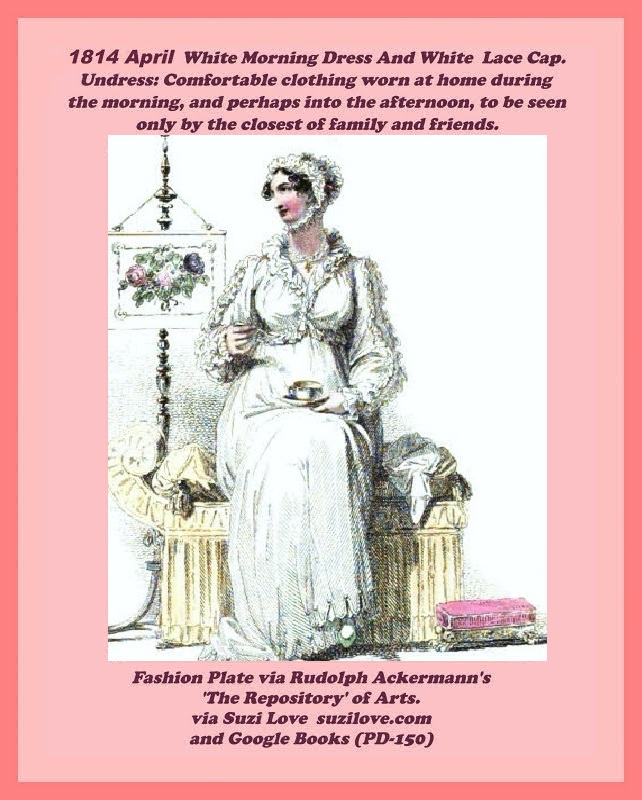
1814 April Morning Dress and Lace Cap. ‘”A petticoat and bodice of fine jaconet muslin, finished round the bottom in vandykes and small buttons. The Rochelle spencer composed of the same material, appliqued with footing lace down the sleeve, and trimmed at each edge with a narrow but full border of muslin. Double fan frill of muslin round the neck, very full, continuing round the bottom of the waist, where it is gathered on a beading of needle-work. Bourdeaux mob cap, composed of lace, with treble full borders, narrowed under the chin. A small flower placed backward, on the left side. Hair much divided in front, and in full waved curls on each side. Necklace of twisted gold and pearl, with pendant cross in the center. Spring Green kid slippers and gloves of the same.” “This dress is from Mrs. Gill, of Cork-street, to whose taste and invention this work as well as the world of fashion, are under continued obligations.” Fashion Plate via Rudolph Ackermann’s ‘The Repository of Arts’. https://books2read.com/SuziLoveFashion1810-1814
Definition Van Dyke Points: V-shaped lace and trims named after a 17th Century Flemish painter, Sir Anthony Van Dyck, known for painting V-shaped lace collars and scalloped edges on sitters.
Definition Jaconet: Cotton fabric of medium thickness made in England, lighter than shirting and heavier than mull.
Definition Muslin: Thin fabric said to take its name from Mosul or Moosul, a large town in Turkish Asia where it was first made.
1814 April Morning Dress and Lace Cap. Petticoat and bodice of fine lace jaconet muslin finished with vandykes and small buttons. Fashion Plate via Rudolph Ackermann’s ‘The Repository of Arts’.HN_27_D2D_fashwomen1810-1814
Love the Bridgerton family and Jane Austen? Reader Or Writer of Regency Era stories? Mourning and riding fashion, dresses, hats, shoes, reticules or bags, underclothing and fashion accessories. books2read.com/SuziLoveFashionWomen1815-1819
History Notes 28 Fashion Women 1815-1819: This book looks at what was fashionable for women in the Georgian Era and at the end of the Regency Era in Britain and the reconstruction in Europe after the wars. Lifestyles were freer and fashions expressed this by becoming the focus of most women’s lives. A wardrobe full of opulent accessories was requisite. Includes mourning and riding fashion, dresses, hats, shoes, reticules or bags, underclothing, and fashion accessories.
Ladies clothing in the early 1800’s featured a high waist line called an Empire Line, or Empire style dress, with a waist line just under the natural bust line and much higher than the natural waist. High-waisted Empire Line styles dominated fashions for at least three decades from the 1790s until the 1820s. The high-waisted, or short-bodied, Regency styles shifted focus away from the natural waist and so left the natural waist unconstricted, in direct contrast to previous and future styles.
Britain took these simple European styles and progressively made them more elaborate by adding more and more complicated embroidery onto white fabrics to create the white on white look popular for many years. The empire look of fine muslin dresses left women more exposed than in the Georgian Era when fabrics had been thicker and styles bulkier. Women, especially in England, preserved their modesty by adding lace, frills, flounces, ruches, and fabric plaits to dresses to adequately cover any parts that might inadvertently be exposed. Outer layers, such as Spencers, coats and shawls, were also added.
Are you a reader or writer of Regency Romance? Love Jane Austen and the Bridgertons? Want to know more about the mourning, riding, underclothing and other Regency Era women’s fashions in Regency romances? What was fashionable for women in Jane Austen’s times? Mourning, riding, daytime, evening clothing, plus underclothing, corsets and accessories. This book looks at what was fashionable for women in Jane Austen’s times, or the early 1800s, or the Regency Era in Britain. Wars were being fought around the globe so women’s fashion adopted a military look in support of soldiers. Fashions, like the lifestyle, became progressively more extravagant and accessories went from colorful to over-the-top. https://books2read.com/SuziLoveFashion1810-1814
The Lady’s Magazine said of the basis of women’s fashion that was popular for the first twenty years of the 1800s, ‘White is still the prevailing color for robes. For morning dresses, linen gowns, in large diamonds or squares, are fashionable. Indian muslins, plain or embroidered, are preferred to Florence and satins. The designs of embroidery for shawls are of infinite variety. Long gloves, which reach above the elbow, are not yet laid aside. Medallions are hung around the neck from crossed chains and some of these medallions are shaped like the bags, called ridicules. These reticules are of the lozenge or hexagon shape, with a small tassel at each angle. Reticules, or ridicules, are in lozenge or hexagon shapes with a small tassel at each angle. In capotes, or hats, and ribbands, the violet and dark green prevail over jonquil. Bracelets in hair, pear-shaped ear-rings, medallions on square plates, saltiers of colored stones, are still in fashion.’
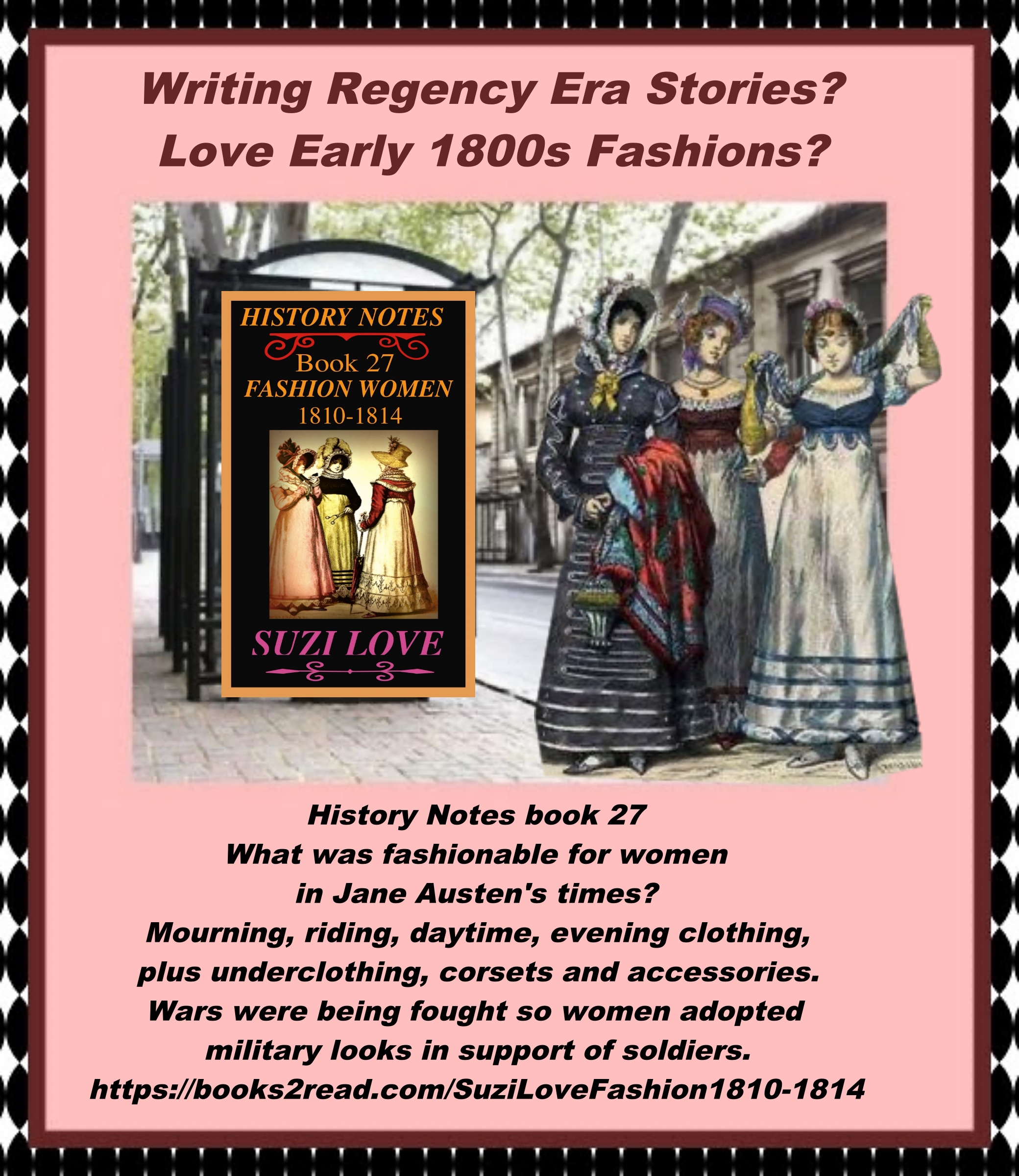
History Notes book 27 What was fashionable for women in Jane Austen’s times? Mourning, riding, daytime, evening clothing, plus underclothing, corsets and accessories. Wars were being fought so women adopted military looks in support of soldiers. https://books2read.com/SuziLoveFashion1810-1814
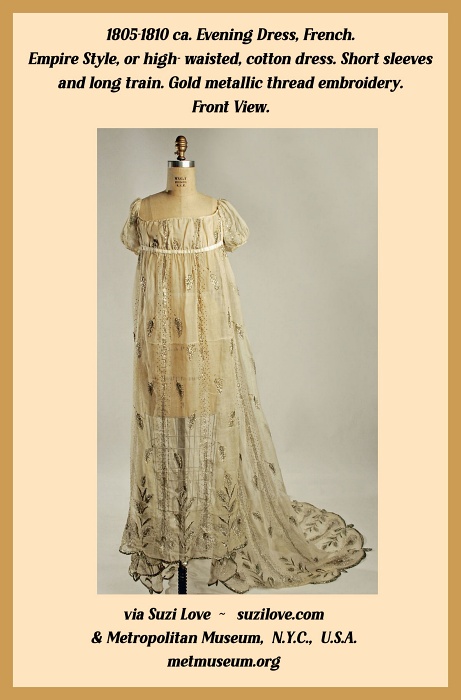
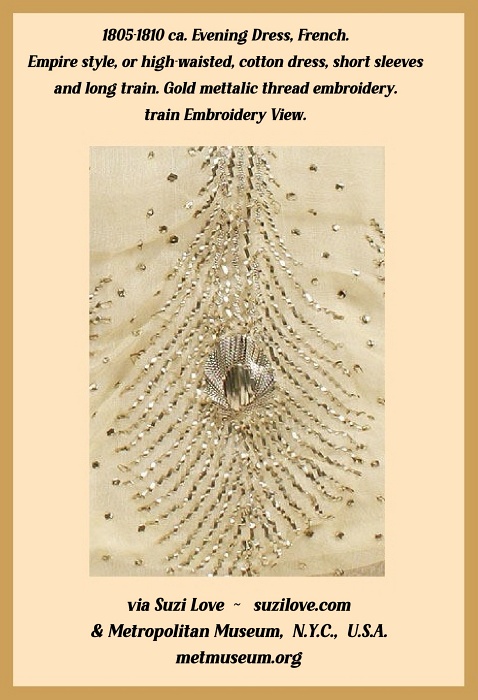
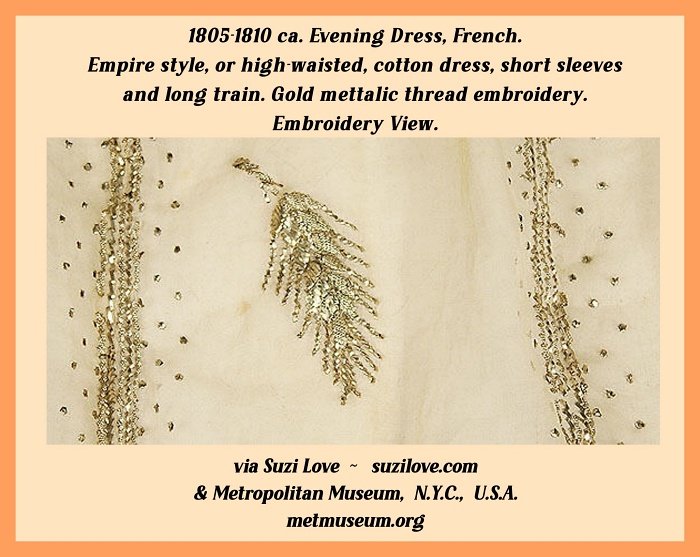
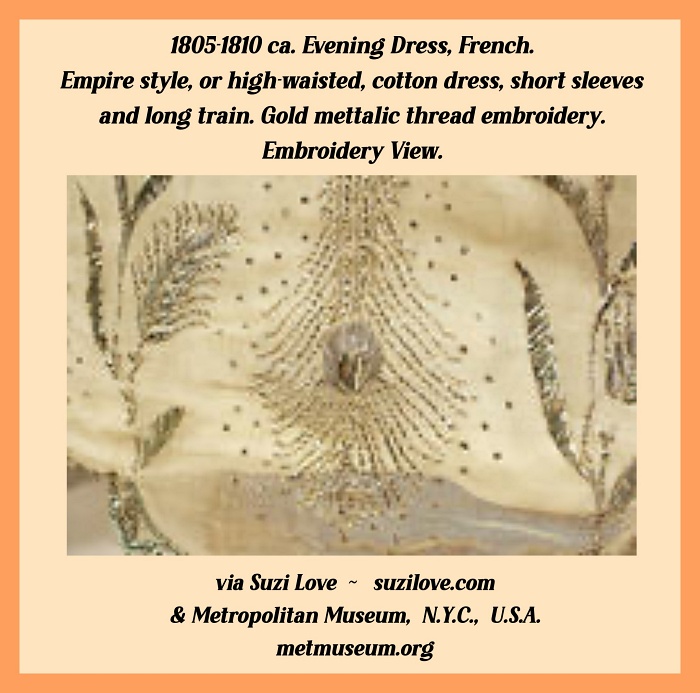
1805-1810 ca. Evening Dress, French. Empire style, or high-waisted, cotton dress, short sleeves and long train. Gold metallic thread embroidery. via Metropolitan Museum, N.Y.C., U.S.A.
1805-1810 ca. Front Evening Dress, French. Empire style, or high-waisted, cotton dress, short sleeves
and long train. Gold metallic thread embroidery. via Suzi Love ~ suzilove.com
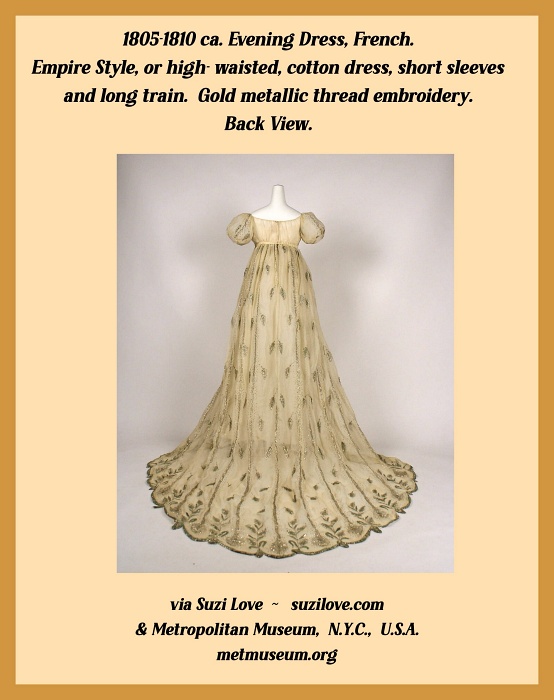
& Metropolitan Museum, N.Y.C., U.S.A. metmuseum.org1805-1810 ca. Back Evening Dress, French. Empire style, or high-waisted, cotton dress, short sleeves
and long train. Gold metallic thread embroidery. via Suzi Love ~ suzilove.com
& Metropolitan Museum, N.Y.C., U.S.A. metmuseum.org1805-1810 ca. Side Evening Dress, French. Empire style, or high-waisted, cotton dress, short sleeves
and long train. Gold metallic thread embroidery. via Suzi Love ~ suzilove.com
& Metropolitan Museum, N.Y.C., U.S.A. metmuseum.org1805-1810 ca. Train Evening Dress, French. Empire style, or high-waisted, cotton dress, short sleeves
and long train. Gold metallic thread embroidery. via Suzi Love ~ suzilove.com
& Metropolitan Museum, N.Y.C., U.S.A. metmuseum.org1805-1810 ca. Embroidery Evening Dress, French. Empire style, or high-waisted, cotton dress, short sleeves
and long train. Gold metallic thread embroidery. via Suzi Love ~ suzilove.com
& Metropolitan Museum, N.Y.C., U.S.A. metmuseum.org1805-1810 ca. Embroidery. Evening Dress, French. Empire style, or high-waisted, cotton dress, short sleeves
and long train. Gold metallic thread embroidery. via Suzi Love ~ suzilove.com
& Metropolitan Museum, N.Y.C., U.S.A. metmuseum.org1805-1810 ca. Embroidery. Evening Dress, French. Empire style, or high-waisted, cotton dress, short sleeves
and long train. Gold metallic thread embroidery. via Suzi Love ~ suzilove.com
& Metropolitan Museum, N.Y.C., U.S.A. metmuseum.org1805-1810 ca. Embroidery Evening Dress, French. Empire style, or high-waisted, cotton dress, short sleeves
and long train. Gold metallic thread embroidery. via Suzi Love ~ suzilove.com
& Metropolitan Museum, N.Y.C., U.S.A. metmuseum.org1805-1810 ca. Embroidery. Evening Dress, French. Empire style, or high-waisted, cotton dress, short sleeves
and long train. Gold metallic thread embroidery. via Suzi Love ~ suzilove.com
& Metropolitan Museum, N.Y.C., U.S.A. metmuseum.org Fashion Women 1805-1809 History Notes Book 26 What did Jane Austen and friends wear? https://books2read.com/SuziLoveFashionWomen1805-1809
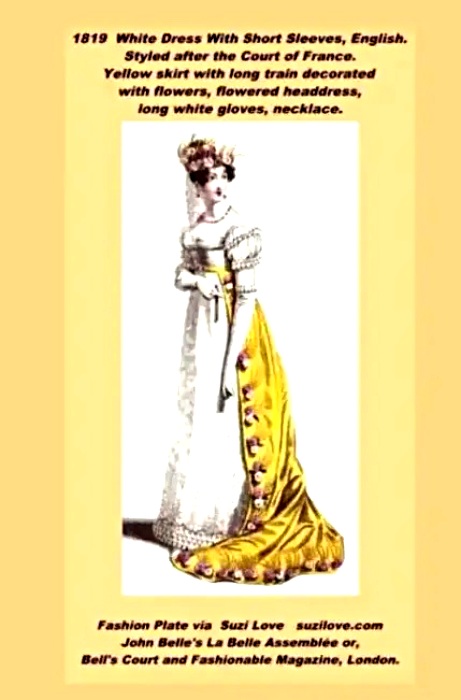
1819 White Dress With Short Sleeves, English. Styled after the Court of France. Yellow skirt with long train decorated with flowers. Flowered headdress, long white gloves, necklace.Fashion Plate via John Belle’s La Belle Assemblée or, Bell’s Court and Fashionable Magazine, London.
Fashion Women 1815-1819 History Notes Book 28 https://books2read.com/SuziLoveFashionWomen1815-1819
1815-1818 ca. Cocoa Silk Figured Dress with Spencer. High-waisted, Empire style, dress with long sleeved Spencer, decorated shoulders, bodice and hem. The Bridgertons, Jane Austen, and their family and friends would have worn this style of dress and Spencer. via Whitaker Auction whitakerauction.smugmug.com Spencers were needed to cover the flimsy dresses made of lightweight fabrics of the Regency years, to provide warmth and some protection from windy conditions when the transparency of gowns might cause modesty issues. Jane Austen and her contemporaries often walked to places and so would have needed the warmth of a Spencer over her dress in the cold British winters.
Definition Spencer: Short jacket said to have originated from an accident to Lord Spencer’s coat when hunting and tails were torn off.
Fashion Women 1815-1819 History Notes Book 28 https://books2read.com/SuziLoveFashionWomen1815-1819
1806 Waiting For the St. Cloud Coach, Place de la Concorde, Paris. Illustrations by Francis Courboin. via Les Modes de Paris. (PD-Art) This couple is depicted waiting for the coach, which was a passenger vehicle drawn by four horses. The woman is wearing a fashionable hat or “capote” that covers her face. Her dress maintains the empire waist and has very long sleeves that also have a ‘mancheron’ or a gathered sleeve at the shoulders. The man is wearing a ‘habit du gagé’ or a coat with tails, buttoned at the waist. His hat is a ‘haut-de-forme’ or what is commonly known in English as a top hat. He wears tight, short pants tucked into large, riding boots, as was the fashion for men. Illustrations by François Courboin from Octave Uzanne‘s Les Modes de Paris. Variations du goût et de l’esthétique de la femme, 1797-1897, L. Henry May, Paris, 1898, or from the English translation of the same work: Fashion in Paris : the various phases of feminine taste and aesthetics from 1797 to 1897, William Heinemann, London, 1898. Modes de Paris VIa Brown University Library .