1817 February Pelisse, or Redingote, English. Carriage dress of white poplin with a deep blond flounce. Blue levantine pelisse or walking dress, or Redingote in France, shorter than the dress and edged with floss silk. Coburg cap of black velvet turns up on one side in front and is lined and edged with blue satin. The head-dress worn with it has a profusion of white ostrich feathers. Ruff is of plain blond, edged with narrow white satin ribbon, and a pink Indian scarf over the shoulders. An ermine muff, gloves and slippers of blue kid, complete the elegant dress. Fashion Plate via John Belle’s La Belle Assemblée or, Bell’s Court and Fashionable Magazine, London.
Definition Coat or Redingote Or Pelisse: Long fitted outdoor coat worn over other garments for warmth. French word developed from English words, riding coat.
1817 February Pelisse, or Redingote, English. Carriage dress of white poplin with a deep blond flounce. Blue levantine pelisse or walking dress, or Redingote in France, edged with floss silk, blonde lace neck ruff, ermine ruff and a pink shawl. Fashion Plate via John Belle’s La Belle Assemblée or, Bell’s Court and Fashionable Magazine, London. Fashion Women 1815-1819 History Notes Book 28 https://books2read.com/SuziLoveFashionWomen1815-1819
1810-1825 ca. Bridgerton and Jane Austen Times Red Twisted Reticule, Or Bag, European. Silk and metal with cord drawstring. via Metropolitan Museum, N.Y.C., U.S.A. metmuseum.org
Definition Reticule Or Bag or Purse: Often with a drawstring to pull closed and usually made of cloth or covered cardboard and often decorated with beading or embroidery. A reticule, or purse, or handbag, was usually carried by a woman during the Regency period to carry all their daily necessities. Earlier, women used pockets that tied at the waistline and were hidden in the folds of their skirts. Empire style, or early 1800s, high-waisted dresses made it impossible to either sewn in a pocket or to tie on a pocket. So women began carrying small, decorated bags called Reticules, or ridicules, which generally pulled close at the top with a drawstring. http://books2read.com/suziloveReticules
In the early nineteenth century, reticules started to look like future handbags as they were often made from rigid card or molded mâché or card into a variety of shapes. Early bags were circular and with a drawstring but as women wanted their reticules to look individual they could be made with two halves and a hinged metal closure or with concertina sides. Materials varied from silk, cotton and string and shapes were round, hexagonal or lozenge shapes with shell shaped bags becoming very popular during the Regency and Romantic Eras.
1800s magazines were written for well bred women who could read, so they gave plenty of ideas for how ladies could make and embellish reticules for their own use and as pretty gifts. Needlework was highly encouraged as a pastime for a lady so bags were frequently embroidered or decorated with beading. By the 1820s, reticules became more like our modern handbags using soft leather gathered at the top or hard leather with a rigid fastener and metal chain for carrying.
1807 Regency Couple, French.Dressed As In Jane Austen’s times.Back view of a lady’s white dress with a cute back bow, long draping scarf with knotted ends, and straw bonnet with a blue ribbon and bows. Gentleman in a long grey coat, orange vest, extremely high collar of a ruffled shirt, tight taupe pants tucked into topped boots, and with a fashionable short curly hairstyle. Fashion Plate via Costume Parisien.
Fashion Women 1805-1809 History Notes Book 26
What did Jane Austen and friends wear? This book looks at early 1800s fashions, which were elegant and pretty with high waists and fabrics that were almost transparent. These Empire style gowns, named after Napoleon’s first Empress, became popular throughout Europe, and were then copied around the world. Colorful outwear was added to make an ensemble more attractive and warmer.
https://books2read.com/SuziLoveFashionWomen1805-1809
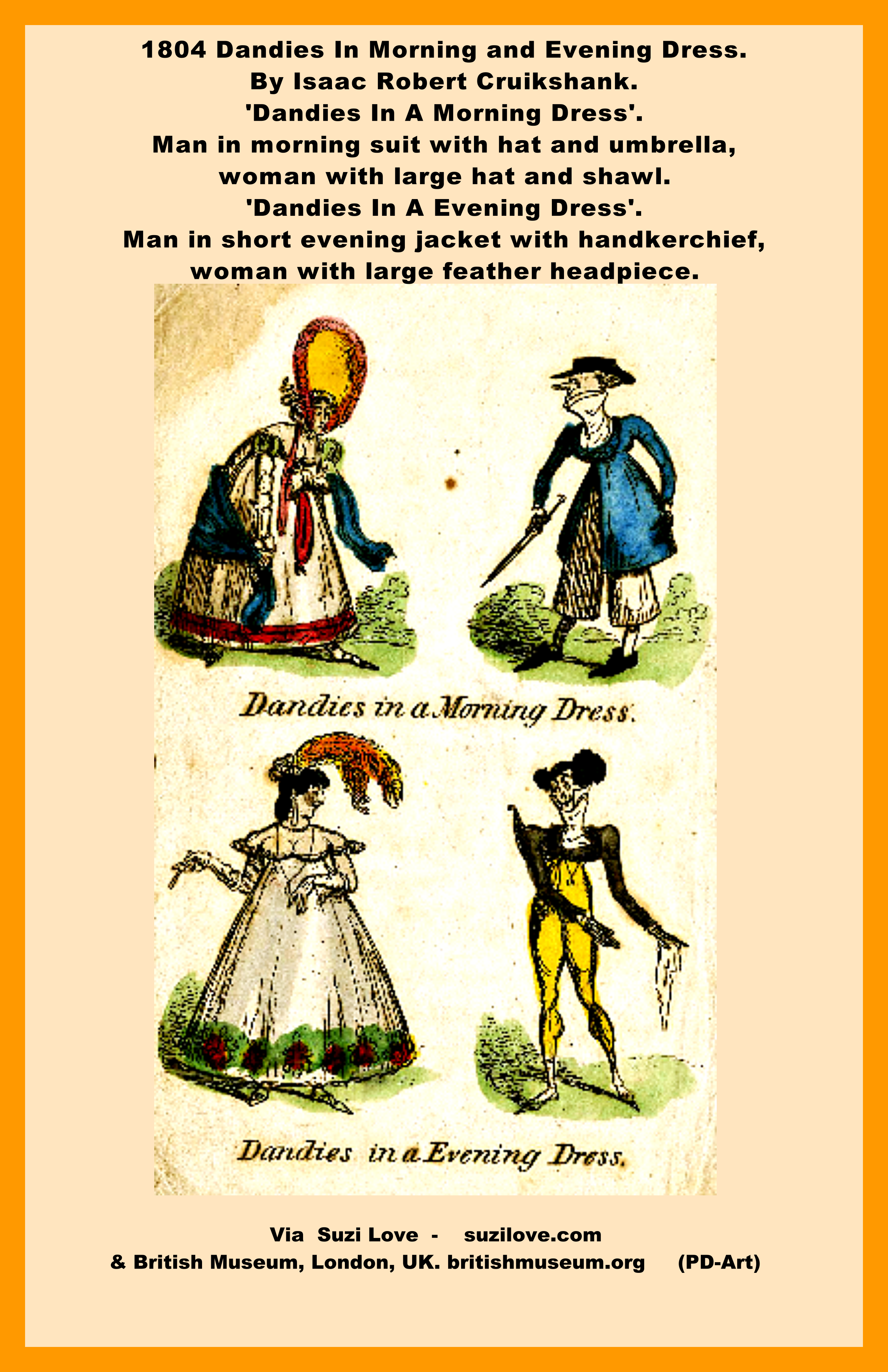
1804 Dandies In Morning and Evening Dress. By Isaac Robert Cruikshank. ‘Dandies In A Morning Dress’. Man in morning suit with hat and umbrella, woman with large hat and shawl. ‘Dandies In A Evening Dress’. Man in short evening jacket with handkerchief, woman with large feather headpiece. Via British Museum, London, UK. britishmuseum.org (PD-Art)
1808 Lady In A High-Waisted White Dress Reading A Book Outdoors, French. Dress has short puffed sleeves and is worn under a frilled Pelerine, or shoulder cape, long tan gloves, walking shoes and a white country style hat with a blue bow. The lady is leaning on a post and reading a book. Fashion Plate via Journal des Dames et des Modes, Costume Parisien.
Empire Style Dress: Named after the First Empire in France. Empire dresses had a low neckline and skirts started directly under the bust and flowed into the classical relaxed wide styles of Greece and Rome. This style of dress is associated with Jane Austen and her contemporaries as a high-waisted dress was worn most days. Cotton, silk or taffeta were the popular fabrics.
Definition Pelerine: Tippet or shoulder cape, usually waist-length, with long, pointed ends in front. Popular in England and colonial America.
Fashion Women 1805-1809 History Notes Book 26
What did Jane Austen and friends wear? This book looks at early 1800s fashions, which were elegant and pretty with high waists and fabrics that were almost transparent. These Empire style gowns, named after Napoleon’s first Empress, became popular throughout Europe, and were then copied around the world. Colorful outwear was added to make an ensemble more attractive and warmer.
https://books2read.com/SuziLoveFashionWomen1805-1809
Fan of Regency London in the times of Jane Austen and Bridgertons? Regency Overview Book 1 Regency Life Series #JaneAusten #RegencyEra #Bridgerton #Nonfiction #amwriting https://books2read.com/ROver
Travel and Luggage By Suzi Love History Notes Book 10. How did people travel in Bridgerton’s and Jane Austen’s times? What did they take with them to make their long journeys easier? Travel by road, ship, canal, or railway all took a long time and had dangers so people learned to prepare. And then, in the nineteenth century, road improvements, inventions, and scientific developments made travel more pleasurable. books2read.com/SuziLoveTravel
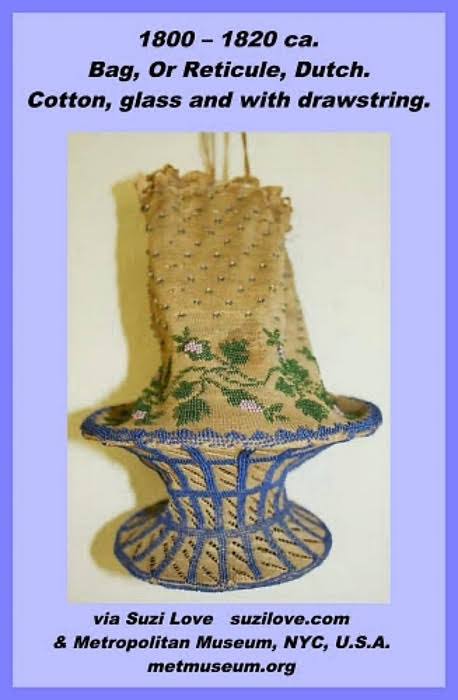
1800 – 1820 ca. Bag, Or Reticule, Dutch. Cotton, glass and with drawstring. via Metropolitan Museum New York City, U.S.A. metmuseum.org http://books2read.com/suziloveReticules Because reticules were so popular, Jane Austen and her family and friends and the Bridgerton family would have made reticules for each other for gifts and carried these small purses with them whenever they went out.
From Historic Dress In America: ‘Reticules were so universally carried during the first part of the nineteenth century that they were called Indispensables, and a few years later ridicules. Miss Southgate describes one in a letter in 1802, ‘Martha sent me a most elegant Indispensable, white lute-string spangled with silver…’
Definition Reticule Or Bag or Purse: Often with a drawstring to pull closed and usually made of cloth or covered cardboard and often decorated with beading or embroidery. A reticule, or purse, or handbag, was usually carried by a woman during the Regency period to carry all their daily necessities. Earlier, women used pockets that tied at the waistline and were hidden in the folds of their skirts. Empire style, or early 1800s, high-waisted dresses made it impossible to either sewn in a pocket or to tie on a pocket. So women began carrying small, decorated bags called Reticules, or ridicules, which generally pulled close at the top with a drawstring.
• Beadwork: Attaching beads to one another by stringing with a needle and thread or thin wire, or sewing them to cloth. Includes loom weaving, stringing, bead embroidery, bead crochet, and bead knitting.
• Embroidery: Decorating fabrics with a needle and thread, or cloth, such as a needlepoint picture of a house or hand sewn initials.
1807 Fashionable French Couple. Man: Blue cutaway coat and yellow breeches. Lady: Lemon and blue dress and bonnet. Typical of the ensembles worn by Jane Austen and her family and friends. Fashion Plate via Journal des Dames et des Modes, or Costume Parisien.
Fashion Women 1805-1809 History Notes Book 26 What did Jane Austen and friends wear? https://books2read.com/SuziLoveFashionWomen1805-1809