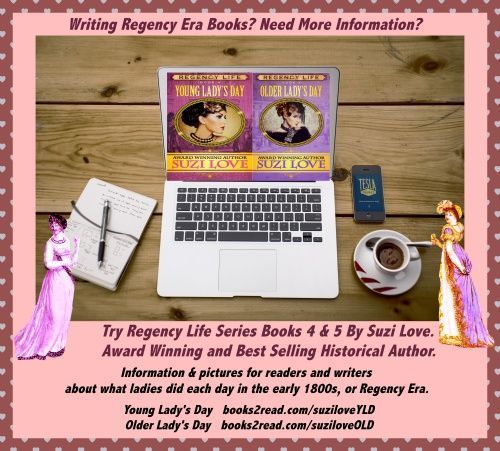
Light-hearted look at Young Lady in Jane Austen’s times, or early 1800s. A glimpse into both the frivolous and more serious occupations filling a young lady’s day in the lifetime of Jane Austen, or the Regency Era, or the early 19th Century. Historic images and historical information show her fashions and frolics. https://books2read.com/suziloveYLD
Do you need more factual and visual information for your historical fiction? Try History Notes Books 1-13. Non-fiction Series: Fashion, music and social manners in the 18th and 19th centuries e.g.
1816 August Back view of a lady in Evening Dress, English. White, high-waisted, dress with short bodice, long sleeves, frilled hem plus decoration above the frill, high plumed headdress, and reading music sheets. “A gown of white soft satin, cut low all round the back and bosom.The skirt gored, and a good deal of fullness thrown behind. The body, which is disposed in small plaits, displays the shape, as our readers perceive by print, to very great advantage; it is trimmed round bosom with a wreath of small white net roses, with a little tuft of pearl in the heart of each. Long loose sleeve, composed of white lace, and finished a la Parisienne with a rich double frill at the wrists.
The skirt is ornamented, in an exquisitely tasteful style, with a broad flounce of rich blond, surmounted by a wreath of roses and deep scallops of white net, the points of which are finished by bows of white satin ribbon. The effect of this trimming is uncommonly beautiful. Hair, cropped and curled full in the back of the neck, and dressed light, and much parted on the forehead: it is ornamented With a superb white ostrich-plume, at the base of which is an aigrette of diamonds. Neck-lace, ear. rings, and bracelets also of diamond. White satin slippers, and white kid gloves. We have to thank the condescension of a lady of much celebrity in the fashionable world, to whom we are indebted for a sight of the very elegant and tasteful dress from which our present print is designed.” Fashion Plate via Rudolph Ackermann’s ‘The Repository of Arts’.
Fashion Women 1815-1819 History Notes Book 28 https://books2read.com/SuziLoveFashionWomen1815-1819
Do you need more factual and visual information for your historical fiction? Try History Notes Books 1-28. Non-fiction Series: Fashion, corsets, Regency Era, music and social manners in the 18th and 19th centuries e.g.
Do you need more factual and visual information for your historical fiction? History of fashion, music, peerage and customs in 18th and 19th centuries. Non-fiction series full of gorgeous pictures and engraved fashion plates. A visual history of fashion, music, peerage, social manners and customs from late 1700s to late 1800s, or 18th and 19th centuries.
What did an older lady do in the Bridgerton family’s and Jane Austen’s times, or the early 1800s. An easy to read overview of what an older lady did, wore, and how she lived in the early 19th Century. Information for history buffs and pictures for readers and writers of historical fiction. Older Lady’s Day, Regency Life Series, Book 5, by Suzi Love. books2read.com/suziloveOLD
Through historic images, historical information, and funny anecdotes, it shows how an older lady in Jane Austen’s times fills her day, where she goes, and with whom she spends her time. This light-hearted look at the longer Regency years is an easy to read overview of what people did and wore, and where they worked and played. There is plenty of information to interest history buffs, and lots of pictures to help readers and writers of historical fiction visualize the people and places from the last years of the 18th Century until Queen Victoria took the throne.
The word ‘carol’ comes from the old French ‘carole’ for a song written and played as a courtly dancing song. Carols then took on a more popular form, telling stories and celebrating religious themes for all seasons until the late 19th century when they became associated with Christmas.
Carols took the place of Psalms in all churches on Christmas Day and, as the whole congregation could join in, were greeted with huge approval. Carols were passed on orally from place to place, often with different words or tunes. The published carols included songs still popular today, including The First Noël, I Saw Three Ships, and God Rest Ye Merry Gentlemen. This collection was followed by compilations of carols from other scholars such as William Sandy’s works in 1833 and 1852.
“Bells are musics laughter.” By Thomas Hood (1799-1845), British poet and humorist.
Bells hold a long time association with Christmas. In Victorian times, carol singers used small handbells to play the tune of the carol. Sometimes there were bells without singing – Church bells are rung after sunset to signal the start of the Christmas Eve service, the first of Christmas. In England, the bellman goes round at midnight ringing his bell, and rattling off a stanza or two, for the gratuity which he confidently anticipates; while watchmen, firemen, rate-collectors, postmen, chimney-sweeps, street scavengers, the errand-boys of your baker, butcher, poultry merchant, and green-grocer, even to the hired singers in the churches all expect their Christmas-box. In Victorian times, carol singers used small hand bells to play the tune of the carol and sometimes there were bells without singing. Church bells are rung after sunset to signal the start of the Christmas Eve service, the first of Christmas.
The Bellman
The Bellman stands full face, shouting with wide-open mouth and ringing his hand-bell.
In his left hand he holds out his verses headed by a little figure of Napoleon wearing a huge tricorne and holding a gigantic sword:
‘This little Boney-says he’ll come At merry Christmas time,
But that I say is all a hum Or I no more will rhyme
Some say in Wooden house he’ll glide, Some say in air Balloon,
E’en those who airy schemes deride. Agree his coming soon.
Now honest people list to me, Though Income is but small, I’ll bet my Wig, to one Penney, He does not come at all.’ Hand-colored etching and aquatint.
How did they celebrate Christmas in Bridgerton and Jane Austen times? Historical information about the traditions of Christmas through the centuries, including the religious aspects, decorations, games, food and plays. History Of Christmases Past has lots of information and images about Christmas through the centuries, including religious aspects, decorations, games, food and plays. Historic images show how some traditions have changed while many have remained the same through the centuries. books2read.com/suziloveHOCP
What did ladies do and wear in Jane Austen’s time, or early 1800s? #Regency #History #nonfiction Books 4 and 5 Regency Life Series. Young Lady’s Day and Older Lady’s Day in Books 4 and 5 in the Regency Life Series. These books depict the often-frivolous life and fashions of ladies in the early 1800’s, or during the lifetime of Jane Austen, but also gives a glimpse into the more serious occupations ladies may undertake. Through historic images, historical information, and funny anecdotes, they show how a lady fills her day, where she is permitted to go, and who she spends time with. These light-hearted looks at the longer Regency years are an easy to read overview of what people did and wore, and where they worked and played. There is plenty of information to interest history buffs, and lots of pictures to help readers and writers of historical fiction visualize the people and places from the last years of the 18th Century until Queen Victoria took the throne. Young Lady’s Day ~ Older Lady’s Day