Music history from the 17th, 18th, and 19th Centuries. Pianos, pianofortes, harps, viols, violins played during Jane Austen’s times. Musical Instruments were so important in most of the more affluent households in history that large industries grew all around the world to manufacture instruments, musical accessories, and to print sheet music. Musical instruction and encouragement could be found everywhere and both young ladies and gentlemen were encouraged to have musical appreciation. And of course, playing music was on the list of social requirements for all young ladies desirous of becoming a wife and homemaker.
London became Europe’s leading centre for the manufacture of scientific instruments and this led to the manufacture of more musical instruments as well as factories developed and rail transport helped the faster distribution of goods to regional areas. One of the first places that music was used to tell stories and to share enjoyment was in Christmas music. Because music was such an integral part of households, music was always a feature in Magazines. There were advertisements everywhere for musical instruments for sale, for sheet music, and for music lessons. And of course, of most interest to the ladies were the hundreds of fashion plates included in magazines where people were depicted with their musical instruments.
Want To Know More About Georgian Era Men’s Fashions? Try History Notes Book 2 By Suzi Love. Fashion Men 1700s Late. books2read.com/suziloveFashMen1700 What was fashionable for men in the late 1700s? Extravagant colors and fabrics and outrageous styles. Take a look at their suits, hats, accessories and bedroom fashions.
What was fashionable for men in the late 1700s? Extravagant colors and fabrics and outrageous styles. Take a look at their suits, hats, accessories and bedroom fashions. Strictly speaking, the Georgian Era might include all the years that a ‘King George’ ruled in England, but for the purposes of this book the ‘Georgian Era’ is primarily the late 1700s when mad King George III ruled. His son became Prince Regent in the early 1800s, therefore creating the years known as the Regency, and became George IV on the death of his father.
The Georgian years officially ended with the death of King George IV in 1830.
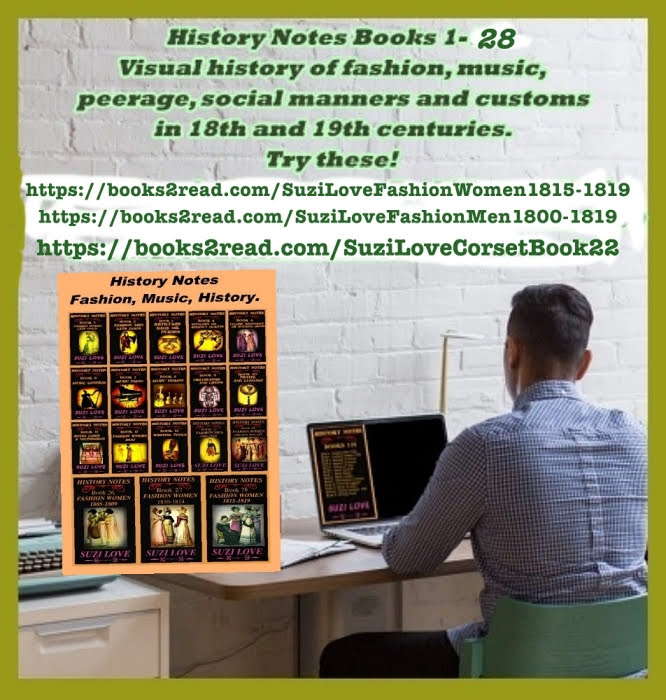
Do you need more factual and visual information for your historical fiction? Try History Notes Books 1-28. Non-fiction Series: Fashion, corsets, Regency Era, music and social manners in the 18th and 19th centuries e.g.
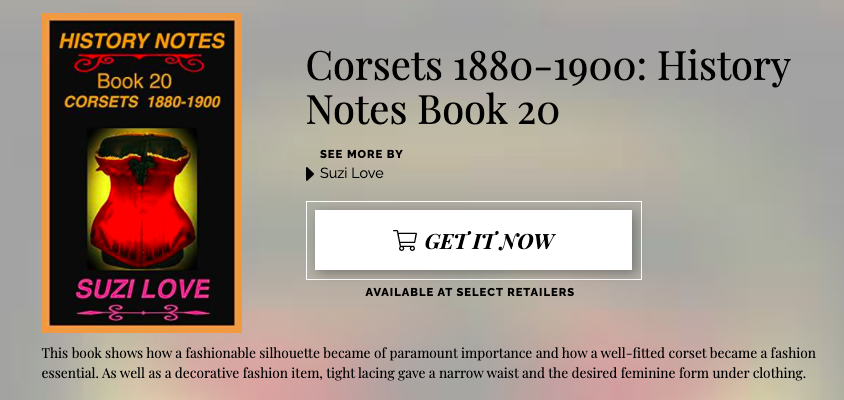
1887 Front View. Wedding Corset, American. Cotton twill, silk thread embroidery. Fully boned wedding corset with front hooks and back lacing. Every boning channel is flossed top and bottom. Via Chicago History Museum, U.S.A. digitalcollection.chicagohistory.org https://books2read.com/SuziLoveCorsetBook20
Do you need more factual and visual information for your historical fiction? History of fashion, music, peerage and customs in 18th and 19th centuries. Non-fiction series full of gorgeous pictures and engraved fashion plates. A visual history of fashion, music, peerage, social manners and customs from late 1700s to late 1800s, or 18th and 19th centuries.
Lover of Jane Austen and the Regency Era fashions? History Notes Book 25. #JaneAusten #RegencyFashion #HistoricalFashion books2read.com/SuziLoveFashionWomen1801-1804
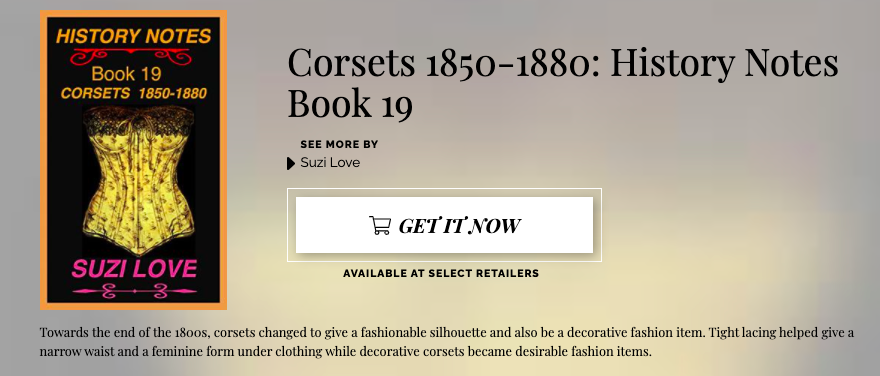
1879-1885 ca. Linen Riding Corset, English. https://books2read.com/SuziLoveCorsetBook19 Woven linen corset, weighs 0.14kg, and worn for riding. Made on a loom with pockets for bones and busk, woven corsets were lightweight, flexible, washable and patented in France in 1832 by Jean Werly. Stitched corsets made from seamed pattern pieces provided more support when on horseback. Manufacturer: Charles Bayer. via Victoria and Albert Museum, London, UK.
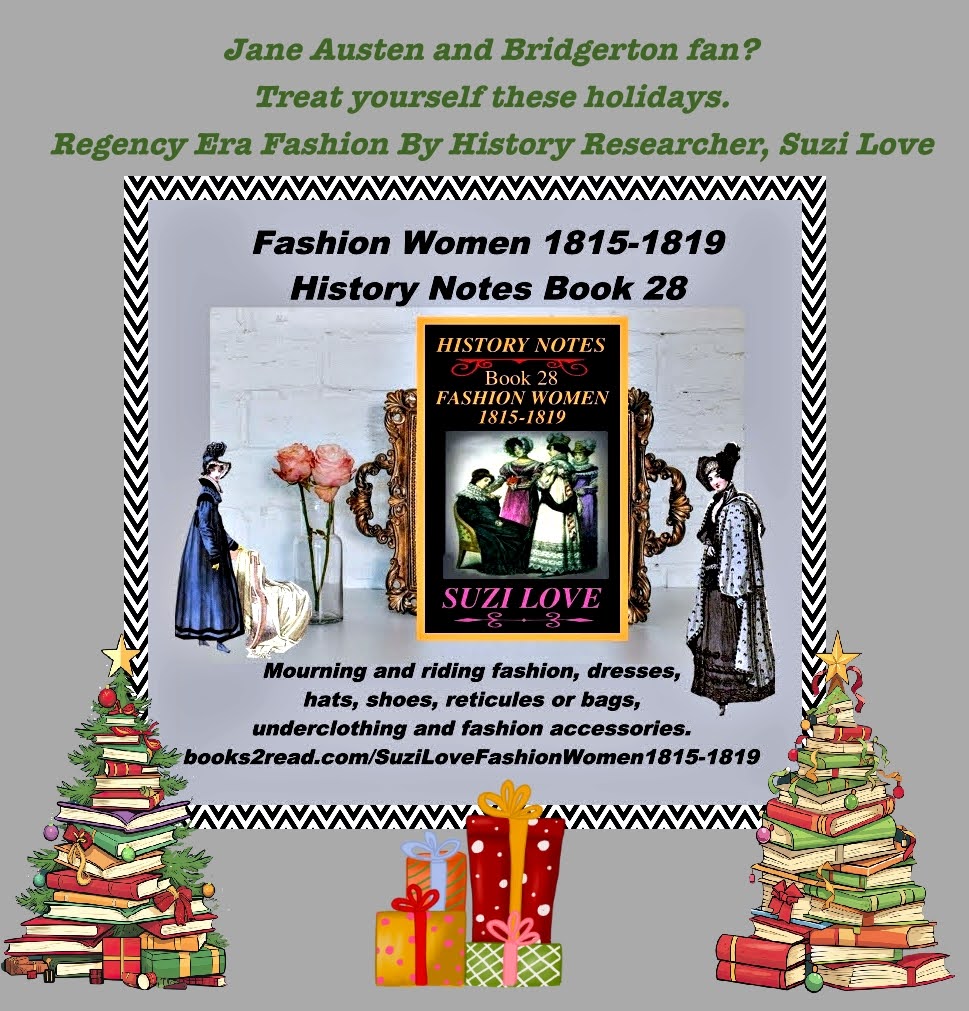
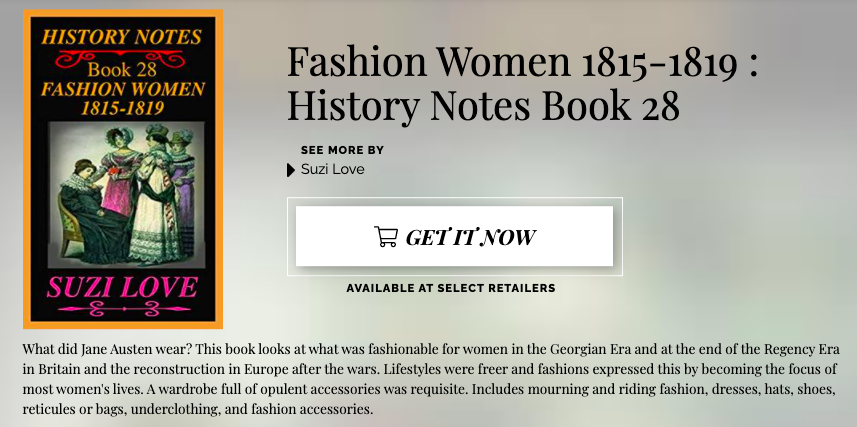
Love the Bridgerton family and Jane Austen? Reader Or Writer of Regency Era stories? Mourning and riding fashion, dresses, hats, shoes, reticules or bags, underclothing and fashion accessories. books2read.com/SuziLoveFashionWomen1815-1819
History Notes 28 Fashion Women 1815-1819: This book looks at what was fashionable for women in the Georgian Era and at the end of the Regency Era in Britain and the reconstruction in Europe after the wars. Lifestyles were freer and fashions expressed this by becoming the focus of most women’s lives. A wardrobe full of opulent accessories was requisite. Includes mourning and riding fashion, dresses, hats, shoes, reticules or bags, underclothing, and fashion accessories.
Have you read Suzi Love’s Books? Romance, Mystery, Military and History. Regency, historical and contemporary romance. Plus non-fiction history and writing.
The Viscount’s Pleasure House Book 1 Irresistible Aristocrats Disenchanted Viscount tutoring three Regency Ladies. What could go wrong? #Regency Erotic https://books2read.com/suziloveTVPH
Four Times A Virgin Book 2 Irresistible Aristocrats: The countess will do anything to prevent her younger sisters being forced into sordid marriages like hers, even if it means joining forces with the Duke of Stirkton and revealing the horrors of their intertwined pasts. books2read.com/suziloveFTAV
Pleasure House Ball Book 3 Irresistible Aristocrats: Lord Mallory attends his first courtesan’s ball in ten years to appease his concerned friends, though he’d rather stay home and read to his motherless daughters. Though mortified that Brenton unmasks her at a scandalous ball, Lady Lillian Armstrong doesn’t regret their night together. books2read.com/suzilovePHB
Petunia and the Pearl Diver Book 4 Irresistible Aristocrats Series: The pearl diver needs a working girl to rouse his body. Petunia needs money to save her family. A night at a London brothel could be the solution to both problems. But walking away is impossible when one night leaves them craving more…and more. https://books2read.com/suzilovePetPD
Loving Lady Katharine Book 5 Irresistible Atistocrats: When Lady Katharine Montgomery flees London after her scandalous husband was murdered, the Pacific islands of the New Hebrides (Vanuatu) become her haven. Her life changes when Lord Alexander St. John, British ship’s captain and trader, sails into Port Vila. https://books2read.com/suzi
Embracing Scandal Book 1 Scandalous Siblings: Lady Rebecca Jamison saves her family from financial ruin by investing in railways, but when a greedy syndicate murders her friend, Becca is forced to beg assistance from Cayle St. Martin, the new Duke of Sherwyn. https://books2read.com/suziloveES
Scenting Scandal Book 2 Scandalous Siblings Series: Richard, Earl of Winchester, may not know it yet, but he’s Lady Laura Jamison’s perfect match. Lady Laura Jamison believes her extraordinary olfactory senses will sniff out her perfect match, but will Richard prove her theory wrong? https://books2read.com/suziloveSS
December Scandal Book 3 Scandalous Siblings: The Jamison family joins the Duke of Sherwyn and the St. Martin clan at the duke’s country estate, but guest numbers double when early December snowfalls make roads impassable. #HistoricalRomance https://books2read.com/suziloveDS
Love After Waterloo: When Lady Melton and son join antagonistic Captain Belling and the last group of wounded British soldiers evacuating Waterloo, she anticipates hardship and trouble with deserters. Not her relationship with a belligerent Captain. #RegencyRomance #military books2read.com/suziloveLAW
Self Publishing: Absolute Beginner’s Guide. Information, contacts, and checklists steer you towards professionally produced books. Helps both fiction and non-fiction authors and available in digital and paperback. Co-Authored by two Australians: multi-published Imogene Nix and best-selling and award winning Suzi Love. http://books2read.com/selfpublishing
History Notes Books 1-28: Do you need more factual and visual information for your historical fiction? Non-fiction Series: Fashion, music and social manners in the 18th and 19th centuries books2read.com/suziloveFashWomen1700s
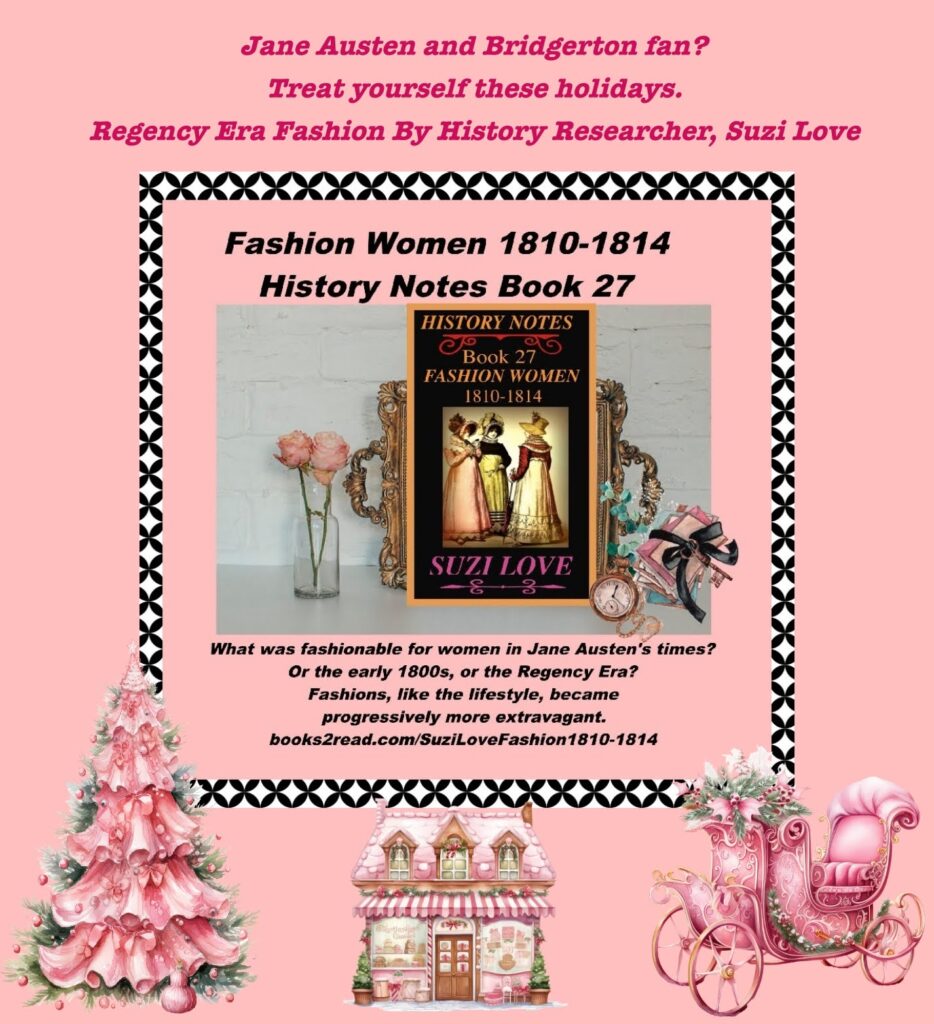
What was fashionable for women in Jane Austen’s times? Mourning, riding, daytime, evening clothing, plus underclothing, corsets and accessories. Fashion Women 1810-1814 History Notes Book 27 This book looks at what was fashionable for women in Jane Austen’s times, or the early 1800s, or the Regency Era in Britain. Wars were being fought around the globe so women’s fashion adopted a military look in support of soldiers. Fashions, like the lifestyle, became progressively more extravagant and accessories went from colorful to over-the-top. https://books2read.com/SuziLoveFashion1810-1814
The Lady’s Magazine said of the basis of women’s fashion that was popular for the first twenty years of the 1800s, ‘White is still the prevailing color for robes. For morning dresses, linen gowns, in large diamonds or squares, are fashionable. Indian muslins, plain or embroidered, are preferred to Florence and satins. The designs of embroidery for shawls are of infinite variety. Long gloves, which reach above the elbow, are not yet laid aside. Medallions are hung around the neck from crossed chains and some of these medallions are shaped like the bags, called ridicules. These reticules are of the lozenge or hexagon shape, with a small tassel at each angle. Reticules, or ridicules, are in lozenge or hexagon shapes with a small tassel at each angle. In capotes, or hats, and ribbands, the violet and dark green prevail over jonquil. Bracelets in hair, pear-shaped ear-rings, medallions on square plates, saltiers of colored stones, are still in fashion.’