How many dukes were there in England in 1804? The number varied from year to year, depending on which titles became extinct etc. From: 1804 Kearsley’s Complete Peerage via Google Books (PD-200)
1804 Nine Princes of the Royal Blood, some of whom are Dukes.
Prince of Wales, Duke of York, Duke of Clarence, Duke of Kent, Duke of Cumberland,
Duke of Sussex, Duke of Cambridge, Duke of Gloucester, Prince William.
1804 Eighteen English Dukes, excluding the Prince Royals holding the title of ‘Duke’.
Norfolk, Somerset, Richmond, Grafton, Beaufort, St. Albans, Leeds,
Regency Life Series: Images, information, funny anecdotes give overview of Jane Austen’s and Bridgerton times. #bridgerton #RegencyEra #JaneAusten #BritishHistory https://books2read.com/suziloveROver
The 26th December was St. Stephen’s Day, the first Christian martyr and patron saint of horses, so Boxing Day became associated with horse racing and sports. It was also when the English churches alms boxes were opened and the contents given to the poor of the parish. In the song Good King Wenceslas, the king gave the poor man meat, wine and wood “on the feast of Stephen.” Written by John Mason Neale and first published in 1853, the lyrics celebrate the spirit of Boxing Day which was generosity. King Wenceslas watches a poor man “gath’ring winter fuel. and he then brings the peasant food and logs for his fire. In parts of Europe, St. Stephen’s Day is considered the second day of Christmas.
On the Boxing Day holiday, servants, apprentices, and the poor were presented with gifts. The origin of the holiday is unknown, but was probably first observed in the Middle Ages and the name may come from the opening of alms boxes that had been placed in churches over the holidays for distribution to the poor. It may also be because servants opened their gift boxes on the day after Christmas because on Christmas Day they were busy cooking and serving a large festive meal for their employers. December 26th is also the feast day of St. Stephen, the first Christian martyr and patron saint of horses, so Boxing Day has now become associated with horse racing and sports.
One of the earliest records of these box gifts dates from 1663. In an entry in his diary, English Parliamentarian Samuel Pepys writes that he sent a coach and messenger to his shoemaker to deliver “something to the boys’ box against Christmas” in addition to funds to cover his bill. During Queen Victoria’s reign, Boxing Day became a chance for church parishioners to deposit donations into a box that was put out for the purpose by the clergyman. The money in the boxes was given to the poor.
Some villages followed the custom of the Hunting of the Wren, where small boys captured a wren, killed it, and then mounted it on a pole and carry to every house in the village while singing a song. Money collected was used for a village dance. In London, and in many other parts of Europe, large families and establishments keep regular lists of tradesman’s servants, apprentices, and other persons, who come about making a sort of annual claim on them for a Christmas box on this day.’
‘The custom of annual donations at Christmas, and on New Year’s-day, is very ancient, being copied by the Christians from the Polytheists of Rome, at the time the public religion was changed. These presents, now-a-days, are more commonly made on the morrow of Christmas. From this circumstance the festival of St. Stephen has got the nickname of Christmas Boxing-day, and by corruption, Boxing-day.’ From:- The Lady’s Monthly Museum, Vernor & Hood: Christmas-boxes, 1824.
‘On the day after Christmas, tradespeople are visited by persons in the employment of their customers for a “Christmas-box,” and every man and boy who thinks he is qualified to ask, solicits from those on whom he calculates as likely to bestow. A writer, in 1731, describes Boxing-day at that time from his own experience. ” By that time I was up, my servants could do nothing but run to the door. Inquiring the meaning, I was answered, the people were come for their Christmas-box : this was logic to me; but I found at last, that, because I had laid out a great deal of ready-money with my brewer, baker, and other tradesmen, they kindly thought it my duty to present their servants with some money for the favor of having their goods. This provoked me a little; but being told it was ‘ he custom,’ I complied. These were followed by the watch, beadles, dustmen, and an innumerable tribe; but what vexed me the most was the clerk, who has an extraordinary place, and makes as good an appearance as most tradesmen in the parish; to see him come a boxing, alias begging, I thought was intolerable: however I found it was ‘ the custom’ too, so I gave him half-a-crown; as I was likewise obliged to do to the bellman, for breaking my rest for many nights together.’ From The Every-day book and table book by William Hone, 1839
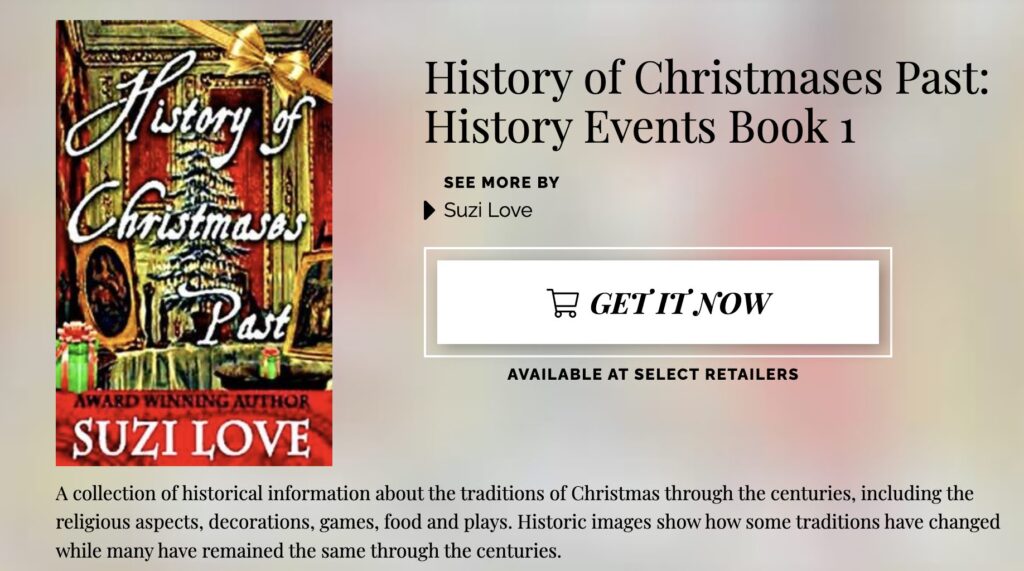
Boxing Day is one of the many customs and traditions associated with Christmas that is featured in History of Christmases Past (Book 1 History Events) by Suzi Love.
The Star of Bethlehem, or Christmas Star appears in nativity story of Gospel of Matthew where wise men from the East, or Magi, follow the star and travel to Jerusalem. The Three Wise Men brought gold, frankincense and myrrh to the newborn king. Myrrh being commonly used as an anointing oil, frankincense as a perfume, and gold as a valuable.
Three Kings came riding from far away,
Melchior and Gaspar and Baltasar;
Three Wise Men out of the East were they,
And they travelled by night and they slept by day,
For their guide was a beautiful, wonderful star.
The Three Kings by Henry Wadsworth Longfellow
Gold, Frankincense and Myrrh were the three presents brought by the Wise Men to the Infant Christ, lying in the manger stall, at Bethlehem. Gold to Christ means that all the affluence of the world surrendered to Him and Gold paid the way for Joseph and Mary and the divine fugitive into Egypt. The gold for Christ, the silver for Christ, the jewels for Christ. The bright, round, beautiful jewel of a world set like a solitaire on the bosom of Christ. The wise men shook myrrh out of their sacks and the cattle snuffed at it but didn’t eat it because it was bitter. This pungent gum resin of Abyssinia was brought to the feet of Christ to show bitter betrayal, persecution, days of suffering and bitter nights. Myrrh was put into His cup when He was dying and put under His head in the wilderness and Myrrh was used on His from the cattle-pen in Bethlehem to the mausoleum. Frankincense means worship and was brought to temples, sprinkled over the living coals, and when they were ready to worship, the cover was lifted and perfumed smoke arose and filled the places of worship and altars.
In modern times, gifts are given on December 25th, or Christmas Day, in most countries but in others it is December 6th, or Saint Nicholas Day, and January 6th, or Epiphany. European countries generally follow the custom of giving each other presents on Christmas Eve.
The origin of Santa Claus begins in the 3rd or 4th century with Saint Nicholas, Bishop of Myra, an area in present day Turkey. By all accounts St. Nicholas was a generous man, particularly devoted to children.Thousands of churches across Europe were dedicated to him and some time around the 12th century an official church holiday was created in his honor. The Feast of St. Nicholas was celebrated December 6 and the day was marked by gift-giving and charity.
After the Reformation, European followers of St. Nicholas dwindled, but the legend was kept alive in Holland where the Dutch spelling of his name Sint Nikolaas was eventually transformed to Sinterklaas, and then Santa Claus. After his death around 340 A.D., he was buried in Myra, but in 1087 Italian sailors purportedly stole his remains and removed them to Bari, Italy, greatly increasing St. Nicholas’ popularity throughout Europe. His kindness and reputation for generosity gave rise to claims he that he could perform miracles and devotion to him increased. St. Nicholas became the patron saint of Russia, where he was known by his red cape, flowing white beard, and bishop’s mitre.
In Greece, he is the patron saint of sailors. In France, the patron of lawyers. In Belgium, the patron of children and travelers. Thousands of churches across Europe were dedicated to him and some time around the 12th century an official church holiday was created in his honor. The Feast of St. Nicholas was celebrated December 6 and the day was marked by gift-giving and charity.
After the Reformation, European followers of St. Nicholas dwindled, but the legend was kept alive in Holland where the Dutch spelling of his name Sint Nikolaas was eventually transformed to Sinterklaas, and then Santa Claus. Dutch children would leave their wooden shoes by the fireplace, and Sinterklaas would reward good children. hence Santa Claus bringing gifts to children who have been good.
The word ‘carol’ comes from the old French ‘carole’ for a song written and played as a courtly dancing song. Carols then took on a more popular form, telling stories and celebrating religious themes for all seasons until the late 19th century when they became associated with Christmas.
Carols took the place of Psalms in all churches on Christmas Day and, as the whole congregation could join in, were greeted with huge approval. Carols were passed on orally from place to place, often with different words or tunes. The published carols included songs still popular today, including The First Noël, I Saw Three Ships, and God Rest Ye Merry Gentlemen. This collection was followed by compilations of carols from other scholars such as William Sandy’s works in 1833 and 1852.
Another Christmas Tradition is kisisng under the Mistletoe. So have fun this Christmas and find someone to kiss. The problem in hotter climates is to find the Mistletoe, of course. Darn!
Mistletoe was used by Druid priests 200 years before the birth of Christ in their winter celebrations. They revered the plant since it had no roots yet remained green during the cold months of winter. The ancient Celtics believed mistletoe to have magical healing powers and used it as an antidote for poison, infertility, and to ward of evil spirits. The plant was also seen as a symbol of peace, and it is said that among Romans, enemies who met under mistletoe would lay down their weapons and embrace.
Scandanavians associated the plant with Frigga, their goddess of love, and it may be from this that we derive the custom of kissing under the mistletoe. Those who kissed under the mistletoe had the promise of happiness and good luck in the following year. Mistletoe was associated with Christmas as both a decoration under which lovers kiss, as well as a protection from witches and demons. Sounds romantic, although mistletoe is actually a parasitic plant that grows on other trees or plants and comes in many varieties.
In Britain, mistletoe was mainly found in the western and southwestern parts, so the custom wasn’t even followed in all parts of England. But where the mistletoe custom was followed, it was hung in doorways and the greenery was watched by young gentlemen in hopes of catching a pretty girl to kiss, usually on the cheek.
Traditionally, a man was allowed to kiss a woman who was standing underneath mistletoe and bad luck would befall any woman who refused. In some places, it was the custom to pick a berry for each kiss and when all the berries were gone, no more kisses could be taken.
Days and nights used to be counted separately, so the important night was often the night before rather than the night of, which is why some parts of the world celebrate Christmas on Christmas Eve. Therefore, the twelve days of Christmas actually begin on the eve of December 25th, the first night, and end on January 6th, which is Epiphany. The day of December 26 is the first day and the eve of December 26 the second night.
The famous Twelfth Night is the eve of Epiphany and the twelfth day is Epiphany itself. During these twelve days, traditional roles were relaxed or turned upside down so that masters waited on their servants, men were allowed to dress as women and women as men. These crazy antics can also be seen in modern Christmas pantomimes in which authority is mocked, women play male leads and the leading older female character is played by a man.
Twelfth Night
The Twelfth Night festival marked the onset of the winter solstice, the point in late December when the sun, whose daily arc had reached its lowest and darkest.
Twelfth Night is the eve before the twelfth day of Christmas or the Epiphany celebration, which commemorates the adoration of the Magi before the infant Jesus and marks the final night of the Christmas season. Twelve Nights,” which extended from the 25th of December to the 6th of January. The Twelve Nights were religiously observed by numerous feasts, and were regarded by the ancient Germans as among the holiest and most solemn of their festivals.
In Tudor England, the Twelfth Night marked the end of a winter festival that started on All Hallows Eve. A King or Lord of Misrule would be appointed to run the Christmas festivities, and the Twelfth Night was the end of his period of rule. Shakespeare’s play, Twelfth Night, or What You Will, was originally written to be performed as a Twelfth Night entertainment. After Twelfth Night, the Carnival season starts and lasts until Mardi Gras. In some places, Twelfth Night celebrations include food traditions such as the king cake or tortell.
In the Bavarian and Styrian Alps the Twelve Nights are called “Rumor Nights,” on account of their visions of ghosts and hobgoblins, when priests and prudent housewives, with prayer and invocation, holy-water and burning incense, fumigate dwelling and outhouse, and sprinkle their cattle with salt. Hence these nights were also called “Fumigating Nights.” As an additional protection against “witches’ feet” and “devils’ paws,” the initials of the holy magicians were formerly inscribed upon the door-posts. On the dreaded Twelfth-night, when Frau Holle, or Berchta, issues with her fearful train from her wild mountain home, where she dwells among the dead, she is generally preceded by the faithful Eckhart, an old man with a long beard and a white wand, who warns every one of her terrible approach.
Christmas: Wassail Bowl History #Christmas #holidays #Traditions #Customs
The term wasseling refers to the jovial revelry and carousing that went on in historic England when all classes of society would gather around a common banquet-table and the wassail bowl and indulge in the most unrestrained joviality and merriment around.
Wassail Bowl: Most great houses had a wassel-bowl, or cup, frequently of massy silver. Toasts were “Drine heil,” or “Was hail,” from which the howl derives its name but were replaced around the nineteenth century by “Come, here’s to you,” or “I’ll pledge you.” Now, we toast with the simplified version of ‘Here’s to you’. As the hour of twelve approached, carol-singers would prepare and bell-ringers would place themselves at their post to usher in the morning of the Nativity with lots of rejoicing and with bands of music parading the towns.
In some parishes in the West of England, carol-singers adjourn to the church to sing in Christmas-day, a remnant probably of popery, as in Catholic countries there were frequently church-services held at this time. In the 16th century, Tusser prescribed for Christmas: good drink, a good fire in the hall, brawn, pudding, and mustard withall, capon, or turkey, cheese, apples, nuts, and jolly carols. In rich houses, a wassail cup would be filled with rich wine, sweet and spicy, and with roasted apples bobbing on the surface. In poorer houses, the cup would hold ale with nutmeg, sugar, ginger, and roasted crab apples.
At the end of the winter term, schoolmasters would set their pupils to work on Christmas Pieces, samplers of writing on superior paper with engraved borders, to show parents how they had progressed during the year. By about 1820, the engraved borders were enhanced with color and the children’s pieces became more decorative.
However, the custom of sending cards at Christmas was started in the United Kingdom in 1843 by Sir Henry Cole. Postage had been standardized three years earlier and Cole was a civil servant who had played a key role in initiating Uniform Penny Post. He wanted ordinary people to become more interested in the new ‘Public Post Office’. With his artist friend John Horsley, they designed the first card which was issued from a periodical, Felix Summerley’s Home Treasury, and were sold for 1 shilling each.
The card was lithographed, hand-colored, had three panels and was in a rustic frame of carved wood and ivy. The outer two panels showed people caring for the hungry and the naked. The centre panel showed a family of three generations having Christmas dinner, although the temperate classes strongly objected to the idea of a child being given a glass of wine with dinner.
New railways carried more post, and a lot faster, than a horse and carriage so the Post Office offered a Penny stamp. Cards became even more popular when they could be posted in an unsealed envelope for one halfpenny. Christmas cards became truly popular when printing improved and cards could be produced in large numbers, around 1860. By the early 1900s, the custom had spread over Europe and especially in Germany.
Early cards usually pictured Nativity scenes, but in the late Victorian times, robins and snow-scenes became popular because the postmen wore red uniforms and were nicknamed ‘Robin Postmen’. Snow-scenes were also popular because they were a reminder of the very bad winter of 1836.
Snow scenes reflected the snowy and often harsh northern hemisphere winters when opening and reading Christmas cards was an enjoyable family experience. In 1860, Charles Goodall & Son, a British publisher of visiting cards, began mass producing cards to be used for visits during the Christmas period. These Christmas and New Year’s visiting cards were decorated with simple designs such as a twig of holly or flowers.
Sales of cards grew and designs and sizes changed. The first cards were meant to appeal to the masses and encourage them to send large numbers by post, so rather than focus on religious images, they showed sentimental or humorous images of family and children, fanciful designs of flowers, fairies, or reminders of the approach of spring. Religious themes of nativity scenes, children looking at the manger, or angels and candles remain popular to the modern day.
Cards could be shaped like bells, a fan, a crescent, a circle, or a diamond and were folding, decorated with jewels, iridescent, embossed, and carried either simple Christmas and New Year greetings or had verses and carols written in them. The next year, Mr W.C.T. Dobson produced a sketch symbolizing the ‘Spirit of Christmas’ which sold many more than the previous thousand and the novelty caught on.
Many artists became famous for their annual illustrations that became postcards and cards. Printing technology became more advanced in the age of industrialisation and the price of card production dropped. With the introduction of the halfpenny postage rate, the Christmas card industry industry increased until in 1880 11.5 million cards were produced.