1801 White Dress With Train, French. Empire style high-waisted dress under a green Spencer and carrying a gorgeous reticule,or bag, with the additional accessories of gloves and red slippers. I can picture Jane Austen and her female friends and family wearing a white Empire style dress and Spencer like this for shopping or paying visits. Fashion Plate via Journal des Dames et des Modes, or Costume Parisien.
Definition Reticule Or Bag: Purse, often with a drawstring to pull closed and usually made of cloth or covered cardboard and often decorated with beading or embroidery. Carried by a woman during the Regency period to carry all their daily necessities. in the place of pockets. Definition Spencer: Short jacket, cropped at the waist, worn over a dress, or gown. Delicate and regency dresses provided so little protection from the cold, so over garments were essential for warmth, modesty and good health.
HN_4_Spencers, Or Jackets. #Regency #Georgian #Victorian #Fashion History Notes Book 4 By Suzi Love.
1800 Young Dandy’s Morning Outfit, French. Brown, doublebreated, cutaway coat, striped trousers tucked into high black boots with tassels, gloves, small jaunty hat and a walking stick. Fashion Plate via Journal des Dames et des Modes, or Costume Parisien.
Dandy: The author of The Hermit in London, a series of sketches published in 1819—1820 observed: ‘A distinguished Exquisite is padded all over to-day; and all the other foplings are, on the morrow, mere walking pin-cushions. A fat prince, or a fat dandy, requires confinement in his limbs; and all his subjects are immediately restrained within the same limits. One day, the back is to be as broad as an Irish chairman’s, and the shoulders to be bolstered up to imitate a hod-man; and the next, the shoulders are to be flat, and a man is to be pinched in and laced up until he resembles an earwig. All these are Master Snip’s maneuvers, who continues to make his bill equally long, whether the spencer or the box-coat be in vogue.
In Jane Austen’s times craftsmen created boxes and containers of precious metals, leather, silks, and decorated them with jewels. Boxes, Cases, Etui, Necessaire and everything else that was used to carry essential items for travel, sewing, medicine, writing, and toiletries. Containers were engraved to make exquisite and expensive items as well as practical carrying cases. books2read.com/suziloveBoxesCases
A sedan chair is a portable enclosed chair for a single passenger. It was generally carried by two “chairmen” holding poles attached to either side of the chair. Sedan chairs were fashionable in England and Europe during the 17th, 18th and early 19th centuries and were an important part of the social life of the times. They were very useful for negotiating crowded, unsafe, narrow, winding and often filthy streets and were particularly used by “invalids, ladies and party goers”. Sedan chairs had the advantage of being able to be carried up and down stairs and could deliver the passenger from inside their own home to inside their destination without having to step outside.
1784 Sedan Chair. ‘The return from a masquerade. A morning scene.’ A young lady dressed as shepherdess with staff slumps in a sedan chair. Asleep or drunk her head and shoulders hang outside window. Two porters smile and dwarf chimney sweep carries a mask.’ By Robert Dighton and Cari.
1784 Sedan Chair. ‘The return from a masquerade. A morning scene.’ A young lady dressed as shepherdess with staff slumps in a sedan chair. Asleep or drunk her head and shoulders hang outside window. Two porters smile and dwarf chimney sweep carries a mask.’ By Robert Dighton and Cari.
The 19th century English author, Elizabeth Gaskell, described the use and function of the sedan perfectly in her novel “Wives and Daughters” when she reminisced how the Browning sisters chose to be transported to a ball by sedan chair, which ‘came into the parlor, and got full of the warm air, and nipped you up, and carried you tight and cosy into another warm room, where you could walk out without having to show your legs by going up steps, or down steps.’
The Bath Chair was invented in Bath, England, in the mid 18th Century to transport the wealthy and the sick around the city. It could be steered by the passenger and rivaled and then outdid the Sedan Chair as only one chairman was needed to operate it. The last Bath Chairman retired in 1949.
Typical 1700s, or Eighteenth Century Sedan Chair. Portable enclosed chair for single passenger usually carried by two chairmen holding poles attached to either side of chair. Fashionable during 17th, 18th and early 19th centuries when needed to negotiate crowded, unsafe, narrow, and dirty streets. Used by invalids, ladies and party goers. The sedan chair comprises a small kiosk with a curved timber roof which is covered with leather and studded with brass nails. The front and side panels are painted in green with floral decorations of cherubs and flowers. The back panel is of plain timber. Access to the chair was via a hinged door at the front. Inside, the chair is upholstered in silk and features padded upholstered arm rests. The windows have raw silk curtains which are gathered with tassels. The present brackets and poles are reproductions made in 1986 prior to display in the Transport exhibition. The total length of the new poles are 80 inches. The sedan chair door lock features the initials “V.F.” and a set of crossed keys with the wording “PARIS” and the number “34”. Via Powerhouse Museum, Sydney, Australia.
Typical 1700s, or Eighteenth Century Sedan Chair. Portable enclosed chair for single passenger usually carried by two chairmen holding poles attached to either side of chair. Fashionable during 17th, 18th and early 19th centuries when needed to negotiate crowded, unsafe, narrow, and dirty streets. Used by invalids, ladies and party goers. The sedan chair comprises a small kiosk with a curved timber roof which is covered with leather and studded with brass nails. The front and side panels are painted in green with floral decorations of cherubs and flowers. The back panel is of plain timber. Access to the chair was via a hinged door at the front. Inside, the chair is upholstered in silk and features padded upholstered arm rests. The windows have raw silk curtains which are gathered with tassels. The present brackets and poles are reproductions made in 1986 prior to display in the Transport exhibition. The total length of the new poles are 80 inches. The sedan chair door lock features the initials “V.F.” and a set of crossed keys with the wording “PARIS” and the number “34”. Via Powerhouse Museum, Sydney, Australia.
The longest journey recorded in a sedan chair was made by Princess Amelia, youngest daughter of King George III, who in 1728 was carried by 8 chairmen working in reliefs from London to Bath, a distance of 172 kms (107 miles). This sedan chair door lock features the initials “V.F.” and a set of crossed keys with the wording “PARIS” and the number “34”.
HN_10_D2D_RetailerBuyLink_ History Notes Book 10 books2read.com/SuziLoveTravel
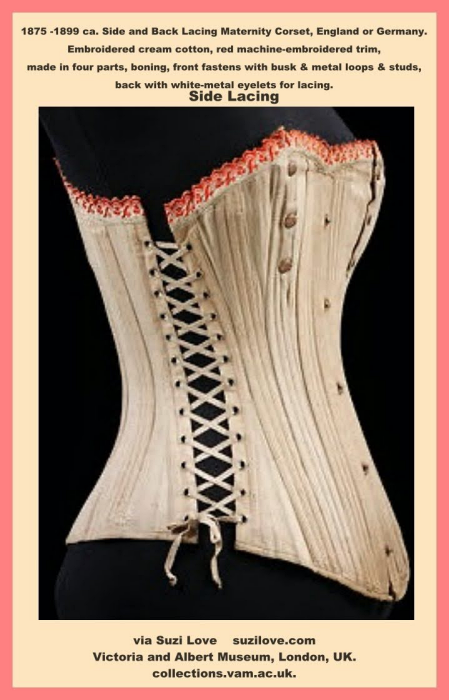
1875-1899 ca. Side Lacing Maternity Corset, Possibly England Or Germany. Embroidered cotton with metal and boning, possibly used as a maternity corset. This corset is made of cream cotton with red machine-embroidered trim and trimmed with a scallop edged tape. The corset is made in four parts and fastens at the front with a busk and with five white metal loops and studs. At the back are seventeen sets of white metal bound eyelets for threading through a lace. At each side, there are twelves sets of metal bound eyelets to fasten with elasticated laces. There is a vertical opening at the bust which fastens with three bronze gilt press studs, clamped into the fabric, and a diamond pattern impressed on the head which shows on the face of the fabric. On the reverse of the stud is a mark.
The corsets reach from the bust to the middle of the hip descending to a point at about the middle of the belly in the centre front. They are machine-stitched and seem lightly boned, encased and sewn to the face of the fabric. Bound at the top and bottom with grey tape. The breast gussets and side lacing suggest this is a maternity corset. Corsets designed for pregnancy and nursing were advertised throughout the 19th century. This maternity corset is a typical example. It is constructed like a fashionable corset, with boning and a central busk. It has side laces, to enable the wearer to adjust the corset to her changing figure. The cups can be opened for breastfeeding by releasing the press studs. via Victoria and Albert Museum, London, UK.
1875-1899 ca. Side Lacing Maternity Corset, Possibly England Or Germany. via collections.vam.ac.uk1875-1899 ca. Side Lacing Maternity Corset, Possibly England Or Germany. via collections.vam.ac.uk1875-1899 ca. Side Lacing Maternity Corset, Possibly England Or Germany. SideView. via collections.vam.ac.uk
1875-1899 ca. Side Lacing Maternity Corset, Possibly England Or Germany. #corset #maternity #victorianfashion https://books2read.com/SuziLoveCorsetBook19
1780 ca. English Guitar, Lisbon Made by Jaco Vieira da Silva. Pine back, sides and soundboards, with pine and wood purfling or bordering, brass openwork rose, framed with mother-of-pearl. The English guitar was a fashionable instrument from about 1750, considered easy to play and tuned in C major, although the player would use a capo, much like a modern folk-guitarist, in order to change the key. The tuning pegs were often small metallic pins that could be turned with a watch-key, to keep the strings in tune longer. This instrument was made in Portugal, a country with strong trading links with England, and its peg box is decorated with a paper ‘cameo’ in imitation of a jasper ware medallion, a motif made popular by Josiah Wedgwood (1730-1795) from about 1770. Victoria and Albert Museum, London, U.K. History Notes Book 6 Music General https://www.suzilove.com/wp-admin/books2read.com/suziloveMusicGeneral \
Blurb: Love After Waterloo: Lady Melton and her son are forced to join antagonistic Captain Belling and the last group of wounded British soldiers evacuating Waterloo and traveling back to London. https://books2read.com/suziloveLAW
Book Hook: Lady Melton’s hand flew to her mouth. “Oh, dear. I’ve taken your bed. I’ve forced you to use a mattress on the floor.”
The Captain laughed. “Believe me, that’s far better than propping against a tree and trying to snatch an hour’s sleep before battle. Or squeezing between a sea of horses and men so you stay warm and don’t expire from frostbite.”
“How long have you been with Wellesley?”
He leaned forward and rested his arms on his knees. “Too damn long.”
“So you’re pleased to be going home?”
“Pleased? No. Resigned, yes. My friends, my fellow officers, were ordered back to Brussels. I feel guilty that I’m not with them.”
“But surely they will return home soon, now that we’ve defeated Napoleon?”
“We’ve thought the war finished several times before, and I fear this time may prove the same. Nobody can predict what the Corsican will do next.”
She squeezed his thigh. “You’re worn out, Gabe. Things will be better when you’re in London once again.”
“Will they? Too much has changed there as well. I doubt I’ll fit back into society very easily.”
“Won’t your family be pleased to have you home?”
“Perhaps, but the only important one, my uncle, died three months ago. No one cares how many thousand British men have been slaughtered, or that there will be hundreds of injured soldiers in London soon who will have no homes and no employment.”
“Some people care, Gabe.”
Book Hooks: Book Hooks: “Oh, dear. I’ve taken your bed. I’ve forced you to use a mattress on the floor.” #Waterloo #regencyromance #militaryromance #BookHook #MFRW https://books2read.com/suziloveLAW
1820-1850 ca. Cotton and Beadwork Reticule Or Bag, Dutch. Couple on shore, man in boat, house and windmill behind, musicians, dancers, onlookers. Yellow metallic frame and green braided silk cord. Beadwork on cotton foundation. Polychrome design: couple on shore, man in boat, house and windmill behind (obv.); musicians, dancers, onlookers (rev.); acanthus motif at base. Yellow metallic frame with dotted design, stud closure, green braided silk cord. Ecru silk lining. via Museum of Fine Arts, Boston, U.S.A. mfa.org
Definition Reticule Or Bag or Purse: Often with a drawstring to pull closed and usually made of cloth or covered cardboard and often decorated with beading or embroidery. A reticule, or purse, or handbag, was usually carried by a woman during the Regency period to carry all their daily necessities. Earlier, women used pockets that tied at the waistline and were hidden in the folds of their skirts. Empire style, or early 1800s, high-waisted dresses made it impossible to either sewn in a pocket or to tie on a pocket. So women began carrying small, decorated bags called Reticules, or ridicules, which generally pulled close at the top with a drawstring.
1820-1850 ca. Cotton and Beadwork Reticule Or Bag, Dutch. Couple on shore, man in boat, house and windmill behind, musicians, dancers, onlookers. Yellow metallic frame and green braided silk cord. via Museum of Fine Arts, Boston, U.S.A. mfa.org
1820-1850 ca. Cotton and Beadwork Reticule Or Bag, With Couple on Shore, Dutch. #holland #sewing #Reticule #RegencyEra #RomanticEra #HistoricalFashion #Antiques http://books2read.com/suziloveReticules
Blurb: Love After Waterloo: Lady Melton and her son are forced to join antagonistic Captain Belling and the last group of wounded British soldiers evacuating Waterloo and traveling back to London. https://books2read.com/suziloveLAW
Book Hook: Lady Melton and the Captain held vastly different views on women’s roles, she instinctively knew he would convey them safely to English shores. Her son liked him, so she’d make allowances for the Captain’s abrasive manner and assume that his stiffness was due to the stress of conveying a party of injured men, a lady, and a child to London.
“Captain, despite you not wanting me to tend to your own wounds, I shall still offer to help your soldiers. Changing their bandages, massaging their limbs, and that sort of thing.”
“Good grief. You’re telling me that your brothers allowed you to massage men’s arms and legs?”
Her amenable attitude towards him dissipated faster than mist on a sunny morning. “Yes, Captain.” She shifted her sleepy son to her other hip. “Brendon is a knowledgeable physician, and he not only allowed me to massage the men’s painful limbs, but he actively encouraged it.”
“Not under my command, you won’t.”
“Perhaps each soldier should decide for himself. I’m sure they would welcome any relief, even if a mere woman offers the only available treatment. Massaging is known to stimulate blood flow which means a limb doesn’t atrophy while a wound is healing. Faster healing means less time in pain.”
“Humph. We’re British soldiers. Taught to keep a stiff upper lip and suffer in silence.”
She scowled. “Are you making a jest? Because I didn’t picture you as capable of levity.”
He snorted. “Yes, sorry. My pathetic attempt at a joke fell flat. I’m not capable of true levity at the moment. Not after spending days searching for friends, or what was left of them, and retrieving valuables and letters before the battlefield pickers stole items I would rather see returned to their loved ones.” He shook his head. “And why did our men charge over those hills and die?” He pointed towards the battleground where thousands of soldiers had been either slaughtered outright, or had passed their last hours in agony. “So that our fat and complacent Regent can congratulate himself on a brilliant battle. So Wellington can be proclaimed Britain’s greatest war hero.”
Anne winced. Gabe had reached his limit, and with good reason. His grief was palpable and she was back to feeling sorry for the wretched man.
Book Hooks: Lady Melton and the Captain held vastly different views on women’s roles. #Waterloo #regencyromance #historicalromance #BookHook https://books2read.com/suziloveLAW
Love After. Waterloo: Blurb: When Lady Melton and her son, Daniel, are forced to join antagonistic Captain Belling and the last group of wounded British soldiers evacuating Waterloo and traveling back to London, she expects clashes with army deserters. What she doesn’t anticipate is how much she and her son will need the belligerent Captain after they reach London. https://books2read.com/suziloveLAW
Book Hook: Lady Melton had conversed with gentlemen in Brussels who’d held similar views to the Captain, and who had looked down their aristocratic noses at any lady who defied tradition. Explaining her long-term interest in medicine to men who assumed that ladies lived to sip, shop, and embroider had been futile, and one of many reasons that she’d gladly left London and traveled to the Continent to live with her brothers. Ironic that she and her unborn child had been safer in battle-torn Europe than in the country of her birth, and sad that she and Daniel were now forced to return to family members that she disliked and a claustrophobic lifestyle that she barely tolerated.
She glanced around the Captain’s headquarters. Most of the walls remained intact, so at least she and her son would be partially protected from the elements tonight. Her brothers’ house hadn’t fared so well. British infantrymen had commandeered a French cannon and had been dragging it down the road towards Brussels when it had misfired. The shell had gone high over the trees and exploded near Brendon’s camp-side hospital. The majority of the roof had collapsed, dragging down large sections of the walls, and forcing them to sleep in army tents the past few nights.
Despite Wellington’s victory over Napoleon four days earlier, soldiers, to use the term loosely, still lingered around Waterloo. They and deserters from both sides had joined local famers in picking through the remains of bodies, uniforms, and armory to pilfer anything of value. There’d been nowhere safe to hide a lady and her son, so her brothers had packed what remained of their equipment and taken them, along with a few wounded British soldiers, to the Captain’s quarters, knowing that his orders were to protect whoever remained of French stragglers and deserters.
The twins hadn’t lingered, because Wellington and what was left of his British troops were marching back towards Brussels and Brendon’s skills as a physician were urgently needed. Benjamin, an aide to Wellington, had stayed to organize the repatriation of their soldiers and the departure of their sister and nephew.
When Lady Melton and son join antagonistic Captain Belling and last group of wounded British soldiers evacuating Waterloo, she expects clashes with army deserters.What she doesn’t anticipate is how much she and her son will need the belligerent Captain after they reach London. #RegencyRomance #MilitaryRomance https://books2read.com/suziloveLAW
Book Hooks: Ironic that Lady Melton and her unborn child had been safer in battle-torn Europe than in England. #MilitaryRomance #RegencyRomance #BattleofWaterloo books2read.com/suziloveLAW