1802 February, 15th. ‘Advantages of Wearing Muslin Dresses.’ during the Regency Era, or Jane Austen’s times. By James Gillray. Fat lady sitting with man and woman at tea table reacts in horror when hot poker from fire falls on her dress. Man sits helplessly while second woman upsets the table. Butler drops plate of muffins and cat scampers away from fire. Painting of Mt. Vesuvius hangs over fireplace. Via Wikimedia Commons commons.wikimedia.org (PD-ART)
1804 September Exhibition of Water Coloured Drawings, Old Bond Street, London, U.K. Designed and etched by Thomas Rowlandson. Via Wikimedia Commons commons.wikimedia.org (PD-ART)
On January 27th, 1772, The Pantheon opened on Oxford Street, London. Designed by James Wyatt, The Pantheon featured a rotunda which was one of the largest rooms in England at the time. The Pantheon was intended as London’s answer to Ranelagh Gardens for winter entertainment and opened to a crush when nearly “two thousand persons of rank and fashion assembled.” The Pantheon officially closed for public entertainments in 1814, after Lord Chamberlain restrictions on the building’s use as a theatre made the final venture unprofitable. It was converted to a bazaar in 1833 and in 1867 became a winemakers office and showrooms until being demolished in 1937.
From 1819 Ackermann: The Pantheon was built “for the purpose of public evening entertainments” and was a “superb and beautiful structure” with elegant interiors furnished with fine paitnings, gilt vases, and statues depicting gods and goddesses. The building consisted of a suite of fourteen rooms, and between 1789-1792 (until a fire) was used as an exhibition space for Italian operas after the destruction by fire of the King’s Theatre in Haymarket.
1814 January The Pantheon via Ackermann’s Repository : This once noble structure, situated on the south side of Oxford-street, was originally built by Mr. James Wyatt, for the purpose of public evening entertainments. It was a most superb and beautiful structure, the admiration of all connoisseurs, foreigners as well as natives. The interior was fitted up in such a magnificent style, that it is scarcely possible for those who never saw it to conceive the elegance and grandeur of the apartments, the boldness of the paintings, or the effect produced by the disposition of the lights, which were reflected from gilt vases. Below the dome were a number of statues, representing most of the heathen gods and goddesses, supposed to be the ancient Pantheon at Rome, from which it derived its name. To these were added three beautiful statues of white porphyry, representing the King and Queen and Britannia.
The whole building formed a suite of fourteen rooms, each affording a striking specimen of taste and splendor. After the destruction of the King’s Theatre in the Haymarket by fire in June 1789, the Pantheon was used for the exhibition of Italian operas, and was frequently honored with the presence of their Majesties; till on the 14th of January, 1792, this beautiful structure also fell a prey to the same devouring element.
The fire broke out in the new buildings which had been added for the most convenient performance of operas; and before any engine reached the spot, the flames had gained such a height, that all attempts to save the building were in vain. Owing to the scenery, oil, paint and other combustible materials in the house, the conflagration was so rapid that not a single article could be saved. Persons who witnessed the progress of this tremendous fire, declare that the appearances exhibited through the windows, the lofty pillars enveloped in flames and smoke, the costly damask curtains waving from the rarefaction of the air, and the superb chandeliers turning round from the same circumstance, together with the successive crashing and falling of different portions of the building, furnished to their minds a more lively representation of Pandemonium than the imagination alone cam possibly supply.
The effects, too, of the intense frost which then prevailed, upon the water poured from the engines upon the blazing pile, are described as equally singular and magnificent. The loss occasioned by this catastrophe amounted to £60,000; only one fourth of which sum was insured. The height of the walls fortunately prevented the conflagration from spreading to the contiguous houses.
The Pantheon has been rebuilt; the original elegant front and portico still remain, but the rest of the edifice exhibits not eve a shadow of its former magnificence. Since its re-edification, it has been used principally for exhibitions, and occasionally for masquerades. Various plans have at different times been brought forward for opening it for dramatic representations; and this was actually done a few months since under a license from the magistrates, by a Mr. Condy, who is understood to have embarked a considerable fortune in the concern; but whose right has been contested by the winter theatres, and is likely to become a subject of legal discussion.
1800 Pantheon Masquerade, London, U.K. via Rudolph Ackermann’s Microcosm of London. Engraved by John Bluck. (1791-1831)
1830 Hatchetts, the White Horse Cellar, Piccadilly, London, UK. By James Pollard. Denver Art Museum.
The dreadful condition of British roads caused great apprehension to all classes of travelers. Making a journey anywhere in the country was a big undertaking and often a gentleman composed his last will and testament before his departure. Traveling in vehicles was only possible during the day or on the nights with very bright moonlight with few vehicles attempting road travel in winter and any travel on a Sunday was frowned upon. books2read.com/SuziLoveTravel
Description of Stage Coach Travel in England. via 1815 Journal Tour of Great Britain. “The gentlemen coachmen, with half-a dozen great coats about them, immense capes, a large nosegay at the button-hole, high mounted on an elevated seat, with squared elbows, a prodigious whip, beautiful horses, four in hand, drive in a file to Salthill, a place about twenty miles from London, and return, stopping in the way at the several public-houses and gin-shops where stage-coachmen are in the habit of stopping for a dram, and for parcels and passengers on the top of the others as many as seventeen persons. These carriages are not suspended, but rest on steel springs, of a flattened oval shape, less easy than the old mode of leathern braces on springs. Some of these stage coaches carry their baggage below the level of the axletree.”
1805 Lady With Her Sketching Portfolio In Half Dress, French. White, At-Home, High-waisted, relaxed & flowing dress with white cap and pink flowers to match, long gloves, slippers. Fashion Plate via Journal des Dames et des Modes, or Costume Parisien. Definition Caps: Worn as morning caps, night caps, or under other hats. Jane Austen and her family and female friends would have worn caps like these, sometimes during the morning at home, to bed to keep their long hair from becoming knotted, or under a bonnet to hold a hairstyle in place. Caps sometimes had hanging ties, or tails, and were also called ‘follow me lads’, or ‘flirtation ribbons’. Or flaps covering theirs called Lappets. Magazine Journal des Dames et des Modes, or Costume Parisien, French. French fashion magazine published between 1797 and 1839 and second oldest fashion magazine published in France. Pierre de la Mesangere was editor and published every five days, which is why there is an abundance of French fashion plates from these years in France and internationally.
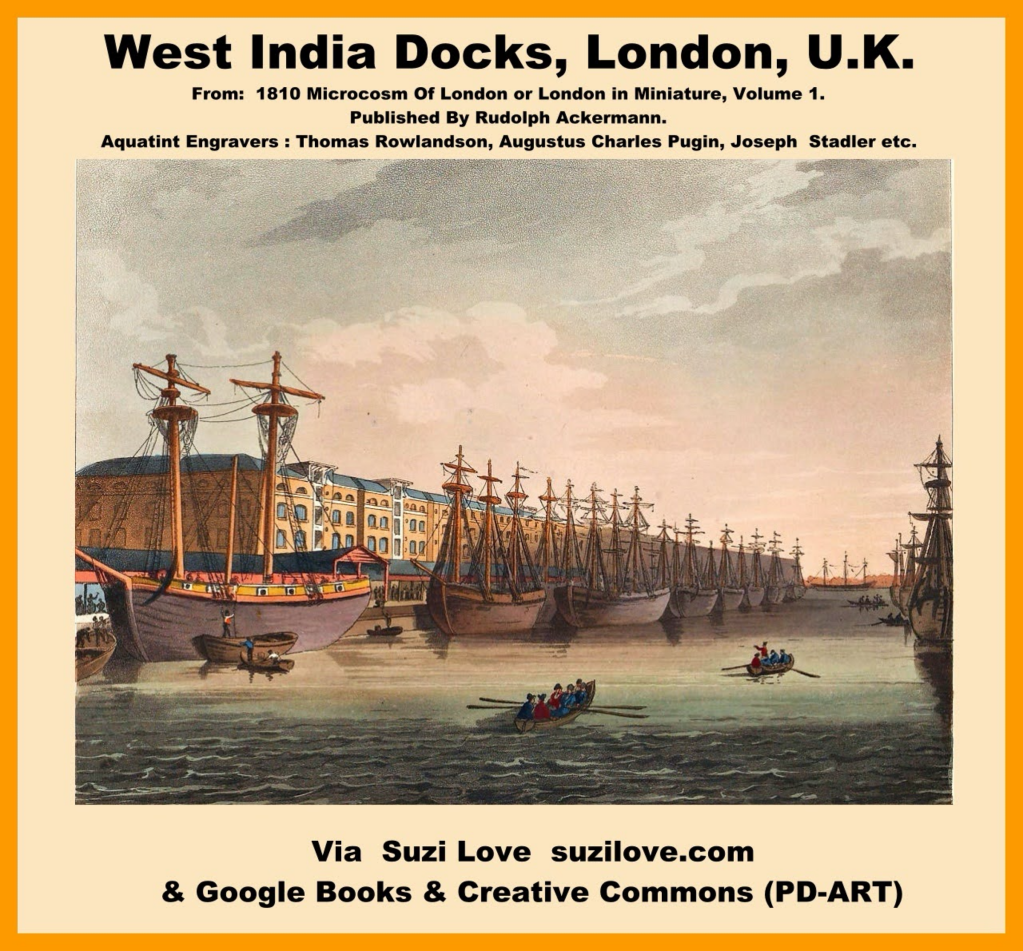
A portrait from 1810-1814 of Rudolph Ackermann, shop owner and founder of ‘The Repository Of Arts’ magazine, The Strand, London. via National Portrait Gallery, London. Plus, an image of Ackermann’s premises in 1809. His ‘Repository of Arts, Literature, Fashion, Manufactures, etc.’ was published from 1809 to 1829 with images of Regency London, Regency furnishings and grand homes as well as beautiful fashion prints and descriptions every month. Ackermann originally supplied artists, amateur and professional, with supplies for watercolor painting. In 1799, he began manufacturing and selling his own watercolor paint blocks which were supplied by other colourmen, although at least three colors were his own mixture – Ackermann’s Green, White and Yellow. From 1817, his eldest son Rudolph Ackermann junior was responsible for the watercolor manufacturing. Ackermann also trained as a carriage designer. He began publishing prints and colour-plate books like ‘The Microcosm of London’ and ‘Doctor Syntax’ in the early 1800s.
The Repository of Arts was one the most popular magazines in Jane Austen’s time as it displayed everything ladies wanted to learn e.g. history, important country seats and houses in England, music, current events such as theatre plays, plus fashion plates and embroidery patterns. Ackermann’s shop in The Strand, London, was one of the fashionable places to shop during the Regency Era. The Repository also included poetry, travel reports, society reports and upcoming lectures. It also included serious subjects e.g. politics, legal matters, medicine and agriculture, a meteorological journal and details of the London markets. In 1817, the price of the magazine was 4 Shillings, so quite expensive for the time.
In the first issue, published for January 1809, Ackermann included an ‘introduction to the history of the useful and polite arts’ which said: “It is universally admitted, that to cultivate a taste for the arts, and an acquaintance with the sciences, is a pleasure of the most refined nature; but to do this without regard to its influence upon the passions and affections, is to ‘tear a tree for its blossoms, which is capable of yielding the richest and most valuable fruit.’ The cultivation of this taste may and ought to be subservient to higher and more important purposes: it should dignify and exalt our affections, and elevate them to the admiration and love of that Being who is the author of every thing that is fair, sublime, and good in nature.”
1816 Inside a dining room by Martin Drolling. Via Wikimedia Commons commons.wikimedia.org (PD-ART) This is typical of the inside of a gentleman’s household in Jane Austen’s times.
18th Century Snuff Boxes. Not only were boxes made to serve a purpose, but decorative boxes of all types were prized, especially in the 18th Century when everything decorative and extravagant was in vogue and taking a pinch of snuff was fashionable. Snuff is made from ground or pulverized tobacco leaves and is sniffed from a pinch of snuff placed on the back of the hand. Flavorings were added to the tobacco to give a fast hit of nicotine and a lasting scent. Snuff began in the Americas and was used in Europe by the 17th Century.
Snuff became popular from the mid 1600s to the mid 1800s and was more popular than smoking. Inhaling snuff, or snuffing, was first seen by a European missionary in 1493 in Christopher Columbus’s new world within Haiti’s indigenous Taino. Until then, tobacco had been unknown to Europeans, but its use spread quickly throughout Europe during the 1500s. By the second half of the 17th century, ornate boxes started being produced to keep the precious powder dry and an entire industry making accessories blossomed around the fashion of taking snuff. Noblemen, and some women, carried extravagantly decorated snuff boxes with them at all times and would offer a pinch of their own particular blend to friends and family. Therefore, these boxes were always on display and so it became a competition to see who could have the most bejeweled or expensive box possible. books2read.com/suziloveFashMen1700
1770-1771 ca. Gold and Enamel Snuffbox 18th Century ca. Gold and Enamel Snuff Box, Europe.1759 Gold Snuff Box, English.1755 Battersea Enamel Snuff Or Patch Box. 1754-1755 ca. Gold Snuffbox, French. 1760 ca. Snuffbox With Scenes from Don Quixote 1760 ca. Gold Mounted Lapis Lazuli Snuff Box 1700s Portrait Miniature Snuff Box of Gold and Tortoiseshell1750 ca. Carved Agate Snuffbox, Germany. 1749-1750 ca. Double Snuff Box, French. 1728-1729 ca. Snuffbox With Dolphin and Ship,18th Century Taking Snuff and Pretty Snuff Boxes. #Georgian #Antiques #BritishHistory books2read.com/suziloveFashMen1700 Share on XRL_2_D2D_RetailerBuyLink_RL_2
https://books2read.com/suziloveYGD
Somerset House, London, UK. London’s Best Places to Visit. Home to Royal Academy and The Great Institutions.
Demolition of the old house, between the Strand and the River Thames, began in 1775 and continued in stages as the new Somerset House was constructed around it. When the new building rose from the rubble, the Royal Academy, which had been one of the last occupants of the old Somerset House, became one of the first occupants of the apartments which fronted the Strand, providing tangible continuity between the old and the new.
Timeline
1547 Edward Seymour, Lord Protector and Duke of Somerset, starts building a palace for himself on the banks of the Thames
1552 Seymour is executed at the Tower of London; ownership of his palace, nearly complete, passes to the Crown
1553 Aged 20, Princess Elizabeth moves to Somerset House; she lives there until 1558, when she’s crowned Queen Elizabeth I
1603 Anne of Denmark, wife of James I of England (James VI of Scotland), moves to Somerset House, which is renamed Denmark House in her honour
1604 The Treaty of London, ending the 19-year Anglo-Spanish War, is negotiated and signed at Denmark House
1609 Anne of Denmark invites Inigo Jones and other architects to redesign and rebuild parts of the palace; work continues until her death in 1619
1625 Charles I is crowned king; his wife, Henrietta Maria of France, commissions Jones and others to undertake more construction and renovation work, including a lavish new Roman Catholic chapel completed in in 1636
1642 The English Civil War begins; soon afterwards, General Thomas Fairfax takes over the palace as the headquarters for the Parliamentary Army
1649 The Civil War ends and Charles I is executed; Parliament tries and fails to sell Denmark House, but successfully sells its contents for the then-huge sum of £118,000
1652 Inigo Jones dies at Denmark House
1660 After Charles II, her son, is crowned king at the start of the Restoration, Henrietta Maria returns to Denmark House; more new construction follows
1665 The Plague sweeps London; Henrietta Maria moves back to France, where she dies in 1669
1666 The Great Fire of London destroys much of the City of London, but stops just short of Denmark House
1685 Charles II dies and his wife, Catherine of Braganza, moves into Denmark House; Sir Christopher Wren oversees yet more construction and renovation work
1693 Catherine of Braganza leaves Denmark House, the last royal to live in the palace
early 1700s Denmark House is used as grace-and-favour apartments, offices, storage and stables
c.1750 Canaletto paints two views from the terrace
1775 After decades of neglect, the original Somerset House is demolished; architect William Chambers immediately starts work on its replacement
1779 The Royal Academy of Arts becomes the first resident of new Somerset House in what’s now known as the North Wing
1780 The Royal Society and the Society of Antiquaries take up residence in the North Wing; Somerset House hosts the first Royal Academy Exhibition
1786 The Embankment Building, known today as the South Wing, is completed; the East and West Wings are completed two years later
1789 The Navy Board completes its move to Somerset House and eventually occupies one-third of the site; the Stamp Office, responsible for taxing newspapers and other documents, joins the board in the South Wing
1795 William Chambers, then aged 72, retires; James Wyatt replaces him as the building’s architect
1801 The new Somerset House is deemed complete, its construction having cost a mammoth £462,323
1829 Sir Robert Smirke starts work on King’s College, which opens in 1831 and is finally completed in 1835
1836 The General Register Office, responsible for births, deaths and marriages, is established here
1837 One year after the final Royal Academy Exhibition at Somerset House, the academy moves to Burlington House on Piccadilly
1849 Having merged in 1834, the Stamp Office and the Board of Taxes join with the Board of Excise to form the Inland Revenue, which remains in residence for more than 150 years
1856 Seven years after James Pennethorne started work on its design, the New Wing is completed
1857 The Royal Society moves out of Somerset House to join the Royal Academy of Arts at Burlington House; the Society of Antiquaries follows 17 years later
1864 Work begins on the Victoria Embankment, designed by Sir Joseph Bazalgette; the embankment is completed in 1870
1873 The Admiralty leaves Somerset House; its offices are taken over by the Inland Revenue
1940s Near the start of World War II, the Inland Revenue temporarily moves out of Somerset House; the Ministry of Supply takes its place
1950 Sir Alfred Richardson starts a two-year project to rebuild the Navy Staircase, known today as the Nelson Stair, which had suffered terrible bomb damage in 1940
1970 After 134 years at Somerset House, the General Register Office moves out
1989 The Courtauld Institute of Art moves into the North Wing
1997 The Somerset House Trust is established to preserve and develop Somerset House for public use
2000 The River Terrace opens to the public for the first time in more than a century; the Hermitage Rooms and the Gilbert Collection both open; then, in December, Somerset House installs a temporary ice rink for the first time
2001 American band Lambchop plays the first gig in the Edmond J. Safra Fountain Court; a full programme of shows follows in 2002 and continues today as the Summer Series
2009 London Fashion Week takes place at Somerset House for the first time
2011 The HMRC (formerly the Inland Revenue) closes its offices at Somerset House
The Royal Academy of Arts
George III, described as an “enthusiastic if undiscriminating collector and patron of the arts”, provided invaluable patronage for the three learned societies. When old Somerset House was relinquished by the Crown, the King reserved to himself the right to appropriate sufficient space in the new building for the Royal Academy of Arts, the Royal Society, and the Society of Antiquaries.
The Great Exhibition Room
1808 The Exhibition Room at Somerset House.
The most important part of the building for the Royal Academy was its Exhibition Room. Situated at the top of the steep, winding staircase, it was roughly 53 x 43 feet and 32 feet high including the lantern, and was described by Joseph Baretti as, “undoubtedly at that date the finest gallery for displaying pictures so far built.” It was here that George III was given a preview of the first Royal Academy Exhibition held at his command in 1780.
Year by year, the exhibits increased. There were 547 in 1781, 1,037 in 1801, and 1,165 in 1821, so that the pictures had to be hung almost from floor to ceiling and with the frames touching one another. From 1832 onwards there was talk of the Royal Academy moving to more spacious rooms in what is now the National Gallery, which was being built at the north end of Trafalgar Square. Accordingly, the last exhibition at Somerset House was held in 1836.
When the Academy moved, the most valuable decorations were taken down and reused in their new quarters. Later they were moved to Burlington House, the Royal Academy’s present home, where the ceiling paintings by Benjamin West and Angelica Kauffmann can now be seen in the entrance hall. The Academy’s old rooms at Somerset House were occupied by the Department of Practical Art, or Government School of Design.
The Royal Society
In 1776, they discovered they were to share the building to the east of the Strand entrance with the Society of Antiquaries, and complained to William Chambers that the accommodation would be inadequate; that the library would be too small and that there would be no room for the Society’s museum.
One of the first discoveries announced to the Society in its new quarters was that of a new planet, first observed by William Herschel in 1781. He wished to call the new planet Georgium Sidus in honour of the King, but other astronomers disagreed and today we know the planet as Uranus. Fellows of the Royal Society were keen to prevent war and politics interfering with the advancement of scientific discovery.
During the Napoleonic Wars of 1796-1815, the President of the Royal Society, Sir Joseph Banks, used his influence both in England and France to ensure that explorers of the two nations were not obstructed by the conflicting armed forces, and that French scientists should continue to be elected Fellows of the Society. When Sir Humphry Davy became president in 1820, the Society became oriented more towards pure scientific enquiry, to which ends, George IV founded two Gold Medals.
After the Royal Academy left Somerset House in 1837, the Royal Society remained there until 1857 when it joined the Academy at Burlington House.
The Society of Antiquaries
In 1776, the Antiquaries heard about the proposed new building at Somerset House, they decided to apply to George III, their Patron, for rooms there. After some intense lobbying by the President, the Reverend Dr Milles, the Society’s request for accommodation was favourably considered, and the King was, “most graciously pleased to order that the Society be accommodated with apartments in the new buildings at Somerset House.”
The resident Secretary of the Society was accommodated in the attic with three rooms “with deal dadoes, and Sienna marble and Sicilian jasper chimney-pieces”. The basement was hotly contested between the Royal Society and the Antiquaries, who were eventually allowed a kitchen, cellar, two vaults, and a privy. However, the lobby, originally intended for the footman in waiting, had to accommodate the Antiquaries’ porter as the Royal Society had taken possession of the Porter’s Lodge!
In the 1850s there was a proposal to move the Royal Society and the Antiquaries from Somerset House but, when the Royal Society moved out in 1857, the Antiquaries decided to remain, taking the opportunity to secure sole use of the disputed rooms, until they joined the other two learned societies at Burlington House in 1874.
The Navy Board
When the Admiralty moved into new premises in Whitehall in 1725, it was decided that the Navy Board, over whom the Admiralty had responsibility, should move to a site much closer; from Seething Lane behind the Tower of London to new offices at Somerset House. Chambers proposed to house the Navy Board on the west side of the south wing of the new building, in the part facing the river, with the Seamen’s Waiting Hall in the centre of the building providing an imposing entrance.
The related Sick and Hurt, Navy Pay, and Victualling Offices were to occupy the range of buildings on the west side of the courtyard. By 1789 the move was completed and, for nearly a century, more than a third of Somerset House was home to the various branches of the Navy Board.
General Register Office
In 1836 the General Register Office was created to set up a comprehensive system for the registration of Births, Marriages and Deaths and appoint the first Registrar General based at Somerset House. It was not until 1970, after slightly less than a century and a half at Somerset House, that the General Register Office moved out.
Principal Probate Registry
The Inland Revenue Stamp duty on documents, including newspapers, was only one of many revenue-raising methods administered by the Stamp Office, one of the government departments which moved to the new Somerset House in 1789. In 1834 the Stamp Office united with the Affairs of Taxes and in 1849 Stamps and Taxes joined the Excise to form a new Board of Inland Revenue. The Board of Inland Revenue today still occupies the east and west wings of Somerset House.
To read more of the history of Somerset House, visit their fascinating site.