
1810 Yellow Dress, British. Plain woven silk, silk crêpe and silk satin. High-waisted dress of yellow silk, ivory colored silks billow out of four openings at sleeve tops. The puffed trimmings are inspired by the fashionable slashing of garments in the Renaissance period when the top fabric was cut to reveal a colored lining or garment worn underneath. A long rectangular strip of ivory silk on inside of sleeve head and excess gathered into pudds through openings. The 19th-century version of slashing is much more controlled by cut, stitching and piped edges, rather than the raw cuts in fabric seen in the 16th century.
Long sleeves narrow at wrists with double bands at cuffs and trimmed with ivory silk satin frills, yellow silk crêpe, cream ribbon and cording. Trimming around lower hem of skirt of applied vandyked border of ivory silk.
Length center back neckline to hem of train length: 158cm Front length shoulder to hem length: 139cm
1817 June Morning Dress as worn in Bridgerton and Jane Austen’s times in England. A round dress composed of jaconet muslin; the bottom of the skirt is trimmed with an intermixture of tucks and embroidery. The body is perfectly novel, it is a three-quarter height, and displays the whole of the throat and a little of the neck: it is composed of the same material as the dress, and is formed to the shape, in a manner at once singular and becoming, by bands of letting-in lace; it is also profusely ornamented with lace, which is set on very full. Long full sleeve, the fullness confined by a tasteful cuff, which is finished by a lace ruffle. Head-dress the Marlborough cap, composed of white lace, ornamented with full-blown roses and blush colored satin ribbon. For the form of this elegant cap, which is perfectly in the English style, we refer our readers to our print. The hair is parted in front so as to display a little of the forehead, and curled lightly over the temples. Necklace and ear-rings white cornelian mixed with gold. White kid slippers and gloves. We are indebted to the elegant taste of Mrs. Marchant of 40, Gerrard-street, Soho, for both our dresses this month. Fashion Plate via Rudolph Ackermann’s ‘The Repository of Arts’.
Definition Morning or At-Home Dress: Loose and comfortable dress and soft lace cap to be worn at home for reading, painting, sewing or for walking in the garden. To be seen by family, servants and close friends. Not accessorized enough to be out in the wider public, although the pretty pink roses and trim on the cap suggest this outfit may have been worn for receiving visitors at home.
1620-1635 ca. Pin For Fastening Clothing, Made In Gloucestershire, England, U.K. Pins were a necessity for the fastening of clothing and the arrangement of dress accessories in the 16th and 17th centuries. Their importance for women as a personal requirement and expense is reflected in the term pin-money, the sum originally allocated to meet this essential cost. Ordinary people would have a small number of pins, the wealthy thousands.Pins were carefully looked after and sharpened periodically. They were extracted after use so as not to tarnish the fabric and placed in a pincushion.
Places Before the mid-16th century the finest pins were imported from France, but their manufacture in England was encouraged under Henry VIII, and an Act for the True Making of Pynnes was passed in 1543, controlling their quality and price. Gloucestershire and London became the main centres of the pin-making industry.
Materials & Making As the industry developed in the 16th century the major advance in the manufacture of pins came with the use of a steel draw-plate with a graduated series of holes. Wire, which was usually brass, could be drawn through this to any gauge, permitting standardisation of the size of the pins. The heads were made from fine coils of wire that were soldered in place.
Enormous quantities of pins were used for the fastening of clothing. Elizabeth I was supplied with 24,000 ‘pynnes of diverse sorts’ just for her coronation. Pins secured the petticoat in a ruffle above the farthingale (hoops that supported a skirt), and held the curves of the ruff in place around the neck. Several dozen might be used for one ensemble. Such a quantity required large pincushions. These pins were found in written documents that were dated between 1620 and 1635.
1810 ca. Cotton Dress Ensemble With Train, French. Cut out in back, lace shawl with sequins can be added to cover shoulders, small low cut bodice, all over embroidery and very short decorative sleeves. Front, Back and Side Views. via Metropolitan Museum New York City, U.S.A. metmuseum.org
1806 Red Velvet Redingote, French. Short puffed sleeves over long straight sleeves, white fur Fichu, or shoulder shawl, interesting matching hat with white satin trim. Fashion Plate via Journal des Dames et des Modes, or Costume Parisien.
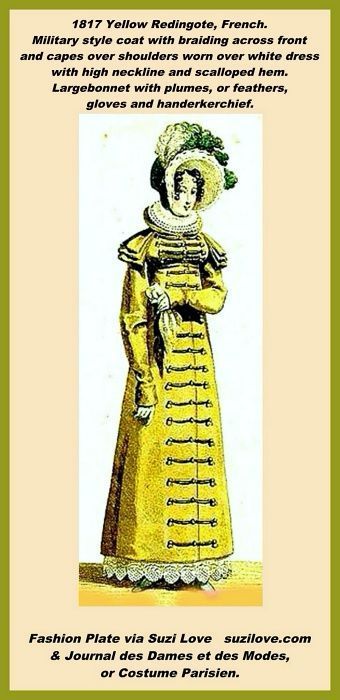
Redingotes or Pelisses were needed to cover the flimsy dresses made of lightweight fabrics of the Regency years to provide warmth and some protection from windy conditions when gowns might lift and cause modesty issues. Jane Austen and her contemporaries often walked to places and so would have needed the warmth of a Pelisse or coat in the cold British winters. https://books2read.com/SuziLoveFashionWomen1805-1809
1806 Jane Austen Style Short Sleeved White Muslin Dress With Train, French. Bodice and sleeves have ribbon decoration, evening flowered headdress, half parure of necklace and ear bobs, and gorgeous Indian hand loomed green shawl. Fashion Plate via Journal des Dames et des Modes, or Costume Parisien.
Definition Jewelry – Parure: Matched set of jewelry, including a necklace, bracelet, earrings, pin etc. Half Parure had no headpiece.
Definition Shawls: The shawl started off in India as a fine wool garment for men that could be worn as a scarf, turban or as a mantle: the word comes from the Persian shäl. Originally imported from the East, European Kashmir shawls were made first in Norwich and Edinburgh in Britain in the late 18th century. Shawls were an essential item in the early 1800s to cover the thin gowns women wore. They were made of muslin, gauze, silk, wool, and velvet, though cashmere shawls were the softest and most prized.
1805 White Fur Coat, or Redingote, French. Black fur and lavender lattice to decorate, white shawl with paisley patterned ends, lavender hat to match and long white gloves. Fashion Plate via Journal des Dames et des Modes, or Costume Parisien. Jane Austen and her contemporaries would have wore long coats like this one to keep warm when out and about, visiting, shopping etc. The thin muslin dresses worn in the early 1800s were little protection against European winters so coats of some sort were added, plus colorful accessories like this shawl and the hat to add color and another layer of warmth.
Definition Shawls: The shawl started off in India as a fine wool garment for men that could be worn as a scarf, turban or as a mantle: the word comes from the Persian shäl. Originally imported from the East, European Kashmir shawls were made first in Norwich and Edinburgh in Britain in the late 18th century. Shawls were an essential item in the early 1800s to cover the thin gowns women wore. They were made of muslin, gauze, silk, wool, and velvet, though cashmere shawls were the softest and most prized.
Fashion Women 1805-1809 History Notes Book 26 What did Jane Austen and friends wear? This book looks at early 1800s fashions, which were elegant and pretty with high waists and fabrics that were almost transparent. These Empire style gowns, named after Napoleon’s first Empress, became popular throughout Europe, and were then copied around the world. Colorful outwear was added to make an ensemble more attractive and warmer. https://books2read.com/SuziLoveFashionWomen1805-1809
1810 ca. Silk Dress, Probably French. High-waisted, or Empire line, dress with long straight sleeves, back opening, embroidery on neck frill and multiple rows of embroidery on the hem. via Metropolitan Museum New York City, U.S.A. ~ metmuseum.org
1806 Two Ladies In White Walking Dresses, French. Puffed sleeves, extra long gloves, bonnets tied under chins and decorated with flowers, walking boots, green cashmere shawl. Fashion Plate via Journal des Dames et des Modes, or Costume Parisien. These fashionable ensembles with a variety of fashionable and practical accessories would have been worn by Jane Austen and her family and friends during the day when out walking in the park or visiting village shops. Hats were a necessity to protect fair skin from the sun and scarfs and shawls added color and warmth to an outfit.
