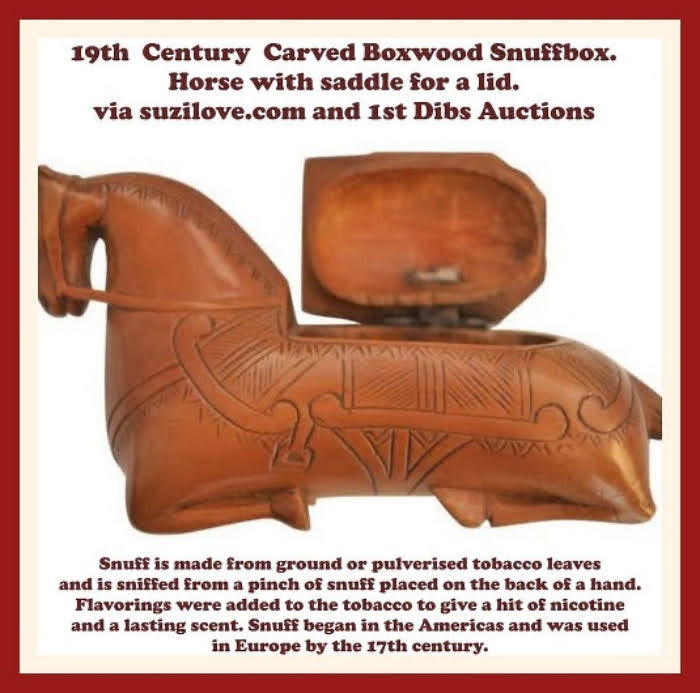
19th Century Snuff Boxes. Not only were boxes made to serve a purpose, but decorative boxes of all types were prized, especially in the 18th-19th Centuries when everything decorative and extravagant was in vogue and taking a pinch of snuff was fashionable. Snuff is made from ground or pulverized tobacco leaves and is sniffed from a pinch of snuff placed on the back of the hand.Flavorings were added to the tobacco to give a fast hit of nicotine and a lasting scent. Snuff began in the Americas and was used in Europe by the 17th Century.
Snuff became popular from the mid 1600s to the mid 1800s and was more popular than smoking. Inhaling snuff, or snuffing, was first seen by a European missionary in 1493 in Christopher Columbus’s new world within Haiti’s indigenous Taino. Until then, tobacco had been unknown to Europeans, but its use spread quickly throughout Europe during the 1500s. By the second half of the 17th century, ornate boxes started being produced to keep the precious powder dry and an entire industry making accessories blossomed around the fashion of taking snuff. Noblemen, and some women, carried extravagantly decorated snuff boxes with them at all times and would offer a pinch of their own particular blend to friends and family. Therefore, these boxes were always on display and so it became a competition to see who could have the most bejeweled or expensive box possible. By the mid 1800s, snuff taking was no longer popular so these exquisite and expensive snuff boxes became decorative, rather than functional.
19th Century Shoe Snuffbox. via 1st Dibs Auctions 1stdibs.com19th Century Engraved Horn Snuffbox. Heart surrounded by flowers and leaves, sides with dove, symbol of purity and peace, brass hinge and setting. via 1st Dibs Auctions19th Century Carved Boxwood Snuffbox. Horse with saddle for a lid. via 1st Dibs Auctions
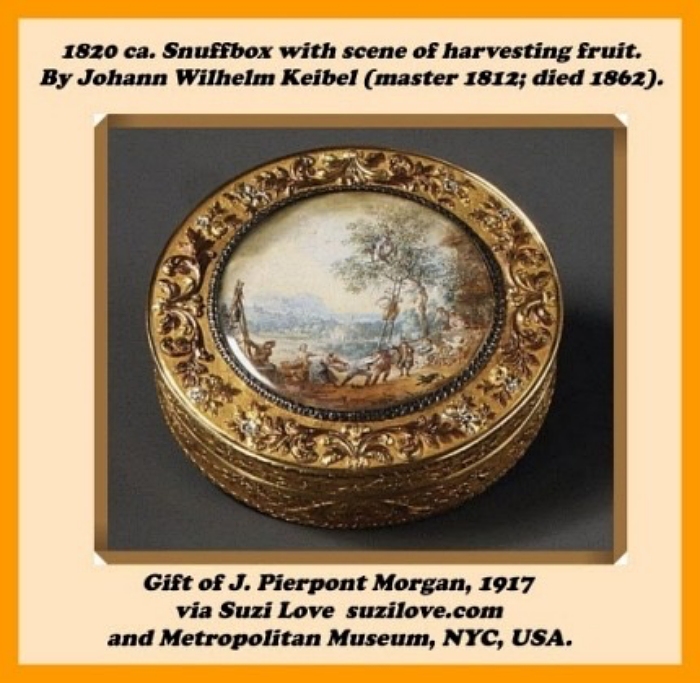
1804-1809 ca. Snuffbox in the Shape of A Lion, Moulinie, Bautte and Cie, Geneva, Switzerland.via Victoria and Albert Museum.1820 Snuffbox with scene of harvesting fruit. By Johann Wilhelm Keibel (master 1812; died 1862). via Metropolitan Museum New York City, U.S.A. metmuseum.org1810 ca. Jeweled Gold Snuff Box, Switzerland. Maker’s Mark Geneva. via Christie’s Auction Rooms. christies.com
“I hate to hear you talk about all women as if they were fine ladies instead of rational creatures. None of us want to be in calm waters all our lives.” Jane Austen Persuasion (1817) #JaneAusten #Quote
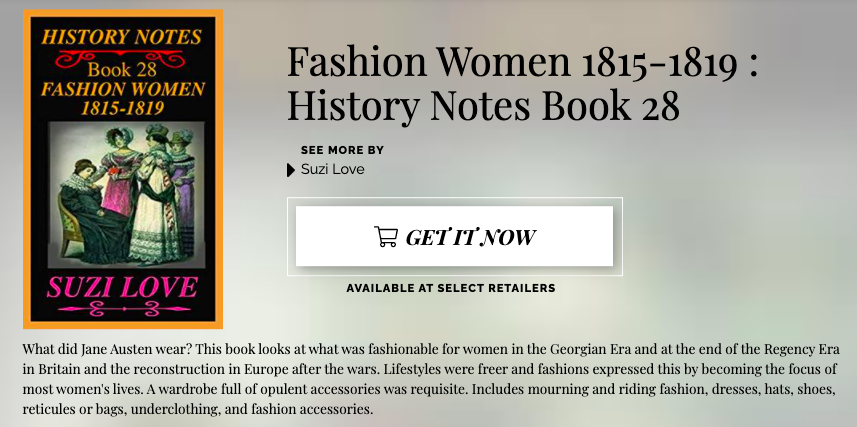
Fashion Women 1815-1819 History Notes Book 28 https://books2read.com/SuziLoveFashionWomen1815-1819
1800 ca. Sleeveless Chemise or Nightgown of white cotton and lace. Length just below knee. Gathered back and front onto yoke of lace and gathered fabric inserts. Gathers around neck by tape in casing. ‘Blanche’ embroidered centre front. Waist up to 50 in or more. via National Trust Collections, UK. nationaltrustcollections.org.uk
Definition Chemise Or Shift: Sleeveless, mid-calf length garment of white cotton or muslin was worn next to the skin under stays or corset. Called ‘Shift’ from early Georgian (1700-1750) until Late Georgian (1750-1790) to replace ‘Smock’. By 1800, name replaced by ‘Chemise’. Sometimes doubled as a nightshift, or nightrail. From around 1700, women wore a long garment, like a man’s shirt, next to their skin, day and night. ‘Costume In England’ describes this as originally a shirt or smock and adopted by women as an undergarment.
This undergarment fell from their shoulders to calves, and was called a chemise, shift, or vest. During the day, it was worn under stays, or a corset, and at night it could be worn as a nightshirt. Wealthier women could afford specific bedroom attire, but lower and working class women wouldn’t have had this luxury and so wore a chemise as both an undergarment and as sleepwear. The rich and the upper classes wore embroidered and otherwise decorated versions of this simple linen or cotton shift. Other classes of women wore a very simple version with little or no decoration as they had no time for decorative embroidery and no money to buy silk threads.
1807-1817 ca. Man’s Leather Breeches, American. These are the sort of pants that the men Jane Austen knew would have worn for riding or in the country. Drop front buttoned flap at the waist, a drawstring at the back waist to adjust waist size, and drawstrings and buttons at the calves to keep the breeches secure when worn with high boots. via Metropolitan Museum New York City, U.S.A. metmuseum.org
19th Century Cross Letter or Cross Writing or Cross Hatching. The writer reached the bottom of the page, turned the paper sideways and adds a second layer of text. During the 19th century, paper was expensive and postal delivery was charged per page, or by the size of the paper. Cross-writing was a way to save paper and postage in Jane Austen and Bridgerton times, and many of Jane Austen’s letters were written this way. Once it becomes familiar, the mind adapts easily and cross-writing letters are surprisingly legible. Charles Darwin also favored this technique.
Rates of Postage of single Letters in Pence.
From any post-office in England or Wales, to any place not exceeding 15 miles from such office – – – 3
For any distance above 15, and not exceeding 30 miles — — 4
For any distance above 30, and not exceeding 50 miles — 5
For any distance above 50, and not exceeding 80 miles – 6
For any distance above 80, and not exceeding 12O miles — 7
For any distance above 120, and not exceeding 170 miles – 8
For any distance above 170, and not exceeding 230 miles — 9
For my distance above 230, and not exceeding 300 miles — — 10
For any distance above 300, and not exceeding 400 miles – 11
For any distance above 400, and nut exceeding 500 mites — 12
1802 Picture of London Printed for R. Phillips via Google Books (PD-180)
And so in proportion; the postage increasing progressively one penny for a single letter for every like excess ok distance of 100 miles. 1802 Picture of London Printed for R. Phillips via Google Books (PD-180)
The Twopenny Post- Office.
There are two principal offices, one in the General Post—office yard, Lombard—street and the other in Gerrard-street, Soho. There are also numerous receiving houses in both the town and country.
There are SI X collections and deliveries of letters in town daily, (Sundays excepted) and there are two dispatches from, and three deliveries at, most places in the country, within the limits of this office.
1802 Picture of London Printed for R. Phillips via Google Books (PD-180)
1810 Stockdale’s Peerage King George William Frederick III. From Stockdale’s Peerage of England, Scotland and Wales. Containing an Account of All the Peers of the United Kingdom . via Google Books Printed for John Stockdale, Piccadilly, London, U.K.
1804 King George III. via Kearsley’s Complete Peerage. Google Books (PD-180)
Our present Most Gracious Sovereign, was born May 24, 1738 and baptized June, 1738, at Norfolk House. Succeeded his father in the titles of Prince of Great Britain, Electoral Prince of Brunswick-Lunenburg, Duke of Edinburgh, Marquis of the Isle of Ely, Earl of Carrick and Eltham, Viscount Launceston, Baron of Renfrew and Snowdon, Lord of the Isles, and Steward of Scotland ; but the Duchy ot Cornwall was merged in the crown. He was, by letters patent, April zr, 1751, created Prince of Wales ; and on the death of his royal grandfather, George II. the crown of Great Britain devolved on his Royal Highness, Oct. z$, 1760, and he was proclaimed the next day with the usual solemnities. His Majesty married, Sept. 8, 1 76 1 , Sophia-Charlotte, Princess of Mecklenburg-Strelit, sister to the present and late Duke, and their Majesties were crowned the 22d of the same month.
By his royal Consort, who was born May 19, 174.4, his Majesty has issue :
1. GEORGE- AUGUSTUS- FREDERICK, Prince of Wales. See Prince of Wales.
2. Frederick, Bishop of Osnaburg, Duke of York ; see Duke of York.
3. William-Henry, Duke of Clarence; see Duke of Clarence,
4. Charlotte-Augusta- Matilda, born Sept. 29, 1766, Lady of the Russian Imperial Order of St. Catherine ; married, May 18, 1797, Frederick-Charles-William, King of Wirtemburg, brother to the Empress of Russia, and relict of the eldest daughter of the Duke of Brunswick, by Augusta, his Majesty King George the third’s eldest sister.
5. Edward, Duke of Kent and Strathern; see Duke of Kent.
6. Sophia-Augusta, born Nov. 8, 1768.
7. Elizabeth, born May 22, 1770.
8. Ernest-Augustus, Duke of Cumberland ; see Duke of Cumberland.
9. Augustus-Frederick, Duke of Sussex ; see Duke of Sussex.
10. Adolphus-Frederick, Duke of Cambridge; sec Duke of Cambridge.
11. Mary, born April 25, 177*.
I2. Sophia, born Nov. 3, 1777. 1
13. Octavius, born Feb. 23, 1779, and died May 3, 1783.
14 Alfred, born Sept 22, 1780, and died Aug. zo, 1782. .
15. Amelia, born Aug. 7, 1783.
PRINCE OF WALES.
GEORGE- AUGUSTUS -FREDERICK, Prince of Great Britain, Prince of Wales, Electoral Prince of Brunswick- Lunenburg, Duke of Cornwall and Rothesay, Earl of Chester and Carrick, Baron of Renfrew, Lord of the Isles, Hereditary Great Steward of Scotland, a Colonel in the Army, and Colonel ef the 10th Regiment of Light Dragoons, Captain-General of the Royal Artillery Company, High Steward o! Plymouth, Knight of the Garter, and F. R. S. Born Aug. 12,1762; and, on the 17th of the same month, his Majesty ordered letters patent for creating him Prince of Wales and Earl of Chester ; and Nov. 1783, his Royal Highness took his seat in the House of Peers ; in 1765, elected a Knight Companion of the Most Noble Order of the Garter, and installed at Windsor, July 25, 1771. Married, April 8, 1795, Caroline-Amelia- Elizabeth, second daughter of the late Duke of Brunswick (born May 17, 1768), by whom he has a daughter, Charlotte-Caroline-Augusta- born Jan 7, 1796. Edward, the Black Prince, was the first Duke of Cornwall, created 1337, in perpetuity to his heirs; by virtue of which the eldest son of the King of England is Duke of Cornwall. The Earldom of Chester is by creation by letters patent 3 1 Henry III. 1247, and has been invariably annexed to the eldest son of the King of England. The titles of Hereditary Steward of Scotland, Duke of Rothesay, Earl of Carrick, and Baron of Renfrew, were titles annexed by B’ belt III. King of Scotland, 1399, to the eldest to the eldest Prince of Scotland, on his birth, and have continued from that period. The title of Prince of Wales was first conferred on the infant son of Edward I 1284, and has never been bestowed but on the heir to the Throne.
DUKE OF YORK. PRINCE FREDERICK, Duka of YORK and ALBANY in Great Britain, and Earl of Ulster in Ireland, Bishop of Osnaburg, Knight of the Garter and Bath, D. C L. F. R. S. and a Field-Marshal, Colonel of trie First Regiment of Foot Guards, Colonel in Chief of the sixtieth (or. Royal American) Regiment of Foot, and of the Royal Dublin Regiment of in.fantiry, Lord Warden of Windsor Forest and Great Park, and Warden and Keeper of the New Forest, Hampshire ; second son of his Majesty. Born Aug. 16, 1763. Created as above Nov. 27, 1784. Married, Sept. 29, 1791, Frederica Charlotte- Ulrica-Catharina, Princess Royal of Prussia (born May 7, 1767), eldest daughter to the late King of Prussia, by his first consort, Elizabeth-Ulrica-Christiana, Princess of Brunswick- Wolfen- buttel, sister to the late Duke.
DUKE OF CLARENCE: PRINCE-WILLIAM-HENRY, Duke of CLARENCE and x ST. ANDREWS in Great Britain, and Earl of Munster in Ireland, Knight of the Garter and Thistle, Admiral of the Red, and Ranger of Bushy Park ; third son of his Majesty. Born Aug. 21, 1765. Created as above, May 16, 1785.
DUKE OF KENT: PRINCE EDWARD, Duke of KENT and STRATHERN Great Britain, Earl of Dublin in Ireland, fourth son of his Majesty, Knight of the Garter and of St. Patrick, Field-Marshal of the Forces, Governor of Gibraltar, Colonel of the First Regiment of Foot, Keeper and Paler 0/ Hampton Court Park. Born Nov. 2, 1767. Created as above, April 23, 1790. Arms.
DUKE OF CUMBERLAND. PRINCE ERNEST-AUGUSTUS, Duke of CUMBERLAND and TlVIOTDALE in Great Britain, Earl of Armagh in Ireland, fifth son of his Majesty, a Knight of the Garter, and D. C. L. Chancellor of the University of Dublin, a General in the Army, and Colonel of the 15th Regiment of Dragoons. Born June 5, 1771. Created as above, April 43, 1799. Arms.
DUKE OF SUSSEX: PRINCE AUGUSTUS-FREDERICK, Duke of SUSSEX, Earl of Inverness in North Britain, Baron Arklow in Ireland, Knight of the Garter. Born Jan. 27, 1773, sixth son of his Majesty. Created as above, Nov. 7, 1801. His Royal Highness married, April 3, 1793, Augusta Murray, second daughter of John Earl of Dunmore, by whom he had Augustus-Frederick, born Jan. 13, 1794; and was re-married Dec 5, 1793, at St. George’s church, Hanover Square, London. This marriage was declared null and void, being in violation of stat. 12 Geo. III. c. 11. which enacts that no descendant of the body of King George II. (other than the issue of princesses married into foreign countries) is capable of contracting. matrimony without the previous consent of the King, signified under the great seal ; and any marriage contracted without such consent is void. And the marriage was accordingly dissolved in August 1794. Arms. — See plate 3.
DUKE OF CAMBRIDGE. PRINCE ADOLPHUS- FREDERICK, Duke of CAMBRIDGE, Earl of Tipperary in Ireland, and Baron of Culloden in North Britain, seventh son of his Majesty. Born Feb. 24, 1 774. Knight of the Garter, a General in the Army, Colonel of the id or Coldstream Regiment of Foot Guards. Created as above, Nov. 27, 1801.
DUKE OF GLOUCESTER: PRINCE WILLIAM-FREDERICK, DUKE of GLOUCESTER and EDINBURGH in Great Britain, Earl of Connaught in Ireland, Knight of the Garter, a General in the Army, Colonel of the third- Regiment of Foot Guards, and Ranger of Bagshot Park and Walk. Born at Rome, Jan.-J5, 1776. Succeeded his father, Prince William-Henry, the, late Duke, Aug. 25,. 1805. His Royal Highness’s father, Prince William-Henry, Duke of Gloucester, was third son of his Royal Highness Frederick- Lewis, Prince of Wales, and brother to his Majesty ; born, Nov. 25, 1743, and by patent Nov. 14, 1764, created Duke of Gloucester and Edinburgh in Great Britain, Earl 0/ Connaught In Ireland, Knight of the Garter, Senior Field-Marshal of his Majesty’s Forces, Colonel of the first Regiment of Foot Guards, Chancellor of the University of Dublin, Ranger and Keeper of Cranbourne Chase, Ranger of Hampton Court Park, Lord Warden and Keeper of the New Forest, Hampshire. His Royal Highness married, Sept. 6, 1766, Maria, Countess Dowager of Waldegrave, widow of James, second Earl of Waldegrave, and daughter of Sir Edward Walpole, Knight of the Bath, and by her (who died Aug. 23, 1807) had issue: (• Sophia-Matilda, born May 29, 1773-; 2. Caroline- Augusta- Maria, born June 24, 1774, died March 14, 1775; 3.Wil liam-Frederick, the present Duke. His Royal Highness died Aug. 25, 1805, and was succeeded by his only son, Prince William-Frederick, the present and second Duke. Anms.
The King’s sons, brothers, uncles, and nephews are Styled Princes of the Blood Royal, and have precedency of all other Dukes, with the title of Royal Highness.
Do you need more factual and visual information for your historical fiction? Try History Notes Books 1-28. Non-fiction Series: Fashion, corsets, Regency Era, music and social manners in the 18th and 19th centuries e.g.
1800-1805 ca. White cotton petticoat of the sort worn by Jane Austen in the early 1800s. Worn under a sleeved, trained dress and over a loose knee length chemise and corset which covered the exposed bust area. The skirt of the petticoat has an apron front open down the side seams. Drawers were not commonly worn at the time. via The John Bright Collection. thejohnbrightcollection.co.uk
Petticoats were made to fit under the low cut bodices of the early 1800s fashions, and to not be seen under a wide and square bodice. This meant thin ribbons were sometimes attached at the shoulders so the petticoat would be virtually without a bodice.
1819 White Percale Dress, French. Deep hem of bubbly muslin, matching Percale Spencer or jacket, pink parasol and flowered straw hat. Spencer has short puffed sleeves over long straight sleeves and military style trimmings. Fashion Plate via Journal des Dames et des Modes, or Costume Parisien. Even though this a French fashion plate, this is typical of the outdoor outfit worn by Jane Austen and her contemporaries when going outside. An Empire style, or high-waisted white cotton dress worn under a Spencer, or jacket, for warmth and with a parasol to protect fair complexions from the sun.
Description Spencer: Short jackets worn for warmth over the high-waisted Empire style gowns that were popular after the French Revolution, where there was a shift away from opulence and decadence to simpler fashion. This jacket with very short bodice and long sleeves was known as a Spencer and was named after the male coat made famous by the Earl Spencer and said to have originated in accident to Lord Spencer in hunting when coat tails torn off and a cropped jacket was invented. The dresses in the early 1800s therefore became looser, lighter, and flowing and women became cold due to their very low cut and short bodices. Short fitted jackets that went easily over the dresses and provided extra modesty and some warmth. As Europe and many other parts of the world were deep in wars in the late 1700s and early 1800s, men in uniform were found everywhere. In support of these military men, fashions leaned towards military style shoulder paddings, shoulder embellishments, loops, buttons, and braids.
Definition Percale or Perkale: From the Persian word pargalah. Fine cotton fabric, or cambric muslin of good quality, originally from India, generally bleached, printed and finished without gloss. Contains more dressing than ordinary muslin, but without the glossy finish of cambric and is printed in fancy patterns on white and colored grounds. In May 1816, Percale was commented on in Rudolph Ackermann’ Repository Of Arts, “Perkale, as they call cambric muslin, is now almost the only thing worn in the morning costume: you must not, however, fancy that this proceeds from a wish to encourage English manufacture, but partly from a love for novelty, and partly because it is less expensive than cambric, and equally fashionable.”
1810-1820 ca. Double Breasted Red Hunting Coat, English.
1810-1820 ca. Red Hunting Coat, English. Hunting was both a popular sport and an essential part of social success. Double-breasted tailcoat of woolen superfine, lined with sateen and cotton, M-notch lapels, nine gold buttons with heraldic crest, cuffs with three smaller matching buttons. via Collection from Castle Howard, Yorkshire, U.K. Victoria and Albert Museum, London, UK. Hunting coats, or colors, often red coats called pinks, were worn by hunt masters and hunters. In Bridgerton and Jane Austen times, or the early 1800s, gentlemen wore red coats like this while riding to the hounds.
Historically, hunt members wore ‘colors’ to distinguish between types of hunters and their level of experience. Traditional red coats were worn by huntsmen, masters, former masters, whippers-in, regardless of sex, while other hunt staff members and male members invited by masters wore colors and hunt buttons as a mark of appreciation for their involvement in the organization and running of the hunt. After the Hunting Act in England and Wales, only Masters and Hunt Servants wore red coats or hunt livery. Gentleman subscribers usually wore black coats, with or without hunt buttons and in some countries, women wore colored collars on their black or navy coats to help them stand out from the rest of the field. Some hunts, including most harrier and beagle packs, wear green rather than red jackets, and some hunts wear other colors such as mustard.