I'm an Australian author of contemporary and historical romances, plus history non-fiction.
My books range from sexy to erotic, late 1700s to the mid 1800s, and with a dash of Australia thrown into the mix. My heroes and heroines challenge tradition and my stories often expose the seamier levels of life.
I now live in a sunny part of Australia after spending many years in developing countries in the South Pacific. My greatest loves are traveling, anywhere and everywhere, meeting crazy characters, and visiting the Australian outback.
I hope my books bring history alive and you have fun adventuring with my roguish heroes and feisty heroines.
1816 Ball Dress, French, as worn by the Bridgertons and Jane Austen. White short length dancing dress, multiple frills above hem, black bodice with a back bow, hair braided and pinned into an upswept evening style. Fashion Plate via Journal des Dames et des Modes, or Costume Parisien.
Women’s clothing came in the late 1810s came in a wide range of styles to suit every season and occasion. When attending assemblies or balls, ladies in Jane Austen’s times women wore Empire style dresses which were usually of light fabric and floaty in style and often of a shorter length suitable for dancing.
Fashion Women 1815-1819 History Notes Book 28 What did Jane Austen wear? https://books2read.com/SuziLoveFashionWomen1815-1819
1802-1812 ca. Bored Women at Longchamp Races Series, French. Three young women sit amidst mass of empty chairs and converse with the woman who is clearing them away. Le Bon Genre, Plate 18.
1802-1812 ca. Bored Women at Longchamp Races Series, France, in Jane Austen’s Era. #JaneAusten #Cartoon #France https://books2read.com/suziloveYLD
1819 Pale Blue Redingote, Pelisse or Walking Dress, French. Blue redingote with pink bow showing off gorgeous neck frills and bonnet of castor decorated with tassels. The type of outfit young Regency Era ladies would have worn if they were out shopping on Bond Street, walking in a park, or taking a carriage ride through Hyde Park. Fashion Plate via Journal des Dames et des Modes, or Costume Parisien.
Definition Redingote Or Pelisse Or Walking Dress Or Coat: French word developed from English words, riding coat. Long fitted outdoor coat worn over other garments for warmth. Often left open at the front to show off the dress underneath. Sometimes cut away in front. Originally made with several capes and trimmed with large buttons. French fashion plates call these coats Redingotes and they are designed for women, men and children. English fashion plates call them a Pelisse, a walking dress, Promenade dress, or Carriage dress.
Pleasure House Ball: Brenton, Lord Mallory, attends his first courtesan’s ball in ten years to appease his concerned friends, though he’d rather stay home and read to his motherless daughter. Though mortified that Brenton unmasks her at a scandalous ball, Lady Lillian Armstrong doesn’t regret their night together. Book 3 Irresistible Aristocrats books2read.com/suzilovePHB
Excerpt
‘Lillian,’ Brent hissed through gritted teeth. ‘Have you been paying attention to me? I know most of the gentlemen attending this ball and there isn’t one of them that’s good enough for you.’
‘Not even you?’ At his shocked look, she waved her hand between them. ‘Sorry. I know you’re not interested in me. Not in that way, anyway.’
She watched his Adam’s apple bob as he swallowed, hard. Was she mistaken? Did he find her attractive, after all? Because, Lord knew, she found him, and his muscled body, very enticing. Many a time she’d ridden behind him purposely so she could watch his taut behind rise and fall in the saddle, his thighs stretched tight as he rose slightly in the stirrups and his coat pulling across wide shoulders. She’d secretly been pleased that he wouldn’t allow visitors to his house, declaring that he and his daughter were still grieving. Though she knew that was a fabrication to prevent his mother from bringing a constant stream of eligible ladies to visit, she enjoyed being the only woman who saw him dressed down and carefree as they rode together. Which they did often.
With her head tilted to one side so she could peer up at him, she said, ‘Are you? Interested in me that way? As a woman.’
She heard the hiss of his indrawn breath and sensed she was about to be rejected. Being rejected by her husband had wounded her feminine pride, though even that pain hadn’t destroyed her. By contrast, if her best friend, the man that knew her better than her mother, turned away from her, the pain would kill her. She spun towards the door, desperate to escape.
‘Ah, there you are.’ Her companion, Maggie, stepped through the balcony doorway and strode towards her. She eyed Brenton, slowly appraising him from top to toe, before turning her back to him. ‘I was worried when I couldn’t find you. Are you all right?’
Brenton stepped around Maggie and gave her the same disdainful look as she’d given him. He gave a small bow and said, ‘I’m Brenton. And your name is…?’
Maggie rolled her eyes. ‘I know better than to reveal myself here. And I already know who you are, my lord.’
Lillian squirmed when Brent’s gaze flicked towards her and back to Maggie. ‘I’ve told my friend about you, Brent.’
‘I see.’ He turned to Maggie and leaned in close. ‘And what sort of friend are you that you brought a young woman to an event that caters to less than respectable ladies?’
‘The best sort, my lord.’ Maggie didn’t flinch form Brent’s blunt question. ‘The sort of friend who recognizes that a woman has been scarred by men and life and needs a chance to enjoy herself without censure. Needs a night of fun and frolic, rather than one of fear and loneliness.’
‘Loneliness?’ Brent repeated the word in surprise and looked at Lillian. ‘Is she correct? You’ve been lonely.’
‘In my marriage, yes, I was lonely. Geoffrey didn’t like me to see my own friends or family too much. He wanted me at home, where he could keep me under control, or attending events on his arm. A decorative addition to enhance his reputation as a man who purchased only the best quality goods. Immaculate clothing, flashy carriage, well-bred horses, and a household where he ruled supreme. There was little room for me to breathe.’
He touched her arm. ‘I’m sorry to have failed you so badly. I was so swept up in my own misery and battling to keep my wife’s affairs under wraps that I gave no thought to how your life was when in London.’
Book Hooks: Brent looked at Lillian. ‘Is she correct? You’ve been lonely.’#RegencyRomance #HistRom #ReadARegency #EroticRomance books2read.com/suzilovePHB
1807 White High-Waisted Dress, French. Black zig-zag edging and decoration, lemon draping shawl, long gloves, orange Fichu, yellow slippers, pink bonnet. Fashion Plate via Journal des Dames et des Modes, or Costume Parisien.
Definition Empire Style Dress: High-waisted white gown defined women’s fashion during the Regency Era. ‘Empire’ is the name given to the period when Napoleon Bonaparte built his French Empire. High-waisted, loose gowns were adopted by the aristocracy as a symbol of turning away from the fussy, elaborate and expensive clothing worn in the 1700s.
1807 White High-Waisted Dress in Jane Austen Style With Black Zig-Zag Edging. #RegencyFashion #JaneAusten #HistoricalFashionhttps://books2read.com/SuziLoveFashionWomen1805-1809
1775-1777 ca. Snuffbox With Medallion, Russian. Made by Johann Baltasar Gass St Petersburg, Russia. Gold, silver, cut diamonds; chased, engraved and pounced. via liveinternet.ru
18th Century Snuff Boxes. Not only were boxes made to serve a purpose, but decorative boxes of all types were prized, especially in the 18th Century when everything decorative and extravagant was in vogue and taking a pinch of snuff was fashionable. Snuff is made from ground or pulverized tobacco leaves and is sniffed from a pinch of snuff placed on the back of the hand. Flavorings were added to the tobacco to give a fast hit of nicotine and a lasting scent. Snuff began in the Americas and was used in Europe by the 17th Century.
1775-1777 ca. Snuffbox With Medallion, Russian. Made by Johann Baltasar Gass St Petersburg, Russia. Gold, silver, cut diamonds; chased, engraved and pounced. via liveinternet.ru
Snuff became popular from the mid 1600s to the mid 1800s and was more popular than smoking. Inhaling snuff, or snuffing, was first seen by a European missionary in 1493 in Christopher Columbus’s new world within Haiti’s indigenous Taino. Until then, tobacco had been unknown to Europeans, but its use spread quickly throughout Europe during the 1500s. By the second half of the 17th century, ornate boxes started being produced to keep the precious powder dry and an entire industry making accessories blossomed around the fashion of taking snuff. Noblemen, and some women, carried extravagantly decorated snuff boxes with them at all times and would offer a pinch of their own particular blend to friends and family. Therefore, these boxes were always on display and so it became a competition to see who could have the most bejeweled or expensive box possible.
1812 May Pink Walking Dress, English. Coat is called a ‘Spencer Robe’ in the description and the fabric is sarcenet in blossom color. High collar, bobble decoration on the hem, pink sleeveless pelisse dress trimmed with a tufted Chinese silk fringe. The deep vandyke black lace is a loose Polonaise style that sits over the collar of the white muslin dress. The provincial muslin bonnet has two curled white ostrich feathers on the front. Half-boots are of pink kid, gloves are lemon or pale tan kid, and pink reticule, or ridicule or bag, has a drawstring. Fashion Plate via Rudolph Ackermann’s ‘The Repository of Arts’.
Definition Pelisse, Redingote, Or Walking Dress: Jane Austen and her contemporaries wore long coats like these to keep warm when out and about, visiting, shopping etc. The thin muslin dresses worn in the early 1800s were little protection against European winters.
Definition Reticule Or Ridicule Or Bag Or Purse: Because reticules were so popular, Jane Austen and her family and friends would have made reticules for each other for gifts and carried these small purses with them whenever they went out.
Definition Aigret, Aigrette, Egret: Plume of feathers or jeweled ornament in shape of feathers worn on head or hats. During the early 19th century., or Jane Austen’s lifetime, the favorite feathers were osprey and heron.
1812 May Pink Walking Dress With Coat in Jane Austen Style. #JaneAusten #RegencyFashion #HistoricalFashion https://books2read.com/SuziLoveFashion1810-1814
1804 Lemon Redingote, or Coat, French. High collar, wide shawl collar or shoulder cape, high-waisted dress buttoned at side waist, long straight sleeves, fitted blue velvet hat, neck scarf and gloves. Fashion Plate via Journal des Dames et des Modes, or Costume Parisien.
Definition Redingote Or Pelisse Or Walking Dress Or Coat: French word developed from English words, riding coat. Long fitted outdoor coat worn over other garments for warmth. Originally made with several capes and trimmed with large buttons. For women, the coat was often cut away in the front or left open to show off the dress underneath. French fashion plates call these coats Redingotes and they were worn by men, women, and children. English fashion plates call the coats a Pelisse, a walking dress, Promenade dress, or Carriage dress.
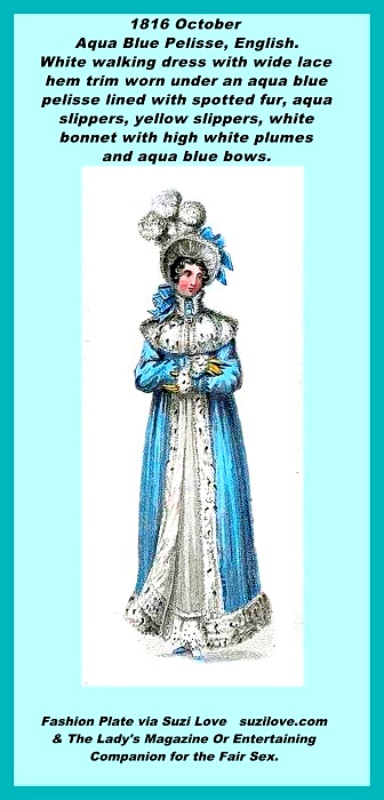
Definition Shawl Collar: Wide turned down collar used on both women’s and men’s coats.
1804 Lemon Redingote, Or Coat, Or Pelisse, With Shoulder Cape, French. #RegencyFashion #JaneAusten #HistoricalFashion https://books2read.com/SuziLoveFashionWomen1801-1804
Flintlock is a firearm that uses a flint-striking ignition and first appeared in Western Europe in the 16th Century and was commonly used during the 17th, 18th, and early 19th centuries until replaced by the percussion cap and then the cartridge-based systems in early to mid 1800s.
Flintlocks are a muzzle-loading firearm that use a mechanism which includes a flint, a hammer, a frizzen, and a pan filled with gunpowder. When the trigger is pulled, the hammer strikes the flint which strikes a steel plate, creating a spark that ignites the gunpowder in the flash pan. This ignition travels through a small hole to the main charge in the barrel, propelling the bullet forward. They fire a single shot and are for short range use. Even under the best of conditions, flintlock weapons misfire about one out of seven times.
This changed with the development of the British dueling pistol as they were highly reliable, accurate, and water resistant. Dueling pistols had little external decoration but excellent internal craftsmanship. They were the size of the horse pistols of the late 1700s, around 16 inches or 41 cm long, and were usually sold in pairs, along with accessories in a wooden case with compartments for each piece. Flintlock pistols were commonly used by soldiers, sailors, and civilians for self-defense or as a sidearm.
1800s Flintlock Pistol from Jane Austen and Bridgerton years. #janeausten #bridgerton #britishhistory #gun #history https://books2read.com/suziloveYGD
Policing in the 17th and 18th centuries – one unarmed able-bodied citizen in each parish a man was appointed or elected annually to serve for a year unpaid as parish constable.
Worked in co-operation with the local Justices in observing laws and maintaining order.
In towns, responsibility for the maintenance of order was conferred on the guilds
Later conferred on other specified groups of citizens
These supplied bodies of paid men, known as The Watch
The Watch guarded the gates and patrolled the streets at night
Huge social and economic changes and increases in town populations meant parish constables and Watch systems couldn’t cope.
In 1812, 1818 and 1822, Parliamentary committees investigated crime and policing.
Impotence of the law-enforcement machinery was a serious menace
Conditions became intolerable and led to the formation of the New Police
The Metropolitan Police
Established by an Act of Parliament in 1829 by Sir Robert Peel
Peel appointed 2 Commissioners
Appointed 895 Constables, 88 Sergeants, 20 Inspectors and 8 Superintendents.
Superseded the local Watch in the London area but the City of London was not covered.
Numbers increased
Grew to include the Greater London area (excluding the City of London)
Included parts of the Home Counties and all Royal Naval Dock Yards throughout the country.
First officer was given the warrant number ‘1’
Today the service is reaching near to a quarter million
The warrant number is unique to the officer
Different from the shoulder number which changes as the officer moves stations. Scotland Yard
Colonel Charles Rowan and Richard Mayne organized and designed the New Police
The two Commissioners occupied a private house at 4, Whitehall Place
The back opened on to a courtyard and used as a police station
This address led to the headquarters of the Metropolitan Police being known as Scotland Yard.
Sir Robert Peel, 2nd Baronet, (5 February 1788 – 2 July 1850) British Conservative statesman who served twice as Prime Minister of the United Kingdom, Chancellor of the Exchequer, and Home Secretary. Regarded as the father of modern British policing as he founded the Metropolitan Police Service.
Other Police organizations
Some older police establishments remained outside control of the Metropolitan Police Office
The Bow Street Patrols, mounted and foot, commonly called the Bow Street runners.
Police Office constables attached to the offices of, and under the control of, the Magistrates.
The Marine or River Police.
By 1839 all these establishments had been absorbed by the Metropolitan Police Force.
The City of London Police was set up in 1839 and is an independent force to this day.
1800s Early The Metropolitan Police In Jane Austen and Bridgerton Years, London. #JaneAusten #Bridgerton #BritishHistory #RegencyEra #police #London books2read.com/suziloveROver