I'm an Australian author of contemporary and historical romances, plus history non-fiction.
My books range from sexy to erotic, late 1700s to the mid 1800s, and with a dash of Australia thrown into the mix. My heroes and heroines challenge tradition and my stories often expose the seamier levels of life.
I now live in a sunny part of Australia after spending many years in developing countries in the South Pacific. My greatest loves are traveling, anywhere and everywhere, meeting crazy characters, and visiting the Australian outback.
I hope my books bring history alive and you have fun adventuring with my roguish heroes and feisty heroines.
Writing and Publishing? Tips and Tricks in Self Publishing: Absolute Beginner’s Guide. Information, contacts, and checklists steer you towards professionally produced books. Helps both fiction and non-fiction authors and available in digital and paperback. Co-Authored by two Australians: multi-published Imogene Nix and best-selling and award winning Suzi Love. books2read.com/selfpublishing
D2D_SP_Contacts, lists, cheat sheets, and checklists to set goals and steer you towards professionally produced books. eBook and paperback #amwriting #nonfiction #selfpublishing books2read.com:selfpublishing
1800 Un salon, or public Room, at Frascati, Paris. This plate depicts a group of people at Frascati’s. The man in the foreground is plainly dressed in dark colors while pastels are favored by the women. From: Illustrations by Francois Courboin from Octave Uzanne’s Les Modes de Paris. (PD-Art) Although this is in Paris, there were similar places in England where Jane Austen and her contemporaries would meet to eat, drink and play games.
Frascati’s was a cafe in Paris, described by the text as “‘A stream of human beauty’, as the expression of the period has it, was still to be seen flowing through the galleries of Greek and Roman antiquities, spreading through the porticos, into the saloons, and smaller chambers, pouring and winding along the garden alleys, and disappearing at last into the kiosks where it was lost to sight. The great mirror at the end of the garden reflected, as in a wonderful prismatic vision, the surging crowd of veiled or turbaned heads of ever-changing couples, each whispering and fondly clasped. While farther off seated at tables in the open air, thirsty nymphs called for creams and tutti frutti and all the various iced compounds then so eagerly consumed.”
1800 Un Salon, or Public Room, at Frascati, Paris. Frascati’s was a popular cafe in Paris where people walked through the galleries of Greek and Roman antiquities, past the porticos, into saloons and smaller chambers, winding along the garden alleys and disappearing into kiosks. The man wears darker clothing while the women are in colorful dresses. via Suzi Love ~ suzilove.com
& Illustrations by François Courboin, French librarian (1865-1926)
From Octave Uzanne’s ‘Les Modes de Paris, or Fashion in Paris,’ the various phases of feminine taste and aesthetics from 1797 to 1897.
(PD-Art) via Brown University Library, U.S.A.
From the finish of the 18th century until 1820, men’s fashions in European and European-influenced countries moved away from the formal wear of brocades, lace, wigs and powder to more informal and relaxed styles. Focus was on undress rather than formal dress. Typical menswear in the early 1800s included a tailcoat, a vest or waistcoat, either breeches, pants, or the newer trousers, stockings, shoes or boots, all worn with an overcoat and hat. This basic ensemble was accessorized with some form of neckcloth or cravat, gloves, walking stick, cane or riding crop, handkerchief, fobs, watch and perhaps a quizzing glass or eye glass.
Skirted coats were replaced with short-fronted, or cutaway, tailcoats worn over fitted waistcoats and plain, white linen shirts. Knee breeches were gradually replaced by tight-fitting pantaloons and later trousers, decorative shoes with buckles were replaced with a variety of boot styles, and fussy and ruffled neckwear gave way to intricately tied, white linen neck cloths. A Regency Era, or early 1800s, gentleman was outfitted in more practical fabrics, such as wool, cotton and buckskin rather than the fussy brocades and silks of the late 1700s.
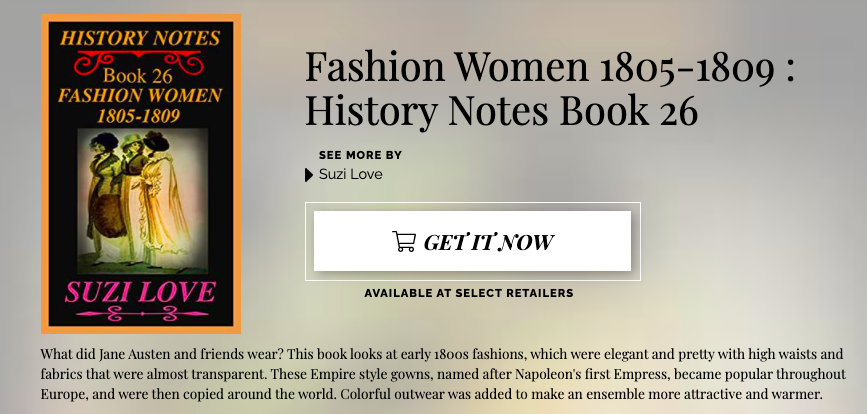
What did Jane Austen and friends wear? Early 1800s fashions were elegant and pretty with high waists and fabrics that were almost transparent. These Empire style gowns, named after Napoleon’s first Empress, became popular throughout Europe, and were then copied around the world. Colorful outwear was added to make an ensemble more attractive and warmer. History Notes Book 26 Fashion Women 1805-1809. https://books2read.com/SuziLoveFashionWomen1805-1809
The Empire waist gown defined women’s fashion during the Regency Era. ‘Empire’ is the name given in France to the period when Napoleon built his French Empire. High-waisted, loose gowns were adopted by the aristocracy as a symbol of turning away from the fussy, elaborate and expensive clothing worn in the 1700s. Jean-Jaques Rousseau advocated copying peasants and returning to a simpler life and more natural fashions. Unrestricting clothing was part of the new Democracy in France and these simpler and flowing fashions were adopted all over Europe, including Britain and despite the continual wars being fought against France during the early 1800s. Not even war stopped fashions from being copied everywhere.
Fashion Women 1805-1809 History Notes Book 26
What did Jane Austen and friends wear? This book looks at early 1800s fashions, which were elegant and pretty with high waists and fabrics that were almost transparent. These Empire style gowns, named after Napoleon’s first Empress, became popular throughout Europe, and were then copied around the world. Colorful outwear was added to make an ensemble more attractive and warmer.
https://books2read.com/SuziLoveFashionWomen1805-1809HN_26_D2D_FsshionWomen1805-1809
16th-19th Centuries Gentlemen’s Banyans. Banyan’s were worn before the Georgian Era and continued to be popular through the Regency and Victorian Eras for Men’s At-Home Fashion. After this, banyans were replaced buy shorter smoking jackets, yet all through these many hundred years banyans served the same purpose of being a comfortable yet respectable item of clothing that could be worn at home by men when they spent time in the evenings with family or friends.
Fabrics imitating animal patterns and colors appeared in European fashionable dress as early as the 18th century, when elaborate trompe l’oeil silk designs emulated exotic furs intertwined with expensive laces. Such fabrics communicated a sense of luxury, wealth and power. Cultural crossdressing was a long-established tradition among merchants working in the East. While it helped them to assimilate into the local community, adopting exotic forms of dress at home also played an important part in fashioning their identity as a worldly traveller. International experience heightened social standing so wearing a banyan showed a high social status. Surviving garments from the 18th and 19th centuries show that it changed little over time, other than to loosely reflect the fashionable line of menswear of the period in the cut of the skirts, choice of collar and fit of the body.
16th-19th Centuries. Collage of Gentlemen’s BanyansDefinition Banyan: Loose coat worn by men as a dressing gown. Often worn with a matching waistcoat over shirt and pants in the comfort of their own home.
HN_23_d2d_fashionmen1800-1819
https://books2read.com/SuziLoveFashionMen1800-1819
1799 Gentleman’s daily outfit of brown cutaway coat and baggy white trousers. #GeorgianEra #FashionPlate #France https://www.books2read.com/suziloveFashMen1700
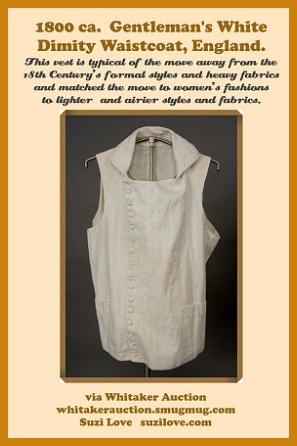
1800 ca. Gentleman’s White Dimity Waistcoat, England. This vest is typical of the move away from the 18th Century’s formal styles and fussy fabrics and matched the shift of women’s fashions towards lighter and airier styles and fabrics. via Whitaker Auction whitakerauction.smugmug.com Typical of a gentleman’s waistcoat, or vest, worn during the early 1800s, or Regency Era, or Jane Austen’s times.
1800 ca. Gentleman’s White Dimity Waistcoat, England. via suzilove.com and Whitaker Auctions.
From the finish of the 18th century until 1820, men’s fashions in European and European-influenced countries moved away from the formal wear of brocades, lace, wigs and powder to more informal and relaxed styles. Focus was on undress rather than formal dress. Typical menswear in the early 1800s included a tailcoat, a vest or waistcoat, either breeches, pants, or the newer trousers, stockings, shoes or boots, all worn with an overcoat and hat. This basic ensemble was accessorized with some form of neckcloth or cravat, gloves, walking stick, cane or riding crop, handkerchief, fobs, watch and perhaps a quizzing glass or eye glass.
Skirted coats were replaced with short-fronted, or cutaway, tailcoats worn over fitted waistcoats and plain, white linen shirts. Knee breeches were gradually replaced by tight-fitting pantaloons and later trousers, decorative shoes with buckles were replaced with a variety of boot styles, and fussy and ruffled neckwear gave way to intricately tied, white linen neck cloths. A Regency Era, or early 1800s, gentleman was outfitted in more practical fabrics, such as wool, cotton and buckskin rather than the fussy brocades and silks of the late 1700s.
1770 Yellow Silk Corset, Italian. Front and Back Lacing. By the 1770s, steel was being used in stays, which increased their strength, though not their flexibility. Credit Line: Gift of The Metropolitan Museum of Art, 1940 Accession Number:C.I.40.173.6a–e Metropolitan Museum, N.Y.C, U.S.A.
By the 1770s, steel was being used in stays, which increased their strength, though not their flexibility. With the tight lacing made possible by stronger stays, doctors and others voiced health concerns, such as this comment from a 1775 correspondence: “I hope Miss Sparrow will not fall into the absurd fashion of ye wasp-waisted ladies. Dr. Pringle declares he has had four of his patients martyrs to that folly (indeed wickedness), and when they were opened it was evident that their deaths were occasioned by straight lacing.” Although admonitions on the dangers of straight lacing are common in the eighteenth and nineteenth centuries, recent scholarship by Valerie Steele has called into question the reality of the many “death by tight lacing” stories of the period.
History Notes Book 15 shows how body wraps, stomachers and stays were worn during the 1700s, or Georgian Era, to create a variety of fashionable silhouettes to suit the elaborate fashions worn for court and daily life. https://books2read.com/SuziLoveCorsetBook15
1770 Yellow Corset, Italian. Front and Back Lacing. By the 1770s, steel was being used in stays, which increased their strength, though not their flexibility. via Metropolitan Museum NYC, U.S.Ametmuseum.org1770 Yellow Corset, Italian. Front and Back Lacing. By the 1770s, steel was being used in stays, which increased their strength, though not their flexibility. via Metropolitan Museum NYC, U.S.Ametmuseum.org
1808 Richard Trevithick’s Steam Circus, Bloomsbury, London, U.K. Site where Trevithick ran his locomotive ‘Catch Me Who Can’. Trevithick wanted to prove that traveling by train was faster than on horseback. Locomotive ran at top speed of 19 km per hour and people paid a shilling to sit in an attached car and be pulled around. Via Wikimedia Commons commons.wikimedia.org (PD-ART) This was the start of the railway expansions across England in Jane Austen’s time.
1808 Richard Trevithick’s Steam Circus, Bloomsbury, London, U.K. Site where Trevithick ran his locomotive ‘Catch Me Who Can’. Trevithick wanted to prove that traveling by train was faster than on horseback. Locomotive ran at top speed of 19 km per hour and people paid a shilling to sit in an attached car and be pulled around. Via Wikimedia Commons commons.wikimedia.org (PD-ART)
D2D_RetailerBuyLink_HN_10.books2read.com/SuziLoveTravel