1821 December Green Promenade Dress, English. High waisted coat over white dress with ruffled collar, vertical front bows, short puffed sleeves over long straight sleeves, matching ruffled bonnet and yellow gloves. Fashion Plate via Rudolph Ackermann’s ‘The Repository of Arts’, London, U.K.
Pleasure House Ball: Brenton, Lord Mallory, attends his first courtesan’s ball in ten years to appease his concerned friends, though he’d rather stay home and read to his motherless daughter. Though mortified that Brenton unmasks her at a scandalous ball, Lady Lillian Armstrong doesn’t regret their night together. Book 3 Irresistible Aristocrats books2read.com/suzilovePHB
Excerpt
‘Brent, why are you eager for me to risk a repeat of my miserable marriage?’ Lady Lillian asked. ‘When you’ve declared that you’ll never marry again.’
‘Because you’re a woman and I’m a man.’
Lillian’s eyes narrowed. ‘That’s a very biased view, and I thought you better than that.’
Brent groaned. ‘You’re right. It’s unfair to tell you to risk more unhappiness when I won’t.’
‘Everyone knows you’re avoiding your family because they push eligible ladies towards you. They want you to remarry and give your daughter a new mother.’
‘They’ve no right to interfere in our lives, mine or my daughter’s. We’re happy as we are, the two of us.’
‘Your wife hurt you, deeply, and so you’ve refused to even speak to the women your mother thinks suitable.’
‘I speak to you.’
‘Only because I visit you and drag you away from your house to go riding. I refuse to let you retreat from the world. You’re a wonderful man with a lot to give to another woman. To another wife.’
‘You’re the only lady that I can tolerate being near for more than ten minutes.’
‘And you’re the only man I’d select for a second husband, and you’re against marriage.’ She looked towards a group of men smoking at the far end of the verandah. ‘Hence my venture into the unknown tonight. The sedate balls are full of married men or old lechers, as all the exciting men are here instead.’ She pointed towards the cluster of five or six young men. ‘Perhaps one of them might be the boost I need to restore my faith in the male gender. A virile young man who knows about pleasurable sex.’
He scowled as he watched the young men laugh and slap each other on the back. ‘Those pups are too inexperienced to give a woman pleasure. At that age, it’s all over too quickly. You need someone who will leave you limp with pleasure.’ He shook his head and seemed to collect himself.
Lillian swallowed. She didn’t doubt that Brent knew many ways to make sex exciting and unforgettable, but there was no point imagining herself with him when she knew how studiously he avoided contact with women these days. Well, except for her and his cook.
‘Not all men are cruel,’ he was saying when she paid attention to his words rather than the way his trousers stretched across his groin when he had his hands on his hips and his coat tails pulled aside. ‘Some husbands value their wives and treat them like queens.’
She sighed. ‘A nice thought, Brent, but unless you can introduce me to one of those paragons of husbands, I’m reduced to finding my excitement with one of the gentlemen here tonight.’
PHB_Lord Mallory, attends first courtesan’s ball in years to appease concerned friends. http://books2read.com/suzilovePHB
Book Hooks: ‘Why are you eager for me to risk a repeat of my miserable marriage?’ Lady Lillian asked. #RegencyRomance #HistRom #ReadARegency #EroticRomance books2read.com/suzilovePHB
1800s Early Typical Regency Gentleman Riding His Horse. Fashions In The Time Of Jane Austen.
From the finish of the 18th century until 1820, men’s fashions in European and European-influenced countries moved away from the formal wear of brocades, lace, wigs and powder to more informal and relaxed styles. Focus was on undress rather than formal dress. Typical menswear in the early 1800s included a tailcoat, a vest or waistcoat, either breeches, pants, or the newer trousers, stockings, shoes or boots, all worn with an overcoat and hat. This basic ensemble was accessorized with some form of neckcloth or cravat, gloves, walking stick, cane or riding crop, handkerchief, fobs, watch and perhaps a quizzing glass or eye glass.
1800s Early A Gentleman Riding His Horse.
In 1806, the Journal des Dames et des Modes stated, ‘The informal outfit for a young man includes a coat of similar style, snug pantaloons which are probably knitted, and a striped waistcoat.’
Skirted coats were replaced with short-fronted, or cutaway, tailcoats worn over fitted waistcoats and plain, white linen shirts. Knee breeches were gradually replaced by tight-fitting pantaloons and later trousers, decorative shoes with buckles were replaced with a variety of boot styles, and fussy and ruffled neckwear gave way to intricately tied, white linen neck cloths. A Regency Era, or early 1800s, gentleman was outfitted in more practical fabrics, such as wool, cotton and buckskin rather than the fussy brocades and silks of the late 1700s.
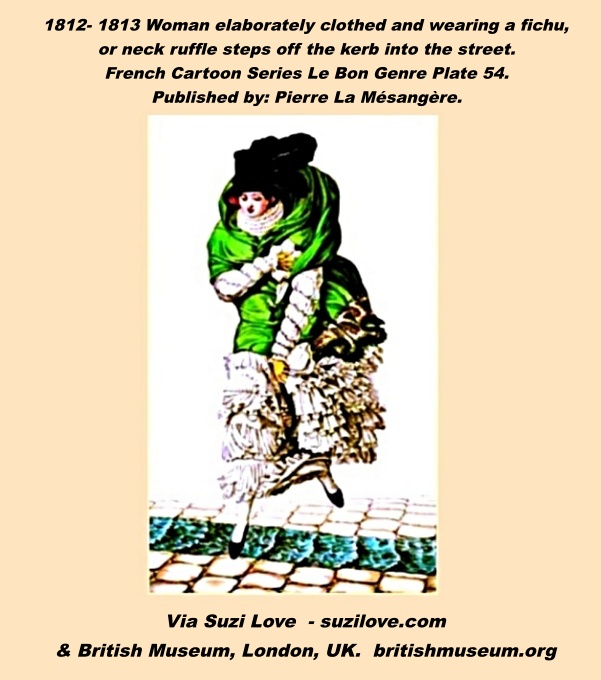
1812 -1813 Woman elaborately clothed and wearing a fichu, or neck ruffle, steps off the kerb into the street. She holds up her dress before stepping over the dirty Parisian gutter. French Cartoon Series Le Bon Genre Plate 54. Published by: Pierre La Mésangère. https://books2read.com/SuziLoveFashion1810-1814
Le Bon Genre, or Good Taste, series pokes fun at the absurdities of the fashion styles adopted by high society.
Plate 54: Manches en Spirale. Profusion de Garnitures. Mouchoir servant de porte-clef.
Manches en Spirale: Spiral Sleeves. Spiraling or puffy sleeves of the late Empire period looked like three-scoop ice cream cones.
Profusion de Garnitures: Profusion of Trimmings.
Ridicules the excessive use of ruffles, bows, and lace on a garment.
Mouchoir servant de porte-Clef: Handkerchief used as a Keyring. Women made a fashion statement by carrying richly decorated handkerchiefs that doubled as makeshift keyrings.
Definition Fichu: Triangular piece of lace, muslin, or other cloth worn about the neck and cleavage to fill in a low bodice or neckline and preserve a lady’s modesty. From the French ‘thrown over’.
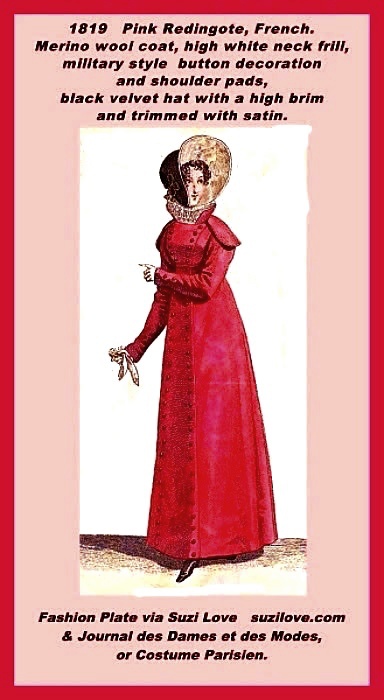
1819 Pink Merino Wool Redingote, French. Merino wool coat over a white dress with a high lace collar, military style buttons decoration and shoulder pads, matched with a black velour, or velvet, hat with a high front brim and lined with white satin. Military style shoulder pads and front buttons. It was fashionable at the time to wear military inspired clothing to show support of all the fighting men involved in the Napoleonic and other wars. The type of outfit young Regency Era ladies would have worn if they were out shopping on Bond Street, walking in a park, or taking a carriage ride through Hyde Park. Fashion Plate via Journal des Dames et des Modes, or Costume Parisien. Fashion Plate via Journal des Dames et des Modes, or Costume Parisien.
Definition Redingote Or Pelisse Or Walking Dress Or Coat: French word developed from English words, riding coat. Long fitted outdoor coat worn over other garments, especially light-weight muslin dresses, for warmth. Often left open at the front to show off the dress underneath. Sometimes cut away in front. Originally made with several capes and trimmed with large buttons. French fashion plates call these coats Redingotes and they are designed for women, men and children. English fashion plates call them a Pelisse, a walking dress, Promenade dress, or Carriage dress.
1819 January Red Redingote, French. Also called a Pelisse or Walking Dress in England. Merino wool coat over a white dress with a high lace collar, matched with a black velour, or velvet, hat lined with white satin. Fashion Plate via suzilove.com and Journal des Dames et des Modes, or Costume Parisien.
1819 Bridgerton or Jane Austen Style Pink Merino Wool Redingote, Or Coat, With Military Styling. #Bridgerton #JaneAusten #RegencyFashion #FashionPlate #French https://books2read.com/SuziLoveFashionWomen1815-1819
Spice up your days with this HOT Regency romance. Tortured duke reunites with a mysterious lady to search for answers. #RegencyRomance #EroticHistoricalRomance #HistoricalMystery #ReadARegency books2read.com/suziloveFTAV
Music history from the 17th, 18th, and 19th Centuries. Pianos, pianofortes, harps, viols, violins played during Jane Austen’s times. Musical Instruments were so important in most of the more affluent households in history that large industries grew all around the world to manufacture instruments, musical accessories, and to print sheet music. Musical instruction and encouragement could be found everywhere and both young ladies and gentlemen were encouraged to have musical appreciation. And of course, playing music was on the list of social requirements for all young ladies desirous of becoming a wife and homemaker.
London became Europe’s leading centre for the manufacture of scientific instruments and this led to the manufacture of more musical instruments as well as factories developed and rail transport helped the faster distribution of goods to regional areas. One of the first places that music was used to tell stories and to share enjoyment was in Christmas music. Because music was such an integral part of households, music was always a feature in Magazines. There were advertisements everywhere for musical instruments for sale, for sheet music, and for music lessons. And of course, of most interest to the ladies were the hundreds of fashion plates included in magazines where people were depicted with their musical instruments.
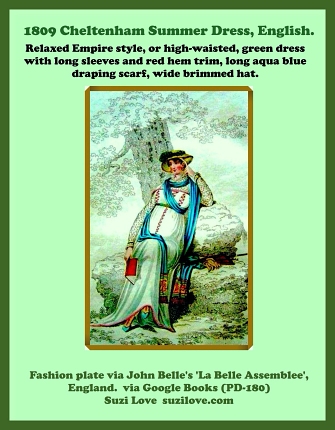
1809 Cheltenham Summer Dress, English. Relaxed Empire style high-waisted green dress with long sleeves and red hem trim, long aqua blue draping scarf, wide brimmed hat and holding a red book. Fashion Plate via John Belle’s ‘La Belle Assemblee’, London.
Seaside clothing was very popular. High-waisted dresses, usually of white muslin, were loose and flowing for the summer heat but ladies could easily add colorful accessories, such as shawls, hats, and parasols. In the early 1800s, it was fashionable to parade along the shorefront or in parks, to see and be seen. These are the sort of ensembles that Jane Austen and her family and friends would have worn at seaside towns or at sea bathing resorts.
Fashion Women 1805-1809 History Notes Book 26 What did Jane Austen and friends wear? This book looks at early 1800s fashions, which were elegant and pretty with high waists and fabrics that were almost transparent. These Empire style gowns, named after Napoleon’s first Empress, became popular throughout Europe, and were then copied around the world. Colorful outwear was added to make an ensemble more attractive and warmer. https://books2read.com/SuziLoveFashionWomen1805-1809
Fashion Women 1805-1809 History Notes Book 26 What did Jane Austen and friends wear? https://books2read.com/SuziLoveFashionWomen1805-1809
1808 ca. Jane Austen style high-waisted muslin dress with bib front, British. High stomacher front, i.e. a bib front fastened with pins, and embroidered with clusters of flowers and leaves. Embroidery satin stitch, chain stitch and French knots. Dress of muslin, embroidered in wool with a design of flowers and leaves down the sleeves and across the front of the dress. The bodice back and side fronts are lined with linen and there are linen undersleeves. The front of the bodice is made up of a panel of bias-cut muslin, which is sewn onto the skirt rather like the bib of an apron so that it can be placed in position at the neck with pins. When the pins are removed the bib front falls away to reveal linen underflaps which fasten across the bust to give support. This type of bodice construction was common during this period in this style of dress and is known as the high stomacher front.
Embroidered with clusters of flowers and leaves and embroidery is worked in satin stitch, chain stitch and French knots, the design trails down across the front of the dress and around the scalloped hemline to simulate a draped tunic-style garment slit up the side seam. Front bodice has panel of bias-cut muslin sewn onto skirt like the bib of an apron so that it can be placed in position at the neck with pins. When the pins are removed the bib front falls away to reveal linen underflaps which fasten across the bust to give support. Bib front bodice construction was common in the Regency Era, or Jane Austen’s years, in this style of dress and is known as the high stomacher front. via Victoria and Albert Museum, London, U.K.
. Fashion Women 1805-1809 History Notes Book 26 What did Jane Austen and friends wear? https://books2read.com/SuziLoveFashionWomen1805-1809
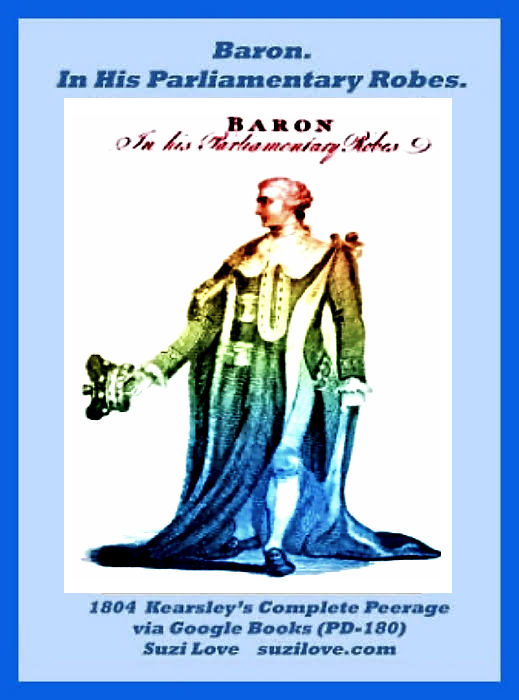
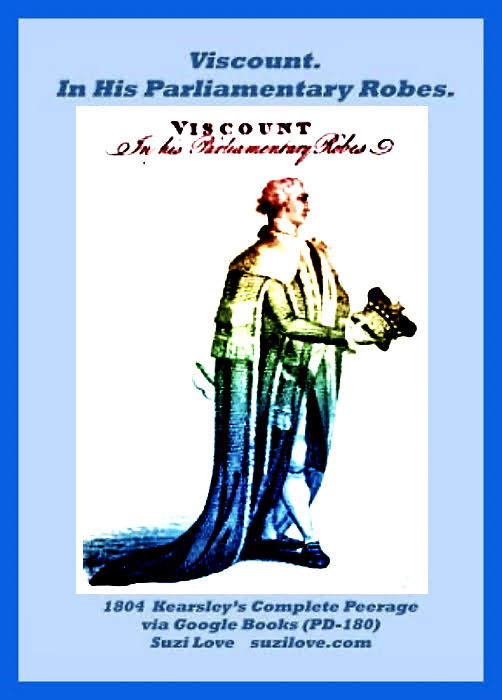
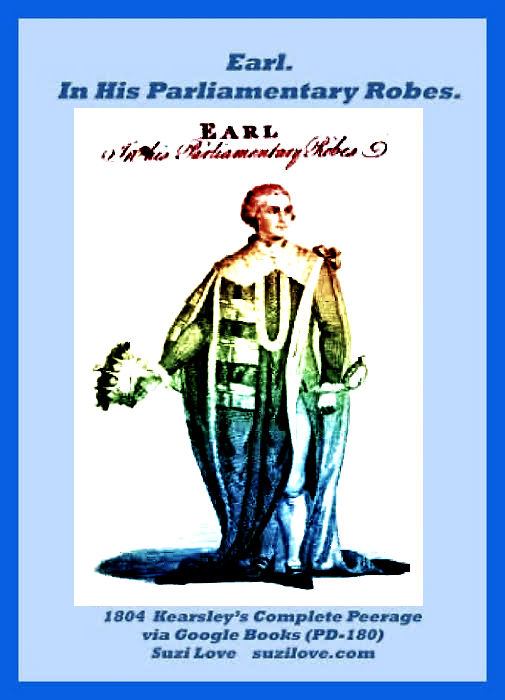
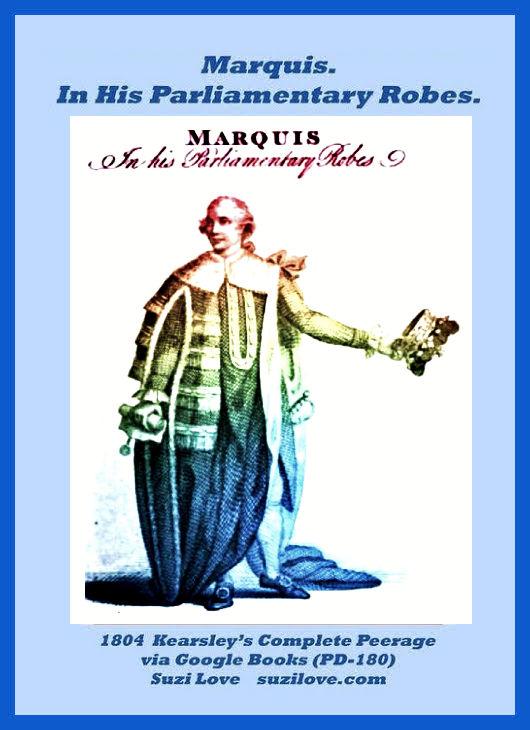
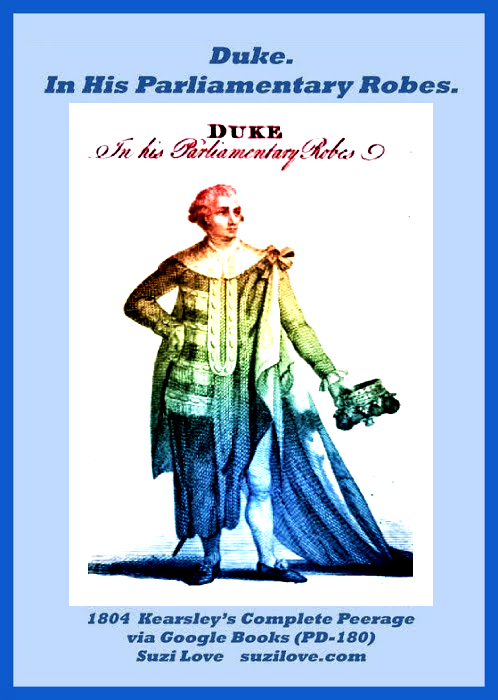
1804 Parliamentary Robes For Titled Men from the King downwards. 1804 Kearsley Complete Peerage of England, Scotland, Wales.
1804 Kearsley’s Complete Peerage. Google Books (PD-180)1804 Baron in his parliamentary robes. via Kearsley’s Complete Peerage. via Google Books (PD-200)1804 Viscount in his parliamentary robes. via Kearsley’s Complete Peerage. via Google Books (PD-200)1804 Earl in his parliamentary robes. via Kearsley’s Complete Peerage. via Google Books (PD-200)1804 Marquis in his parliamentary robes. via Kearsley’s Complete Peerage. via Google Books (PD-200)1804 Duke in his parliamentary robes. via Kearsley’s Complete Peerage. via Google Books (PD-200)RL_1_D2D_Regency Overview RetailerLinks
https://books2read.com/suziloveROver