↓
 

Suzi Love

Making history fun, one year at a time.

Header_
  • Home
  • Newsletter
  • Pre order form
  • Shop
    • Cart
    • Checkout
    • My account
    • Refund and Returns Policy
  • Blog
  • BOOKS
    • History Events
    • Kelly’s Justice
    • Outback Arrival
    • Irresistible Aristocrats
    • History Notes
    • Scandalous Siblings
    • Love After Waterloo
    • Regency Life Series
  • Privacy Policy
  • EVENTS
Home » Georgian era » Page 2 << 1 2 3 4 … 14 15 >>

Category Archives: Georgian Era

Post navigation

← Previous Post
Next Post→

In Bridgerton and Jane Austen’s times craftsmen created boxes and containers of precious metals, leather, silks. #Bridgerton #JaneAusten #travel #writing #sewing

Suzi Love Posted on September 12, 2026 by Suzi LoveSeptember 12, 2026

In Jane Austen’s times craftsmen created boxes and containers of precious metals, leather, silks, and decorated them with jewels. Boxes, Cases, Etui, Necessaire and everything else that was used to carry essential items for travel, sewing, medicine, writing, and toiletries. Containers were engraved to make exquisite and expensive items as well as practical carrying cases. books2read.com/suziloveBoxesCases

HN_11_Craftsmen created containers of precious metals, leather, silks, and decorated them with jewels to make exquisite and expensive items as well as practical carrying cases. books2read.com/suziloveBoxesCases
HN_11_D2D_Craftsmen created containers of precious metals, leather, silks, and decorated them with jewels to make exquisite and expensive items as well as practical carrying cases. books2read.com/suziloveBoxesCases
Posted in 1700s, 1800s, 1900s, Australia, Box Or Container, Bridgerton, Canada, Customs & Manners, Decorative Item, Edwardian Era, England, Europe, Food and Drink, Georgian Era, History, History Notes, household, Jane Austen, medical, military, Regency Era, Romantic Era, sewing, South Pacific, Suzi Love Books, U.S.A, Victorian Era, weapons, Writing Tools | Tagged 1800s women's fashion, antiques, Book 11, Box Or Container, Bridgerton, British history, decorative, drinks, England, europe, fabrics, fashion accessories, Food, Georgian era, History Notes, Jane Austen, jewelry, money, postal, Regency Era, sewing, snuff, Suzi Love Books, tantalus, tea, travel, USA, Victorian Era, Writing Tools

Fascinated with historical fashion? Treat yourself to a nonfiction Box Set on corsets, including Bridgerton and Jane Austen years. #Bridgerton #JaneAusten #Historicalfashion #Corset #nonfiction

Suzi Love Posted on September 12, 2026 by Suzi LoveSeptember 11, 2026

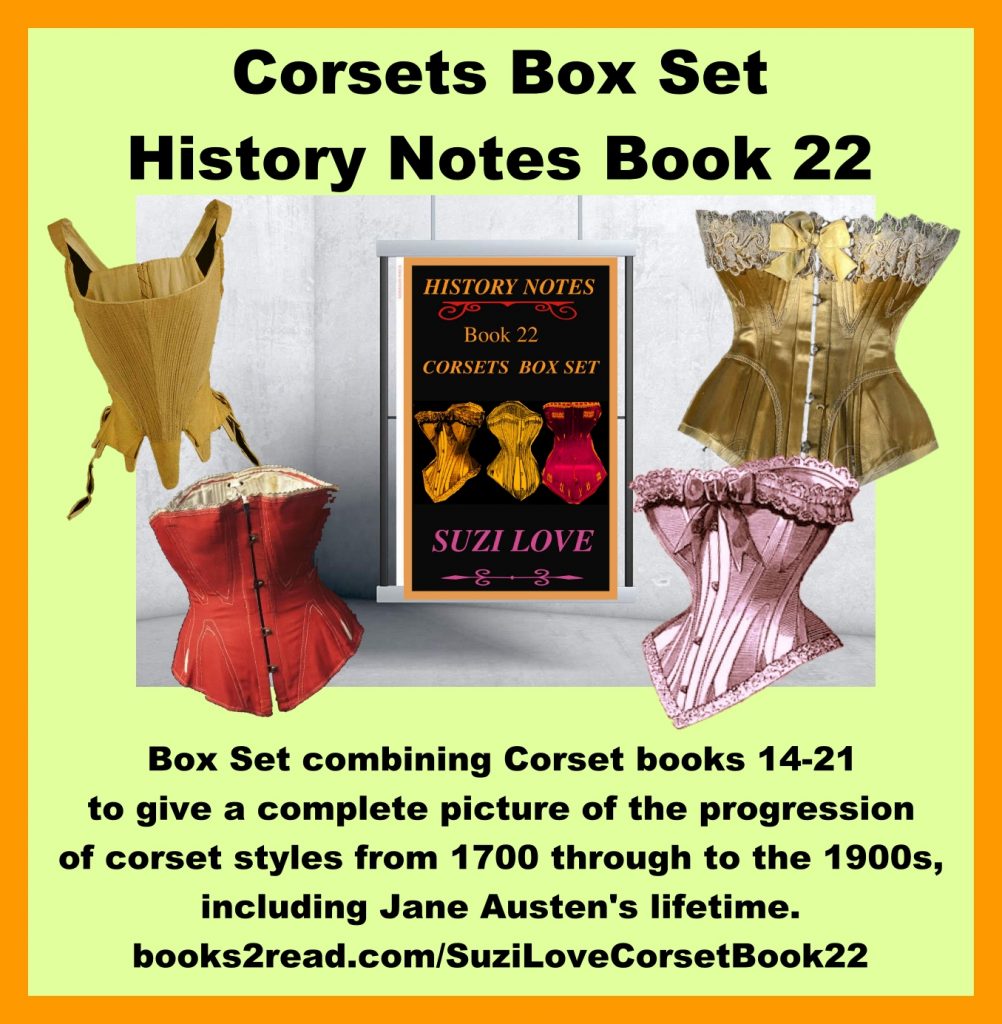
Fascinated with historical fashion? Treat yourself to a nonfiction Box Set on corsets, including Bridgerton and Jane Austen years. Corsets Box Set History Notes Book 22. This Box Set combines corset books 14-21 to give a complete picture of the progression of corset styles from 1700 through to the 1900s, including Jane Austen’s lifetime. These books show how body wraps, stays, and corsets were worn through the centuries to create a variety of fashionable silhouettes through various historical eras. Corsets flattened breasts and accentuated rounded hips or pushed up breasts and showed off the bust line depending on the fashions of the time and the desired silhouette. https://books2read.com/SuziLoveCorsetBook22

HN_22_Corsets Box Set History Notes Book 22 This Box Set combines corset books 14-21 to give a complete picture of the progression of corset styles from 1700 through to the 1900s, including Jane Austen's lifetime. These books show how body wraps, stays, and corsets were worn through the centuries to create a variety of fashionable silhouettes through various historical eras. Corsets flattened breasts and accentuated rounded hips or pushed up breasts and showed off the bust line depending on the fashions of the time and the desired silhouette. Box Set combining Corset books 14-21 to give a complete picture of the progression of corset styles from 1700 through to the 1900s, including Jane Austen's lifetime. https://books2read.com/SuziLoveCorsetBook22
HN_22_D2D_Corset Box Set
https://books2read.com/SuziLoveCorsetBook22
HN_22_D2D_Corset Box Set

Posted in 1700s, 1700s Womens Fashion, 1800s, 1800s women's fashion, 1900s, Australia, Bridgerton, Canada, children, Children, Corset, Edwardian Era, England, Europe, France, Georgian Era, Georgian Fashion, History Notes, Jane Austen, London, Regency Era, Regency Fashion, Romantic Era, Suzi Love Books, U.S.A, underclothing, Victorian Era | Tagged 1700s Women's Fashion, 1800s women's fashion, Book 22, Bridgerton, Corset, fashion accessories, Fashion Plate, Georgian Fashion, History Notes, Jane Austen, Regency Fashion, Romantic Era, Suzi Love Books, underclothing, Victorian fashion

Do you love music, Jane Austen and the Bridgerton family? Treat yourself to a nonfiction book on music history from the 17th, 18th, and 19th Centuries. #Bridgerton #Music #JaneAusten

Suzi Love Posted on September 12, 2026 by Suzi LoveSeptember 11, 2026

Music history from the 17th, 18th, and 19th Centuries. Pianos, pianofortes, harps, viols, violins played during Jane Austen’s times. Musical Instruments were so important in most of the more affluent households in history that large industries grew all around the world to manufacture instruments, musical accessories, and to print sheet music. Musical instruction and encouragement could be found everywhere and both young ladies and gentlemen were encouraged to have musical appreciation. And of course, playing music was on the list of social requirements for all young ladies desirous of becoming a wife and homemaker.

London became Europe’s leading centre for the manufacture of scientific instruments and this led to the manufacture of more musical instruments as well as factories developed and rail transport helped the faster distribution of goods to regional areas. One of the first places that music was used to tell stories and to share enjoyment was in Christmas music. Because music was such an integral part of households, music was always a feature in Magazines. There were advertisements everywhere for musical instruments for sale, for sheet music, and for music lessons.  And of course, of most interest to the ladies were the hundreds of fashion plates included in magazines where people were depicted with their musical instruments.

books2read.com/suziloveMusicGeneral

books2read.com/suziloveMusicPiano

books2read.com/suziloveMusicViolins

HN_6-7-8 Music General History Notes
HN_7 D2D Retailer Buy Link Music Piano History Notes
books2read.com/suziloveMusicPiano
HN_7 D2D Retailer Buy Link Music Piano History Notes

Posted in 1700s, 1800s, 1900s, Australia, Canada, Edwardian Era, England, Europe, furniture, Georgian Era, History, History Notes, household, Music, Pastimes, Quotations, Regency Era, Romantic Era, Suzi Love Books, Suzi Love Images, U.S.A, Victorian Era | Tagged Bridgerton, British history, furniture, Georgian era, guitar, History Notes, HN_6-7-8, household, Jane Austen, music, pastimes, piano, Regency Era, Romantic Era, Suzi Love Books, Victorian Era, violin

1700-1800 ca. Women’s Pockets With Waist Ties as worn in Jane Austen’s years. #Georgianera #Regencyera #JaneAusten #Underclothing

Suzi Love Posted on September 5, 2026 by Suzi LoveSeptember 9, 2026

From 1700 until the early 1800s, pockets with waist ties were worn by women to keep essential items on their person. Generally of linen or some other cotton fabric, they were often quilted, or embroidered and gifted or handed down to others. In the 18th century, women’s pockets were not sewn into their gowns. Instead they were attached to a tape and tied around the waist as separate garments. Worn under the hoops and petticoats, they were accessed through openings in the gown and petticoat seams. By the early 1800s, round gowns were both flowing and almost transparent so pockets could no longer be worn under dresses, so ridicules, or bags, or reticules were carried instead. Jane Austen and her female friends and family would have worn pockets under their out layers.

From the Curator Victoria and Albert Museum, London: Quilting was a popular form of decoration for a variety of garments including pockets. However, hand-quilting was a time-consuming method of decoration. The increased demand for quilted petticoats, waistcoats and pockets led to the invention of woven quilting.

1700-1725 ca. Pair of Linen Twill Women’s Pockets With Crewel Embroidery and Waist Ties, British. Embroidered in yellow, green and pink worsted thread with chain and stem stitches, design of flower pot with flowering plant, bound with green worsted tape and sewn to linen tape tie. Designs are similar but not identical, suggesting both hand-drawn and possibly work of an amateur. Pockets may have been handed down to another person who found them too small as each pocket has been extended at top by 4 cms. via Victoria and Albert Museum, London, UK.
collections.vam.ac.uk.

1700-1725 ca. Pair of Linen Twill Women's Pockets With Crewel Embroidery and Waist Ties, British. Embroidered in yellow, green and pink worsted thread with chain and stem stitches, design of flower pot with flowering plant, bound with green worsted tape and sewn to linen tape tie. Designs are similar but not identical, suggesting both hand-drawn and possibly work of an amateur. Pockets may have been handed down to another person who found them too small as each pocket has been extended at top by 4 cms. via Victoria and Albert Museum, London, UK. collections.vam.ac.uk.
by 4 cms. via Victoria and Albert Museum, London, UK. collections.vam.ac.uk.

1750-1800 ca. Woman’s Pocket With Waist Ties, New England, America. Linen plain weave, cotton plain weave, wool embroidery. Dimensions 39.5 cm x 27.5 cm. Polychrome crewels on cotton and linen, vine with buds, flowers and leaves and initials M.W. in center. In 18th century, women’s pockets were tied around waist with tape as separate garments, worn under hoops and petticoats, accessed through openings in gown and petticoat seams. via Museum of Fine Arts, Boston, U.S.A. mfa.org

1750-1800 ca. Woman's Pocket With Waist Ties, New England, America. Linen plain weave, cotton plain weave, wool embroidery. Dimensions 39.5 cm x 27.5 cm. Polychrome crewels on cotton and linen, vine with buds, flowers and leaves and initials M.W. in center. In 18th century, women’s pockets were tied around waist with tape as separate garments, worn under hoops and petticoats, accessed through openings in gown and petticoat seams. via Museum of Fine Arts, Boston, U.S.A. mfa.org
1750-1800 ca. Woman’s 1750-1800 ca. Woman’s Pocket With Waist Ties, New England, America. Linen plain weave, cotton plain weave, seams. via Museum of Fine Arts, Boston, U.S.A. mfa.org
HN_1_D2D_Fashion Women 1700s
books2read.com/suziloveFashWomen1700s
HN_1 Fashion Women Late 1700s History Notes Book 1 by Suzi Love. What was fashionable for women in the late 1700s? Extravagant colors and fabrics and outrageous styles were all seen in these flamboyant fashions. books2read.com/suziloveFashWomen1700s
Posted in 1700s, 1700s Womens Fashion, 1800s, 1800s women's fashion, Australia, Canada, England, Europe, fashion accessories, Georgian Era, Georgian Fashion, Jane Austen, Regency Era, Regency Fashion, Suzi Love Images, U.S.A | Tagged 1700s Women's Fashion, 1800s women's fashion, fashion accessories, Georgian Fashion, Jane Austen, Museum Of Fine Arts, Regency Fashion, underclothing, Victoria and Albert Museum

18th-19th Century Sedan Chair Travel In Jane Austen’s Times. #JaneAusten #BritishHistory #Travel #GeorgianEra

Suzi Love Posted on September 3, 2026 by Suzi LoveSeptember 2, 2026

A sedan chair is a portable enclosed chair for a single passenger. It was generally carried by two “chairmen” holding poles attached to either side of the chair. Sedan chairs were fashionable in England and Europe during the 17th, 18th and early 19th centuries and were an important part of the social life of the times. They were very useful for negotiating crowded, unsafe, narrow, winding and often filthy streets and were particularly used by “invalids, ladies and party goers”. Sedan chairs had the advantage of being able to be carried up and down stairs and could deliver the passenger from inside their own home to inside their destination without having to step outside.

1784 Sedan Chair. ‘The return from a masquerade. A morning scene.’ A young lady dressed as shepherdess with staff slumps in a sedan chair. Asleep or drunk her head and shoulders hang outside window. Two porters smile and dwarf chimney sweep carries a mask.’ By Robert Dighton and Cari.

1784 Sedan Chair. ‘The return from a masquerade. A morning scene.' A young lady dressed as shepherdess with staff slumps in a sedan chair. Asleep or drunk her head and shoulders hang outside window. Two porters smile and dwarf chimney sweep carries a mask.’ By Robert Dighton and Cari.
1784 Sedan Chair. ‘The return from a masquerade. A morning scene.’ A young lady dressed as shepherdess with staff slumps in a sedan chair. Asleep or drunk her head and shoulders hang outside window. Two porters smile and dwarf chimney sweep carries a mask.’ By Robert Dighton and Cari.

The 19th century English author, Elizabeth Gaskell, described the use and function of the sedan perfectly in her novel “Wives and Daughters” when she reminisced how the Browning sisters chose to be transported to a ball by sedan chair, which ‘came into the parlor, and got full of the warm air, and nipped you up, and carried you tight and cosy into another warm room, where you could walk out without having to show your legs by going up steps, or down steps.’

The Bath Chair was invented in Bath, England, in the mid 18th Century to transport the wealthy and the sick around the city.  It could be steered by the passenger and rivaled and then outdid the Sedan Chair as only one chairman was needed to operate it. The last Bath Chairman retired in 1949. 

Typical 1700s, or Eighteenth Century Sedan Chair. Portable enclosed chair for single passenger usually carried by two chairmen holding poles attached to either side of chair. Fashionable during 17th, 18th and early 19th centuries when needed to negotiate crowded, unsafe, narrow, and dirty streets. Used by invalids, ladies and party goers. The sedan chair comprises a small kiosk with a curved timber roof which is covered with leather and studded with brass nails. The front and side panels are painted in green with floral decorations of cherubs and flowers. The back panel is of plain timber. Access to the chair was via a hinged door at the front. Inside, the chair is upholstered in silk and features padded upholstered arm rests. The windows have raw silk curtains which are gathered with tassels. The present brackets and poles are reproductions made in 1986 prior to display in the Transport exhibition. The total length of the new poles are 80 inches. The sedan chair door lock features the initials “V.F.” and a set of crossed keys with the wording “PARIS” and the number “34”. Via Powerhouse Museum, Sydney, Australia.

Typical 1700s, or Eighteenth Century Sedan Chair. Portable enclosed chair for single passenger usually carried by two chairmen holding poles attached to either side of chair. Fashionable during 17th, 18th and early 19th centuries when needed to negotiate crowded, unsafe, narrow, and dirty streets. Used by invalids, ladies and party goers. The sedan chair comprises a small kiosk with a curved timber roof which is covered with leather and studded with brass nails. The front and side panels are painted in green with floral decorations of cherubs and flowers. The back panel is of plain timber. Access to the chair was via a hinged door at the front. Inside, the chair is upholstered in silk and features padded upholstered arm rests. The windows have raw silk curtains which are gathered with tassels. The present brackets and poles are reproductions made in 1986 prior to display in the Transport exhibition. The total length of the new poles are 80 inches. The sedan chair door lock features the initials "V.F." and a set of crossed keys with the wording "PARIS" and the number "34". Via Powerhouse Museum, Sydney, Australia.

Typical 1700s, or Eighteenth Century Sedan Chair. Portable enclosed chair for single passenger usually carried by two chairmen holding poles attached to either side of chair. Fashionable during 17th, 18th and early 19th centuries when needed to negotiate crowded, unsafe, narrow, and dirty streets. Used by invalids, ladies and party goers. The sedan chair comprises a small kiosk with a curved timber roof which is covered with leather and studded with brass nails. The front and side panels are painted in green with floral decorations of cherubs and flowers. The back panel is of plain timber. Access to the chair was via a hinged door at the front. Inside, the chair is upholstered in silk and features padded upholstered arm rests. The windows have raw silk curtains which are gathered with tassels. The present brackets and poles are reproductions made in 1986 prior to display in the Transport exhibition. The total length of the new poles are 80 inches. The sedan chair door lock features the initials “V.F.” and a set of crossed keys with the wording “PARIS” and the number “34”. Via Powerhouse Museum, Sydney, Australia. 

The longest journey recorded in a sedan chair was made by Princess Amelia, youngest daughter of King George III, who in 1728 was carried by 8 chairmen working in reliefs from London to Bath, a distance of 172 kms (107 miles). This sedan chair door lock features the initials “V.F.” and a set of crossed keys with the wording “PARIS” and the number “34”.

HN_10_D2D_RetailerBuyLink

books2read.com/SuziLoveTravel
HN_10_D2D_RetailerBuyLink_ History Notes Book 10 books2read.com/SuziLoveTravel
Posted in 1700s, 1700s Mens fashion, 1700s Womens Fashion, 1800s, Carriage, cartoon, Customs & Manners, England, Europe, France, Georgian Era, Georgian Fashion, hats, History, Jane Austen, London, travel | Tagged 1700s Mens Fashion, 1700s Women's Fashion, British history, carriages, Customs and Traditions, europe, Georgian era, Georgian Fashion, google books, Jane Austen, Regency Era, travel
guitar_1780 ca. English Guitar, Lisbon, Portugal. Made by Jaco Vieira da Silva Pine back, sides and soundboards, with pine and wood purfling (bordering); brass openwork rose, framed with mother-of-pearl. The English guitar was a fashionable instrument from about 1750, considered easy to play and tuned in C major, although the player would use a capo, much like a modern folk-guitarist, in order to change the key. The tuning pegs were often small metallic pins that could be turned with a watch-key, to keep the strings in tune longer. This instrument was made in Portugal, a country with strong trading links with England, and its peg box is decorated with a paper ‘cameo’ in imitation of a jasper ware medallion, a motif made popular by Josiah Wedgwood (1730-1795) from about 1770. Victoria and Albert Museum, London, U.K.

1780 ca. English Guitar, Lisbon Made by Jaco Vieira da Silva. #Music #Guitar #Portugal #GeorgianEra

Suzi Love Posted on August 27, 2026 by Suzi LoveAugust 22, 2026

1780 ca. English Guitar, Lisbon Made by Jaco Vieira da Silva. Pine back, sides and soundboards, with pine and wood purfling or bordering, brass openwork rose, framed with mother-of-pearl. The English guitar was a fashionable instrument from about 1750, considered easy to play and tuned in C major, although the player would use a capo, much like a modern folk-guitarist, in order to change the key. The tuning pegs were often small metallic pins that could be turned with a watch-key, to keep the strings in tune longer. This instrument was made in Portugal, a country with strong trading links with England, and its peg box is decorated with a paper ‘cameo’ in imitation of a jasper ware medallion, a motif made popular by Josiah Wedgwood (1730-1795) from about 1770. Victoria and Albert Museum, London, U.K.  History Notes Book 6 Music General https://www.suzilove.com/wp-admin/books2read.com/suziloveMusicGeneral \

1780 ca. English Guitar, Lisbon, Portugal. Made by Jaco Vieira da Silva Pine back, sides and soundboards, with pine and wood purfling (bordering); brass openwork rose, framed with mother-of-pearl. The English guitar was a fashionable instrument from about 1750, considered easy to play and tuned in C major, although the player would use a capo, much like a modern folk-guitarist, in order to change the key. The tuning pegs were often small metallic pins that could be turned with a watch-key, to keep the strings in tune longer. This instrument was made in Portugal, a country with strong trading links with England, and its peg box is decorated with a paper ‘cameo’ in imitation of a jasper ware medallion, a motif made popular by Josiah Wedgwood (1730-1795) from about 1770. Victoria and Albert Museum, London, U.K.
.
1780 ca. English Guitar, Lisbon, Portugal. Made by Jaco Vieira da Silva Pine back, sides and soundboards, with pine and wood purfling (bordering); brass openwork rose, framed with mother-of-pearl. The English guitar was a fashionable instrument from about 1750, considered easy to play and tuned in C major, although the player would use a capo, much like a modern folk-guitarist, in order to change the key. The tuning pegs were often small metallic pins that could be turned with a watch-key, to keep the strings in tune longer. This instrument was made in Portugal, a country with strong trading links with England, and its peg box is decorated with a paper ‘cameo’ in imitation of a jasper ware medallion, a motif made popular by Josiah Wedgwood (1730-1795) from about 1770. Victoria and Albert Museum, London, U.K.
HN_6_D2D_Music General_ books2read.com/suziloveMusicGeneral

Posted in 1700s, Decorative Item, Europe, Georgian Era, History, Music, Pastimes, Suzi Love Images | Tagged 1700s Or Georgian Era, europe, Georgian era, guitar, music, Victoria and Albert Museum
corsets_1790-1810 ca. Collage View. Linen and Metal Corset, American Or European. Front Lacing. via metmuseum.org.

1790-1810 ca. Linen and Metal Corset, American Or European. Front Lacing. #Corset #RegencyEra #GeorgianEra #JaneAusten

Suzi Love avatarPosted on August 25, 2026 by Suzi LoveAugust 22, 2026

1790-1810 ca. Linen and Metal Corset, American Or European. Front Lacing. #Corset #RegencyEra #GeorgianEra #JaneAusten. https://books2read.com/SuziLoveCorsetBook16

Continue reading →
Posted in 1700s, 1700s Womens Fashion, 1800s, 1800s women's fashion, Australia, Canada, Corset, England, Europe, fashion accessories, Georgian Era, Georgian Fashion, Jane Austen, Regency Era, Regency Fashion, Suzi Love Images, U.S.A, underclothing | Tagged 1700s Women's Fashion, 1800s women's fashion, Corset, Georgian Fashion, Jane Austen, Metropolitan Museum NYC, Regency Fashion, underclothing

1798 Gentleman’s Outfit Of Long Green Overcoat With Yellow Buttons, Tan Gloves, and Black Boots, French. #GeorgianEra #France #FashionPlate

Suzi Love Posted on August 15, 2026 by Suzi LoveAugust 2, 2026

1798 Gentleman’s Outfit, French. Long green overcoat with yellow buttons, tan gloves, black boots topped with yellow band, gloves with three seams across the back of the hand, high white cravat, black hat, fob at his waist and holding a cane. Fashion Plate via Journal des Dames et des Modes, or Costume Parisien.

1798 Gentleman's Outfit, French. Long green overcoat with yellow buttons, tan gloives, black boots topped with yellow band, gloves with three seams across the back of the hand, high white cravat, black hat, fob at his waist and holding a cane. Fashion Plate via Journal des Dames et des Modes, or Costume Parisien.
1798 Gentleman’s Outfit Of Long Green Overcoat With Yellow Buttons, Tan Gloves, and Black Boots, French. #GeorgianEra #France #FashionPlate https://books2read.com/suziloveFashMen1700s
Post On X
What was fashionable for men in the late 1700s? Extravagant colors and fabrics and outrageous styles were all seen in these flamboyant fashions.
books2read.com/suziloveFashMen1700
Posted in 1700s Womens Fashion, Coat or Pelisse Or Redingote, France, Georgian Era, Georgian Fashion, Suit, Suzi Love Images, Vest or Waistcoat | Tagged cravat, fashion accessories, gloves, Hats And Hair, pants, Redingote Or Pelisse Or Coat, Shoes

18th Century Early.  Silk, Leather, and Linen Mules (shoes), European, and embroidered in Florentine Style. #shoes #georgianfashion #europe

Suzi Love Posted on August 12, 2026 by Suzi LoveAugust 2, 2026

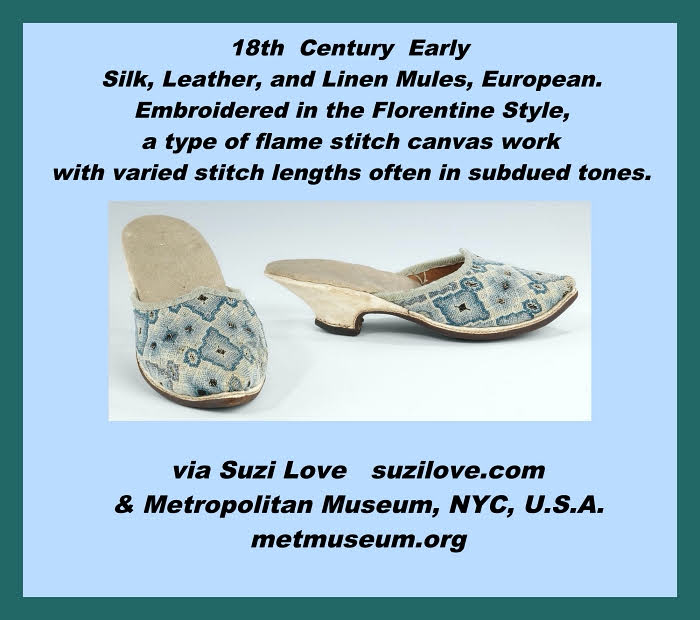
18th  Century  Early.  Silk, Leather, and Linen Mules, European. Embroidered in the Florentine Style, a type of flame stitch canvas work with varied stitch lengths often in subdued tones. via  Metropolitan Museum, NYC, U.S.A.

shoes_18th Century Early. Silk, Leather, and Linen Mules, European. Embroidered in the Florentine Style, a type of flame stitch canvas work with varied stitch lengths often in subdued tones. via Metropolitan Museum, NYC, U.S.A.
18th Century Early.  Silk, Leather, and Linen Mules (shoes), European, and embroidered in Florentine Style. #shoes #georgianfashion #europe https://books2read.com/suziloveFashWomen1700s
Post On X
HN_1_D2D_Fashion Women 1700s
books2read.com/suziloveFashWomen1700s
HN_1 Fashion Women Late 1700s History Notes Book 1 by Suzi Love. What was fashionable for women in the late 1700s? Extravagant colors and fabrics and outrageous styles were all seen in these flamboyant fashions. books2read.com/suziloveFashWomen1700s
Posted in 1700s, 1700s Womens Fashion, Europe, Georgian Era, Georgian Fashion, shoes, Suzi Love Images | Tagged 1700s Or Georgian Era, 1700s Women's Fashion, Georgian era, Georgian Fashion, Metropolitan Museum NYC, sewing, Shoes

Jane Austen and the Bridgerton family and contemporaries used boxes of metal, leather, or silks, decorated with jewels and engraving. #Bridgerton #Travel #JaneAusten #RegencyEra #Antiques

Suzi Love Posted on August 10, 2026 by Suzi LoveAugust 4, 2026

Craftsmen created containers of precious metals, leather, and silks and decorated them with jewels and engraving. Jane Austen and her contemporaries would have used writing boxes, linen boxes when travelling, boxes to hold their food and drink supplies while traveling by carriage, and decorative boxes to keep letters, ribbons, gloves, hairpins etc. Boxes, Cases, and Necessaires By Suzi Love, History Notes Book 11. books2read.com/suziloveBoxesCases.

HN_11_Craftsmen created containers of precious metals, leather, silks, and decorated them with jewels to make exquisite and expensive items as well as practical carrying cases. books2read.com/suziloveBoxesCases
Jane Austen and the Bridgerton family used boxes of metal, leather, or silks, decorated with jewels and engraving. #Bridgerton #Travel #JaneAusten #RegencyEra #Antiques books2read.com/suziloveBoxesCases

Post On X
HN_11_D2D_RetailerBuyLink_HN_11
books2read.com/suziloveBoxesCases

HN_11_D2D_RetailerBuyLink_HN_11

Posted in 1700s, 1800s, 1900s, Australia, Box Or Container, Canada, Carriage, cartoon, Decorative Item, Edwardian Era, England, Europe, Food and Drink, France, Georgian Era, Google Books, Grand Tour, History, History Notes, household, Jane Austen, London, medical, military, Music, postal, Regency Era, Romantic Era, Russia, sewing, Suzi Love Books, Suzi Love Images, Suzi Love Writing, travel, U.S.A, Victorian Era, weapons, Writing Tools | Tagged Book 11, Box Or Container, Bridgerton, carriages, decorative, drinks, fashion accessories, Food, furniture, Georgian era, History Notes, Jane Austen, Regency Era, Romantic Era, sewing, Suzi Love Books, travel, Victorian Era, Writing Tools

Post navigation

← Previous Post
Next Post→

SUBSCRIBE TO SUZI LOVE'S NEWSLETTER.

Recent Posts

  • 19th Century First Half. Gentleman’s Black Wool Tailcoat With Embroidered Buttons as Worn in Bridgerton and Jane Austen times. #Bridgerton #JaneAusten #RegencyFashion
  • Do you love Jane Austen and Bridgerton fashions? Corsets Or Stays Worn During the Early 1800s, or Regency Era, Book 17 History Notes #Bridgerton #JaneAusten #RegencyFashion #Corsets
  • Tradition of Birthday Parties #history #customs #birthday
  • 1800 Riding Dress For A Young Man of Jane Austen’s Acquaintance. Blue cutaway coat and loose pants tucked into high black riding boots. #JaneAusten #ridingfashion #RegencyFashion #France
  • 1816 November. Bridgerton and Jane Austen High-waisted, Striped Evening Dress With Short Puffed Sleeves. #bridgerton #RegencyFashion #JaneAusten

Recent Comments

  1. Suzi Love on Book Hooks: Petunia and the Pearl Diver. Petunia was too well spoken for a brothel worker. #Regencyromance #historicalromance #London #mfrw
  2. Bianca White on Book Hooks: Petunia and the Pearl Diver. Petunia was too well spoken for a brothel worker. #Regencyromance #historicalromance #London #mfrw
  3. Suzi Love on Book Hooks: Petunia and the Pearl Diver. Petunia was too well spoken for a brothel worker. #Regencyromance #historicalromance #London #mfrw
  4. Suzi Love on Book Hooks: Petunia and the Pearl Diver. Petunia was too well spoken for a brothel worker. #Regencyromance #historicalromance #London #mfrw
  5. Suzi Love on Book Hooks: Petunia and the Pearl Diver. Petunia was too well spoken for a brothel worker. #Regencyromance #historicalromance #London #mfrw

Login

  • Log in

Archives

  • October 2026
  • September 2026
  • August 2026
  • July 2026
  • June 2026
  • May 2026
  • April 2026
  • March 2026
  • February 2026
  • January 2026
  • December 2025
  • November 2025
  • October 2025
  • September 2025
  • August 2025
  • July 2025
  • June 2025
  • May 2025
  • April 2025
  • March 2025
  • February 2025
  • January 2025
  • December 2024
  • November 2024
  • October 2024
  • September 2024
  • August 2024
  • July 2024
  • June 2024
  • May 2024
  • April 2024
  • March 2024
  • February 2024
  • January 2024
  • November 2023
  • October 2023
  • September 2023
  • August 2023
  • April 2023
  • June 2022
  • April 2022

Categories

  • 1700s
  • 1700s Mens fashion
  • 1700s Womens Fashion
  • 1800s
  • 1800s Mens Fashions
  • 1800s women's fashion
  • 1900s
  • art
  • Australia
  • Bath
  • bedroom fashion
  • Book Hooks
  • Box Or Container
  • Bridgerton
  • Bus Trips
  • Canada
  • Carriage
  • cartoon
  • Celebrity
  • Chatelaine
  • children
  • Children
  • Christmas
  • Coat or Pelisse Or Redingote
  • Contemporary
  • Corset
  • Couple
  • Customs & Manners
  • dancing
  • December Scandal
  • Decorative Item
  • Dress Or Robe
  • Easter
  • Edwardian Era
  • Embracing Scandal
  • England
  • Ester In Images
  • Europe
  • Events
  • Fashion
  • fashion accessories
  • Food and Drink
  • Four Times A Virgin
  • France
  • furniture
  • Georgian Era
  • Georgian Fashion
  • Google Books
  • Grand Tour
  • Group
  • hats
  • History
  • History Events
  • History Notes
  • History Of Christmases Past
  • household
  • Hygiene
  • Irresistible Aristocrats
  • Jane Austen
  • Keanu Reeves
  • Kellys Justice
  • Legal
  • London
  • Love After Waterloo
  • Loving Lady Katharine
  • medical
  • military
  • money
  • mourning
  • Music
  • Outback Arrival
  • pants
  • Pastimes
  • peerage
  • People
  • Petunia and Pearl Diver
  • Places
  • Pleasure House Ball
  • postal
  • Queensland
  • Quotations
  • Regency Era
  • Regency Fashion
  • Regency Life Series
  • Reticule or Bag
  • riding
  • Romantic Era
  • Royalty
  • Russia
  • Scandalous Siblings Series
  • Scenting Scandal
  • Self Publishing
  • sewing
  • Shirt
  • shoes
  • Shopping
  • South Pacific
  • Spencer
  • sports
  • Suit
  • Sunday Snippet
  • Suzi Love
  • Suzi Love Books
  • Suzi Love Images
  • Suzi Love Writing
  • Swain Cove
  • THe Viscount's Pleasure House
  • travel
  • U.S.A
  • underclothing
  • Vest or Waistcoat
  • Victorian Era
  • Victorian Fashion
  • weapons
  • weddings
  • Writing Tools

1800s men fashion 1800s women's fashion antiques Bridgerton British history Cartoons Corset cravat decorative Dress Or Gown England europe fashion accessories Fashion Plate France Georgian era Georgian Fashion gloves google books Hats And Hair historical romance History Notes household Jane Austen jewelry Journal des Dames et des Modes London Metropolitan Museum NYC pants Redingote Or Pelisse Or Coat Regency Era Regency Fashion Regency London Regency romance reticule or bag riding sewing shawls Shoes Suzi Love Books Suzi Love Images Tailcoat The Repository Of Arts underclothing Vest or Waistcoat

©2026 - Suzi Love - Weaver Xtreme Theme Privacy Policy
↑