1815 June White Carriage Dress, English. Lady reading a book in a high-waisted white satin Pelisse, or Walking Or Carriage dress in the relaxed Empire style as would have been worn at home in the early 1800s, or during Jane Austen’s time. Richly ornamented with clusters of leaves made in white twilled sarsnet, headed with tull. Open fronts, trimmed to the bottom of the waist with a superb shell trimming of white satin ribbon and tull, loose sleeves trimmed at the wrists. High hat of white satin and tull with a plume of feathers of the pomona green. Half-boots of similar color. Gloves en suite and a necklace. Lady is viewing paintings and the program in her hand says ‘British Institution’. In this issue of The Repository there is an article called ‘Exhibition of Paintings by the Flemish and Dutch Masters at the British Institution, Pall Mall.’ Fashion Plate via Rudolph Ackermann’s ‘The Repository of Arts’.
1815 June White Carriage Dress, English. Lady reading a book in a high-waisted white dress in the relaxed Empire style, frill on V-neckline, high flowered bonnet.long white gloves and a necklace. Fashion Plate via Rudolph Ackermann’s ‘The Repository of Arts’. Fashion Women 1815-1819 History Notes Book 28 What did Jane Austen wear? . D2D_HN_28_https://books2read.com/SuziLoveFashionWomen1815-1819
18th Century Late Women’s Fashions. A conical body shape was still fashionable while the shape of the skirts changed. The wide panniers which held the skirts out at the sides mostly disappeared by 1780 for all but the most formal court functions and false rumps, or bum-pads or hip-pads were worn for a time. A low-necked gown, usually called in French a robe, was worn over a petticoat and most gowns had skirts that opened in front to show the petticoat worn beneath. As part of the general simplification of dress, the open bodice with a separate stomacher was replaced by a bodice with edges that met center front. Strapless stays which still were cut high at the armpit, to encourage a woman to stand with her shoulders slightly back, a fashionable posture. The fashionable shape was a rather conical torso, with large hips. The waist was not particularly small. Stays were usually laced snugly, but comfortably. Shoes had high, curved heels (the origin of modern “louis heels”) and were made of fabric or leather. Shoe buckles remained fashionable until they were abandoned along with high-heeled footwear and other aristocratic fashions in the years after the French Revolution,
18th Century Late Men’s Fashions. A man’s outfit consisted of a knee-length coat, knee breeches, a vest or long waistcoat, a linen shirt with frills and linen under drawers. Lower legs showed and were an important part of life. Men wore stockings and leather shoes with stacked heels of low or medium height. The whole ensemble would have been topped by a shoulder-length wig and a tricorne, or three-cornered, hat an upturned brim. By end of the 18th century, wigs were out of fashion except for the most formal occasions. Undergarments and knee breeches did not change very much. Coats gradually became less full and die front was cut in a curve towards the back. Waistcoats became shorter. The upper leg began to show more and more and by the end of the century breeches fitted better because they were often made of knitted silk. Shoes became low-heeled with pointed toes and were fastened with a detachable strap or ribbon on the front.
18th Century Snuff Boxes. Not only were boxes made to serve a purpose, but decorative boxes of all types were prized, especially in the 18th Century when everything decorative and extravagant was in vogue and taking a pinch of snuff was fashionable. Snuff is made from ground or pulverized tobacco leaves and is sniffed from a pinch of snuff placed on the back of the hand. Flavorings were added to the tobacco to give a fast hit of nicotine and a lasting scent. Snuff began in the Americas and was used in Europe by the 17th Century.
Snuff became popular from the mid 1600s to the mid 1800s and was more popular than smoking. Inhaling snuff, or snuffing, was first seen by a European missionary in 1493 in Christopher Columbus’s new world within Haiti’s indigenous Taino. Until then, tobacco had been unknown to Europeans, but its use spread quickly throughout Europe during the 1500s. By the second half of the 17th century, ornate boxes started being produced to keep the precious powder dry and an entire industry making accessories blossomed around the fashion of taking snuff. Noblemen, and some women, carried extravagantly decorated snuff boxes with them at all times and would offer a pinch of their own particular blend to friends and family. Therefore, these boxes were always on display and so it became a competition to see who could have the most bejeweled or expensive box possible. books2read.com/suziloveFashMen1700
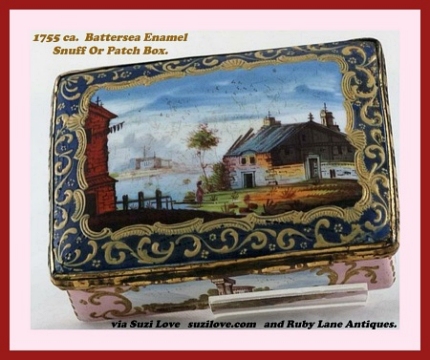
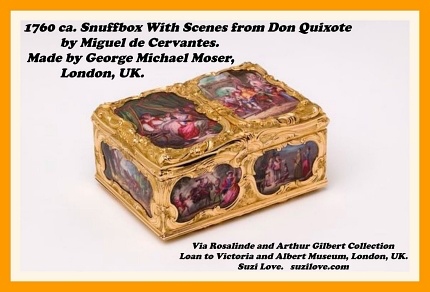
1770-1771 ca. Gold and Enamel Snuffbox 18th Century ca. Gold and Enamel Snuff Box, Europe.1759 Gold Snuff Box, English.1755 Battersea Enamel Snuff Or Patch Box. 1754-1755 ca. Gold Snuffbox, French. 1760 ca. Snuffbox With Scenes from Don Quixote 1760 ca. Gold Mounted Lapis Lazuli Snuff Box 1700s Portrait Miniature Snuff Box of Gold and Tortoiseshell1750 ca. Carved Agate Snuffbox, Germany. 1749-1750 ca. Double Snuff Box, French. 1728-1729 ca. Snuffbox With Dolphin and Ship,RL_2_D2D_RetailerBuyLink_RL_2
https://books2read.com/suziloveYGD
“For the sake of propriety,” Lady Jamison informed the Earl. “I was ensuring your garments were intact. You’ve a reputation for disappearing into dark corners and re-emerging with your clothing askew.” https://books2read.com/suziloveSS The Earl says he has no time for their family friend and mad scientist, Lady Laura, yet when he’s with her, passion and desire explode. Can Richard resist Laura’s obvious charms and choose instead a passive and pleasing wife? Probably not!
SS_For the sake of propriety,” Lady Jamison informed the Earl. “I was ensuring your garments were intact. You’ve a reputation for disappearing into dark corners and re-emerging with your clothing askew.” https://books2read.com/suziloveSS
SS_D2D_
https://books2read.com/suziloveSS
1800 ca. Pair of Flintlock Duelling Pistols. Owned by Captain William Waller (active 1794-1807). Walnut stock, chequered grips, rounded butts, fitted with two silver pipes containing ramrods. Silver trigger guards engraved and end in pineapple shaped finials, each with flintlock containing flints. Lock plates engraved with leaf design, octagonal barrels browned with narrow gold bands near lock. via Royal Museums Greenwich collections.rmg.co.uk
During the Regency Era and Jane Austen’s writing years, dueling was illegal, although secret duels still happened. Courts were made up of peers and they rarely charged another peer for anything illegal. Honor and gentlemanly behavior were the most important things to men so if there was an offense committed, a dawn duel was arranged with seconds to check the weapons used and a doctor in case of injuries.
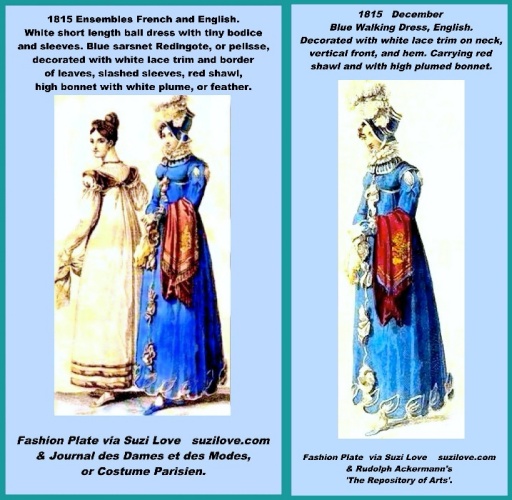
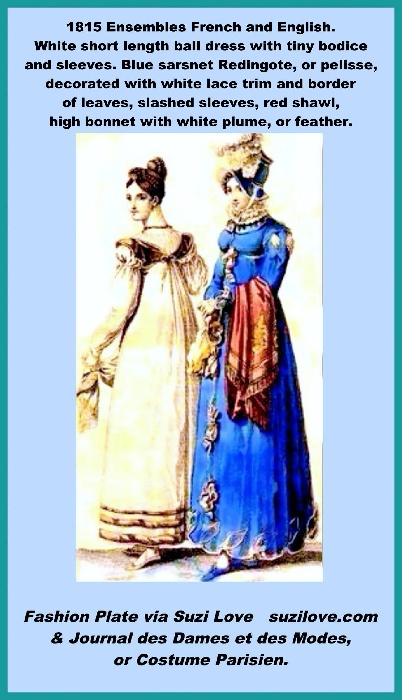
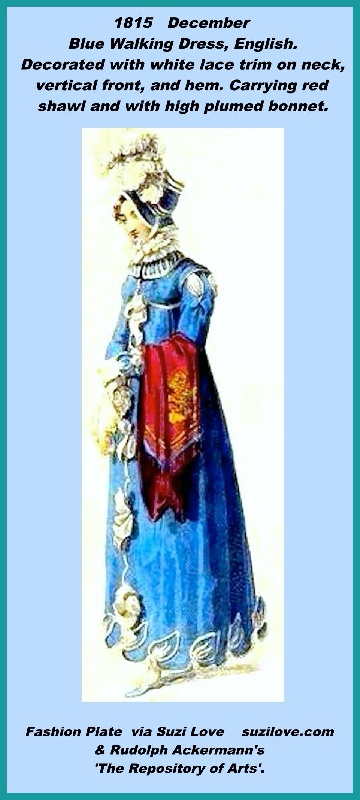
Here is an example of when English magazines copied French fashion plates. 1815 December Left: French fashion plate Ensembles French and English via Journal des Dames et des Modes. White short length ball dress with tiny bodice. Right: English fashion plate by Rudolph Ackermann in the Repository Of arts. Blue sarsnet Pelisse, or Walking dress, or Redingote. Decorated with white lace trim on neck, vertical front, and hem. Carrying red shawl and with high plumed bonnet.
Typical of the outfits worn by Jane Austen and her contemporaries for daytime and evening activities. An Empire style, or high-waisted white dress with jewelry for evening and for daytime a Pelisses or Walking Dress or Redingote or coat for warmth and with pretty hats, shawls and shoes.
Here is an example of when English magazines copied French fashion plates.
1815 December Left: French fashion plate Ensembles French and English via Journal des Dames et des Modes. White short length ball dress with tiny bodice.
Right: English fashion plate by Rudolph Ackermann in the Repository Of arts. Blue sarsnet Pelisse, or Walking dress, or Redingote. Decorated with white lace trim on neck, vertical front, and hem. Carrying red shawl and with high plumed bonnet.1815 December Ensembles French and English. White short length ball dress with tiny bodice. Blue sarsnet Pelisse, or Walking dress, or Redingote. Decorated with white lace trim on neck, vertical front, and hem. Carrying red shawl and with high plumed bonnet. via Journal des Dames et des Modes. 1815 December Blue Walking Dress, English. Decorated with white lace trim on neck, vertical front, and hem. Carrying red shawl and with high plumed bonnet. Fashion Plate via Rudolph Ackermann’s ‘The Repository of Arts’.
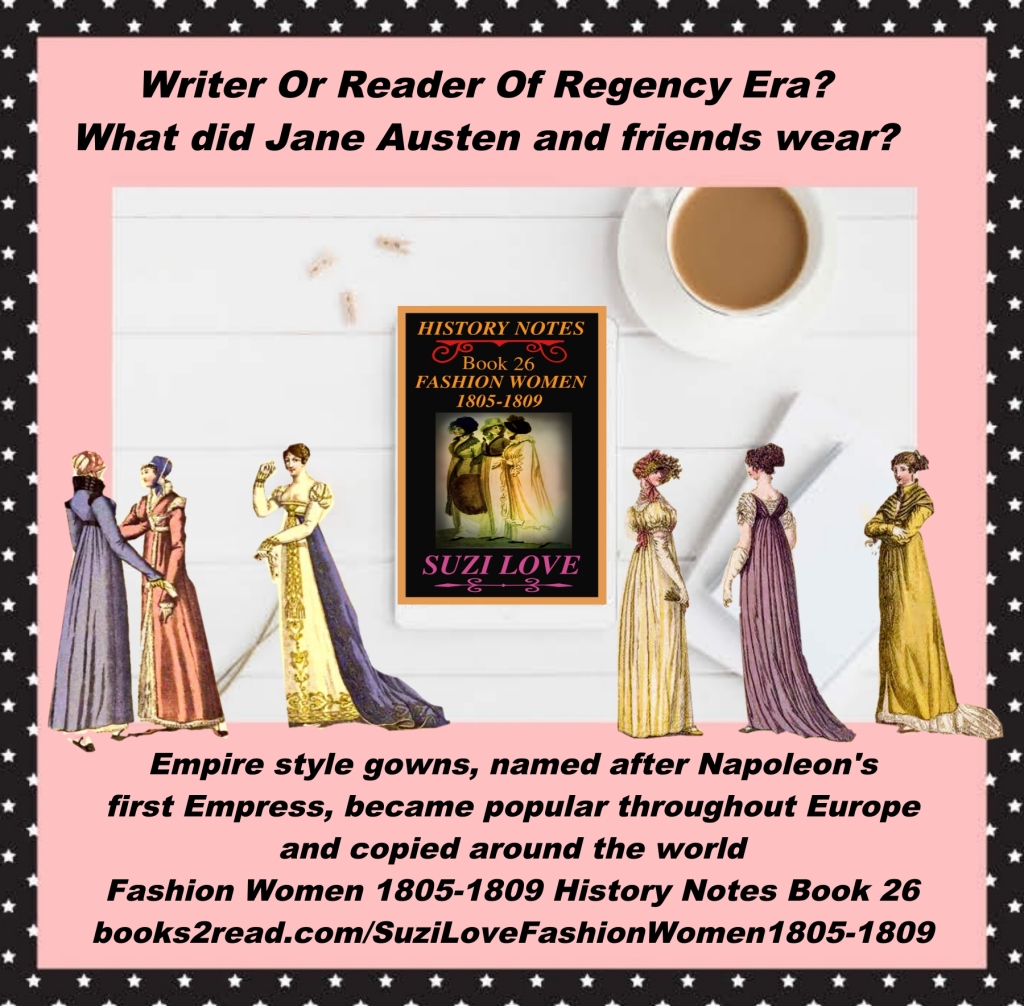
What did Jane Austen and friends wear? Early 1800s fashions were elegant and pretty with high waists and fabrics that were almost transparent. These Empire style gowns, named after Napoleon’s first Empress, became popular throughout Europe, and were then copied around the world. Colorful outwear was added to make an ensemble more attractive and warmer. History Notes Book 26 Fashion Women 1805-1809. https://books2read.com/SuziLoveFashionWomen1805-1809
What did Jane Austen and friends wear? Early 1800s fashions were elegant and pretty with high waists and fabrics that were almost transparent. These Empire style gowns, named after Napoleon’s first Empress, became popular throughout Europe, and were then copied around the world. Colorful outwear was added to make an ensemble more attractive and warmer.
https://books2read.com/SuziLoveFashionWomen1805-1809
Fashion Women 1805-1809 History Notes Book 26 What did Jane Austen and friends wear? https://books2read.com/SuziLoveFashionWomen1805-1809
Lover of Bridgerton and Jane Austen fashions? What was fashionable for their outer wear? Different names in different countries: Pelisse, Redingote, Or Walking Dress. #Regency #Fashion #History http://books2read.com/suzilovePelisse
The Pelisse or Redingote was essentially a coat or robe like garment worn both indoors and out. Worn indoors open to reveal a dress, the outdoor version was made of heavier materials and of darker colors than the type worn indoors. The name comes from the term ‘riding coat.’ In the Georgian Era, Redingotes were worn by men, women and children when outdoors and especially as part of a riding costume by both sexes.
In England, the Pelisse was the main sort of fashionable outerwear, or coat, for women in the Regency Era, or Jane Austen’s times. Though this sort of coat was popular from the late 1700s until around 1850. In the early 1800s, this sort of Empire style coat reached the hip or knee but around 1810 the Pelisse lengthened to become a full length coat. Around 1812, the Pelisse often had a broad, cape-like collar with fur trim and thanks to the Napoleonic Wars and an avid interest in all things military, a Pelisse took on a military look with epaulettes and braiding very popular.
While the terms Redingote and Pelisse are often used interchangeably, Pelisse and Walking Dress and Carriage Costume were the names used in English Fashion Plates, whereas French Fashion Plates refer to the longer style of coats as a Redingote and the shorter shoulder capes worn by military men as a Pelisse.
Pelisse, Redingote, Or Walking Dress. History Notes Book 5 By Suzi Love. What was fashionable for outer wear in past centuries? Call them what you like: Coat, Pelisse, Redingote, Walking Dress, Promenade Dress. Take a look at what was being worn by women, men, and children. books2read.com/suzilovePelisseD2D_RetailerBuyLink_HN_5_books2read.com/suzilovePelisse
What did Jane Austen and friends wear? Early 1800s fashions were elegant and pretty with high waists and fabrics that were almost transparent. These Empire style gowns, named after Napoleon’s first Empress, became popular throughout Europe, and were then copied around the world. Colorful outwear was added to make an ensemble more attractive and warmer. History Notes Book 26 Fashion Women 1805-1809. https://books2read.com/SuziLoveFashionWomen1805-1809
The Empire waist gown defined women’s fashion during the Regency Era. ‘Empire’ is the name given in France to the period when Napoleon built his French Empire. High-waisted, loose gowns were adopted by the aristocracy as a symbol of turning away from the fussy, elaborate and expensive clothing worn in the 1700s. Jean-Jaques Rousseau advocated copying peasants and returning to a simpler life and more natural fashions. Unrestricting clothing was part of the new Democracy in France and these simpler and flowing fashions were adopted all over Europe, including Britain and despite the continual wars being fought against France during the early 1800s. Not even war stopped fashions from being copied everywhere.
Fashion Women 1805-1809 History Notes Book 26
What did Jane Austen and friends wear? This book looks at early 1800s fashions, which were elegant and pretty with high waists and fabrics that were almost transparent. These Empire style gowns, named after Napoleon’s first Empress, became popular throughout Europe, and were then copied around the world. Colorful outwear was added to make an ensemble more attractive and warmer.
https://books2read.com/SuziLoveFashionWomen1805-1809HN_26_D2D_FsshionWomen1805-1809