1900-1910 ca. Livingstone Medicine Chest, England. via Science Museum, London, U.K.
sciencemuseum.org.uk



1900-1910 ca. Livingstone Medicine Chest, England. via Science Museum, London, U.K.
sciencemuseum.org.uk
1817 April Ladies’ Voucher for all the Wednesday balls at Almack’s Assembly Rooms, London, U.K. in April 1817. The voucher is for the Marchioness of Buckingham to attend the balls at Almack’s “on the Wednesdays in April 1817.” There are initials in the lower right hand corner marked, “MD”. These initials might be for Mary Marchioness of Downshire who may briefly have been a patroness ca. 1816-1817. The red wax seal is also intact on the front. “Pall Mall” is written on the back of the card.Via Huntington Museum, California, U.S.A. https://hdl.huntington.org/digital/collection/p15150coll7/id/10672/
Subscribers to Almack’s were allowed to bring a guest to a Ball, if they were approved first. They called at the Rooms in person and were either granted a Strangers Ticket of admission or were banned. Rooms were open for supper, gaming dancing lasting the night. At eleven o’clock, doors were closed and no one, not even celebrities were admitted. Once a young lady making her debut during the London Season had been granted a ticket to Almack’s, her social standing was assured. The Patronesses introduced the debutante to people of importance and selected her dance partners.


Michael Brandon nodded. “Yes, I’m related to Lord Brandon, Frederick, who disappeared four years ago.” He faced the sick man. “We searched everywhere for you. Men scoured the streets of London for weeks after you disappeared, and then we widened our search. Ports, inns, the countryside, anywhere you might have gone. Or anywhere that you might have been taken if you’d been kidnapped and held for ransom.”
Michael groaned. “Three years of nothing. Not a sign. The police declared you a missing person, most likely deceased, and told us to wait out the seven years until we could officially declare you dead.” He swiped at his eyes, brushing aside the gathering tears. He took Frederick’s hand. “But we never gave up hope. None of us, and especially not mother.”
Tears trickled down Michael’s cheek and he brushed them aside impatiently. He didn’t care that everyone saw his raw grief. He only cared that his brother, if this shell of a man truly was his previously vibrant brother, heard his words and understood the truth in them. The heartache and sorrow that they’d all carried for years. The pain they’d suffered thinking they might never set eyes on Frederick again.
“Your mother …” His words caught as a sob escaped him, echoing the continuing sobbing from Melissa behind him. “Your mother died a year ago, but her last words were a desperate plea for me to keep looking for you. To find you, and to bring you home.”
Michael watched tears trickle and run over the creases on the aged face before him, and he knew. This was Frederick, his constant companion during hundreds of childish escapades.
https://books2read.com/suziloveDS December Scandal, Book 3 Scandalous Siblings.


1805-1810 ca. High-Waisted White Muslin Evening Dress, Possibly Made in France. Embroidered in white cotton in French knots, with collars, border, and vertical stripe in chain stitch with a design down the front of vine tendrils and acorns. Low square neck with draw-cord, ‘stomacher’ front closing over inner lining flaps. Straight cut skirt gathers at back and fastens with tape tie. Long oval train, short sleeves with ‘vandyke’ trimming. An evening ensemble typical of the early 19th century love of Neo-classical where this high-waisted dress with short sleeves copies Greek and Roman shape and dress as seen in sculptures from the time. White muslin fabric was usually imported from India but in the case, made in Europe to imitate Indian materials. via Victoria and Albert Museum, London, UK. collections.vam.ac.uk. https://books2read.com/SuziLoveFashionWomen1805-1809
Definition Van Dyke Points: V-shaped lace and trims named after a 17th Century Flemish painter, Sir Anthony Van Dyck, known for painting V-shaped lace collars and scalloped edges on sitters.
Definition Empire Style: Named after the First Empire in France, by 1800 Empire dresses had a very low décolleté, or neckline and a short narrow backed bodice attached to a separate skirt. Skirts started directly under the bust and flowed into the classical relaxed wide styles of Greece and Rome. This style of dress is associated with Jane Austen and her contemporaries as a simple cotton high-waisted dress was worn most days and accessorized according to the importance of the occasion.


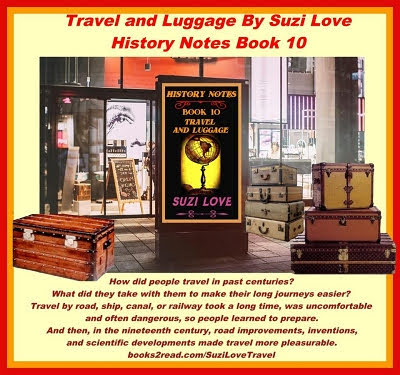
Travel and Luggage By Suzi Love History Notes Book 10. How did people travel in Bridgerton’s and Jane Austen’s times? What did they take with them to make their long journeys easier? Travel by road, ship, canal, or railway all took a long time and had dangers so people learned to prepare. And then, in the nineteenth century, road improvements, inventions, and scientific developments made travel more pleasurable. books2read.com/SuziLoveTravel

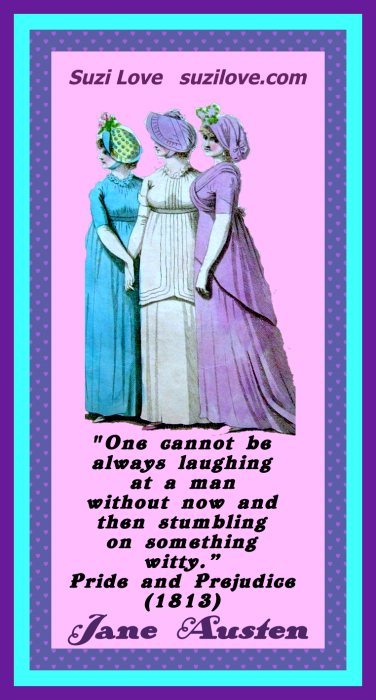
“One cannot be always laughing at a man without now and then stumbling on something witty.” Jane Austen Pride and Prejudice (1813) #JaneAusten #Quote #Regency

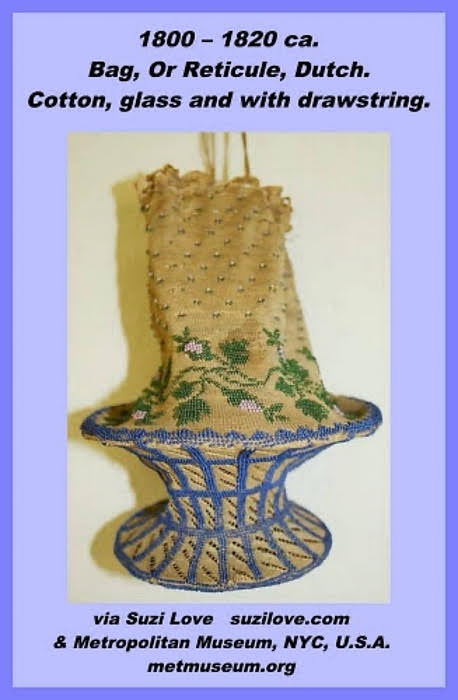
1800 – 1820 ca. Bag, Or Reticule, Dutch. Cotton, glass and with drawstring. via Metropolitan Museum New York City, U.S.A. metmuseum.org http://books2read.com/suziloveReticules Because reticules were so popular, Jane Austen and her family and friends and the Bridgerton family would have made reticules for each other for gifts and carried these small purses with them whenever they went out.
From Historic Dress In America: ‘Reticules were so universally carried during the first part of the nineteenth century that they were called Indispensables, and a few years later ridicules. Miss Southgate describes one in a letter in 1802, ‘Martha sent me a most elegant Indispensable, white lute-string spangled with silver…’
Definition Reticule Or Bag or Purse: Often with a drawstring to pull closed and usually made of cloth or covered cardboard and often decorated with beading or embroidery. A reticule, or purse, or handbag, was usually carried by a woman during the Regency period to carry all their daily necessities. Earlier, women used pockets that tied at the waistline and were hidden in the folds of their skirts. Empire style, or early 1800s, high-waisted dresses made it impossible to either sewn in a pocket or to tie on a pocket. So women began carrying small, decorated bags called Reticules, or ridicules, which generally pulled close at the top with a drawstring.
• Beadwork: Attaching beads to one another by stringing with a needle and thread or thin wire, or sewing them to cloth. Includes loom weaving, stringing, bead embroidery, bead crochet, and bead knitting.
• Embroidery: Decorating fabrics with a needle and thread, or cloth, such as a needlepoint picture of a house or hand sewn initials.

I love golf and I love bits and pieces of history, so these facts on Golf Holes combine my two loves,
Suzi
The 18 holes come from the renovations of the Old Course at St. Andrews, the ostensible first golf course from 1400’s.
In 1848 or so, with the invention of the new, cheap, golf ball, the Brits went golf mad, like the tennis buffs in the 1970’s and the joggers in the ‘1980’s. They were churning up the Old Course something fierce, playing the 9 holes both directions, (this was way it was done, up, then back same course.)
So decisions were made to alleviate the problem. First thought was to extend the course and bring it around into a circle, ending at beginning. This was met with great uproar and consternation. So the additional 8 greens were added by increasing the width and people go up “the back nine” and back the additional.
Then George V saw what they had done and had an 18 hole course built at Richmond Palace, with the object in mind to provide the people who couldn’t afford the private clubs a golf course. Old Course at St. Andrews 18 hole, this Prince’s and the subsequent Duke’s courses are part of the heart of the British people.
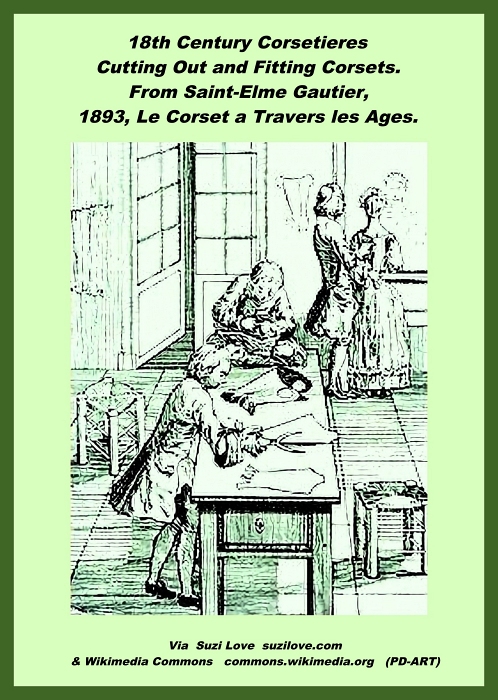
There has been some discussion on the names for Corset Makers. I’ve seen lots of names, including Stay Maker, Stay Manufacturer, Corset Maker, Body Tailor and Milliner. It was mainly men who were Stay Makers, but there were also some women who included stay making with their millinery.
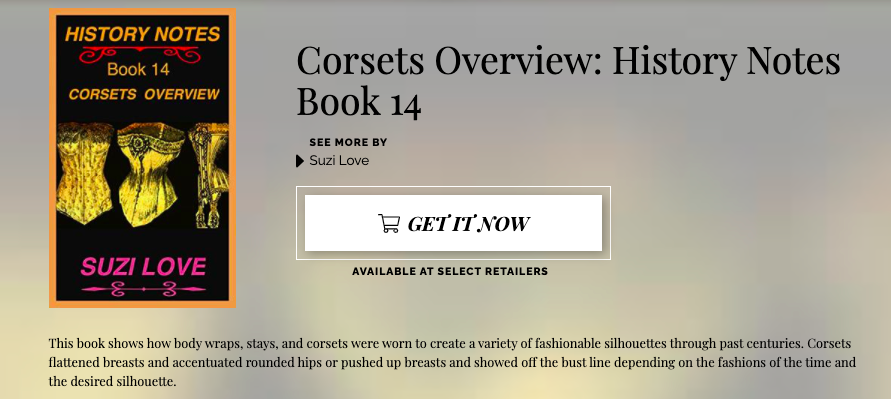
Corsets Overview History Notes Nonfiction Book 14. This book shows how body wraps, stays, and corsets were worn to create a variety of fashionable silhouettes through past centuries. Corsets flattened breasts and accentuated rounded hips or pushed up breasts and showed off the bust line depending on the fashions of the time and the desired silhouette. Includes corsets through the Georgian, Regency, Victorian and Edwardian Eras and Jane Austen’s lifetime. Overview of corsets through history, including the Georgian, Regency, Victorian and Edwardian Eras and Jane Austen’s lifetime.


19th Century Early Women’s Cotton Caps. Worn as morning caps, night caps, or under other hats. The proper 19th century woman wore various forms of headwear throughout the day and evening. Unstructured, finely decorated cotton caps were worn in the morning hours with the informal attire appropriate for the early part of the day. Jane Austen and her family and female friends, and the Bridgerton family, would have worn caps like these, sometimes during the morning at home, to bed to keep their long hair from becoming knotted, or under a bonnet to hold a hairstyle in place. via Museum of Fine Arts, Boston, U.S.A. mfa.org
Definition Boudoir Or Morning Cap: worn by women in the privacy of their ‘boudoir’ and was not a simple night-cap but a lightweight, decorated cap which covered the hair before it was dressed for daytime activities or for at-home pursuits.
Definition Cornette or Morning Cap: Muslin or other lightweight material, worn to cover hair during at-home pursuits such as reading or sketching, tied under chin and sometimes worn under bonnet.
Definition Lappets: Two long strips of material, often lace, hanging from top of head down back or over shoulders. Sometimes extensions of a headdress and a requirement for court dress.

