Want a HOT Regency Romance for the holidays? “You want me to be your mistress?” The Countess of Dorchester’s sculpted brow rose in an exaggerated show of disbelief. #christmas #holidays #RegencyRomance #HistoricalMystery #EroticHistoricalRomance books2read.com/suziloveFTAV
Christmas: Wassail Bowl History #Christmas #holidays #Traditions #Customs
The term wasseling refers to the jovial revelry and carousing that went on in historic England when all classes of society would gather around a common banquet-table and the wassail bowl and indulge in the most unrestrained joviality and merriment around.
Wassail Bowl: Most great houses had a wassel-bowl, or cup, frequently of massy silver. Toasts were “Drine heil,” or “Was hail,” from which the howl derives its name but were replaced around the nineteenth century by “Come, here’s to you,” or “I’ll pledge you.” Now, we toast with the simplified version of ‘Here’s to you’. As the hour of twelve approached, carol-singers would prepare and bell-ringers would place themselves at their post to usher in the morning of the Nativity with lots of rejoicing and with bands of music parading the towns.
In some parishes in the West of England, carol-singers adjourn to the church to sing in Christmas-day, a remnant probably of popery, as in Catholic countries there were frequently church-services held at this time. In the 16th century, Tusser prescribed for Christmas: good drink, a good fire in the hall, brawn, pudding, and mustard withall, capon, or turkey, cheese, apples, nuts, and jolly carols. In rich houses, a wassail cup would be filled with rich wine, sweet and spicy, and with roasted apples bobbing on the surface. In poorer houses, the cup would hold ale with nutmeg, sugar, ginger, and roasted crab apples.
Drama and romance at the Duke Of Sherwyn’s snowbound country estate in the English countryside in December. Michael Brandon travels to introduce the woman he loves to family but is shocked when his missing brother, presumed dead for years, arrives at the country estate of the Duke Of Sherwyn where several people are stranded due to a severe snow storm. https://books2read.com/suziloveDS December Scandal, Book 3, Scandalous Siblings Series.
At the end of the winter term, schoolmasters would set their pupils to work on Christmas Pieces, samplers of writing on superior paper with engraved borders, to show parents how they had progressed during the year. By about 1820, the engraved borders were enhanced with color and the children’s pieces became more decorative.
However, the custom of sending cards at Christmas was started in the United Kingdom in 1843 by Sir Henry Cole. Postage had been standardized three years earlier and Cole was a civil servant who had played a key role in initiating Uniform Penny Post. He wanted ordinary people to become more interested in the new ‘Public Post Office’. With his artist friend John Horsley, they designed the first card which was issued from a periodical, Felix Summerley’s Home Treasury, and were sold for 1 shilling each.
The card was lithographed, hand-colored, had three panels and was in a rustic frame of carved wood and ivy. The outer two panels showed people caring for the hungry and the naked. The centre panel showed a family of three generations having Christmas dinner, although the temperate classes strongly objected to the idea of a child being given a glass of wine with dinner.
New railways carried more post, and a lot faster, than a horse and carriage so the Post Office offered a Penny stamp. Cards became even more popular when they could be posted in an unsealed envelope for one halfpenny. Christmas cards became truly popular when printing improved and cards could be produced in large numbers, around 1860. By the early 1900s, the custom had spread over Europe and especially in Germany.
Early cards usually pictured Nativity scenes, but in the late Victorian times, robins and snow-scenes became popular because the postmen wore red uniforms and were nicknamed ‘Robin Postmen’. Snow-scenes were also popular because they were a reminder of the very bad winter of 1836.
Snow scenes reflected the snowy and often harsh northern hemisphere winters when opening and reading Christmas cards was an enjoyable family experience. In 1860, Charles Goodall & Son, a British publisher of visiting cards, began mass producing cards to be used for visits during the Christmas period. These Christmas and New Year’s visiting cards were decorated with simple designs such as a twig of holly or flowers.
Sales of cards grew and designs and sizes changed. The first cards were meant to appeal to the masses and encourage them to send large numbers by post, so rather than focus on religious images, they showed sentimental or humorous images of family and children, fanciful designs of flowers, fairies, or reminders of the approach of spring. Religious themes of nativity scenes, children looking at the manger, or angels and candles remain popular to the modern day.
Cards could be shaped like bells, a fan, a crescent, a circle, or a diamond and were folding, decorated with jewels, iridescent, embossed, and carried either simple Christmas and New Year greetings or had verses and carols written in them. The next year, Mr W.C.T. Dobson produced a sketch symbolizing the ‘Spirit of Christmas’ which sold many more than the previous thousand and the novelty caught on.
Many artists became famous for their annual illustrations that became postcards and cards. Printing technology became more advanced in the age of industrialisation and the price of card production dropped. With the introduction of the halfpenny postage rate, the Christmas card industry industry increased until in 1880 11.5 million cards were produced.
“Bells are musics laughter.” By Thomas Hood (1799-1845), British poet and humorist.
Bells hold a long time association with Christmas. In Victorian times, carol singers used small handbells to play the tune of the carol. Sometimes there were bells without singing – Church bells are rung after sunset to signal the start of the Christmas Eve service, the first of Christmas. In England, the bellman goes round at midnight ringing his bell, and rattling off a stanza or two, for the gratuity which he confidently anticipates; while watchmen, firemen, rate-collectors, postmen, chimney-sweeps, street scavengers, the errand-boys of your baker, butcher, poultry merchant, and green-grocer, even to the hired singers in the churches all expect their Christmas-box. In Victorian times, carol singers used small hand bells to play the tune of the carol and sometimes there were bells without singing. Church bells are rung after sunset to signal the start of the Christmas Eve service, the first of Christmas.
The Bellman
The Bellman stands full face, shouting with wide-open mouth and ringing his hand-bell.
In his left hand he holds out his verses headed by a little figure of Napoleon wearing a huge tricorne and holding a gigantic sword:
‘This little Boney-says he’ll come At merry Christmas time,
But that I say is all a hum Or I no more will rhyme
Some say in Wooden house he’ll glide, Some say in air Balloon,
E’en those who airy schemes deride. Agree his coming soon.
Now honest people list to me, Though Income is but small, I’ll bet my Wig, to one Penney, He does not come at all.’ Hand-colored etching and aquatint.
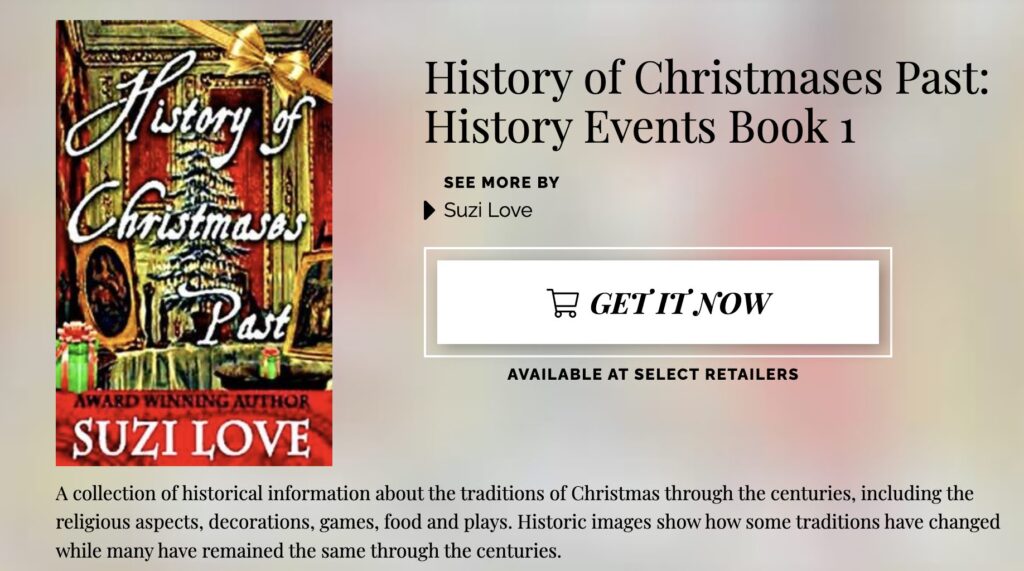
How did they celebrate Christmas in Bridgerton and Jane Austen times? Historical information about the traditions of Christmas through the centuries, including the religious aspects, decorations, games, food and plays. History Of Christmases Past has lots of information and images about Christmas through the centuries, including religious aspects, decorations, games, food and plays. Historic images show how some traditions have changed while many have remained the same through the centuries. books2read.com/suziloveHOCP
Christmas: Typical Christmas Food Eaten By the Bridgerton and Jane Austen Families. #Christmas #Food #JaneAusten #Bridgerton
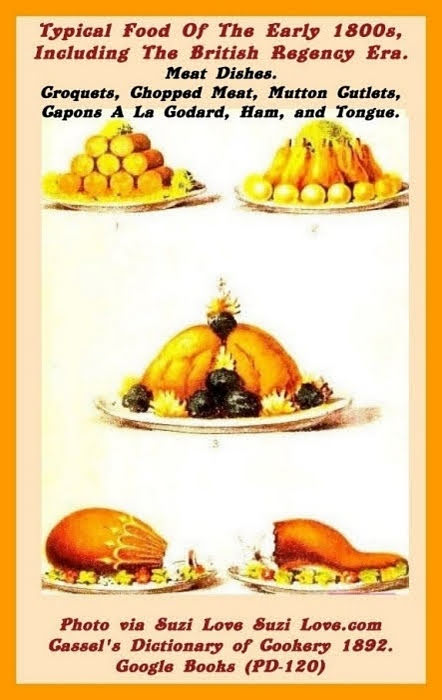
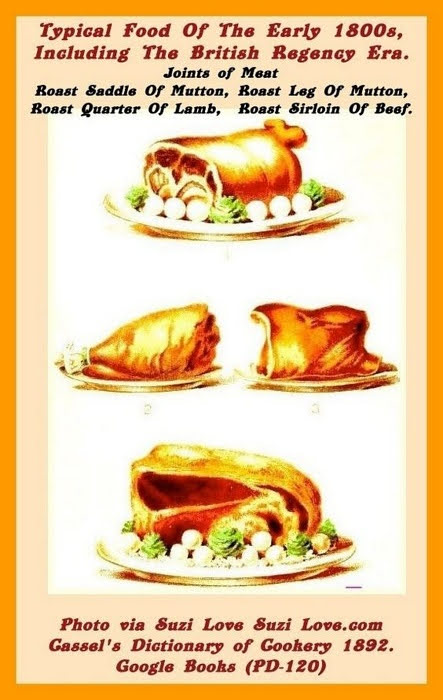
On the Christmas menu was generally mince pies and perhaps a goose or a piece of beef, depending on the family’s wealth and status. Mince pies were not made of fruit mince as we do now, but of offal or meat such as bullock’s tongue cooked with spices, orange peel, and wine and then used to fill pastry cases.
Another Christmas specialty was a Yorkshire Christmas pie which would be filled with turkey, goose, a hen, or perhaps woodcocks, partridge, or pigeons. And after the main courses, came the Plum Pudding, mixed on Stir-Up Sunday according to each family’s recipe and then boiled in a cloth.
‘The following is a valued receipt that has been handed down in a Cornish family for many generations, and the hand-writing of the receipt book will vouch for its antiquity. ‘A pound of beef-suet chopped fine; a pound of raisins do. stoned. A pound of currants cleaned dry. A pound of apples chopped fine. Two or three eggs. Allspice beat very fine, and sugar to your taste. A little salt, and as much brandy and wine as you like. An ancient Cornish custom at Christmas.” A small piece of citron in each pie is an improvement.’ From: 1833 Christmas Carols, Ancient and Modern by William Sandys.
Mince meat pies, or Christmas or Twelfth Night pies, were always part of Christmas feasts. Originally the mince pies were oblong or oval but in the 1600’s, the pies became circular, although were quite large and could weigh up to 20 lbs. In London, they could be brought out on Lord Mayor’s Day which was the 9th of November.
Timeline of Mince Pies via Minced Pie Club.
In the 13th century, crusaders returned from the Middle Eastern with recipes containing meat, fruit and spices mixed together, which helped preserve meat without having to smoke, dry or salt.
1413 King Henry served a mincemeat pie at his coronation.
1588 Good Hous-Wiues Treasurie by Edward Allde: meats were still cut up to be eaten with a spoon and combined with fruits and heavy spices. His recipe for Minst Pye had practically the same ingredients as modern mince pies.
1657 Mince Pies were banned during the reign of Oliver Cromwell, along with other Christian traditions that were classed as gluttony.
1659 Oliver Cromwell’s Puritan influence spread to the American British Colonies and many towns banned mincemeat pies at Christmas time.
When pies were reintroduced in Britain, they were a lot smaller and could be served individually to guests and were named Wayfarer pies.
1832 Bill of Fare: no less than one hundred and eleven dishes of mince pies included.
More Minced Pie Trivia
When the monarchy was restored in 1660, the law regarding Minced Pies was disregarded but apparently never repealed so Mince pies are still, supposedly, illegal.
Pastry crusts sink in the middle and are thought to resemble Jesus’ manger so sometimes a small pastry doll was put in the middle and these were called crib pies.
Pies could last up to two months in cold weather.
Recipes varied by region, but usually included beef, poultry and other meats, suet, sugar, raisins or currants, spices, orange and lemon peel, eggs, apples and brandy.
Minced-meat was only supposed to be stirred clockwise, otherwise the stirrer would have bad luck in the coming year. bring bad luck for the coming year.
Filling included cinnamon, cloves and nutmeg to represent the gifts of the Magi to the infant Jesus and the star shaped pastry on top represents the star of Bethlehem.
If you ate minced pie every day of the twelve days of Christmas you were supposed to have twelve months of happiness, especially if the pies were baked by the dozen and offered by friends.
At Christmas time, households had guests to stay and games were played to either fill in the time inside when the weather was too bad to venture out with sleds or skates, or to keep tradition. Blind man’s bluff, forfeits, and snap dragon were all played.
A list of some entertainments for Christmas…From The book Of Christmas by Thomas kibble Hervey. “jugglers, and jack-puddings, scrambling for nuts and apples, dancing the hobby-horse, hunting owls and squirrels, the fool-plough, hot-cockles, a stick moving on a pivot, with an apple at one end and a candle at the other, so that he who missed his bite burned his nose, blindman’s buffs, forfeits, interludes and mock plays :” — also of ” thread my needle, Nan,” ” he can do little that can’t do this,” feed the dove, hunt the slipper, shoeing the wild mare, post and pair, snap dragon, the gathering of omens….
Snap Dragon A favorite game was Snap Dragon, often played on Christmas Eve. Raisins were put into a large, shallow bowl and brandy was poured over them and then ignited. Lights were extinguished to increase the eerie effect of the blue flames playing across the liquor. The object of the game was to reach through the blue flames and grab as many raisins as possible from the flaming brandy and pop them into your mouth. The risk of burning yourself increased the excitement.
Samuel Johnson’s Dictionary of the English Language in 1755 describes the. game as “a play in which they catch raisins out of burning brandy and, extinguishing them by closing the mouth, eat them”. According to an eighteenth-century article in Richard Steele’s Tatler magazine, “the wantonness of the thing was to see each other look like a demon, as we burnt ourselves, and snatched out the fruit.”
Snap-dragon was played in England, Canada, U/S.A, and probably other countries with British backgrounds. The words snap-dragon and flap-dragon can refer to the game, the raisins used in the game, or the bowl with brandy and raisins.
The first reference to Snap-dragon as a game is in Francis Grose’s Dictionary of the Vulgar Tongue in 1811. “Christmas gambol: raisins and almonds being put into a bowl of brandy, and the candles extinguished, the spirit is set on fire, and the company scramble for the raisins.” Snap-dragon as a Christmas parlour game was mentioned in 1836 in Charles Dickens’ The Pickwick Papers and in 1861, in Anthony Trollope’s novel Orley Farm. Lewis Carroll, in Through the Looking-Glass, and What Alice Found There in 1871 describes “A snap-dragon-fly. Its body is made of plum pudding, its wings of holly-leaves, and its head is a raisin burning in brandy.”
Agatha Christie’s book Hallowe’en Party describes a children’s party during which a child’s murder causes Hercule Poirot to be brought in to solve the case and at which Snap-dragon is played at the end of the evening.