Light-Hearted look at an Older Lady’s Life In Jane Austen’s Times, or early 1800s. An easy to read overview of what an older lady did, wore, and how she lived in the early 19th Century. Information for history buffs and pictures for readers and writers of historical fiction.
The older lady’s day usually started with her toilette in her bedroom, where her maid helped her dress for the day and styled her hair. After that, she would join her family downstairs for breakfast unless she preferred a tray with either tea or hot chocolate in her bedroom as she prepared for her busy day. Her day would be made up of speaking with the housekeeper and the cook about the week’s menus, assuring that the servants were all available that day and no one was ill, and checking the list of foods needed. She would also enquire if the laundry was up to date and that they had enough good linen to make up all the beds before extended family members and guests arrived. If she was in the country and hosting a weekend house party, she would assign rooms to the guests on her lists and query that all was in readiness for their arrival.
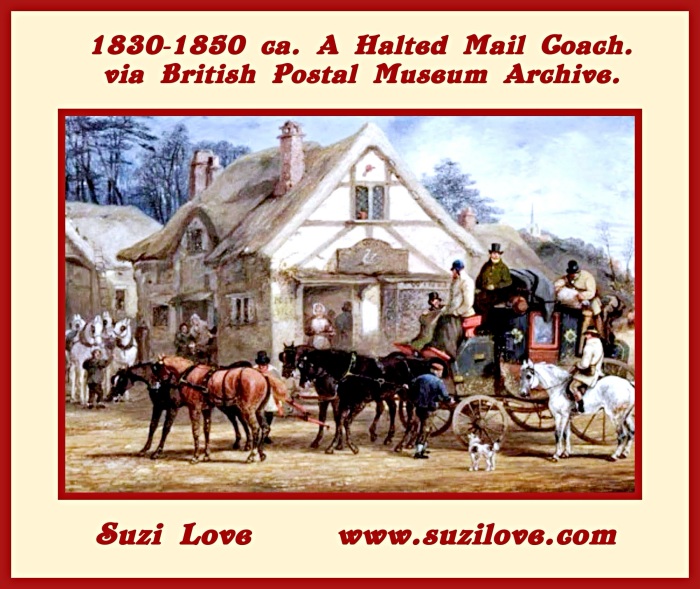
1830-1850 A Halted Mail Coach via British Postal Museum.
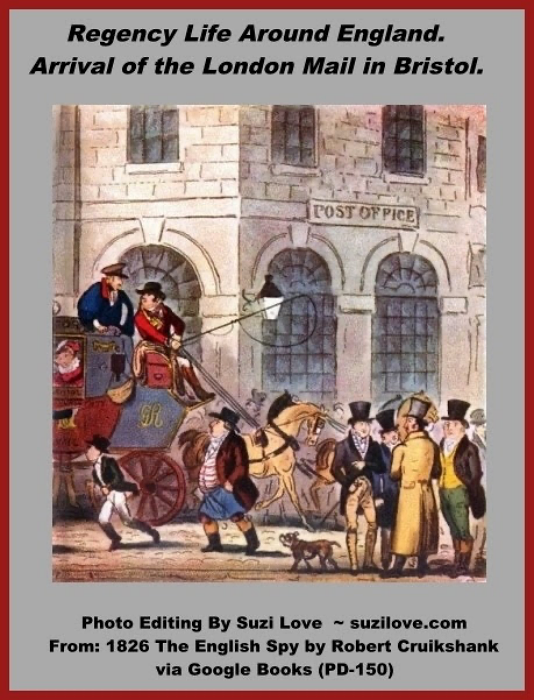
For many years in England, mounted carriers rode between posts and carried letters to and from local postmasters who delivered them to people in his area. The system was inefficient and post riders often robbed. John Palmer, a theatre owner, transported actors and materials and wanted to improve mail delivery so the Chancellor of the Exchequer, William Pitt, let Palmer try. He beat the old delivery time by 22 hours and brought the mail from Bristol to London in 16 hours. A year later, in 1785, the mail coach, sometimes called a post coach, was delivering mail from London to Norwich, Liverpool, Leeds, Dover, Portsmouth, Poole, Exeter, Gloucester, Worcester, Holyhead and Carlisle.
Palmer’s mail service improved after turnpike roads were introduced in the late 1780s, allowing faster travel and encouraged business between the proprietors of stage coaches.” The first mail coaches were supplied by contractors who received on average “one penny-halfpenny per mile.”, despite these contracted coaches being poorly built.. By the 1800s, the Post Office owned their own fleets of coaches with black and scarlet livery.
Mail coaches were usually drawn by four horses and took four passengers inside and three outside. The mail box was locked and secured at the rear of the coach and guarded by an armed Royal mail post office guard who followed strict rules.
Travel and Luggage By Suzi Love History Notes Book 10. How did people travel in Jane Austen’s times. In past centuries? What did they take with them to make their long journeys easier? Travel by road, ship, canal, or railway all took a long time and had dangers so people learned to prepare. And then, in the nineteenth century, road improvements, inventions, and scientific developments made travel more pleasurable. books2read.com/SuziLoveTravel
What Sort Of Pianoforte or Piano Was Played By Jane Austen and Contemporaries? Pianos, pianofortes and more. History Notes Book 7 Music Pianos books2read.com/suziloveMusicPiano
Definition Pianoforte or Piano: ‘Stringed keyboard instrument with a hammer action, as opposed to the jack and quill action of the harpsichord. Capable of gradations of soft and loud, the piano became the central instrument of music pedagogy and amateur study. By the end of the nineteenth century, no middle-class household of any stature in Europe or North America was without one.’ Definition via the Metropolitan Museum, NYC.
Around 1700, the Pianoforte, or Piano, was invented in Italy by Bartolomeo Cristofori, who created a hammer action keyboard instrument on which a musician could make changes in loudness by changing the force with which the keys were struck. He called his instrument “gravicembalo col piano e forte”, or, (harpsichord with soft and loud). Cristofori’s long name was later shortened to fortepiano or pianoforte, and finally just piano.
Musical Instruments were so important in most of the more affluent households in history that large industries grew all around the world to manufacture instruments, musical accessories, and to print sheet music. Pianos, pianofortes, harpsichords, and organs were found everywhere and were often the focus of a family gathering. By the end of the 18th Century, the pianoforte, or piano, was the leading instrument of Western music.
D2D_RetailerBuyLink_HN_7 Piano
books2read.com/suziloveMusicPiano
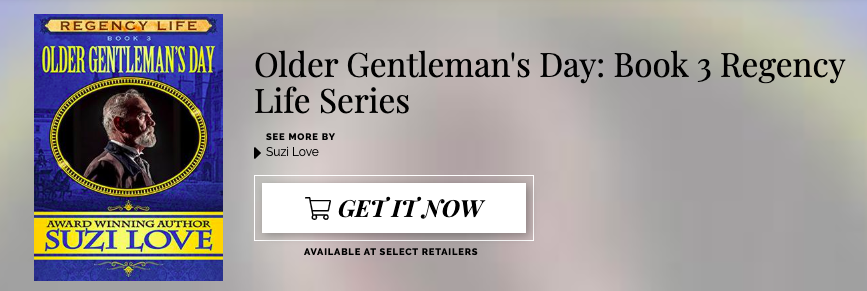
Writing Regency Era Fiction Or Nonfiction? Need more information on Older Gentleman’s Day in early 1800s, or the Bridgerton family or Jane Austen’s Regency Era. A lighthearted overview of an older gentleman’s clothing, social life, and responsibilities in the early 1800s. Take a look at where an older man went, what he wore, and how he managed the family’s finances and his estates. Older Gentleman’s Day Regency Life Series Book 3 books2read.com/suziloveOGD
An overview of an older gentleman’s clothing, social life, and responsibilities in the early 1800s. books2read.com/suziloveYGD
A portrait from 1810-1814 of Rudolph Ackermann, shop owner and founder of ‘The Repository Of Arts’ magazine, The Strand, London. via National Portrait Gallery, London. Plus, an image of Ackermann’s premises in 1809. His ‘Repository of Arts, Literature, Fashion, Manufactures, etc.’ was published from 1809 to 1829 with images of Regency London, Regency furnishings and grand homes as well as beautiful fashion prints and descriptions every month. Ackermann originally supplied artists, amateur and professional, with supplies for watercolor painting. In 1799, he began manufacturing and selling his own watercolor paint blocks which were supplied by other colourmen, although at least three colors were his own mixture – Ackermann’s Green, White and Yellow. From 1817, his eldest son Rudolph Ackermann junior was responsible for the watercolor manufacturing. Ackermann also trained as a carriage designer. He began publishing prints and colour-plate books like ‘The Microcosm of London’ and ‘Doctor Syntax’ in the early 1800s.
The Repository of Arts was one the most popular magazines in Jane Austen’s time as it displayed everything ladies wanted to learn e.g. history, important country seats and houses in England, music, current events such as theatre plays, plus fashion plates and embroidery patterns. Ackermann’s shop in The Strand, London, was one of the fashionable places to shop during the Regency Era. The Repository also included poetry, travel reports, society reports and upcoming lectures. It also included serious subjects e.g. politics, legal matters, medicine and agriculture, a meteorological journal and details of the London markets. In 1817, the price of the magazine was 4 Shillings, so quite expensive for the time.
In the first issue, published for January 1809, Ackermann included an ‘introduction to the history of the useful and polite arts’ which said: “It is universally admitted, that to cultivate a taste for the arts, and an acquaintance with the sciences, is a pleasure of the most refined nature; but to do this without regard to its influence upon the passions and affections, is to ‘tear a tree for its blossoms, which is capable of yielding the richest and most valuable fruit.’ The cultivation of this taste may and ought to be subservient to higher and more important purposes: it should dignify and exalt our affections, and elevate them to the admiration and love of that Being who is the author of every thing that is fair, sublime, and good in nature.”
1810-1814 Portrait of Rudolph Ackermann, shop owner and founder of The Repository Of Arts magazine. via National Portrait Gallery, London.
1809 January Ackermann’s Repository of Arts, 101 Strand, London, U.K. Drawn by Augustus Pugin and Thomas Rowlandson. Published By Rudolph Ackermann. Etching and aquatint with hand coloring.
Reader or Writer of Regency Era Books? Love the Bridgertons and Jane Austen? Nonfiction book, Older Gentleman’s Day, gives an overview of his daily life by Award Winning researcher and author, Suzi Love. A sometimes comical look at an older gentleman’s clothing, social life, and responsibilities in the early 1800s. Take a look at where he went, what he wore, and how he managed the family’s finances. Older Gentleman’s Day, Regency Life Series Book 3 books2read.com/suziloveOGD
Regency is the time period in England that began in 1811 when King George III had increasing bouts of madness and was finally declared mad. The Prince of Wales was officially named Regent, often referred to as “Prinny”, and the Regency period ran until 1820 when King George III died and the prince was crowned King George IV. The long Regency era is from the time of Jane Austen and the Napoleonic Wars until the time Queen Victoria ascended the throne.
RL_3_OGD_Older Man’s Day Regency Life Series Book 3 by Suzi Love #Regency #History books2read.com_suziloveOGD
Reader or Writer of the Regency Era? Love the Bridgertons and Jane Austen? Try Older Gentleman’s Day for an overview of daily life. #Bridgerton #RegencyEra #JaneAusten #nonfiction http://books2read.com/suziloveOGD
1806 Waiting For the St. Cloud Coach, Place de la Concorde, Paris. Illustrations by Francis Courboin. via Les Modes de Paris. (PD-Art) This couple is depicted waiting for the coach, which was a passenger vehicle drawn by four horses. The woman is wearing a fashionable hat or “capote” that covers her face. Her dress maintains the empire waist and has very long sleeves that also have a ‘mancheron’ or a gathered sleeve at the shoulders. The man is wearing a ‘habit du gagé’ or a coat with tails, buttoned at the waist. His hat is a ‘haut-de-forme’ or what is commonly known in English as a top hat. He wears tight, short pants tucked into large, riding boots, as was the fashion for men. Illustrations by François Courboin from Octave Uzanne‘s Les Modes de Paris. Variations du goût et de l’esthétique de la femme, 1797-1897, L. Henry May, Paris, 1898, or from the English translation of the same work: Fashion in Paris : the various phases of feminine taste and aesthetics from 1797 to 1897, William Heinemann, London, 1898. Modes de Paris VIa Brown University Library .
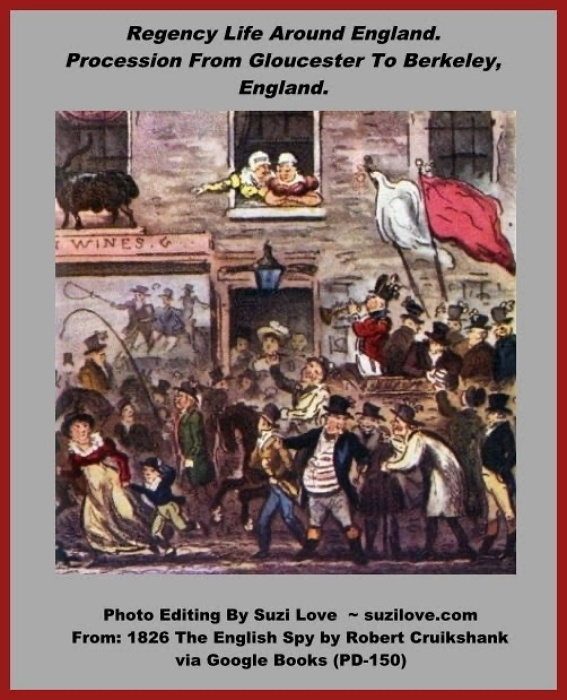
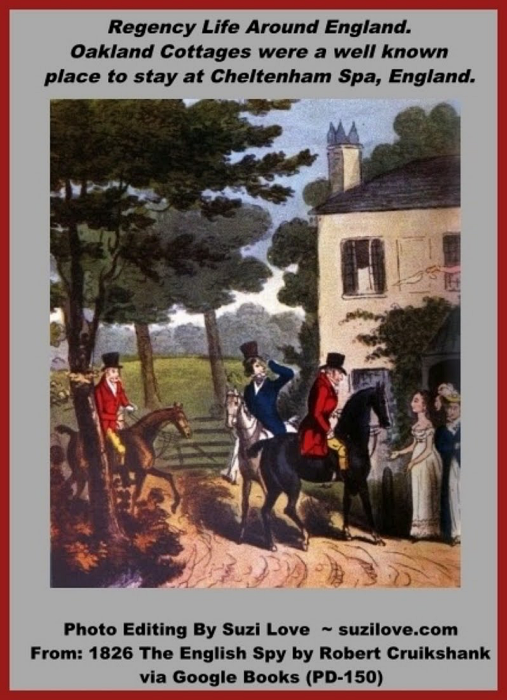
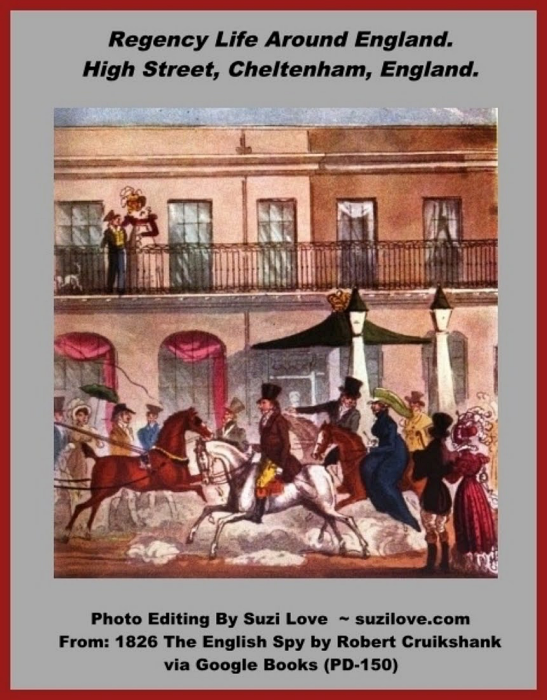
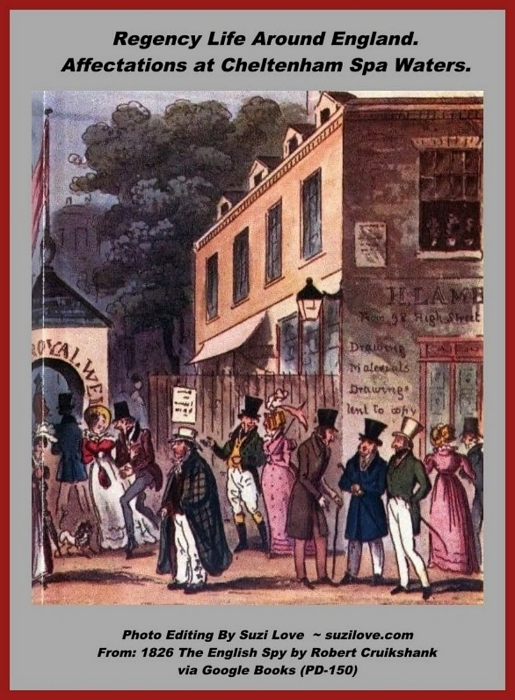
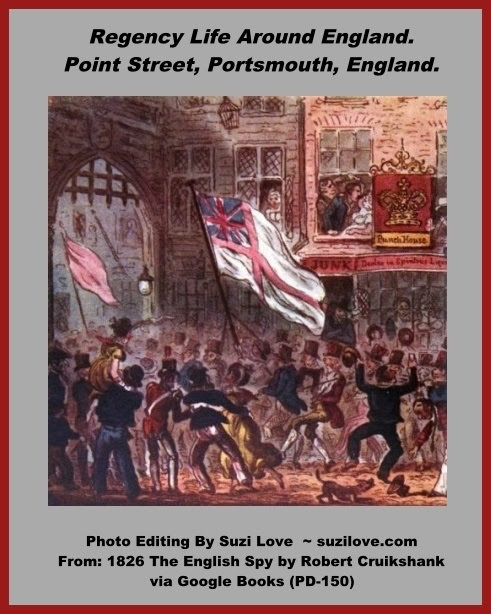
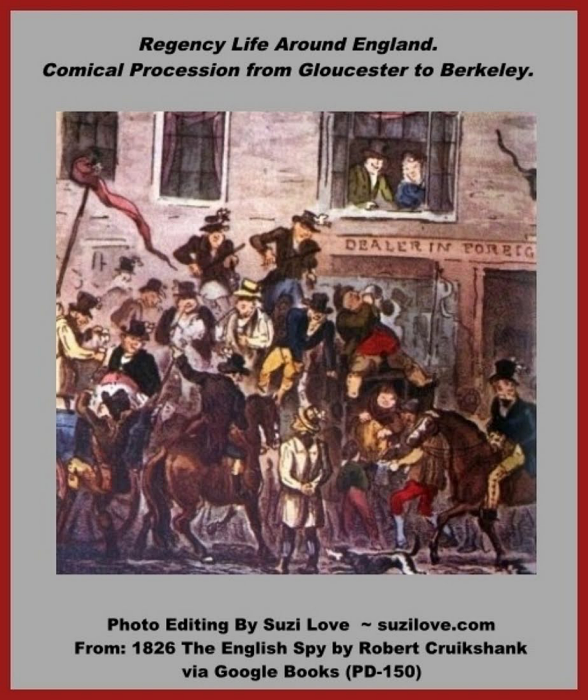
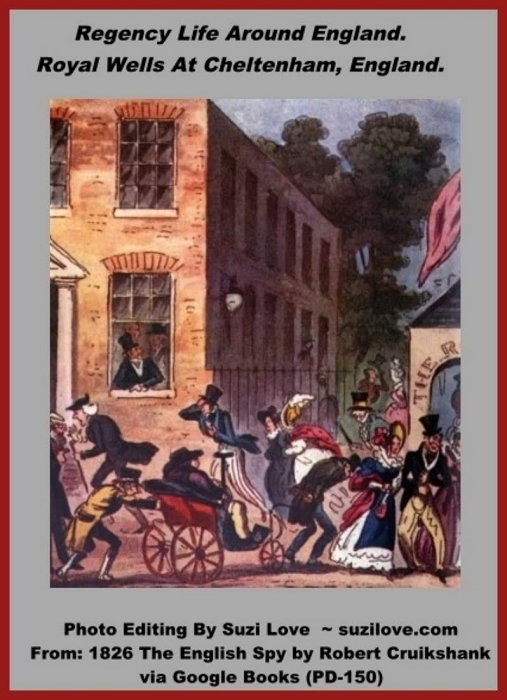
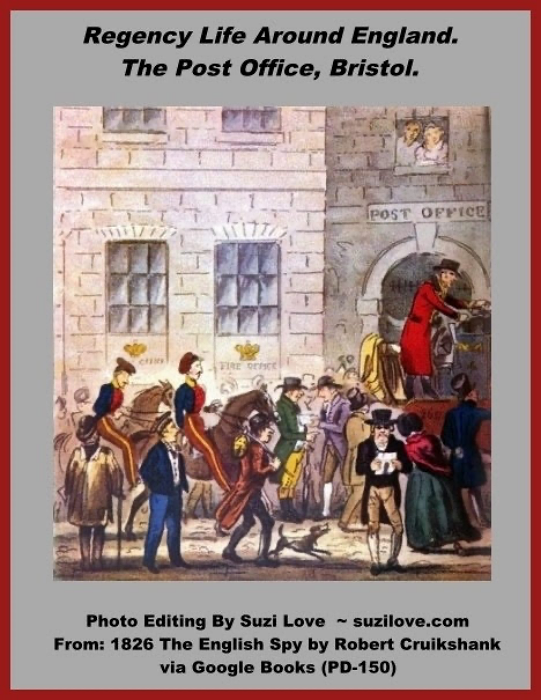
1826 Sights the Bridgertons and Jane Austen Saw Around Regency England. The sights that the families and friends would have seen around while traveling around England. via 1826 The English Spy By Robert Cruikshank via Google Books (PD-150)