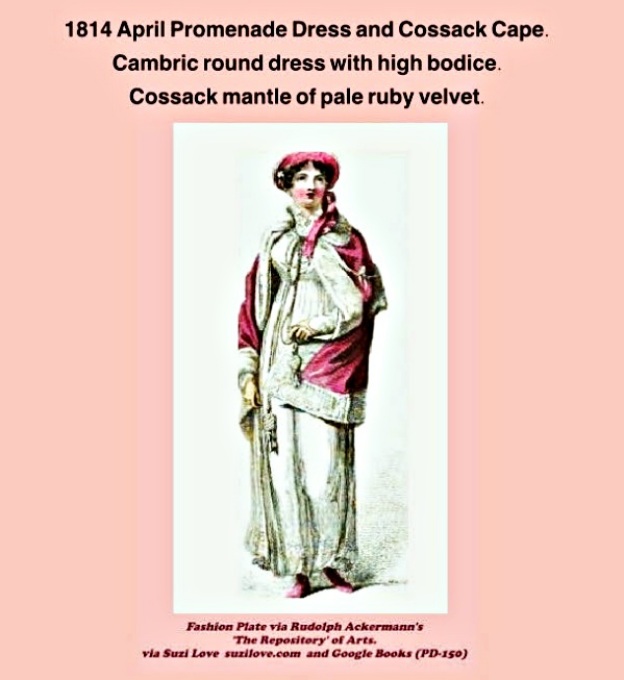
1808 Jane Austen Style Blue Redingote Over A White Dress. Green turban and lace veils. Bodice. Fashion Plate via Journal des Dames et des Modes, or Costume Parisien.
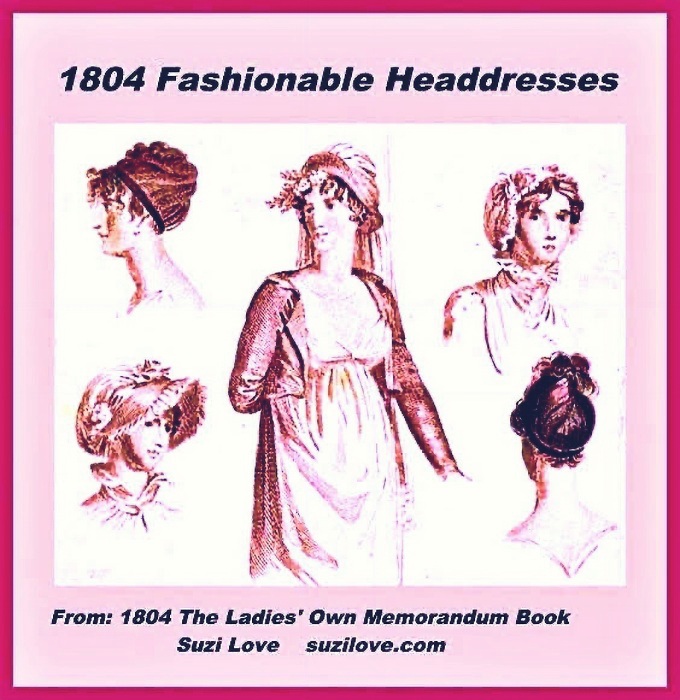
French fashions like this were copied by English magazines so these styles of hats would have been worn by Jane Austen and her contemporaries.
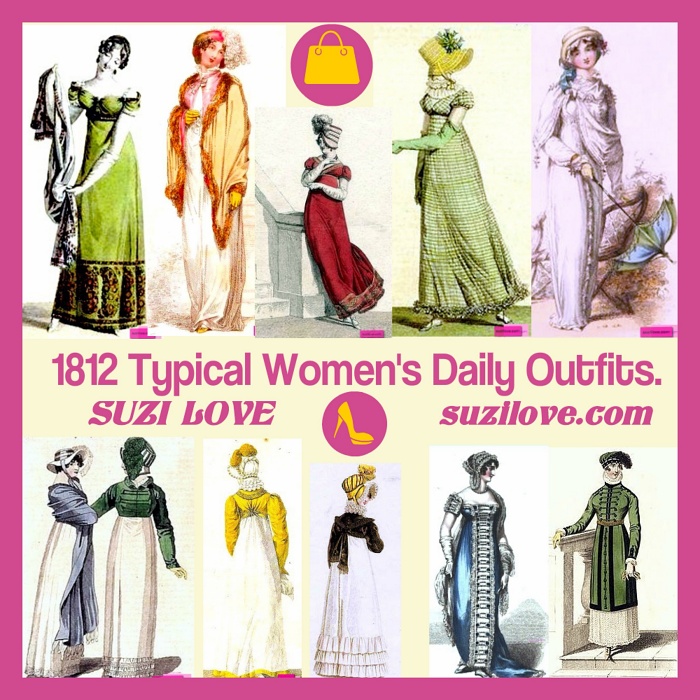
1800s Early Women’s Fashions Collage . Typical of the outfits worn by Jane Austen and her contemporaries for daytime and evening activities. An Empire style, or high-waisted white cotton dress worn under a Spencer or short jacket, a Redingote, or coat, for warmth and with pretty hats, shawls and shoes.Women’s Fashions By Suzi Love. High-waisted dresses, hats, muff, parasol, cape, reticule or bag and shoes.
Regency Era women’s fashions are elegant, pretty, and sometimes afford a gentleman a tiny glimpse of a well-turned ankle. Though to me, that sounds more like the lady has sprained her ankle rather than her ankle looking fashionably slim. High-waisted, or Empire style, white gowns defined women’s fashion during the Regency Era. ‘Empire’ is the name given to the period when Napoleon Bonaparte built his French Empire. High-waisted, loose gowns were adopted by the aristocracy as a symbol of turning away from the fussy, elaborate and expensive clothing worn in the 1700s.
Dress fabrics were thinner, sometimes almost transparent, which meant outerwear needed to be thicker and more practical. A coat, called a Redingote in France, a Pelisse in England, and a Walking Dress or Carriage Dress in Rudolph Ackermann’s fashion plates, became a necessity to keep out the chilling cold. Half cloaks, cloche or close-fitting hats, and accessories such as oversized fur muffs were very popular.
1800s Typical Meat and Game Meals served during the 1800s. These are the sort of dishes Jane Austen’s family and the Bridgertons would have eaten on a regular basis.
Pig’s Feet and Truffles, Lyons Sausage, Puree of Game and Rice, Pigeon Pie, Brawn, Calf’s Heart, Larks and Potatoes, Lamb Chops and Potatoes, Calf’s Tongue, Scotch Eggs and Forcemeat, Stuffed tomatoes, Hot and Cold Fowl and Jelly, Veal Cutlets and Olives, Veal Cutlets, Filet Of Beef In the Garden, Fillets Of Beef, Lamb Cutlets and Green Peas, Partridges, Garnished Ham, Garnished Tongue, Chicken Fricassée, Chicken Croquettes, Fricandeau Of Veal, Half Calf’s Head, Chartreuse Of Partridge, Timbale Milanese Or Macoroni.
From: 1860s Mrs. Beeton’s Book of Household Management. via Google Books (PD-150)
1815 ca. Tailcoat, Probably British. Black wool, silk cotton and wood. Double-breasted, cutaway at the front waist, notched collar, straight sleeves, pleat falling from the back waist. via Metropolitan Museum, N.Y.C., U.S.A. As Worn By the Men in the Families of Jane Austen and the Bridgertons. #Regency #JaneAusten #Fashion #BritishHistory
Tailcoat: A Regency Era, or early 1800s, gentleman was outfitted in more practical fabrics, such as wool, cotton and buckskin rather than the fussy brocades and silks of the late 1700s. The men in Jane Austen’s life would have worn a black tailcoat like this for everyday wear. https://books2read.com/SuziLoveFashionMen1800-1819
1792 Grand Piano, London, UK. Maker John Broadwood (1732–1812) Mahogany, oak, curly maple, ivory, ebony, brass. Credit: Mr. and Mrs. Jerome C. Neuhoff, 1957 via Metropolitan Museum New York City, U.S.A. metmuseum.org books2read.com/suziloveMusicPiano
19th Century Food For The Upper Classes In Bridgerton and Jane Austen Times.
Typical Meals Served for the upper classes in the Georgian and Regency Eras. For the Upper classes in the 18th and through to the end of the 19th century, meals were elaborate affairs. and served by well-trained staff anticipated their every need. Women prided themselves on hosting dinners for 50-60 people which often consisted of numerous courses, and all served with the best wines and followed, for the men at least, by expensive port.
An older lady usually controlled the servants and the serving of meals. For more about this, take a look at Older Lady’s Day Regency Life Series Book 5 by Suzi Love. Overview of what an older lady did, wore, and how she lived in the early 19th Century. Information for history buffs and pictures for readers and writers of historical fiction. books2read.com/suziloveOLD
1813 October Morning Dress, English. Jane Austen and her family and friends would have worn this style of relaxed dress and cap. White At-Home dress with morning lace cap and a red shawl. Plain cambric underdress, three-quartered muslin or Chinese silk robe trimmed round the bottom and up the front with Indian border, or needle-work, and finished with a deep flounce of lace. Convent hood and pelerine of white net lace, confined under the chin with a silk cord and tassel. Hair in irregular curls with a fancy flower in the front. Short rosary and cross, plus bracelets, of coquilla beads. Buff or lemon kid slippers and pale tan gloves. Fashion Plate via Rudolph Ackermann’s ‘The Repository of Arts’.
This is a typical outfit worn at home in the morning in the house, to be seen only by family or close friends. A lady might wear this while writing having breakfast, writing letters, or reading. Called by the various names of Undress, to At-Home dress, or Morning dress, it is the most relaxed ensemble a lady will wear all day. The sort of outfit Jane Austen would have worn when writing her books.
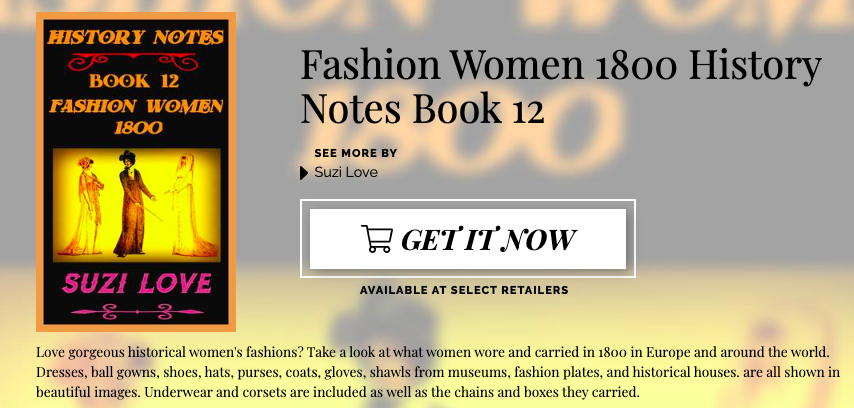
What did Jane Austen and friends wear? Early 1800s fashions were elegant and pretty with high waists and fabrics that were almost transparent. These Empire style gowns, named after Napoleon’s first Empress, became popular throughout Europe, and were then copied around the world. Colorful outwear was added to make an ensemble more attractive and warmer. History Notes Book 26 Fashion Women 1805-1809. https://books2read.com/SuziLoveFashionWomen1805-1809
The Empire waist gown defined women’s fashion during the Regency Era. ‘Empire’ is the name given in France to the period when Napoleon built his French Empire. High-waisted, loose gowns were adopted by the aristocracy as a symbol of turning away from the fussy, elaborate and expensive clothing worn in the 1700s. Jean-Jaques Rousseau advocated copying peasants and returning to a simpler life and more natural fashions. Unrestricting clothing was part of the new Democracy in France and these simpler and flowing fashions were adopted all over Europe, including Britain and despite the continual wars being fought against France during the early 1800s. Not even war stopped fashions from being copied everywhere.
1818 Blue Pelisse, Or Coat, English. Short puffed sleeves over long straight sleeves, military style braiding to decorate. matching shoes and high bonnet with feathers. Fashion Plate John Belle’s La Belle Assemblée or, Bell’s Court and Fashionable Magazine, London. The type of outfit young Regency Era ladies would have worn if they were out shopping on Bond Street, walking in a park, or taking a carriage ride through Hyde Park.
Definition Redingote Or Pelisse Or Walking Dress Or Coat: French word developed from English words, riding coat. Long fitted outdoor coat worn over other garments for warmth. Often left open at the front to show off the dress underneath. Sometimes cut away in front. Originally made with several capes and trimmed with large buttons. French fashion plates call these coats Redingotes and they are designed for women, men and children. English fashion plates call them a Pelisse, a walking dress, Promenade dress, or Carriage dress.
Carina, Countess of Dorchester, glanced out at the square for the twentieth time and clutched the window casing for support when she saw that striding along the pavement towards her house was an exceedingly tall man, dressed in up-to-the minute fashion and wreathed in an aura of power and control. The Duke of Stirkton cut such a superior figure that men stepped aside and women turned to stare as he passed them on the footpath. The fact that he was oblivious to their attention and admiration made him more interesting, and for the first time in many years, Carina felt a glimmer of hope.
“Oh, Gertie, yes, yes,” she said, clapping her hands and spinning in a giddy circle before the window. “I think Georgie’s way out is about to present itself, and sooner than we thought.”
Gertie joined her at the window but groaned aloud. “Oh, no, no, no, Carina! Not him. The Duke of Stirkton is not the best person to help us introduce the girls to gentlemen.”
“Why not? He may not be a perfect solution but, with his influence in society, he may provide our best way forward.”
“You were only going to ask to see his grandfather’s papers. Look at whatever the Duke may have already found, whether it’s letters, directions, or anything else to help us work out the names and locations of those two men.”