↓
 

Suzi Love

Making history fun, one year at a time.

Header_
  • Home
  • Newsletter
  • Pre order form
  • Shop
    • Cart
    • Checkout
    • My account
    • Refund and Returns Policy
  • Blog
  • BOOKS
    • History Events
    • Kelly’s Justice
    • Outback Arrival
    • Irresistible Aristocrats
    • History Notes
    • Scandalous Siblings
    • Love After Waterloo
    • Regency Life Series
  • Privacy Policy
  • EVENTS
Home » Music » Page 4 << 1 2 3 4 5 >>

Category Archives: Music

Post navigation

← Previous Post
Next Post→

1800 Highly Decorated Six String Guitar, Probably Italian, as used in Jane Austen’s lifetimes. #RegencyEra #JaneAusten #Music #Guitar

Suzi Love Posted on August 27, 2025 by Suzi LoveAugust 21, 2025

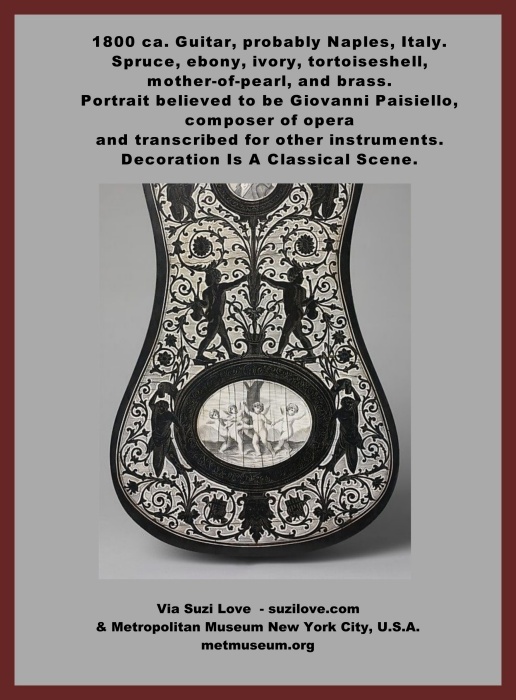
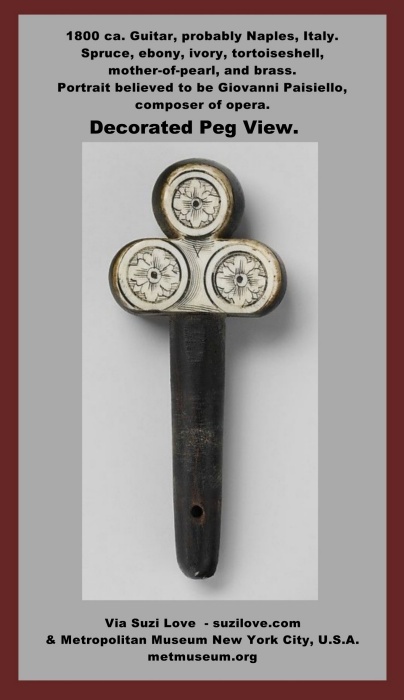
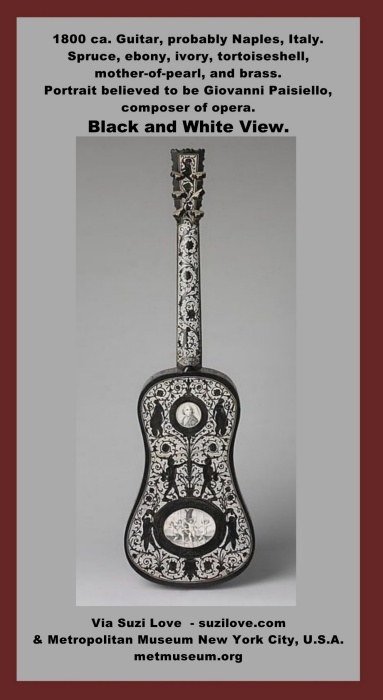
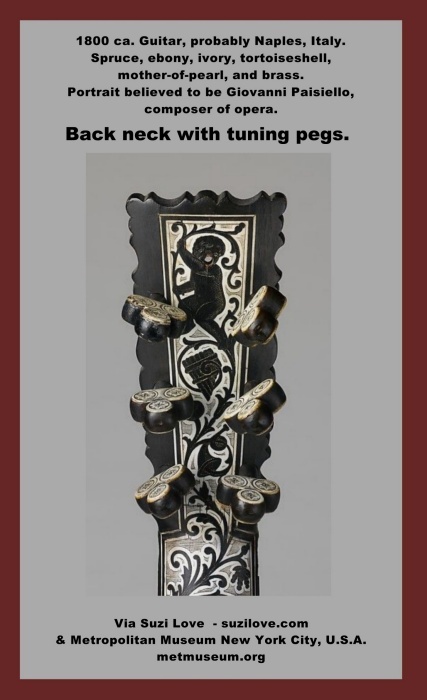
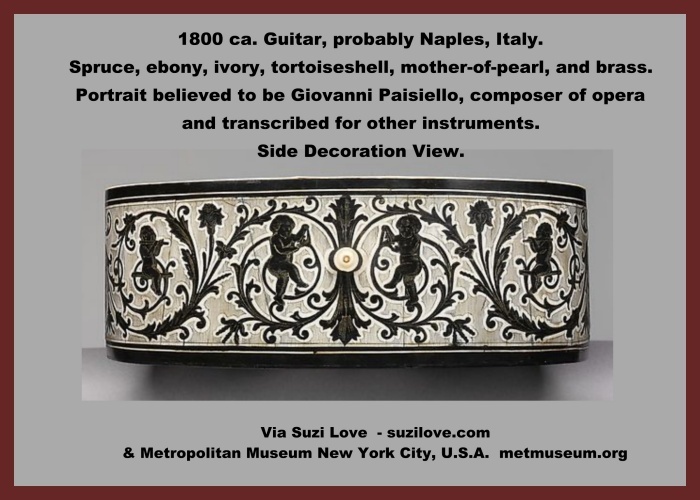
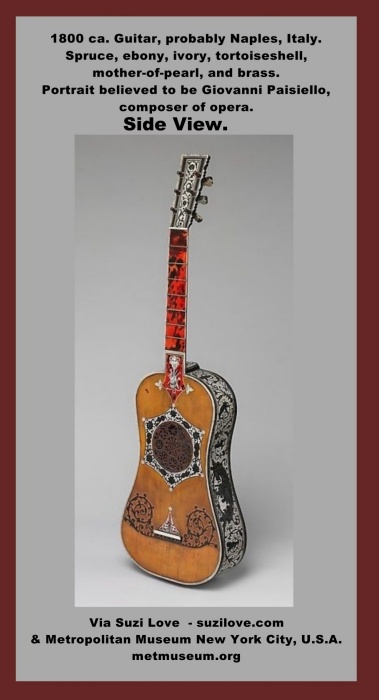
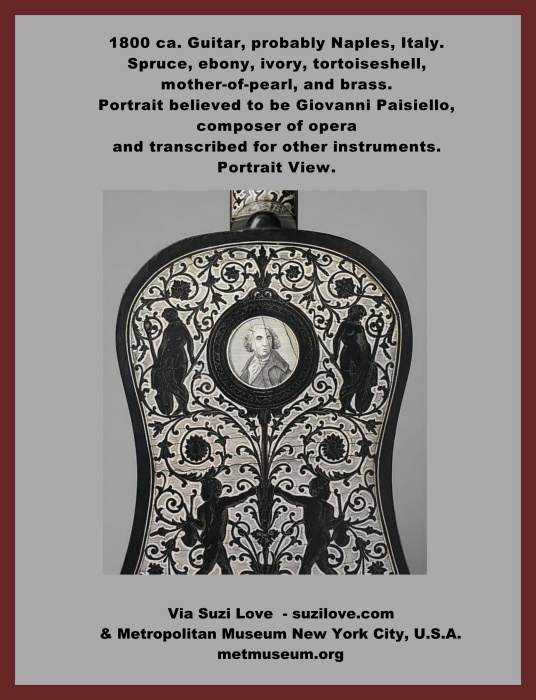
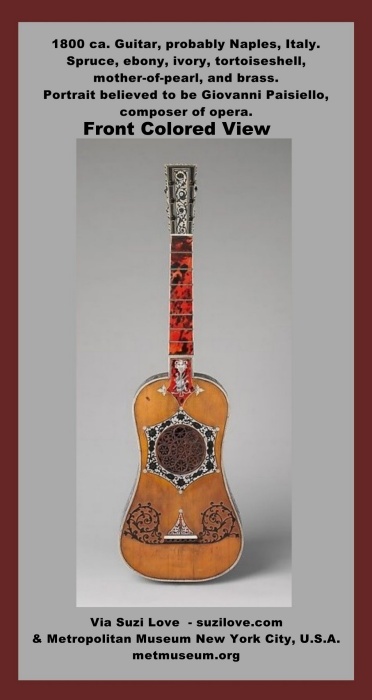
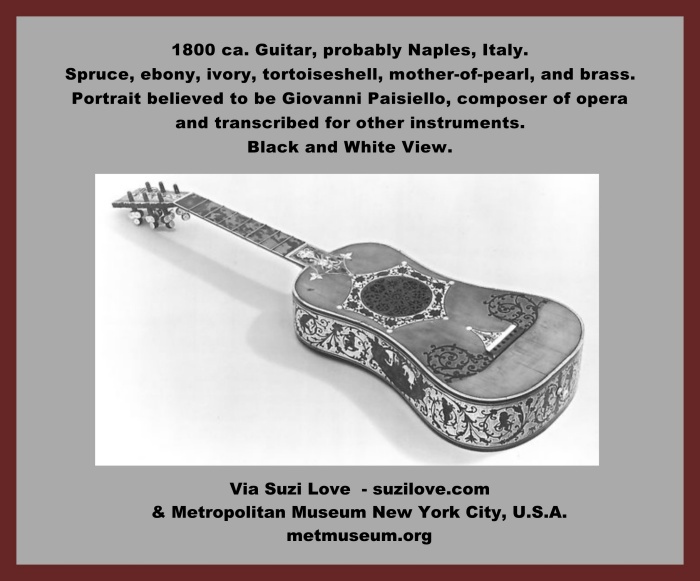
1800 Guitar, Probably Naples, Italy. The sort of guitar people in Jane austen’s era would have played in their homes. Spruce, ebony, ivory, tortoiseshell, mother-of-pearl, and brass. This highly decorated guitar is an early example of a six-string, single-course guitar. The elaborate decoration features classical figures, musical instruments, and floral motifs made from ebony and fit into an ivory ground covering the back, sides, neck, and headstock of the guitar.

A second guitar at the Yale Collection of Musical Instruments features the same decoration, only in reverse, indicating that the decoration was made at the same time by cutting through thin layers of stacked ebony and ivory. A portrait in the center of the upper back is believed to be of Giovanni Paisiello based on his 1791 portrait. Paisiello was a composer of opera and many of his works were transcribed for use on other instruments and his pieces were a favorite of guitarists.

The fingerboard is covered with tortoiseshell over read paint with an ivory satyr inlaid where the neck meets the body.  A carved wooden rosette may be a replacement and is surrounded by an ivory hexagon with ebony inlaid instruments and flowers matching the back. The decorative style is evocative of so-called Baroque guitars of the seventeenth century.  The six-string, single-course guitar became popular in Naples at the end of the eighteenth century and then spread throughout the rest of Europe replacing the earlier five and six double-course guitars. via  Metropolitan Museum New York City, U.S.A. books2read.com/suziloveMusicGeneral

guitar_1800 ca. Guitar, probably Naples, Italy. Spruce, ebony, ivory, tortoiseshell, mother-of-pearl, and brass. Portrait believed to be Giovanni Paisiello, composer of opera and transcribed for use in other instruments. Elaborate decoration features classical figures, musical instruments, and floral motifs of ebony in ivory background on the back, sides, neck and headstock. Via Metropolitan Museum New York City, U.S.A. metmuseum.org
HN_7 D2D Retailer Buy Link Music Piano History Notes
books2read.com/suziloveMusicPiano
HN_7 D2D Retailer Buy Link Music Piano History Notes
Posted in 1800s, Decorative Item, Europe, Jane Austen, Music, Regency Era | Tagged europe, guitar, Italy, Jane Austen, music, Regency Era

1826 A Regency Gentleman’s Life In Jane Austen’s and Bridgerton Times. #bridgerton #JaneAusten #RegencyEra #Cartoon #England

Suzi Love Posted on August 16, 2025 by Suzi LoveAugust 11, 2025

1826 A Regency Gentleman’s Life In Jane Austen’s Times. #JaneAusten #RegencyEra #Cartoon #England. via 1826 The English Spy By Robert Cruikshank via Google Books (PD-150)

The young man’s friends may help him decide what activities they would engage in.  Perhaps they would decide to watch a dogfight or a cockfight.  Or perhaps go and see a mill, where two burly boxers would pummel each other’s faces until one was declared winner and bets could be settled. Later that night, the rowdy group would head to whatever gambling hell was in vogue where they would pass several hours drinking and playing cards. Dark and sordid rooms, smoky interiors, loud and drunken men, and losing your quarter’s allowance from your father were all willingly suffered if a  young man had enticed a buxom wench to sit on his lap and make him forget his woes. And how angry his father would be when he learned his son had gambled away yet another three months of his allowance.

Having filled in their morning, the men wander into Town to meet their cronies for luncheon. Thank goodness it’s time for a few bottles of claret!!  Just the thing for fixing a hang-over, plus, a great place to discuss how to eke out their never-enough allowances until the young men could beg their long-suffering fathers for a little more spending money.

Price Egan’s ‘Life In London in 1823 described a young man’s entertainment choices.  ‘ …bit of a stroll,’ in order to get rid of an hour or two. A turn or two in Bond Street, a stroll through Piccadilly, a look in at Tattersall’s, a ramble through Pall Mall, and a strut on the Corinthian path, fully occupied the time until the hour for dinner arrived, when a few glasses of rich wine put them on the path for vice.’ A group of young men would then head to Vauxhall. ‘‘…if enjoyment is your motto, you may make the most of an evening at Vauxhall, more than at any other place in the metropolis. It is all free-and-easy. Stay as long as you like, and depart when you think proper.’

1826 The Buff Club at the Pig and Whistle, Avon Street, Bath, U.K. A Regency Gentleman's English Life. via 1826 The English Spy By English Cartoonist, Robert Cruikshank.
1826 The Buff Club at the Pig and Whistle, Avon Street, Bath, U.K.
1826 House of Lords in High Debate, London, England. A Regency Gentleman's Life. via 1826 The English Spy By Robert Cruikshank via Google Books (PD-150)
1826 House of Lords in High Debate, London,
1826 The Cyprian Ball At The Argyll Rooms. A Regency Gentleman's Life. via 1826 The English Spy By Robert Cruikshank via Google Books (PD-150)
1826 The Cyprian Ball At The Argyll Rooms.
1826 A Cyprian Ball at the Argyll Rooms, London. A Regency Gentleman's Life. via 1826 The English Spy By Robert Cruikshank via Google Books (PD-150)
1826 A Cyprian Ball at the Argyll Rooms, London.
1826 A Sarcastic Look At Those Admitted To The Stock Exchange, London. A Regency Gentleman's Life. via 1826 The English Spy By Robert Cruikshank via Google Books (PD-150)
1826 A Sarcastic Look At Those Admitted To The Stock Exchange, London.
1826 Buff Club at the Pig and Whistle, Avon Street, Bath, England. A Regency Gentleman's Life. via 1826 The English Spy By Robert Cruikshank via Google Books (PD-150)

1826 Buff Club at the Pig and Whistle, Avon Street, Bath, England.
RL_2_D2D_RetailerBuyLink_RL_2
https://books2read.com/suziloveYGD
Posted in 1800s, 1800s Mens Fashions, 1800s women's fashion, cartoon, Customs & Manners, England, fashion accessories, Food and Drink, Google Books, Jane Austen, London, Music, peerage, Regency Era, Regency Fashion, Regency Life Series, Suzi Love Books, Suzi Love Images | Tagged Book 2, Cartoons, England, google books, Jane Austen, Regency Fashion, Regency Life Series, Regency London, Regency Men, Suzi Love Books, Young Gentlemans Day

Writing Regency Era Stories? Lover of the Bridgertons and Jane Austen? Mourning, riding, daytime, evening fashions plus underclothing. #Bridgerton #RegencyEra #JaneAusten #HistoricalFashion

Suzi Love Posted on July 29, 2025 by Suzi LoveJuly 29, 2025

Are you a reader or writer of Regency Romance? Love Jane Austen’s books? Want to know more about the mourning, riding, underclothing and other Regency Era women’s fashions in Regency romances? What was fashionable for women in Jane Austen’s times? Mourning, riding, daytime, evening clothing, plus underclothing, corsets and accessories. This book looks at what was fashionable for women in Jane Austen’s times, or the early 1800s, or the Regency Era in Britain. Wars were being fought around the globe so women’s fashion adopted a military look in support of soldiers. Fashions, like the lifestyle, became progressively more extravagant and accessories went from colorful to over-the-top. https://books2read.com/SuziLoveFashion1810-1814

HN_27_History Notes book 27 What was fashionable for women in Jane Austen's times? Mourning, riding, daytime, evening clothing, plus underclothing, corsets and accessories. Wars were being fought so women adopted military looks in support of soldiers. https://books2read.com/SuziLoveFashion1810-1814
HN_27_D2D_FashWomen1810-1814

https://books2read.com/SuziLoveFashion1810-1814
Posted in 1800s, 1800s women's fashion, Australia, bedroom fashion, Canada, cartoon, Chatelaine, Coat or Pelisse Or Redingote, Corset, dancing, Decorative Item, Dress Or Robe, England, Europe, fashion accessories, France, Google Books, hats, History, History Notes, Jane Austen, London, mourning, Music, Pastimes, peerage, Quotations, Regency Era, Regency Fashion, Reticule or Bag, riding, Russia, sewing, shoes, Spencer, Suzi Love Books, Suzi Love Images, travel, U.S.A, underclothing, weddings | Tagged 1800s women's fashion, Book 27, Bridgerton, Corset, Dress Or Gown, fans, fashion accessories, Fashion Plate, Fashions Of London and Paris, gloves, google books, Hats And Hair, History Notes, Jane Austen, jewelry, Journal des Dames et des Modes, La Belle Assemblee, mourning, parasol, Regency Fashion, reticule or bag, riding, shawls, Shoes, stockings, Suzi Love Books, The Lady's Magazine, The Lady's Monthly Museum, The Repository Of Arts, underclothing

Love the Bridgertons and Jane Austen? Mourning, riding, dresses, underclothing, accessories. History Notes Book 24 Box Set. #JaneAusten #Regency #HistoricalFashion

Suzi Love Posted on July 13, 2025 by Suzi LoveJuly 12, 2025

An overview of women’s fashions in the first twenty years of the 19th century. What was fashionable for women in Jane Austen’s times, or the early 1800s. Wars were being fought around the globe so women’s fashion adopted a military look in support of soldiers. In Britain, the Prince Regent ruled instead of his father, King George III, so fashions, like the lifestyle, became more extravagant and accessories went from pretty to opulent.

Reader Or Writer of Regency Era? Love Jane Austen and Bridgerton fashions? What was fashionable for women in Jane Austen’s times, or 1800s, or Regency Era. High-waisted dresses were extravagantly accessorized and hats, shoes, parasols and bags were added. Set includes History Notes Books 12, 25, 26, 27 and 28. https://books2read.com/SuziLoveFashionWomenBoxSet

Ladies clothing in the early 1800’s featured a high waist line called an Empire Line, or Empire style dress, with a waist line just under the natural bust line and much higher than the natural waist. The high-waisted, or short-bodied, Regency styles shifted focus away from the natural waist and so left the natural waist unconstricted, in direct contrast to previous and future styles. Britain took these simple European styles and progressively made them more elaborate by adding more and more complicated embroidery onto white fabrics to create the white on white look popular for many years.  

The empire look of fine muslin dresses left women more exposed than in the Georgian Era when fabrics had been thicker and styles bulkier. Women, especially in England, preserved their modesty by adding lace, frills, flounces, ruches, and fabric plaits to dresses to adequately cover any parts that might inadvertently be exposed. Outer layers, such as Spencers, Redingotes or Pelisses or coats, and shawls, were also added for warmth and to brighten outfits. This Empire fashion was totally dependent on a supply of fine, translucent cotton muslin – at first imported from India, then later, less exclusive imitations often woven and printed or embroidered in Britain. Fabrics were soft and lightweight and muslins and other cotton fabrics from India and other Asian countries were in high demand.

HN_24_Fashion Women 1800-1819 Box Set History Notes Book 24 An overview of the first twenty years of the 19th century. These books look at what was fashionable for women in Jane Austen's times, or the early 1800s. Wars were being fought around the globe so women's fashion adopted a military look in support of soldiers. In Britain, the Prince Regent ruled instead of his father, King George III, so fashions, like the lifestyle, became more extravagant and accessories went from pretty to opulent. This set includes books 12, 25, 26, 27 and 28. https://books2read.com/SuziLoveFashionWomenBoxSet
HN_24_D2D Fashion Women 1800-1819  Box Set
https://books2read.com/SuziLoveFashionWomenBoxSet
Posted in 1800s, 1800s women's fashion, art, Australia, bedroom fashion, Bridgerton, Canada, cartoon, Chatelaine, Coat or Pelisse Or Redingote, Corset, dancing, Decorative Item, Dress Or Robe, England, Europe, fashion accessories, France, hats, History, History Notes, Jane Austen, London, mourning, Music, Pastimes, Regency Era, Regency Fashion, Reticule or Bag, riding, Russia, sewing, shoes, Spencer, Suzi Love Books, Suzi Love Images, U.S.A, underclothing, weddings | Tagged 1800s women's fashion, Book 24, Bridgerton, Corset, Dress Or Gown, fashion accessories, Fashion Plate, Fashions Of London and Paris, gloves, google books, Hats And Hair, History Notes, Jane Austen, jewelry, Journal des Dames et des Modes, La Belle Assemblee, mourning, parasol, Regency Fashion, reticule or bag, riding, Shoes, stockings, Suzi Love Books, The Lady's Magazine, The Lady's Monthly Museum, The Repository Of Arts, underclothing

What did an older lady do in Jane Austen and Bridgerton Years? Lighthearted look at daily life for readers and writers of RegencyEra. #JaneAusten #Bridgerton #RegencyEra

Suzi Love Posted on June 15, 2025 by Suzi LoveJune 15, 2025

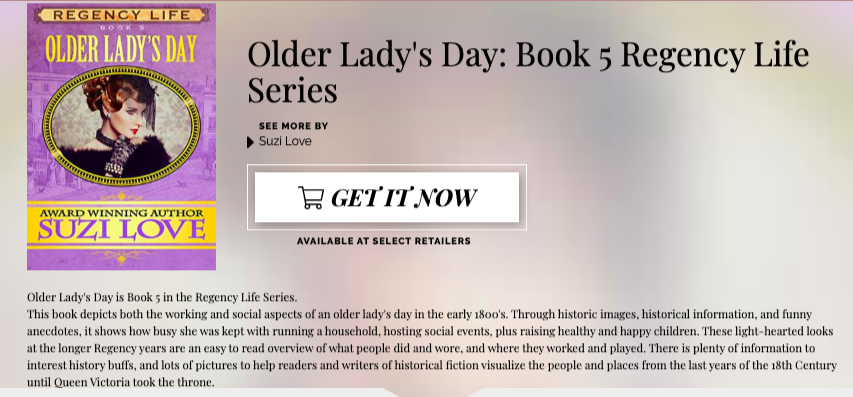
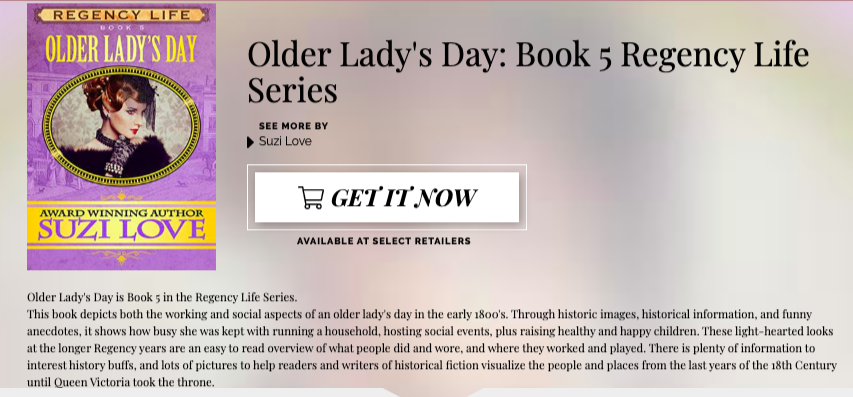
Light-Hearted look at an Older Lady’s Life In Jane Austen’s Times, or early 1800s. An easy to read overview of what an older lady did, wore, and how she lived in the early 19th Century. Information for history buffs and pictures for readers and writers of historical fiction. Older Lady’s Day, Regency Life Series, Book 5, by Suzi Love.  books2read.com/suziloveOLD

The older lady’s day usually started with her toilette in her bedroom, where her maid helped her dress for the day and styled her hair. After that, she would join her family downstairs for breakfast unless she preferred a tray with either tea or hot chocolate in her bedroom as she prepared for her busy day. Her day would be made up of speaking with the housekeeper and the cook about the week’s menus, assuring that the servants were all available that day and no one was ill, and checking the list of foods needed. She would also enquire if the laundry was up to date and that they had enough good linen to make up all the beds before extended family members and guests arrived. If she was in the country and hosting a weekend house party, she would assign rooms to the guests on her lists and query that all was in readiness for their arrival.

RL_5_OLD_OlderLadysDayBook 5 Regency Life Series by Suzi Love
RL_5_D2D_RetailerBuyLink_RL_5_2
https://books2read.com/suziloveOLD

Posted in 1800s, 1800s women's fashion, art, Box Or Container, Bridgerton, Canada, cartoon, Chatelaine, Children, Coat or Pelisse Or Redingote, Corset, Customs & Manners, Dress Or Robe, England, Europe, fashion accessories, Food and Drink, Google Books, hats, History, household, Jane Austen, London, medical, mourning, Music, postal, Regency Era, Regency Fashion, Regency Life Series, Reticule or Bag, riding, sewing, shoes, South Pacific, Spencer, Suzi Love Books, Suzi Love Images, Suzi Love Writing, U.S.A, underclothing | Tagged 1800s women's fashion, Book 5, Dress Or Gown, fashion accessories, Fashion Plate, Food, gloves, Hats And Hair, household, Jane Austen, pastimes, Regency Era, Regency Fashion, Regency Life Series, Regency London, Shoes, Suzi Love Books

Auld Lang Syne Traditionally Sung To Farewell the Old Year. #NewYear. #2025 #Scotland #BritishHistory

Suzi Love Posted on December 31, 2024 by Suzi LoveDecember 30, 2024

Auld Lang Syne is traditionally sung to farewell the old year at the stroke of midnight on New Year’s Eve. It’s a poem written by Robert Burns in 1788 in Scotland, but based on an older Scottish folk song. In 1799, it was set to the traditional tune.

The song begins by posing a rhetorical question: Is it right that old times be forgotten? The answer is generally interpreted as a call to remember long-standing friendships.[9] Alternatively, “Should” may be understood to mean “if” (expressing the conditional mood) referring to a possible event or situation.

George Thomson‘s Select Songs of Scotland was published in 1799 in which the second verse about greeting and toasting was moved to its present position at the end.[9]

Most common usage of the song involves only the first verse and the chorus. The last lines of both of these are often sung with the extra words “For the sake of” or “And days of”, rather than Burns’s simpler lines. This makes these lines strictly syllabic, with just one note per syllable.

Should auld acquaintance be forgot,
And never brought to mind?
Should auld acquaintance be forgot,
And auld lang syne?


(Chorus)
For auld lang syne, my jo,
For auld lang syne,
We’ll tak a cup o’ kindness yet,
For auld lang syne.


And surely ye’ll be your pint-stowp!
And surely I’ll be mine!
And we’ll tak a cup o’ kindness yet,
For auld lang syne.


We twa hae run about the braes
And pu’d the gowans fine;
But we’ve wander’d mony a weary foot
Sin auld lang syne.


We twa hae paidl’d i’ the burn,
Frae mornin’ sun till dine;
But seas between us braid hae roar’d
Sin auld lang syne.


And there’s a hand, my trusty fiere!
And gie’s a hand o’ thine!
And we’ll tak a right guid willy waught,
For auld lang syne.

English version

Should old acquaintance be forgot,
And never brought to mind?
Should old acquaintance be forgot,
And old lang syne?


(Chorus)
For auld lang syne, my dear,
For auld lang syne,
We’ll take a cup of kindness yet,
For auld lang syne.


And surely you’ll buy your pint cup!
And surely I’ll buy mine!
And we’ll take a cup o’ kindness yet,
For auld lang syne.


We two have run about the slopes,
And picked the daisies fine;
But we’ve wandered many a weary foot,
Since auld lang syne.


We two have paddled in the stream,
From morning sun till dine;
But seas between us broad have roared
Since auld lang syne.


And there’s a hand my trusty friend!
And give me a hand o’ thine!
And we’ll take a right good-will draught,
For auld lang syne.

Robert Burns
Robert Burns Robert Burns, engraving from A Biographical Dictionary of Eminent Scotsmen, 1870.

Xmas_NewYear_AuldLangSyne_Sml

Posted in Christmas, Georgian Era, History Of Christmases Past, Music, Regency Era, Suzi Love Images | Tagged British history, Christmas, Customs and Traditions, music, New Year, Scotland

Are you following my Pinterest Boards? Images galore for history, books, Regency Era, fashion and writing. #RegencyEra #books #History #Pinterest #SuziLove

Suzi Love Posted on October 16, 2024 by Suzi LoveSeptember 16, 2024

Pinterest Boards By Suzi Love.

I love Pinterest for keeping thousands of historical images in some sort of order. And I love using Pinterest Boards as inspiration for my romance books. What about you? Do you use Pinterest for planning something, or just for fun? Need more hints for what to do with your boards and pins? Take a look at these fascinating articles on Pinterest. if you want even more Pinterest information and tips for becoming a power user, check out my Suzi Love Pinterest Boards

Are you following my Pinterest Boards? Images galore for history, books, Regency Era, fashion and writing. #Regency #books #Historyhttp://www.pinterest.com/suziloveoz/
RL_2_D2D_RetailerBuyLink_RL_2
RL_2_D2D_RetailerBuyLink_RL_2 https://books2read.com/suziloveYGD
Posted in 1700s, 1700s Mens fashion, 1700s Womens Fashion, 1800s, 1800s Mens Fashions, 1800s women's fashion, 1900s, art, Australia, bedroom fashion, Box Or Container, Bridgerton, Canada, Carriage, cartoon, Chatelaine, children, Children, Coat or Pelisse Or Redingote, Corset, Couple, Customs & Manners, dancing, Decorative Item, Dress Or Robe, Edwardian Era, England, Europe, Events, fashion accessories, Food and Drink, furniture, Georgian Era, Georgian Fashion, Google Books, Grand Tour, hats, History, household, Jane Austen, Keanu Reeves, medical, military, money, mourning, Music, pants, Pastimes, peerage, People, Places, postal, Quotations, Regency Era, Regency Fashion, Reticule or Bag, riding, Romantic Era, Royalty, sewing, shoes, South Pacific, Spencer, sports, Suit, Suzi Love Books, Suzi Love Images, Suzi Love Writing, travel, U.S.A, underclothing, Vest or Waistcoat, Victorian Era, weapons, weddings, Writing Tools | Tagged 1800s men fashion, 1800s women's fashion, Battle of Waterloo, Bridgerton, Cartoons, Dress Or Gown, Edwardian Era, fans, fashion accessories, Fashion Plate, Georgian era, gloves, google books, Hats And Hair, historical erotic romance, Historical Mystery, historical romance, History Notes, Irresistible Aristocrats, Jane Austen, Journal des Dames et des Modes, La Belle Assemblee, military, money, pants, Regency Fashion, Romantic Era, Scandalous Siblings Series, Shoes, Suzi Love Books, The Lady's Magazine, The Lady's Monthly Museum, The Repository Of Arts, travel, Victorian Era
guitar_1780 ca. English Guitar, Lisbon, Portugal. Made by Jaco Vieira da Silva Pine back, sides and soundboards, with pine and wood purfling (bordering); brass openwork rose, framed with mother-of-pearl. The English guitar was a fashionable instrument from about 1750, considered easy to play and tuned in C major, although the player would use a capo, much like a modern folk-guitarist, in order to change the key. The tuning pegs were often small metallic pins that could be turned with a watch-key, to keep the strings in tune longer. This instrument was made in Portugal, a country with strong trading links with England, and its peg box is decorated with a paper ‘cameo’ in imitation of a jasper ware medallion, a motif made popular by Josiah Wedgwood (1730-1795) from about 1770. Victoria and Albert Museum, London, U.K.

1780 ca. English Guitar, Lisbon Made by Jaco Vieira da Silva. #Music #Guitar #Portugal #GeorgianEra

Suzi Love Posted on September 12, 2024 by Suzi LoveAugust 28, 2024

1780 ca. English Guitar, Lisbon Made by Jaco Vieira da Silva. Pine back, sides and soundboards, with pine and wood purfling or bordering, brass openwork rose, framed with mother-of-pearl. The English guitar was a fashionable instrument from about 1750, considered easy to play and tuned in C major, although the player would use a capo, much like a modern folk-guitarist, in order to change the key. The tuning pegs were often small metallic pins that could be turned with a watch-key, to keep the strings in tune longer. This instrument was made in Portugal, a country with strong trading links with England, and its peg box is decorated with a paper ‘cameo’ in imitation of a jasper ware medallion, a motif made popular by Josiah Wedgwood (1730-1795) from about 1770. Victoria and Albert Museum, London, U.K.  History Notes Book 6 Music General https://www.suzilove.com/wp-admin/books2read.com/suziloveMusicGeneral \

1780 ca. English Guitar, Lisbon, Portugal. Made by Jaco Vieira da Silva Pine back, sides and soundboards, with pine and wood purfling (bordering); brass openwork rose, framed with mother-of-pearl. The English guitar was a fashionable instrument from about 1750, considered easy to play and tuned in C major, although the player would use a capo, much like a modern folk-guitarist, in order to change the key. The tuning pegs were often small metallic pins that could be turned with a watch-key, to keep the strings in tune longer. This instrument was made in Portugal, a country with strong trading links with England, and its peg box is decorated with a paper ‘cameo’ in imitation of a jasper ware medallion, a motif made popular by Josiah Wedgwood (1730-1795) from about 1770. Victoria and Albert Museum, London, U.K.
.
1780 ca. English Guitar, Lisbon, Portugal. Made by Jaco Vieira da Silva Pine back, sides and soundboards, with pine and wood purfling (bordering); brass openwork rose, framed with mother-of-pearl. The English guitar was a fashionable instrument from about 1750, considered easy to play and tuned in C major, although the player would use a capo, much like a modern folk-guitarist, in order to change the key. The tuning pegs were often small metallic pins that could be turned with a watch-key, to keep the strings in tune longer. This instrument was made in Portugal, a country with strong trading links with England, and its peg box is decorated with a paper ‘cameo’ in imitation of a jasper ware medallion, a motif made popular by Josiah Wedgwood (1730-1795) from about 1770. Victoria and Albert Museum, London, U.K.
HN_6_D2D_Music General_ books2read.com/suziloveMusicGeneral

Posted in 1700s, Decorative Item, Europe, Georgian Era, History, Music, Pastimes, Suzi Love Images | Tagged 1700s Or Georgian Era, europe, Georgian era, guitar, music, Victoria and Albert Museum | Leave a reply

What Sort Of Pianoforte Or Piano Was Played By the Bridgertons and Jane Austen? #Bridgerton #Music #JaneAusten #RegencyEra #GeorgianEra

Suzi Love Posted on September 2, 2024 by Suzi LoveSeptember 1, 2024

What Sort Of Pianoforte or Piano Was Played By Jane Austen and Contemporaries? Pianos, pianofortes and more. History Notes Book 7 Music Pianos books2read.com/suziloveMusicPiano

Definition Pianoforte or Piano: ‘Stringed keyboard instrument with a hammer action, as opposed to the jack and quill action of the harpsichord.  Capable of gradations of soft and loud, the piano became the central instrument of music pedagogy and amateur study. By the end of the nineteenth century, no middle-class household of any stature in Europe or North America was without one.’  Definition via the Metropolitan Museum, NYC.

Around 1700, the Pianoforte, or Piano,  was invented in Italy by Bartolomeo Cristofori, who created a hammer action keyboard instrument on which a musician could make changes in loudness by changing the force with which the keys were struck. He called his instrument “gravicembalo col piano e forte”, or,  (harpsichord with soft and loud). Cristofori’s  long name was later shortened to fortepiano or pianoforte, and finally just piano.

Musical Instruments were so important in most of the more affluent households in history that large industries grew all around the world to manufacture instruments, musical accessories, and to print sheet music.  Pianos, pianofortes, harpsichords, and organs were found everywhere and were often the focus of a family gathering. By the end of the 18th Century, the pianoforte, or piano, was the leading instrument of Western music.

What sort of pianos did Jane Austen and the Bridgerton family play? Pianos, pianofortes etc in 17th, 18th, and 19th Centuries. Music Piano. History Notes Book 7 By Suzi Love. Pianos, pianofortes, harpsichord, organs in 17th, 18th, and 19th Centuries, as used by Jane Austen and her family.  books2read.com/suziloveMusicPiano
HN_7_Music Piano. History Notes Book 7 By Suzi Love. Pianos, pianofortes, harpsichord, organs in 17th, 18th, and 19th Centuries. #music #history #nonfiction books2read.com_suziloveMusicPiano
D2D_RetailerBuyLink_HN_7 Piano
D2D_RetailerBuyLink_HN_7 Piano books2read.com/suziloveMusicPiano
Posted in 1700s, 1800s, 1900s, art, Australia, Bridgerton, Canada, Edwardian Era, England, Europe, furniture, Georgian Era, History Notes, household, Jane Austen, Music, Regency Era, Romantic Era, Suzi Love Books, Suzi Love Images, U.S.A, Victorian Era | Tagged 1700s Or Georgian Era, 1800s Or 19th Century, Book 7, Bridgerton, Georgian era, History Notes, Jane Austen, music, piano, Regency Era, Suzi Love Books, Victorian Era | Leave a reply

1809-1829 Magazine for the Bridgertons and Jane Austen: Rudolph Ackermann and ‘The Repository of Arts’, The Strand, London. #JaneAusten #Bridgerton #RegencyEra #London #History

Suzi Love Posted on August 28, 2024 by Suzi LoveAugust 24, 2024

A portrait from 1810-1814 of Rudolph Ackermann, shop owner and founder of ‘The Repository Of Arts’ magazine, The Strand, London. via National Portrait Gallery, London. Plus, an image of Ackermann’s premises in 1809. His ‘Repository of Arts, Literature, Fashion, Manufactures, etc.’ was published from 1809 to 1829 with images of Regency London, Regency furnishings and grand homes as well as beautiful fashion prints and descriptions every month. Ackermann originally supplied artists, amateur and professional, with supplies for watercolor painting. In 1799, he began manufacturing and selling his own watercolor paint blocks which were supplied by other colourmen, although at least three colors were his own mixture – Ackermann’s Green, White and Yellow. From 1817, his eldest son Rudolph Ackermann junior was responsible for the watercolor manufacturing. Ackermann also trained as a carriage designer. He began publishing prints and colour-plate books like ‘The Microcosm of London’ and ‘Doctor Syntax’ in the early 1800s.

The Repository of Arts was one the most popular magazines in Jane Austen’s time as it displayed everything ladies wanted to learn e.g. history, important country seats and houses in England, music, current events such as theatre plays, plus fashion plates and embroidery patterns. Ackermann’s shop in The Strand, London, was one of the fashionable places to shop during the Regency Era. The Repository also included poetry, travel reports, society reports and upcoming lectures. It also included serious subjects e.g. politics, legal matters, medicine and agriculture, a meteorological journal and details of the London markets. In 1817, the price of the magazine was 4 Shillings, so quite expensive for the time.

 In the first issue, published for January 1809, Ackermann included an ‘introduction to the history of the useful and polite arts’ which said: “It is universally admitted, that to cultivate a taste for the arts, and an acquaintance with the sciences, is a pleasure of the most refined nature; but to do this without regard to its influence upon the passions and affections, is to ‘tear a tree for its blossoms, which is capable of yielding the richest and most valuable fruit.’ The cultivation of this taste may and ought to be subservient to higher and more important purposes: it should dignify and exalt our affections, and elevate them to the admiration and love of that Being who is the author of every thing that is fair, sublime, and good in nature.”

1810-1814 Portrait of Rudolph Ackermann, shop owner and founder of The Repository Of Arts magazine. via National Portrait Gallery, London.
1809 January Ackermann's Repository of Arts, 101 Strand, London, U.K. Drawn by Augustus Pugin and Thomas Rowlandson. Published By Rudolph Ackermann. Etching and aquatint with hand coloring.
1809 January Ackermann’s Repository of Arts, 101 Strand, London, U.K. Drawn by Augustus Pugin and Thomas Rowlandson. Published By Rudolph Ackermann. Etching and aquatint with hand coloring.
D2D_RL_4_YLD_Young Lady's Day Regency Life Series Book 4 by Suzi Love. A light-hearted look at the longer Regency years and an easy to read view of what a young lady did, wore, and lived. https://books2read.com/suziloveYLD

D2D_RL_4_YLD_Young Lady's Day Regency Life Series Book 4 by Suzi Love. A light-hearted look at the longer Regency years and an easy to read view of what a young lady did, wore, and lived. https://books2read.com/suziloveYLD
Posted in 1800s, 1800s women's fashion, art, Bridgerton, Coat or Pelisse Or Redingote, Decorative Item, Dress Or Robe, England, fashion accessories, furniture, Google Books, hats, History, household, Jane Austen, London, mourning, Music, Pastimes, Regency Era, Regency Fashion, Reticule or Bag, sewing, shoes, Spencer, Suzi Love Images, travel, weddings | Tagged 1800s women's fashion, art, Dress Or Gown, fashion accessories, Fashion Plate, gloves, Hats And Hair, Jane Austen, London, magazines, music, pastimes, Regency Fashion, Regency Life, Regency London, Regency Women, Rudolph Ackermann, Shoes, shopping, The Repository Of Arts

Post navigation

← Previous Post
Next Post→

SUBSCRIBE TO SUZI LOVE'S NEWSLETTER.

Recent Posts

  • 1823 Couple In Evening Costumes, French. #RegencyFashion #RomanticEra #HistoricalFashion
  • 1809 Josiah Wedgwood and Thomas Byerley China Showrooms in Jane Austen’s times in York Street, London. #JaneAusten #RegencyEra #London #trade
  • 1876 ‘Queen Bess’ Silk Corset By Worcester Company, American. #VictorianFashion #VictorianEra #Corset #Worcester
  • 18th Century Early.  Silk, Leather, and Linen Mules (shoes), European, and embroidered in Florentine Style. #shoes #georgianfashion #europe
  • Book Hooks: Ironic that Lady Melton and her unborn child had been safer in battle-torn Europe than in England.  #MilitaryRomance #RegencyRomance #BattleofWaterloo

Recent Comments

  1. Jana Richards on Book Hooks: Ironic that Lady Melton and her unborn child had been safer in battle-torn Europe than in England.  #MilitaryRomance #RegencyRomance #BattleofWaterloo
  2. Kayelle Allen on Book Hooks: Ironic that Lady Melton and her unborn child had been safer in battle-torn Europe than in England.  #MilitaryRomance #RegencyRomance #BattleofWaterloo
  3. James DiBenedetto on Book Hooks: Ironic that Lady Melton and her unborn child had been safer in battle-torn Europe than in England.  #MilitaryRomance #RegencyRomance #BattleofWaterloo
  4. Lisabet Sarai on Book Hooks: Ironic that Lady Melton and her unborn child had been safer in battle-torn Europe than in England.  #MilitaryRomance #RegencyRomance #BattleofWaterloo
  5. Suzi Love on Book Hooks: Captain Belling said in a cold voice, “The only thing I don’t know is why the hell you and that child are still near Waterloo.” #MilitaryRomance #RegencyRomance #BattleofWaterloo
Login

  • Log in

Archives

  • August 2026
  • July 2026
  • June 2026
  • May 2026
  • April 2026
  • March 2026
  • February 2026
  • January 2026
  • December 2025
  • November 2025
  • October 2025
  • September 2025
  • August 2025
  • July 2025
  • June 2025
  • May 2025
  • April 2025
  • March 2025
  • February 2025
  • January 2025
  • December 2024
  • November 2024
  • October 2024
  • September 2024
  • August 2024
  • July 2024
  • June 2024
  • May 2024
  • April 2024
  • March 2024
  • February 2024
  • January 2024
  • November 2023
  • October 2023
  • September 2023
  • August 2023
  • July 2023
  • April 2023
  • March 2023
  • June 2022
  • April 2022

Categories

  • 1700s
  • 1700s Mens fashion
  • 1700s Womens Fashion
  • 1800s
  • 1800s Mens Fashions
  • 1800s women's fashion
  • 1900s
  • art
  • Australia
  • Bath
  • bedroom fashion
  • Book Hooks
  • Box Or Container
  • Bridgerton
  • Bus Trips
  • Canada
  • Carriage
  • cartoon
  • Celebrity
  • Chatelaine
  • Children
  • children
  • Christmas
  • Coat or Pelisse Or Redingote
  • Contemporary
  • Corset
  • Couple
  • Customs & Manners
  • dancing
  • December Scandal
  • Decorative Item
  • Dress Or Robe
  • Easter
  • Edwardian Era
  • Embracing Scandal
  • England
  • Ester In Images
  • Europe
  • Events
  • Fashion
  • fashion accessories
  • Food and Drink
  • Four Times A Virgin
  • France
  • furniture
  • Georgian Era
  • Georgian Fashion
  • Google Books
  • Grand Tour
  • Group
  • hats
  • History
  • History Events
  • History Notes
  • History Of Christmases Past
  • household
  • Hygiene
  • Irresistible Aristocrats
  • Jane Austen
  • Keanu Reeves
  • Kellys Justice
  • Legal
  • London
  • Love After Waterloo
  • Loving Lady Katharine
  • medical
  • military
  • money
  • mourning
  • Music
  • Outback Arrival
  • pants
  • Pastimes
  • peerage
  • People
  • Places
  • Pleasure House Ball
  • postal
  • Queensland
  • Quotations
  • Regency Era
  • Regency Fashion
  • Regency Life Series
  • Reticule or Bag
  • riding
  • Romantic Era
  • Royalty
  • Russia
  • Scandalous Siblings Series
  • Scenting Scandal
  • Self Publishing
  • sewing
  • Shirt
  • shoes
  • Shopping
  • South Pacific
  • Spencer
  • sports
  • Suit
  • Sunday Snippet
  • Suzi Love
  • Suzi Love Books
  • Suzi Love Images
  • Suzi Love Writing
  • Swain Cove
  • THe Viscount's Pleasure House
  • travel
  • U.S.A
  • underclothing
  • Vest or Waistcoat
  • Victorian Era
  • Victorian Fashion
  • weapons
  • weddings
  • Writing Tools

1800s men fashion 1800s women's fashion antiques Bridgerton British history Cartoons Corset cravat decorative Dress Or Gown England europe fashion accessories Fashion Plate France Georgian era Georgian Fashion gloves google books Hats And Hair historical romance History Notes household Jane Austen jewelry Journal des Dames et des Modes London Metropolitan Museum NYC pants Redingote Or Pelisse Or Coat Regency Era Regency Fashion Regency London reticule or bag riding Romantic Era sewing shawls Shoes Suzi Love Books Suzi Love Images Tailcoat The Repository Of Arts underclothing Vest or Waistcoat

©2026 - Suzi Love - Weaver Xtreme Theme Privacy Policy
↑