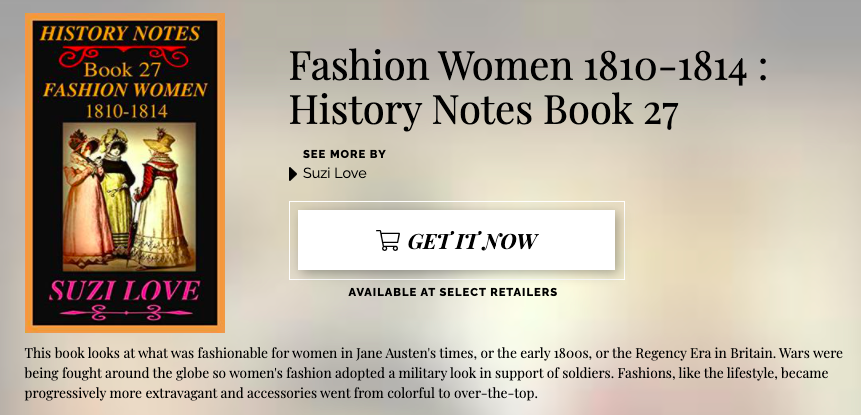
Are you a reader or writer of Regency Romance? Love Jane Austen and the Bridgertons? Want to know more about the mourning, riding, underclothing and other Regency Era women’s fashions in Regency romances? What was fashionable for women in Jane Austen’s times? Mourning, riding, daytime, evening clothing, plus underclothing, corsets and accessories. This book looks at what was fashionable for women in Jane Austen’s times, or the early 1800s, or the Regency Era in Britain. Wars were being fought around the globe so women’s fashion adopted a military look in support of soldiers. Fashions, like the lifestyle, became progressively more extravagant and accessories went from colorful to over-the-top.
History Notes book 27
What was fashionable for women
in Jane Austen’s times?
Mourning, riding, daytime, evening clothing,
plus underclothing, corsets and accessories.
Wars were being fought so women adopted
military looks in support of soldiers.
https://books2read.com/SuziLoveFashion1810-1814
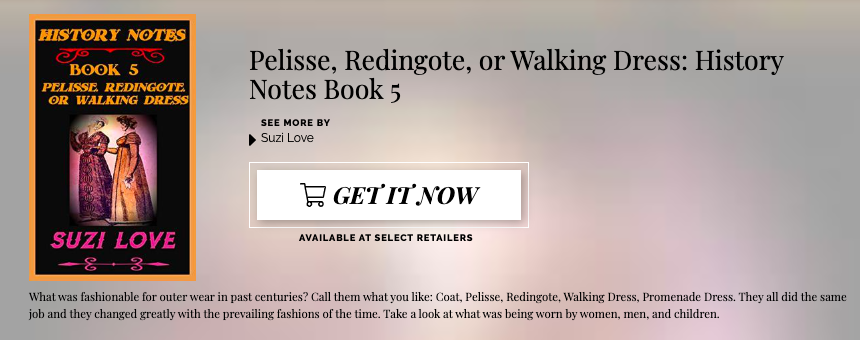
Lover of Bridgerton and Jane Austen fashions? What was fashionable for their outer wear? Different names in different countries: Pelisse, Redingote, Or Walking Dress. #Regency #Fashion #History http://books2read.com/suzilovePelisse
The Pelisse or Redingote was essentially a coat or robe like garment worn both indoors and out. Worn indoors open to reveal a dress, the outdoor version was made of heavier materials and of darker colors than the type worn indoors. The name comes from the term ‘riding coat.’ In the Georgian Era, Redingotes were worn by men, women and children when outdoors and especially as part of a riding costume by both sexes.
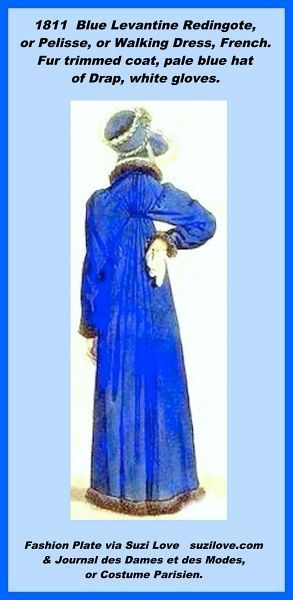
In England, the Pelisse was the main sort of fashionable outerwear, or coat, for women in the Regency Era, or Jane Austen’s times. Though this sort of coat was popular from the late 1700s until around 1850. In the early 1800s, this sort of Empire style coat reached the hip or knee but around 1810 the Pelisse lengthened to become a full length coat. Around 1812, the Pelisse often had a broad, cape-like collar with fur trim and thanks to the Napoleonic Wars and an avid interest in all things military, a Pelisse took on a military look with epaulettes and braiding very popular.
While the terms Redingote and Pelisse are often used interchangeably, Pelisse and Walking Dress and Carriage Costume were the names used in English Fashion Plates, whereas French Fashion Plates refer to the longer style of coats as a Redingote and the shorter shoulder capes worn by military men as a Pelisse.
Pelisse, Redingote, Or Walking Dress. History Notes Book 5 By Suzi Love. What was fashionable for outer wear in past centuries? Call them what you like: Coat, Pelisse, Redingote, Walking Dress, Promenade Dress. Take a look at what was being worn by women, men, and children. books2read.com/suzilovePelisseD2D_RetailerBuyLink_HN_5_books2read.com/suzilovePelisse
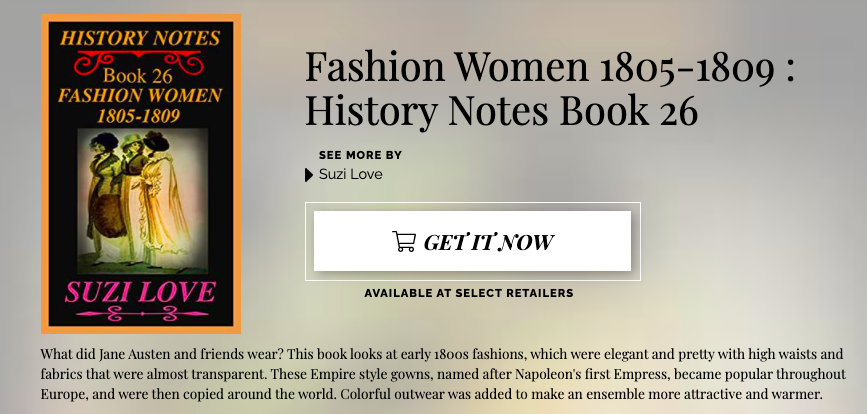
What did Jane Austen and friends wear? Early 1800s fashions were elegant and pretty with high waists and fabrics that were almost transparent. These Empire style gowns, named after Napoleon’s first Empress, became popular throughout Europe, and were then copied around the world. Colorful outwear was added to make an ensemble more attractive and warmer. History Notes Book 26 Fashion Women 1805-1809. https://books2read.com/SuziLoveFashionWomen1805-1809
The Empire waist gown defined women’s fashion during the Regency Era. ‘Empire’ is the name given in France to the period when Napoleon built his French Empire. High-waisted, loose gowns were adopted by the aristocracy as a symbol of turning away from the fussy, elaborate and expensive clothing worn in the 1700s. Jean-Jaques Rousseau advocated copying peasants and returning to a simpler life and more natural fashions. Unrestricting clothing was part of the new Democracy in France and these simpler and flowing fashions were adopted all over Europe, including Britain and despite the continual wars being fought against France during the early 1800s. Not even war stopped fashions from being copied everywhere.
Fashion Women 1805-1809 History Notes Book 26
What did Jane Austen and friends wear? This book looks at early 1800s fashions, which were elegant and pretty with high waists and fabrics that were almost transparent. These Empire style gowns, named after Napoleon’s first Empress, became popular throughout Europe, and were then copied around the world. Colorful outwear was added to make an ensemble more attractive and warmer.
https://books2read.com/SuziLoveFashionWomen1805-1809HN_26_D2D_FsshionWomen1805-1809
What was fashionable outdoor wear for Jane Austen and contemporaries? Reticules, Spencers, and Pelisses, or Walking Dresses, Or Redingotes. History Notes Books 3, 4, and 5 By Suzi Love.
What sort of coats did women wear during the Regency years? them what you like: Coat, Pelisse, Redingote, Walking Dress, Promenade Dress. Take a look at what was being worn by women, men, and children. books2read.com/suzilovePelisse
HN_5_What was fashionable for outer wear in past centuries? Different names in different countries- Pelisse, Redingote, Or Walking Dress. #Regency #Fashion #History books2read.com:suzilovePelisse
Early 1800s Typical Regency Couple in a Curricle. The sort of vehicle Jane Austen and her contemporaries would have driven in. Young men loved them and occasionally women drove them.
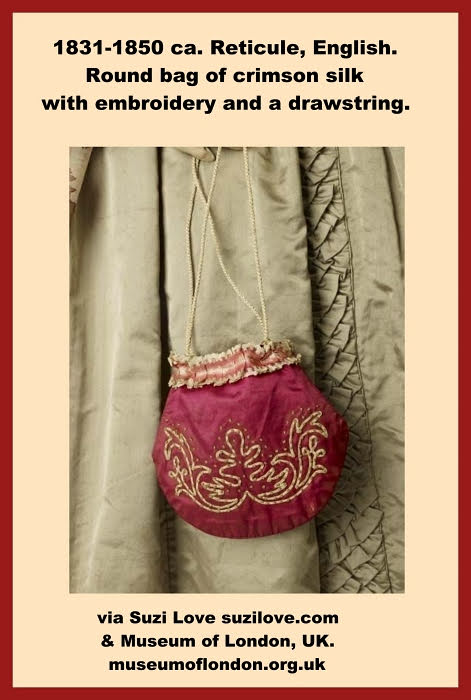
1831-1850 ca. Reticule, English. Round bag of crimson silk with embroidery and a drawstring. via Museum Of London.
1831-1850 ca. Reticule, English. Round bag of crimson silk with embroidery and a drawstring. via Museum Of London. D2D_RetailerBuyLink_HN_3 http://books2read.com/suziloveReticules
1811 Lady’s Redingote, or Pelisse, or Walking Dress, French. Blue Levantine walking dress, with pale blue hat of Drap. Fashion Plate via Journal des Modes et des Dames, or Costume Parisienne.
The term, Redingote, was used more in France and other parts of Europe and Pelisse or Walking Dress was used more in England.While the terms Redingote and Pelisse are often used interchangeably, the Redingote usually features a close fitted top and flares out at the hemline with a more tailored or military look than a Pelisse. Redingotes or Pelisses were needed to cover the flimsy dresses made of lightweight fabrics of the Regency years to provide warmth and some protection from windy conditions when gowns might lift and cause modesty issues.In Europe, a Redingote was a coat or robe like garment worn both indoors and out, indoors left open to reveal a dress while the outdoor version was made of heavier materials and of darker colors than the type worn indoors. The name comes from the term ‘riding coat.’
Definition Drap: Made of wool, shiny and velvety after treatment, hair uniformly laid in the direction of the cut, thick and resistant. Used for coats.
Definition Levantine: Stout silk cloth in twill weave. First made in the Levant, a large area in the Eastern Mediterranean region of Western Asia.
1810-1815 ca. Salmon Pink Empire Style Dress, Norway. Typical Regency high-waisted dress. Long sleeves with puckered sleeve cap. Deep neckline with short shirred bodice. Long full skirt. via Digital Museum, Norway. digitalmuseum.no Regency fashion at its prettiest. The style of Empire style, or high-waisted, dress worn by Jane Austen and her contemporaries.
The Empire waist gown defined women’s fashion during the Regency Era. ‘Empire’ is the name given in France to the period when Napoleon built his French Empire. High-waisted, loose gowns were adopted by the aristocracy as a symbol of turning away from the fussy, elaborate and expensive clothing worn in the 1700s. Jean-Jaques Rousseau advocated copying peasants and returning to a simpler life and more natural fashions. Unrestricting clothing was part of the new Democracy in France and these simpler and flowing fashions were adopted all over Europe, including Britain and despite the continual wars being fought against France during the early 1800s. Not even war stopped fashions from being copied everywhere.
1810-1815 ca. Salmon Pink Empire Style Dress, Norway. Typical Regency high-waisted dress. Long sleeves with puckered sleeve cap. Deep neckline with short shirred bodice. Long full skirt. via Digital Museum, Norway. digitalmuseum.no
HN_27_D2D_fashwomen1810-1814
https://books2read.com/SuziLoveFashion1810-1814