1826 The Cyprian’s Ball At the Argyll Rooms. A Regency Gentleman’s Life. From The English Spy By Robert Cruikshank.



1826 The Cyprian’s Ball At the Argyll Rooms. A Regency Gentleman’s Life. From The English Spy By Robert Cruikshank.
Writing Regency Era Fiction Or Nonfiction? Need more information on Older Gentleman’s Day in early 1800s, or the Bridgerton family or Jane Austen’s Regency Era. A lighthearted overview of an older gentleman’s clothing, social life, and responsibilities in the early 1800s. Take a look at where an older man went, what he wore, and how he managed the family’s finances and his estates. Older Gentleman’s Day Regency Life Series Book 3 books2read.com/suziloveOGD

A portrait from 1810-1814 of Rudolph Ackermann, shop owner and founder of ‘The Repository Of Arts’ magazine, The Strand, London. via National Portrait Gallery, London. Plus, an image of Ackermann’s premises in 1809. His ‘Repository of Arts, Literature, Fashion, Manufactures, etc.’ was published from 1809 to 1829 with images of Regency London, Regency furnishings and grand homes as well as beautiful fashion prints and descriptions every month. Ackermann originally supplied artists, amateur and professional, with supplies for watercolor painting. In 1799, he began manufacturing and selling his own watercolor paint blocks which were supplied by other colourmen, although at least three colors were his own mixture – Ackermann’s Green, White and Yellow. From 1817, his eldest son Rudolph Ackermann junior was responsible for the watercolor manufacturing. Ackermann also trained as a carriage designer. He began publishing prints and colour-plate books like ‘The Microcosm of London’ and ‘Doctor Syntax’ in the early 1800s.
The Repository of Arts was one the most popular magazines in Jane Austen’s time as it displayed everything ladies wanted to learn e.g. history, important country seats and houses in England, music, current events such as theatre plays, plus fashion plates and embroidery patterns. Ackermann’s shop in The Strand, London, was one of the fashionable places to shop during the Regency Era. The Repository also included poetry, travel reports, society reports and upcoming lectures. It also included serious subjects e.g. politics, legal matters, medicine and agriculture, a meteorological journal and details of the London markets. In 1817, the price of the magazine was 4 Shillings, so quite expensive for the time.
In the first issue, published for January 1809, Ackermann included an ‘introduction to the history of the useful and polite arts’ which said: “It is universally admitted, that to cultivate a taste for the arts, and an acquaintance with the sciences, is a pleasure of the most refined nature; but to do this without regard to its influence upon the passions and affections, is to ‘tear a tree for its blossoms, which is capable of yielding the richest and most valuable fruit.’ The cultivation of this taste may and ought to be subservient to higher and more important purposes: it should dignify and exalt our affections, and elevate them to the admiration and love of that Being who is the author of every thing that is fair, sublime, and good in nature.”


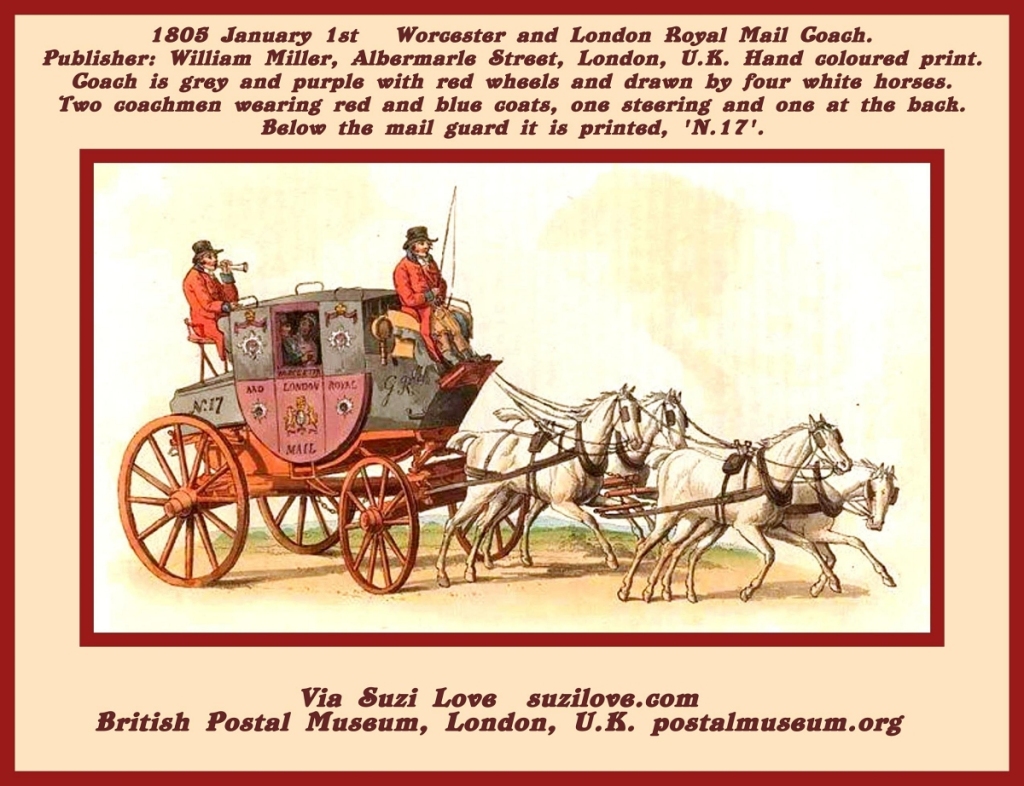
How did Jane Austen and her family? Did they go by stagecoach? The dreadful condition of British roads caused great apprehension to all classes of travelers. Making a journey anywhere in the country was a big undertaking and often a gentleman composed his last will and testament before his departure. Traveling in vehicles was only possible during the day or on the nights with very bright moonlight with few vehicles attempting road travel in winter and any travel on a Sunday was frowned upon.
Description of Stage Coach Travel in England. via 1815 Journal Tour of Great Britain. “The gentlemen coachmen, with half-a dozen great coats about them, immense capes, a large nosegay at the button-hole, high mounted on an elevated seat, with squared elbows, a prodigious whip, beautiful horses, four in hand, drive in a file to Salthill, a place about twenty miles from London, and return, stopping in the way at the several public-houses and gin-shops where stage-coachmen are in the habit of stopping for a dram, and for parcels and passengers on the top of the others as many as seventeen persons. These carriages are not suspended, but rest on steel springs, of a flattened oval shape, less easy than the old mode of leathern braces on springs. Some of these stage coaches carry their baggage below the level of the axletree.”


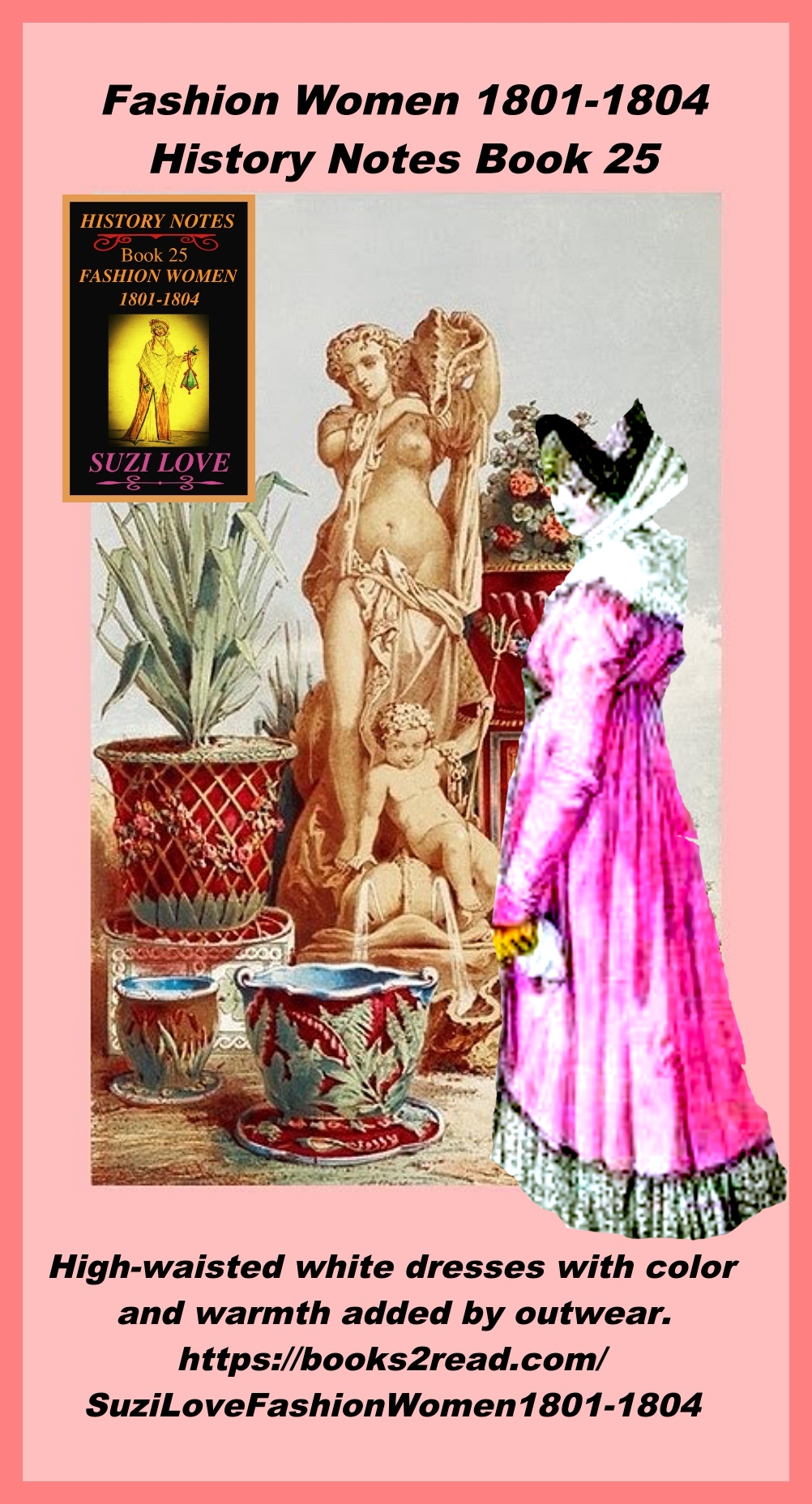
Fan of the Bridgerton Series? Jane Austen Lover? Writer Or Reader Of Regency Era? What did they wear in early 1800s? Women’s clothing changed dramatically in early 1800s. New silhouette copied simplistic styles of Greeks and Romans. High-waisted white dresses and flowing skirts with color and warmth added by outerwear and accessories. Fashion Women 1801-1804 History Notes Book 25 https://books2read.com/SuziLoveFashionWomen1801-1804
Definition Empire Style Dress: High-waisted white gowns defined women’s fashion during the Regency Era. ‘Empire’ is the name given to the period when Napoleon Bonaparte built his French Empire. High-waisted, loose gowns were adopted by the aristocracy as a symbol of turning away from the elaborate clothing worn in the 1700s. This sort of high-waisted dress would have been worn by Jane Austen and her contemporaries in England.
Definition Shawls: The shawl started off in India as a fine wool garment for men that could be worn as a scarf, turban or as a mantle: the word comes from the Persian shäl. Originally imported from the East, European Kashmir shawls were made first in Norwich and Edinburgh in Britain in the late 18th century. Shawls were an essential item in the early 1800s to cover the thin gowns women wore. They were made of muslin, gauze, silk, wool, and velvet, though cashmere shawls were the softest and most prized.


1816 July Opera Dress, English. Dress of white lace worn over a rich soft white satin slip. Skirt trimmed in a style of peculiar elegance, with lace festooned at regular distances, festoons edged by plain band of byas satin and finished by pearl ornaments of a very novel and pretty shape. Lace body is cut byas and richly ornamented round the bosom with pointed lace. Plain long sleeve, very full, except towards the wrist, which is nearly tight to the arm, and elegantly finished with lace. Hair ornamented with a wreath of French roses, parted in front, and simply dressed in loose curls, which fall very low on each side. Hind hair forms a tuft at the back of the head. Necklace, ear-rings, and bracelets of pearl. White satin slippers, and white kid gloves and a blush colored French silk scarf. Fashion Plate via Rudolph Ackermann’s ‘The Repository of Arts’. https://books2read.com/SuziLoveFashionWomen1815-1819
Gorgeous Regency Era clothing came in a wide range of styles to suit every season and occasion. Ladies in the Bridgerton series and in Jane Austen’s times wore Empire style dresses which were usually made of light fabric and floaty in style. By the later 1810s, stripes were very popular and lace and frills were added to make the dress more individual.

Reader or writer of the Regency Era? Love Jane Austen and Bridgerton fashions? This book covers corsets from late 1700s to early 1800s. #JaneAusten #Georgian #Regency #Corsets Corsets 1790-1810 History Notes Book 16
Corsets or stays transitioning from 1700s into 1800s and worn during Jane Austen’s lifetime. This book shows how supporting underclothing moved away from stomachers and tightly laced stays worn during the 1700s and transitioned into corsets that were less formed and far more comfortable. Wearing the correct underclothing was essential for keeping garments in place and giving the best fashion display. Corsets worn during Jane Austen’s lifetime.


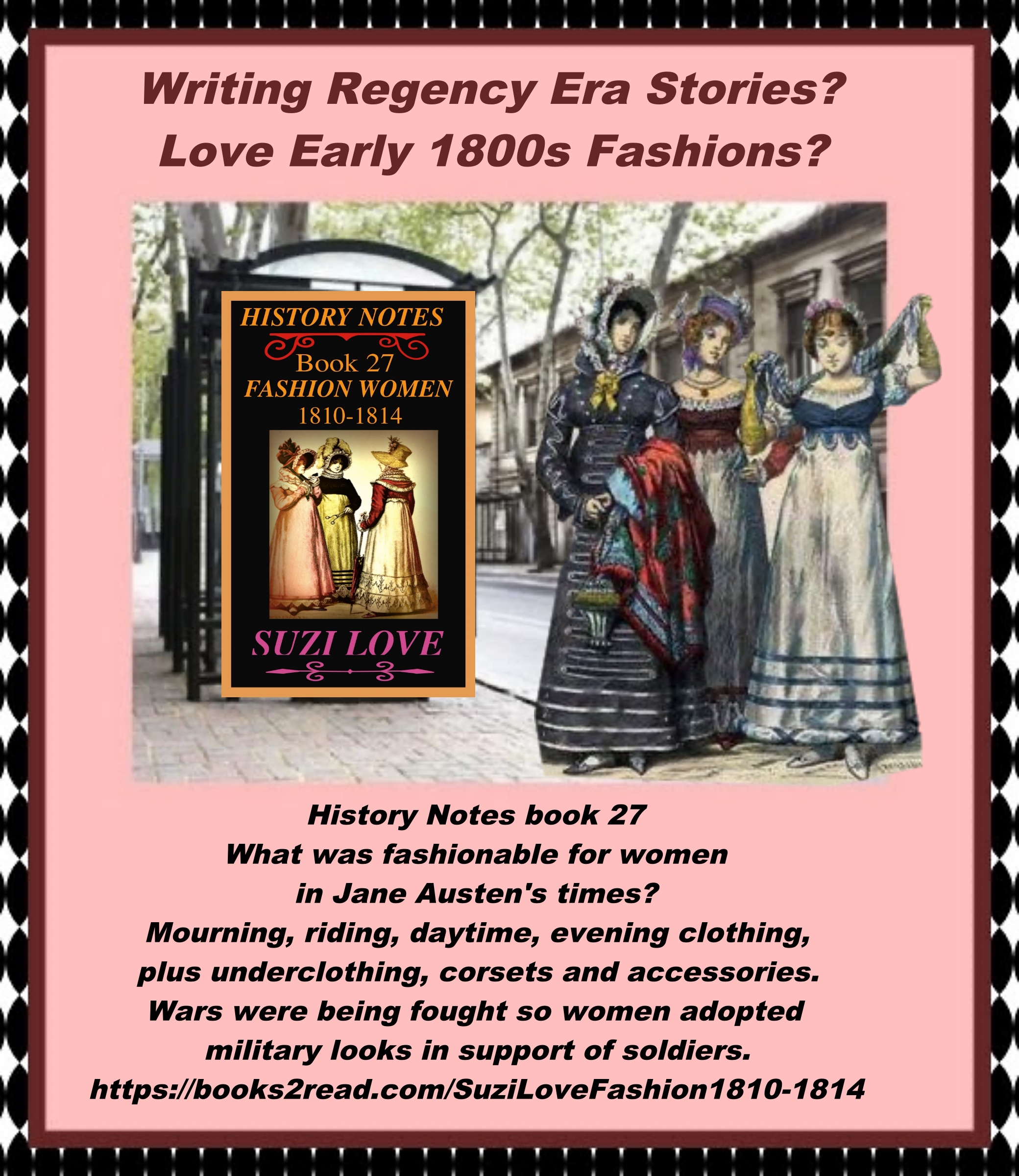
Are you a reader or writer of Regency Romance? Love Jane Austen and the Bridgertons? Want to know more about the mourning, riding, underclothing and other Regency Era women’s fashions in Regency romances? What was fashionable for women in Jane Austen’s times? Mourning, riding, daytime, evening clothing, plus underclothing, corsets and accessories. This book looks at what was fashionable for women in Jane Austen’s times, or the early 1800s, or the Regency Era in Britain. Wars were being fought around the globe so women’s fashion adopted a military look in support of soldiers. Fashions, like the lifestyle, became progressively more extravagant and accessories went from colorful to over-the-top. https://books2read.com/SuziLoveFashion1810-1814
The Lady’s Magazine said of the basis of women’s fashion that was popular for the first twenty years of the 1800s, ‘White is still the prevailing color for robes. For morning dresses, linen gowns, in large diamonds or squares, are fashionable. Indian muslins, plain or embroidered, are preferred to Florence and satins. The designs of embroidery for shawls are of infinite variety. Long gloves, which reach above the elbow, are not yet laid aside. Medallions are hung around the neck from crossed chains and some of these medallions are shaped like the bags, called ridicules. These reticules are of the lozenge or hexagon shape, with a small tassel at each angle. Reticules, or ridicules, are in lozenge or hexagon shapes with a small tassel at each angle. In capotes, or hats, and ribbands, the violet and dark green prevail over jonquil. Bracelets in hair, pear-shaped ear-rings, medallions on square plates, saltiers of colored stones, are still in fashion.’
Reader or Writer of Regency Era Books? Love the Bridgertons and Jane Austen? Nonfiction book, Older Gentleman’s Day, gives an overview of his daily life by Award Winning researcher and author, Suzi Love. A sometimes comical look at an older gentleman’s clothing, social life, and responsibilities in the early 1800s. Take a look at where he went, what he wore, and how he managed the family’s finances. Older Gentleman’s Day, Regency Life Series Book 3 books2read.com/suziloveOGD
Regency is the time period in England that began in 1811 when King George III had increasing bouts of madness and was finally declared mad. The Prince of Wales was officially named Regent, often referred to as “Prinny”, and the Regency period ran until 1820 when King George III died and the prince was crowned King George IV. The long Regency era is from the time of Jane Austen and the Napoleonic Wars until the time Queen Victoria ascended the throne.