↓
 

Suzi Love

Making history fun, one year at a time.

Header_
  • Home
  • Newsletter
  • Pre order form
  • Shop
    • Cart
    • Checkout
    • My account
    • Refund and Returns Policy
  • Blog
  • BOOKS
    • History Events
    • Kelly’s Justice
    • Irresistible Aristocrats
    • History Notes
    • Scandalous Siblings
    • Love After Waterloo
    • Regency Life Series
  • Privacy Policy
  • EVENTS
Home » Canada » Page 4 << 1 2 3 4 5 6 … 10 11 >>

Category Archives: Canada

Post navigation

← Previous Post
Next Post→

Christmas: Boxing Day History #Christmas #holidays #BritishHistory

Suzi Love Posted on December 26, 2025 by Suzi LoveDecember 20, 2025

The 26th December was St. Stephen’s Day, the first Christian martyr and patron saint of horses, so Boxing Day became associated with horse racing and sports. It was also when the English churches alms boxes were opened and the contents given to the poor of the parish. In the song Good King Wenceslas, the king gave the poor man meat, wine and wood “on the feast of Stephen.” Written by John Mason Neale and first published in 1853, the lyrics celebrate the spirit of Boxing Day which was generosity. King Wenceslas watches a poor man “gath’ring winter fuel. and he then brings the peasant food and logs for his fire.  In parts of Europe, St. Stephen’s Day is considered the second day of Christmas.

On the Boxing Day holiday, servants, apprentices, and the poor were presented with gifts. The origin of the holiday is unknown, but was probably first observed in the Middle Ages and the name may come from the opening of alms boxes that had been placed in churches over the holidays for distribution to the poor. It may also be because servants opened their gift boxes on the day after Christmas because on Christmas Day they were busy cooking and serving a large festive meal for their employers. December 26th is also the feast day of St. Stephen, the first Christian martyr and patron saint of horses, so Boxing Day has now become associated with horse racing and sports.

One of the earliest records of these box gifts dates from 1663. In an entry in his diary, English Parliamentarian Samuel Pepys writes that he sent a coach and messenger to his shoemaker to deliver “something to the boys’ box against Christmas” in addition to funds to cover his bill. During Queen Victoria’s reign, Boxing Day became a chance for church parishioners to deposit donations into a box that was put out for the purpose by the clergyman. The money in the boxes was given to the poor.

Some villages followed the custom of the Hunting of the Wren, where small boys captured a wren, killed it, and then mounted it on a pole and carry to every house in the village while singing a song. Money collected was used for a village dance. In London, and in many other parts of Europe, large families and establishments keep regular lists of tradesman’s servants, apprentices, and other persons, who come about making a sort of annual claim on them for a Christmas box on this day.’

‘The custom of annual donations at Christmas, and on New Year’s-day, is very ancient, being copied by the Christians from the Polytheists of Rome, at the time the public religion was changed. These presents, now-a-days, are more commonly made on the morrow of Christmas. From this circumstance the festival of St. Stephen has got the nickname of Christmas Boxing-day, and by corruption, Boxing-day.’ From:- The Lady’s Monthly Museum, Vernor & Hood: Christmas-boxes, 1824.

‘On the day after Christmas, tradespeople are visited by persons in the employment of their customers for a “Christmas-box,” and every man and boy who thinks he is qualified to ask, solicits from those on whom he calculates as likely to bestow.
A writer, in 1731, describes Boxing-day at that time from his own experience. ” By that time I was up, my servants could do nothing but run to the door. Inquiring the meaning, I was answered, the people were come for their Christmas-box : this was logic to me; but I found at last, that, because I had laid out a great deal of ready-money with my brewer, baker, and other tradesmen, they kindly thought it my duty to present their servants with some money for the favor of having their goods.
This provoked me a little; but being told it was ‘ he custom,’ I complied. These were followed by the watch, beadles, dustmen, and an innumerable tribe; but what vexed me the most was the clerk, who has an extraordinary place, and makes as good an appearance as most tradesmen in the parish; to see him come a boxing, alias begging, I thought was intolerable: however I found it was ‘ the custom’ too, so I gave him half-a-crown; as I was likewise obliged to do to the bellman, for breaking my rest for many nights together.’ From The Every-day book and table book by William Hone, 1839

Boxing Day is one of the many customs and traditions associated with Christmas that is featured in History of Christmases Past (Book 1 History Events) by Suzi Love.

Xmas_Boxing Day
Christmas: Boxing Day History #Christmas #holidays #BritishHistory. https://books2read.com/suziloveHOCP Share on X

Posted in Australia, Canada, Christmas, Customs & Manners, England, Europe, Food and Drink, Google Books, Suzi Love Images | Tagged British history, Christmas, Customs and Traditions, drinks, Food, household, Suzi Love Images

Christmas: Yule Log

Suzi Love Posted on December 24, 2025 by Suzi LoveDecember 24, 2025

Christmas: Yule Log

Pagans burned a great log and a mammoth candle on the 21st of December, the shortest day in the year, because it was seen as the turning-point in the conflict between the contending forces of winter and spring.

From Harpers Bazaaar “The Yule-block, or Christmas-log, with its warm welcome, extending even to the poor and the stranger as they gathered around the hospitable board is being gradually supplanted by the Christmas-tree.”

Formerly the Yule-log, a huge section of the birch, was cut from a tree selected on Candlemas-day, which so late as the time of Queen Elizabeth was the last day of the Christmas holidays. On the following Christmas-eve it was dragged in and placed upon the hearth with great ceremony, the merry-makers pulling with a will, and singing the while the modernized Christmas carol commencing,

“Come, bring with a noise,

My merrie, merrie boys,

The Christmas-log to the firing.”

It was then kindled with a brand from last year’s Christmas fire, which, if it was not thus kept continually burning, still linked the merrymaking of one Christmas-time to that of another.

In Ramsgate, Kent, and the Isle of Thanet, the custom styled “hodening” is still in vogue. The “hoden,” which appears to be a cross between the “white horse” and the Klapperbock of the Germans, is accompanied by a number of youths in fantastic dress, who go round from door to door ringing bells and singing Christmas carols.

Xmas_Yule Log
Christmas: Bring In the Yule Log #christmas #holidays #custom #tradition http://books2read.com/suziloveHOCP. Share on X
Posted in 1700s, 1800s, 1900s, Australia, Canada, Christmas, Customs & Manners, Edwardian Era, England, Europe, Georgian Era, History Of Christmases Past, Regency Era, Romantic Era, South Pacific, U.S.A, Victorian Era | Tagged Christmas, Customs and Traditions, holidays, household, Jane Austen, Regency Era

Christmas: 24th December Or Christmas Eve #christmas #holidays #customs

Suzi Love Posted on December 24, 2025 by Suzi LoveDecember 22, 2025

Christmas: 24th December Or Christmas Eve. The evening leading up to Christmas Day is filled with excitement, last-minute preparations, and religious services. In many cultures, especially European countries, gifts are exchanged on Christmas Eve, while in other places, this happens on Christmas morning.  http://books2read.com/suziloveHOCP.

Xmas_24th December
Xmas_24th December
Xmas_24th December
Xmas_24th December
Xmas_24th December
Xmas_24th December
Christmas: 24th December Or Christmas Eve #christmas #holidays #customs http://books2read.com/suziloveHOCP. Share on X
Posted in 1800s, 1900s, Australia, Canada, children, Christmas, Customs & Manners, England, Europe, South Pacific, U.S.A | Tagged children, Christmas, Customs and Traditions, holidays

Christmas Three Wise Men Bringing Gifts. #Christmas #holidays #Traditions #Customs

Suzi Love Posted on December 23, 2025 by Suzi LoveDecember 20, 2025

Gifts From The Three Wise Men

The Star of Bethlehem, or Christmas Star appears in nativity story of Gospel of Matthew where wise men from the East, or Magi, follow the star and travel to Jerusalem. The Three Wise Men brought gold, frankincense and myrrh to the newborn king. Myrrh being commonly used as an anointing oil, frankincense as a perfume, and gold as a valuable.

Three Kings came riding from far away,

Melchior and Gaspar and Baltasar;

Three Wise Men out of the East were they,

And they travelled by night and they slept by day,

For their guide was a beautiful, wonderful star.

The Three Kings by Henry Wadsworth Longfellow

Gold, Frankincense and Myrrh were the three presents brought by the Wise Men to the Infant Christ, lying in the manger stall, at Bethlehem. Gold to Christ means that all the affluence of the world surrendered to Him and Gold paid the way for Joseph and Mary and the divine fugitive into Egypt. The gold for Christ, the silver for Christ, the jewels for Christ. The bright, round, beautiful jewel of a world set like a solitaire on the bosom of Christ. The wise men shook myrrh out of their sacks and the cattle snuffed at it but didn’t eat it because it was bitter. This pungent gum resin of Abyssinia was brought to the feet of Christ to show bitter betrayal, persecution, days of suffering and bitter nights. Myrrh was put into His cup when He was dying and put under His head in the wilderness and Myrrh was used on His from the cattle-pen in Bethlehem to the mausoleum. Frankincense means worship and was brought to temples, sprinkled over the living coals, and when they were ready to worship, the cover was lifted and perfumed smoke arose and filled the places of worship and altars.

In modern times, gifts are given on December 25th, or Christmas Day, in most countries but in others it is December 6th, or Saint Nicholas Day, and January 6th, or Epiphany. European countries generally follow the custom of giving each other presents on Christmas Eve.

Xmas_Three Wise Men
Xmas_Three Wise Men
Xmas_Three Wise Men
Xmas_Three Wise Men
Xmas_Three Wise Men
Xmas_Three Wise Men
Xmas_Three Wise Men
Xmas_Three Wise Men
Christmas Three Wise Men Bringing Gifts. #Christmas #holidays #Traditions #Customs https://books2read.com/suziloveHOCP Share on X

Posted in Australia, Canada, Christmas, Customs & Manners, England, Europe, History Of Christmases Past, Suzi Love Images, U.S.A | Tagged British history, Christmas, europe, History Of Christmases Past, religion, Suzi Love Images

Looking for a gift for a fan of the Bridgertons and Jane Austen? What did men wear in the early 1800s? #christmas #holidays #Bridgerton #RegencyFashion #JaneAusten #BritishHistory

Suzi Love Posted on December 18, 2025 by Suzi LoveDecember 19, 2025

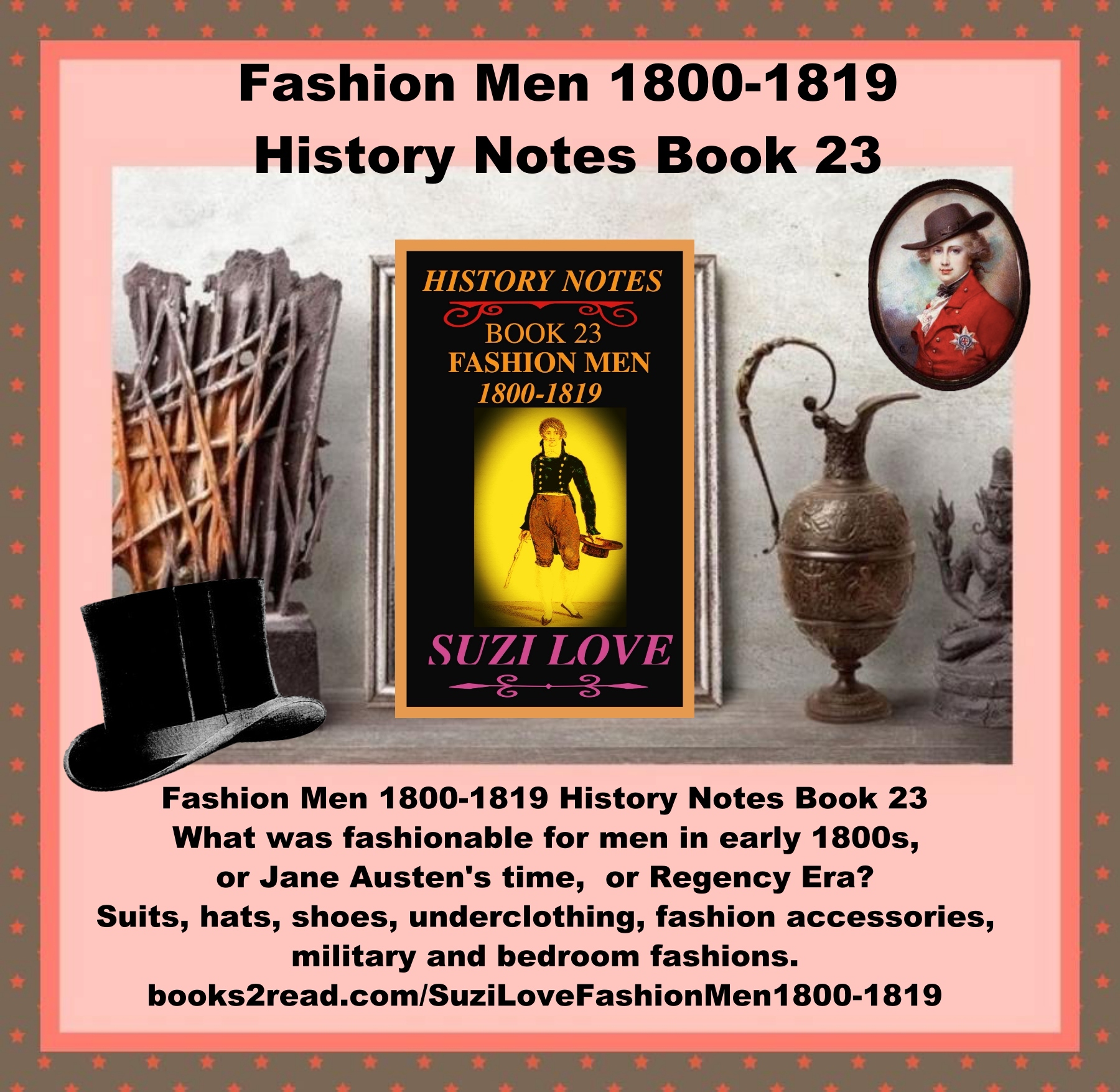
Looking for a gift for a fan of the Bridgertons and Jane Austen? What did men wear in the early 1800s? Suits, hats, shoes, underclothing, military and bedroom fashions. #christmas #holidays #Bridgerton #RegencyFashion #JaneAusten #BritishHistory

Xmas_HN_23

Looking for a gift for a fan of the Bridgertons and Jane Austen? What did men wear in the early 1800s? #christmas #holidays #Bridgerton #RegencyFashion #JaneAusten #BritishHistory https://books2read.com/SuziLoveFashionMen1800-1819 Share on X
HN_23_D2D_Fashion Men 1800-1819
https://books2read.com/SuziLoveFashionMen1800-1819
Posted in 1800s, 1800s Mens Fashions, Australia, bedroom fashion, Bridgerton, Canada, cartoon, Christmas, Coat or Pelisse Or Redingote, England, Europe, fashion accessories, France, hats, History, History Notes, Jane Austen, London, military, pants, Pastimes, peerage, Regency Era, Regency Fashion, riding, Russia, shoes, sports, Suit, Suzi Love Books, Suzi Love Images, travel, U.S.A, underclothing, Vest or Waistcoat, weapons | Tagged Book 23, Bridgerton, Christmas, Corset, Dress Or Gown, fashion accessories, Fashion Plate, Fashions Of London and Paris, gloves, google books, Hats And Hair, History Notes, Jane Austen, jewelry, Journal des Dames et des Modes, La Belle Assemblee, mourning, parasol, Regency Fashion, reticule or bag, riding, Shoes, stockings, Suzi Love Books, The Lady's Magazine, The Lady's Monthly Museum, The Repository Of Arts, underclothing

Christmas: Santa Claus Or Father Christmas. #Christmas #Holidays #Traditions #SantaClaus

Suzi Love Posted on December 18, 2025 by Suzi LoveDecember 17, 2025

Santa Claus The origin of Santa Claus begins in the 4th century with Saint Nicholas, Bishop of Myra, an area in present day Turkey. By all accounts St. Nicholas was a generous man, particularly devoted to children. In the Western world, where Christmas is characterized by the exchange of gifts among friends and family members, some of the gifts are attributed to a character called Santa Claus. He is also known as Father Christmas, Saint Nicholas, St. Nikolaus, Sinterklaas, Kris Kringle, Joulupukki, Weihnachtsmann, Saint Basil and Father Frost.

    In the 4th century, Saint Nicholas, Bishop of Myra, Turkey, was a kind and generous man who was particularly devoted to children. His kindness and reputation for generosity gave rise to claims he that he could perform miracles and devotion to him increased. Thousands of churches across Europe were dedicated to him and some time around the 12th century an official church holiday was created in his honor. The Feast of St. Nicholas was celebrated December 6 and the day was marked by gift-giving and charity.

Father Christmas, who predates Santa Claus, was first recorded in the 15th century and then associated with holiday merrymaking and drunkenness.  In Victorian Britain, his image was remade to match that of Santa and France’s Père Noël (Papa Noël) evolved the same way and eventually began using the same Santa image.

Today’s version of Santa Claus was created by the German-American cartoonist Thomas Nast (1840-1902), who drew a new image of the character annually, beginning in 1863.  By the 1880s, Nast’s Santa had become the one now know and in the 1920s, this image was used in most advertising. But it was the early to mid Coca Cola advertising that cemented the idea of Santa Claus as a jolly man with a white beard and wearing a red suit. He was portrayed as drinking a coke and smiling happily. Many famous artists started doing yearly illustrations of Santa Claus that were used for magazine covers and Christmas postcards.

Xmas_Santa
Xmas_Santa
Xmas_Santa
Xmas_Santa
Xmas_Santa
Xmas_Santa
Xmas_Santa
Xmas_Santa
Xmas_Santa
Christmas: Santa Claus Or Father Christmas In Modern Times. #Christmas #Holidays #Traditions #SantaClaus https://books2read.com/suziloveHOCP Share on X

Posted in 1900s, Australia, Canada, Christmas, Customs & Manners, England, Europe, South Pacific, Suzi Love Images, U.S.A | Tagged art, Christmas, Customs and Traditions, History, History Of Christmases Past

Christmas: Lord Of Misrule #Christmas #holidays #Traditions #Customs

Suzi Love Posted on December 16, 2025 by Suzi LoveDecember 15, 2025

The Lord of Misrule was generally a peasant, or sub-deacon, and the revelries followed the Pagan tradition of Saturnalia and was a time of drunkenness and wild partying. The Church’s festival with a Boy Bishop, the leader of children’s festivities in choir schools, was similar, but was abolished by Henry VIII in 1541, restored by the Catholic Queen Mary, but again abolished by Protestant Elizabeth I. On the Continent, the Council of Basle suppressed it in 1431 but the custom was revived in some places from time to time, even as late as the eighteenth century. After the death of Edward VI in 1553, the English court stopped appointing a Lord of Misrule.

From A Survey of London by John Stow: Reprinted from the text of 1603.

‘…in the feaste of Christmas, there was in the kings house, wheresoeuer he was lodged, a Lord of Misrule, or Maister of merry disports, and the like had yee in the house of euery noble man, of honor, or good worshippe, were he spirituall or temporall.’

During the late medieval and early Tudor periods in England, Lord of Misrule, also called Abbot Of Misrule, or King Of Misrule, was appointed to manage the Christmas festivities held at court, in the houses of great noblemen, in the law schools of the Inns of Court, and in many of the colleges at the universities of Cambridge and Oxford.

His reign lasted anywhere from 12 days to 3 months and his role was to direct the masques, processions, plays, and feasts. Although this was mostly a British custom, in ancient Rome from the 17th to 23rd of December, a Lord of Misrule took on the guise of Saturn for the feast of Saturnalia and the ordinary rules were changed so that masters became slaves and the offices of state were held by slaves. The Lord of Misrule presided and could command anyone to do anything. Our contemporary Christmas holidays seem to have originated from this idea of festive holidays.

The custom began in December 1551 when the Duke of Somerset, Edward VI’s uncle Edward Seymour, was in the Tower of London awaiting execution. He sent a note to the Master of Revels to appoint George Ferrers as Lord of Misrule. Ferrers was a courtier and poet who later contributed to A Mirror for Magistrates, described by Scott Lucas as a “compendium of tragic monologues” by a series of historical personages.

Scotland had the Abbot of Unreason (suppressed in 1555) as their equivalent to the Lord of Misrule and scholars believe both ideas came from the “king” or “bishop” who presided over the earlier Feast of Fools.

Xmas_Lord Of Misrule
Christmas: Lord Of Misrule Custom #Christmas #holidays #Traditions #Customs. books2read.com/suziloveHOCP Share on X
Posted in Australia, Canada, Christmas, Customs & Manners, England, Europe, History Of Christmases Past, Suzi Love Images, U.S.A | Tagged Christmas, Customs and Traditions, History Of Christmases Past, pastimes

Christmas Greenery: Holly, Ivy and Evergreen Boughs. #Christmas #Holidays #customs #Europe

Suzi Love avatarPosted on December 12, 2025 by Suzi LoveDecember 11, 2025

Christmas Greenery: Holly, Ivy and Evergreen Boughs. #Christmas #Holidays #customs #Europe https://books2read.com/suziloveHOCP

Continue reading →
Posted in Australia, Canada, Christmas, Customs & Manners, Edwardian Era, England, Europe, Georgian Era, History, household, Regency Era, Romantic Era, South Pacific, Suzi Love Images, U.S.A, Victorian Era | Tagged Christmas, Customs and Traditions, History Events, History Of Christmases Past, household

Christmas: Christmas Card History #Christmas #holidays #Traditions #Customs #VictorianEra

Suzi Love Posted on December 11, 2025 by Suzi LoveDecember 11, 2025

Sending Christmas Cards.

At the end of the winter term, schoolmasters would set their pupils to work on Christmas Pieces, samplers of writing on superior paper with engraved borders, to show parents how they had progressed during the year. By about 1820, the engraved borders were enhanced with color and the children’s pieces became more decorative.

However, the custom of sending cards at Christmas was started in the United Kingdom in 1843 by Sir Henry Cole. Postage had been standardized three years earlier and Cole was a civil servant who had played a key role in initiating Uniform Penny Post. He wanted ordinary people to become more interested in the new ‘Public Post Office’. With his artist friend John Horsley, they designed the first card which was issued from a periodical, Felix Summerley’s Home Treasury, and were sold for 1 shilling each.

The card was lithographed, hand-colored, had three panels and was in a rustic frame of carved wood and ivy. The outer two panels showed people caring for the hungry and the naked. The centre panel showed a family of three generations having Christmas dinner, although the temperate classes strongly objected to the idea of a child being given a glass of wine with dinner.

Xmas_Christmas Card

New railways carried more post, and a lot faster, than a horse and carriage so the Post Office offered a Penny stamp. Cards became even more popular when they could be posted in an unsealed envelope for one halfpenny. Christmas cards became truly popular when printing improved and cards could be produced in large numbers, around 1860. By the early 1900s, the custom had spread over Europe and especially in Germany.

Early cards usually pictured Nativity scenes, but in the late Victorian times, robins and snow-scenes became popular because the postmen wore red uniforms and were nicknamed ‘Robin Postmen’. Snow-scenes were also popular because they were a reminder of the very bad winter of 1836.

Snow scenes reflected the snowy and often harsh northern hemisphere winters when opening and reading Christmas cards was an enjoyable family experience.  In 1860, Charles Goodall & Son, a British publisher of visiting cards, began mass producing cards to be used for visits during the Christmas period. These Christmas and New Year’s visiting cards were decorated with simple designs such as a twig of holly or flowers.

Sales of cards grew and designs and sizes changed. The first cards were meant to appeal to the masses and encourage them to send large numbers by post, so rather than focus on religious images, they showed sentimental or humorous images of family and children, fanciful designs of flowers, fairies, or reminders of the approach of spring. Religious themes of nativity scenes, children looking at the manger, or angels and candles remain popular to the modern day.

Cards could be shaped like bells, a fan, a crescent, a circle, or a diamond and were folding, decorated with jewels, iridescent, embossed, and carried either simple Christmas and New Year greetings or had verses and carols written in them. The next year, Mr W.C.T. Dobson produced a sketch symbolizing the ‘Spirit of Christmas’ which sold many more than the previous thousand and the novelty caught on.

Many artists became famous for their annual illustrations that became postcards and cards.  Printing technology became more advanced in the age of industrialisation and the price of card production dropped. With the introduction of the halfpenny postage rate, the Christmas card industry industry increased until in 1880 11.5 million cards were produced.

Xmas_Christmas Card
Xmas_Christmas Card
Xmas_Christmas Card
Xmas_Christmas Card
Xmas_Christmas Card
Xmas_Christmas Card
Xmas_Christmas Card
Xmas_Christmas Card
Xmas_Christmas Card
Christmas Card History #Christmas #holidays #Traditions #Customs #VictorianEra https://books2read.com/suziloveHOCP Share on X
Posted in 1800s, Australia, Canada, Christmas, Customs & Manners, England, Europe, household, Pastimes, Suzi Love Images, U.S.A, Victorian Era | Tagged British history, British Postal Museum, Christmas, Customs and Traditions, europe, History Of Christmases Past, postal, Victoria and Albert Museum, Victorian Era

Christmas: How did they celebrate Christmas in Bridgerton and Jane Austen times? #Christmas #Christianity #Bridgerton #JaneAusten #holidays

Suzi Love Posted on December 10, 2025 by Suzi LoveDecember 9, 2025

How did they celebrate Christmas in Bridgerton and Jane Austen times? Historical information about the traditions of Christmas through the centuries, including the religious aspects, decorations, games, food and plays. History Of Christmases Past has lots of information and images about Christmas through the centuries, including religious aspects, decorations, games, food and plays. Historic images show how some traditions have changed while many have remained the same through the centuries. books2read.com/suziloveHOCP

How did they celebrate Christmas in Bridgerton and Jane Austen times? Historical information about the traditions of Christmas through the centuries, including the religious aspects, decorations, games, food and plays. #holidays #Christmas #Christianity #Bridgerton #JaneAusten http://books2read.com/suziloveHOCP
How did they celebrate Christmas in Bridgerton and Jane Austen times? Historical information about the traditions of Christmas. #holidays #Christmas #Christianity #Bridgerton #JaneAusten http://books2read.com/suziloveHOCP Share on X


Posted in 1700s, 1800s, 1900s, Australia, Bridgerton, Canada, Christmas, Customs & Manners, Edwardian Era, England, Europe, Events, Food and Drink, Georgian Era, History Of Christmases Past, household, Jane Austen, Music, Regency Era, Romantic Era, Royalty, South Pacific, Suzi Love Books, Suzi Love Images, U.S.A, Victorian Era | Tagged Book 1, Bridgerton, British history, Christmas, Customs and Traditions, drinks, Edwardian Era, Food, Georgian era, History Events, History Of Christmases Past, household, Jane Austen, music, Queen Victoria, Regency Era, Regency Royalty, Suzi Love Books, Victorian Era

Post navigation

← Previous Post
Next Post→

SUBSCRIBE TO SUZI LOVE'S NEWSLETTER.

Recent Posts

  • 1815 Typical English Dinner In Jane Austen and Bridgerton Times. Two Courses and Desert. #RegencyEra #JaneAusten #Food #History
  • Why Did Women Wear Chatelaines Dangling From Chains In Bridgerton and Jane Austen’s Times? Women carried essential items on them. #Bridgerton #JaneAusten #RegencyFashion #GeorgianFashion #VictorianFashion
  • 19th Century Food For The Upper Classes In Bridgerton and Jane Austen Times. #Bridgerton #JaneAusten #RegencyEra #HistoricalFood
  • 1813 October White At-Home Dress, Lace Cap and Red Shawl As Worn in Jane Austen and Bridgerton years. #RegencyFashion #JaneAusten #Bridgerton
  • 1803 Jane Austen Style Bodice and Colorful Turbans, French. #RegencyFashion #Hats #JaneAusten

Recent Comments

  1. Suzi Love on Book Hooks: Earl of Winchester requires a placid bride, the opposite of Lady Laura. #HistoricalRomance #RomCom #RegencyRomance
  2. Lisabet Sarai on Book Hooks: Earl of Winchester requires a placid bride, the opposite of Lady Laura. #HistoricalRomance #RomCom #RegencyRomance
  3. Suzi Love on Book Hooks: Earl of Winchester requires a placid bride, the opposite of Lady Laura. #HistoricalRomance #RomCom #RegencyRomance
  4. Maggie Blackbird on Book Hooks: Earl of Winchester requires a placid bride, the opposite of Lady Laura. #HistoricalRomance #RomCom #RegencyRomance
  5. Suzi Love on Book Hooks: Earl of Winchester requires a placid bride, the opposite of Lady Laura. #HistoricalRomance #RomCom #RegencyRomance

Login

  • Log in

Archives

  • May 2026
  • April 2026
  • March 2026
  • February 2026
  • January 2026
  • December 2025
  • November 2025
  • October 2025
  • September 2025
  • August 2025
  • July 2025
  • June 2025
  • May 2025
  • April 2025
  • March 2025
  • February 2025
  • January 2025
  • December 2024
  • November 2024
  • October 2024
  • September 2024
  • August 2024
  • July 2024
  • June 2024
  • May 2024
  • April 2024
  • March 2024
  • February 2024
  • January 2024
  • November 2023
  • October 2023
  • September 2023
  • August 2023
  • July 2023
  • June 2023
  • April 2023
  • March 2023
  • February 2023
  • June 2022
  • April 2022
  • March 2022

Categories

  • 1700s
  • 1700s Mens fashion
  • 1700s Womens Fashion
  • 1800s
  • 1800s Mens Fashions
  • 1800s women's fashion
  • 1900s
  • art
  • Australia
  • Bath
  • bedroom fashion
  • Book Hooks
  • Box Or Container
  • Bridgerton
  • Bus Trips
  • Canada
  • Carriage
  • cartoon
  • Celebrity
  • Chatelaine
  • children
  • Children
  • Christmas
  • Coat or Pelisse Or Redingote
  • Contemporary
  • Corset
  • Couple
  • Customs & Manners
  • dancing
  • December Scandal
  • Decorative Item
  • Dress Or Robe
  • Easter
  • Edwardian Era
  • Embracing Scandal
  • England
  • Ester In Images
  • Europe
  • Events
  • Fashion
  • fashion accessories
  • Food and Drink
  • Four Times A Virgin
  • France
  • furniture
  • Georgian Era
  • Georgian Fashion
  • Google Books
  • Grand Tour
  • Group
  • hats
  • History
  • History Events
  • History Notes
  • History Of Christmases Past
  • household
  • Hygiene
  • Irresistible Aristocrats
  • Jane Austen
  • Keanu Reeves
  • Kellys Justice
  • Legal
  • London
  • Love After Waterloo
  • Loving Lady Katharine
  • medical
  • military
  • money
  • mourning
  • Music
  • Outback Arrival
  • pants
  • Pastimes
  • peerage
  • People
  • Petunia and Pearl Diver
  • Places
  • Pleasure House Ball
  • postal
  • Queensland
  • Quotations
  • Regency Era
  • Regency Fashion
  • Regency Life Series
  • Reticule or Bag
  • riding
  • Romantic Era
  • Royalty
  • Russia
  • Scandalous Siblings Series
  • Scenting Scandal
  • Self Publishing
  • sewing
  • Shirt
  • shoes
  • South Pacific
  • Spencer
  • sports
  • Suit
  • Sunday Snippet
  • Suzi Love
  • Suzi Love Books
  • Suzi Love Images
  • Suzi Love Writing
  • Swain Cove
  • THe Viscount's Pleasure House
  • travel
  • U.S.A
  • underclothing
  • Vest or Waistcoat
  • Victorian Era
  • Victorian Fashion
  • weapons
  • weddings
  • Writing Tools

1800s men fashion 1800s women's fashion antiques Bridgerton British history Cartoons Corset cravat decorative Dress Or Gown England europe fashion accessories Fashion Plate France Georgian era Georgian Fashion gloves google books Hats And Hair historical romance History Notes household Jane Austen jewelry Journal des Dames et des Modes London Metropolitan Museum NYC pants Redingote Or Pelisse Or Coat Regency Era Regency Fashion Regency London Regency Men reticule or bag riding sewing shawls Shoes Suzi Love Books Suzi Love Images Tailcoat The Repository Of Arts underclothing Vest or Waistcoat

©2026 - Suzi Love - Weaver Xtreme Theme Privacy Policy
↑