“For the sake of propriety,” Lady Jamison informed the Earl. “I was ensuring your garments were intact. You’ve a reputation for disappearing into dark corners and re-emerging with your clothing askew.” https://books2read.com/suziloveSS The Earl says he has no time for their family friend and mad scientist, Lady Laura, yet when he’s with her, passion and desire explode. Can Richard resist Laura’s obvious charms and choose instead a passive and pleasing wife? Probably not!
SS_For the sake of propriety,” Lady Jamison informed the Earl. “I was ensuring your garments were intact. You’ve a reputation for disappearing into dark corners and re-emerging with your clothing askew.” https://books2read.com/suziloveSS
SS_D2D_
https://books2read.com/suziloveSS
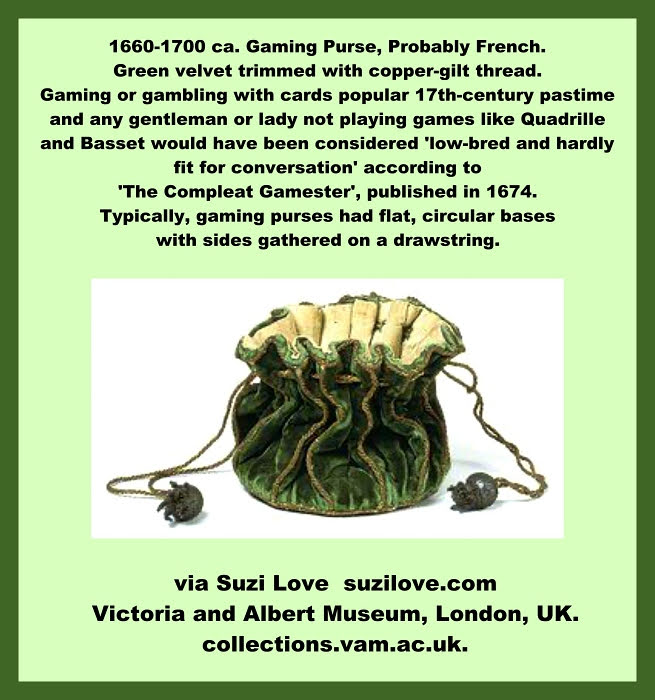
1660-1700 ca. Green Velvet Gaming Purse, Probably French. Trimmed with Copper-Gilt Thread, probably French. This purse was designed especially for gaming, or gambling, and would have held money, or counters, and is of a different design to other 17th-century purses. The base is a flat circle and the sides are gathered on a drawstring to stop money or gaming counters from spilling out, and to hide how much a gambler had in the purse. The bag’s plain look was probably a deliberate move to fool other gamblers into thinking the owner had little money.The purse is quite plain, with no embroidery and only a twist of copper gilt thread, gilt being a cheap substitute for gold or silver thread.
Playing and betting on card games was a socially acceptable pastime for the wealthy in the late 17th century. Along with dancing, riding and the theatre, it was an amusement for those classes that did not have to work. A gentleman or lady who did not participate in games such as ‘Quadrille’ and ‘Basset’ would have been considered ‘low-bred and hardly fit for conversation’ according to ‘The Compleat Gamester’, published in 1674. Victoria and Albert Museum, London, UK.
1660-1700-ca. Gaming Purse, probably French. Green velvet trimmed with copper gilt thread. Gaming or gambling with cards popular as a 17th Century Pastime and any gentleman or lady. D2D_RetailerBuyLink_HN_3 http://books2read.com/suziloveReticules
1806 Young French Gentleman. Brown Castorine Coat Over Blue Tailcoat, French. White cashmere breeches, white stockings, yellow gloves, black hat and a cane. Fashion Plate via Journal des Dames et des Modes, or Costume Parisien.
French fashions and Georgian and Regency Era fashions from Great Britain were copied around the world. This is the normal daily outfit for a gentleman in the early 1800s, or in the times of Jane Austen, for daily city and country life.
Le Beau Monde magazine made suggestions for men’s fashion in November 1806.
“The neckcloth should, by no means, be too greatly puffed out; but should be neatly united in front with a large unspread bow. Dark bottle green coats will be as generally worn this season, as those of brown colours were last winter.
“For morning dress frock coats will be prevalent: those of an olive hue, with a black velvet collar, will be the most universal. Fancied waistcoats of all manufactures may be worn with this kind of coat; but fashion ordains the invariable use of dark blue or light-coloured kerseymere pantaloons, and half-boots. The boots must rise somewhat higher in the leg than has recently been the custom, and the toes of them should be formed into a perfect semi-cirlce.
“Full dress coats will likewise be made of dark green cloth, double-breasted, and will possess the similar ornament of a black velvet collar. Single-breasted white waistcoats, and light-coloured kerseymere breeches will be in much estimation. Either flesh-coloured or now-white silk stockings fashion now considered as elegant.
“The hair, for morning dress, should be cut à la Titus; for full dress, it should be powdered. Buckles for the shoes are employed in full dress; but ribbands are allowed in afternoon or dinner dress.”
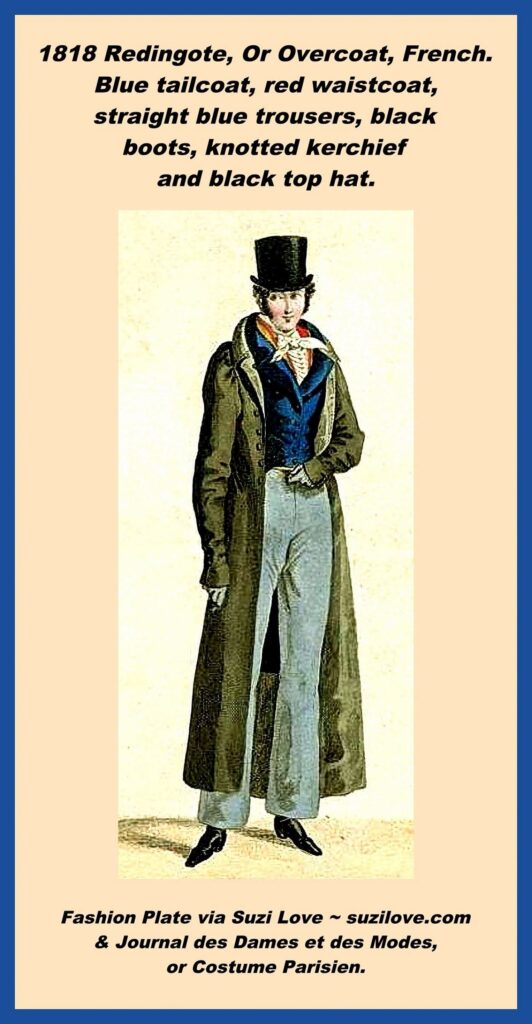
1818 Redingote Or Overcoat French. Blue tailcoat, red waistcoat, straight blue trousers, black boots, knotted kerchief and black top hat. Fashion Plate via Journal des Dames et des Modes, or Costume Parisien.
1818 Redingote Or Overcoat French. Blue tailcoat, red waistcoat, straight blue trousers, black boots, knotted kerchief and black top hat. Fashion Plate via Journal des Dames et des Modes, or Costume Parisien.HN_23_D2D_Fashion Men 1800-1819
1800 ca. Pair of Flintlock Duelling Pistols. Owned by Captain William Waller (active 1794-1807). Walnut stock, chequered grips, rounded butts, fitted with two silver pipes containing ramrods. Silver trigger guards engraved and end in pineapple shaped finials, each with flintlock containing flints. Lock plates engraved with leaf design, octagonal barrels browned with narrow gold bands near lock. via Royal Museums Greenwich collections.rmg.co.uk
During the Regency Era and Jane Austen’s writing years, dueling was illegal, although secret duels still happened. Courts were made up of peers and they rarely charged another peer for anything illegal. Honor and gentlemanly behavior were the most important things to men so if there was an offense committed, a dawn duel was arranged with seconds to check the weapons used and a doctor in case of injuries.
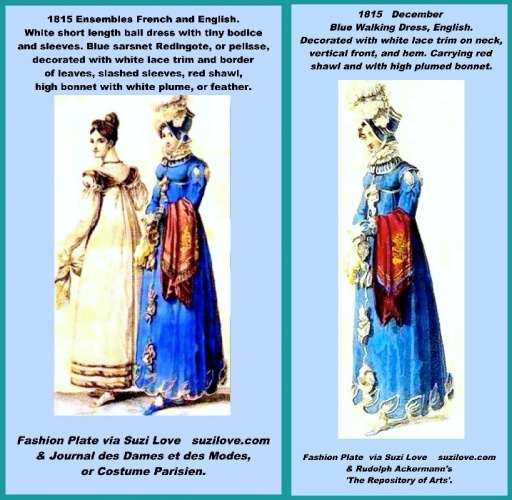
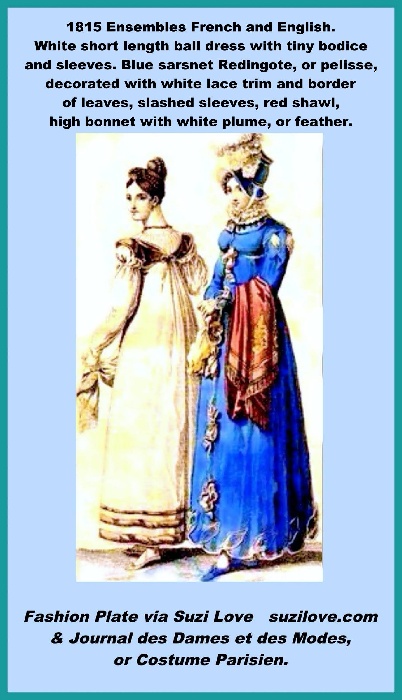
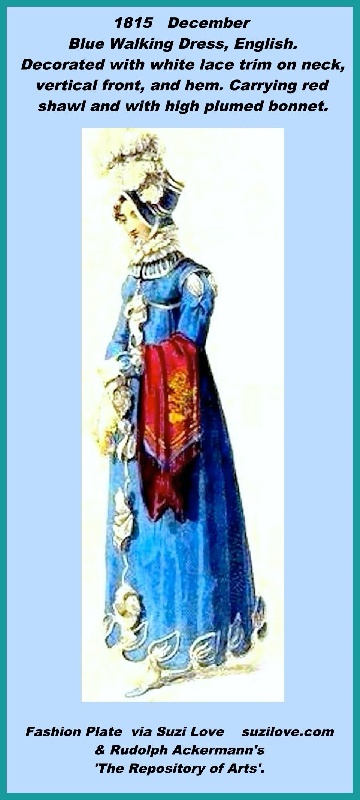
Here is an example of when English magazines copied French fashion plates. 1815 December Left: French fashion plate Ensembles French and English via Journal des Dames et des Modes. White short length ball dress with tiny bodice. Right: English fashion plate by Rudolph Ackermann in the Repository Of arts. Blue sarsnet Pelisse, or Walking dress, or Redingote. Decorated with white lace trim on neck, vertical front, and hem. Carrying red shawl and with high plumed bonnet.
Typical of the outfits worn by Jane Austen and her contemporaries for daytime and evening activities. An Empire style, or high-waisted white dress with jewelry for evening and for daytime a Pelisses or Walking Dress or Redingote or coat for warmth and with pretty hats, shawls and shoes.
Here is an example of when English magazines copied French fashion plates.
1815 December Left: French fashion plate Ensembles French and English via Journal des Dames et des Modes. White short length ball dress with tiny bodice.
Right: English fashion plate by Rudolph Ackermann in the Repository Of arts. Blue sarsnet Pelisse, or Walking dress, or Redingote. Decorated with white lace trim on neck, vertical front, and hem. Carrying red shawl and with high plumed bonnet.1815 December Ensembles French and English. White short length ball dress with tiny bodice. Blue sarsnet Pelisse, or Walking dress, or Redingote. Decorated with white lace trim on neck, vertical front, and hem. Carrying red shawl and with high plumed bonnet. via Journal des Dames et des Modes. 1815 December Blue Walking Dress, English. Decorated with white lace trim on neck, vertical front, and hem. Carrying red shawl and with high plumed bonnet. Fashion Plate via Rudolph Ackermann’s ‘The Repository of Arts’.
What did Jane Austen and friends wear? Early 1800s fashions were elegant and pretty with high waists and fabrics that were almost transparent. These Empire style gowns, named after Napoleon’s first Empress, became popular throughout Europe, and were then copied around the world. Colorful outwear was added to make an ensemble more attractive and warmer. History Notes Book 26 Fashion Women 1805-1809. https://books2read.com/SuziLoveFashionWomen1805-1809
What did Jane Austen and friends wear? Early 1800s fashions were elegant and pretty with high waists and fabrics that were almost transparent. These Empire style gowns, named after Napoleon’s first Empress, became popular throughout Europe, and were then copied around the world. Colorful outwear was added to make an ensemble more attractive and warmer.
https://books2read.com/SuziLoveFashionWomen1805-1809
Fashion Women 1805-1809 History Notes Book 26 What did Jane Austen and friends wear? https://books2read.com/SuziLoveFashionWomen1805-1809
Lover of Bridgerton and Jane Austen fashions? What was fashionable for their outer wear? Different names in different countries: Pelisse, Redingote, Or Walking Dress. #Regency #Fashion #History http://books2read.com/suzilovePelisse
The Pelisse or Redingote was essentially a coat or robe like garment worn both indoors and out. Worn indoors open to reveal a dress, the outdoor version was made of heavier materials and of darker colors than the type worn indoors. The name comes from the term ‘riding coat.’ In the Georgian Era, Redingotes were worn by men, women and children when outdoors and especially as part of a riding costume by both sexes.
In England, the Pelisse was the main sort of fashionable outerwear, or coat, for women in the Regency Era, or Jane Austen’s times. Though this sort of coat was popular from the late 1700s until around 1850. In the early 1800s, this sort of Empire style coat reached the hip or knee but around 1810 the Pelisse lengthened to become a full length coat. Around 1812, the Pelisse often had a broad, cape-like collar with fur trim and thanks to the Napoleonic Wars and an avid interest in all things military, a Pelisse took on a military look with epaulettes and braiding very popular.
While the terms Redingote and Pelisse are often used interchangeably, Pelisse and Walking Dress and Carriage Costume were the names used in English Fashion Plates, whereas French Fashion Plates refer to the longer style of coats as a Redingote and the shorter shoulder capes worn by military men as a Pelisse.
Pelisse, Redingote, Or Walking Dress. History Notes Book 5 By Suzi Love. What was fashionable for outer wear in past centuries? Call them what you like: Coat, Pelisse, Redingote, Walking Dress, Promenade Dress. Take a look at what was being worn by women, men, and children. books2read.com/suzilovePelisseD2D_RetailerBuyLink_HN_5_books2read.com/suzilovePelisse