1821 December Green Promenade Dress, English. High waisted coat over white dress with ruffled collar, vertical front bows, short puffed sleeves over long straight sleeves, matching ruffled bonnet and yellow gloves. Fashion Plate via Rudolph Ackermann’s ‘The Repository of Arts’, London, U.K.
1817-1820 ca. Spencer, or Jacket, English. The sort of jacket worn by Jane Austen and friends over their loose Empire style dresses. Green silk Spencer, brown satin puffs, silk cord on deep V collar and sleeves. With the rise of fashionable waistlines in women’s dresses after around 1800, women’s outerwear followed suit. This jacket with very short bodice and long sleeves was known as a Spencer and was named after the male coat. via Museum of London, UK. museumoflondon.org.uk
Description Spencer: Short jackets worn for warmth over the high-waisted Empire style gowns that were popular after the French Revolution, where there was a shift away from opulence and decadence to simpler fashion. This jacket with very short bodice and long sleeves was known as a Spencer and was named after the male coat made famous by the Earl Spencer and said to have originated in accident to Lord Spencer in hunting when coat tails torn off and a cropped jacket was invented. The dresses in the early 1800s therefore became looser, lighter, and flowing and women became cold due to their very low cut and short bodices. Short fitted jackets that went easily over the dresses and provided extra modesty and some warmth. As Europe and many other parts of the world were deep in wars in the late 1700s and early 1800s, men in uniform were found everywhere. In support of these military men, fashions leaned towards military style shoulder paddings, shoulder embellishments, loops, buttons, and braids.
1817-1820 ca. Spencer, English. With the rise of fashionable waistlines in women’s dresses after around 1800, women’s outerwear followed suit. This jacket with very short bodice and long sleeves was known as a spencer. via Museum Of London. 1817-1820 ca. Spencer, English. Back View. Green silk, brown satin puffs, silk cord on deep V collar and sleeves.
With the rise of fashionable waistlines in women’s dresses after around 1800, women’s outerwear followed suit.
This jacket with very short bodice and long sleeves
was known as a spencer and was named after the male coat.
via Museum of London, UK. museumoflondon.org.uk suzilove.com1817-1820 ca. Jane Austen and Bridgerton Style Green Silk Spencer, Or Jacket, English. #Bridgerton #RegencyFashion #BritishFashion #JaneAusten https://books2read.com/SuziLoveFashionWomen1815-1819 Share on XHN_28_D2D_FashionWomen 1815-1819
1808 Silver Wax Jack, Irish. By Robert Breading (active 1775–1822) Dublin. via suzilove.com and Metropolitan Museum New York City, U.S.A. metmuseum.org
How did Jane Austen seal her letters? Wax was melted by lighting the tip of a coiled wax length. This is called a wax jack. The melted wax blob was placed on the outside of a letter or document. A personal desk seal or a fob seal was pressed into the wax to identify the sender or owner of the document. Aristocrat families had their own coat of arms and others may have had their initials or their name on the seal.
1810-1815 ca. Salmon Pink Empire Style Dress, Norway. Typical Regency high-waisted dress. Long sleeves with puckered sleeve cap. Deep neckline with short shirred bodice. Long full skirt. via Digital Museum, Norway. digitalmuseum.no Regency fashion at its prettiest. The style of Empire style, or high-waisted, dress worn by Jane Austen and her contemporaries.
The Empire waist gown defined women’s fashion during the Regency Era. ‘Empire’ is the name given in France to the period when Napoleon built his French Empire. High-waisted, loose gowns were adopted by the aristocracy as a symbol of turning away from the fussy, elaborate and expensive clothing worn in the 1700s. Jean-Jaques Rousseau advocated copying peasants and returning to a simpler life and more natural fashions. Unrestricting clothing was part of the new Democracy in France and these simpler and flowing fashions were adopted all over Europe, including Britain and despite the continual wars being fought against France during the early 1800s. Not even war stopped fashions from being copied everywhere.
1819 January Red Redingote, French. Merino wool coat over a white dress with a high lace collar, matched with a black velour, or velvet, hat lined with white satin. Military style shoulder pads and front buttons. It was fashionable at the time to wear military inspired clothing to show support of all the men fighting in wars across the world. The type of outfit young Regency Era ladies would have worn if they were out shopping on Bond Street, walking in a park, or taking a carriage ride through Hyde Park. Fashion Plate via Journal des Dames et des Modes, or Costume Parisien.
Definition Redingote Or Pelisse Or Walking Dress Or Coat: French word developed from English words, riding coat. Long fitted outdoor coat worn over other garments for warmth. Often left open at the front to show off the dress underneath. Sometimes cut away in front. Originally made with several capes and trimmed with large buttons. French fashion plates call these coats Redingotes and they are designed for women, men and children. English fashion plates call them a Pelisse, a walking dress, Promenade dress, or Carriage dress.
1819 January Red Redingote, French. Also called a Pelisse or Walking Dress in England. Merino wool coat over a white dress with a high lace collar, matched with a black velour, or velvet, hat lined with white satin. Fashion Plate via suzilove.com and Journal des Dames et des Modes, or Costume Parisien.
1819 Red Merino Wool Redingote Or Coat With Matching Bonnet. #Regency #Fashion #FashionPlate #French https://www.books2read.com/SuziLoveFashionWomen1815-1819
1817 December Black Walking Mourning Dress, English. Black bombazine dress with a black crepe hem, with tight bodice wrapping across to the right side, trimmed with a piping of black crape that looks like braiding and finished by rosettes of crape, in the center of each of which is a small jet ornament. Long sleeves trimmed similarly at the wrists, half-sleeve of a new form trimmed with crape, high standing collar displaying a mourning ruff. Claremont bonnet, named because it is the same shape as one worn by the Princess, whose home with her husband, Prince Leopold, was called Claremont. Black crape over black sarsnet and lined with double white crape. Low crown but large front and tastefully finished by black crape with a bunch of crape flowers on one side. Black shamois gloves, and black shoes. “We have again to acknowledge our obligations to the lady who favored us last month; and we understand that the dresses from which our prints this month have been taken were also purchased from Mrs. Bell of St. James’s-street.” Fashion Plate via Rudolph Ackermann’s ‘The Repository of Arts’.
Mrs. Bell ‘invented’ fashion plates and as well as publishing in La Belle assemblee, she also sold them to other magazines. Hence the crossover we often see where the same plate, or a similar version, appears in different magazines.
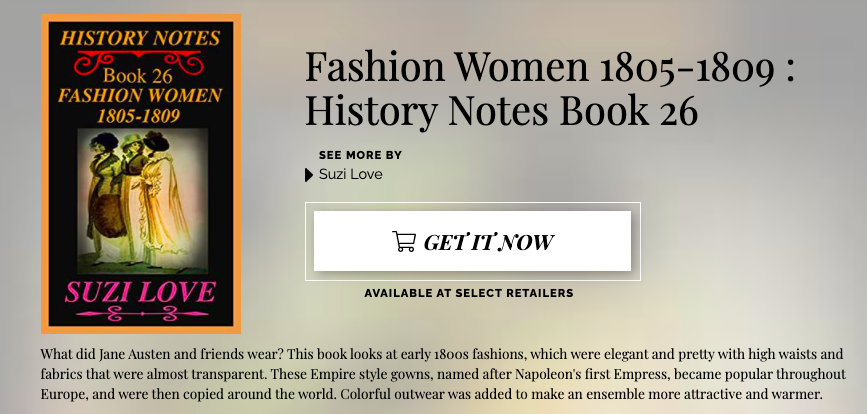
1808 Gorgeous Women’s Fashion In The Times Of Jane Austen. Fashion plates from Journal des Dames et des Modes or Costume Parisien. Dresses, coats or Redingotes, Spencers in purple and red, shawls, fichu or shoulder cape, shoes, hats and headdresses, gloves, and Reticules or bags. https://books2read.com/SuziLoveFashionWomen1805-1809
1808 High-Waisted White Dress, French. White Fichu over the shoulders, pale blue shoes, pink striped hat.1808 White Dress With Purple Spencer, French. 1800 White Dress, French. Black ribbon criss-crossing the back bodice. 1808 White Dress With Train Under A Red Spencer, French. Pointed shawl bodice and long sleeves.1808 Negligee Or At-Home Dress, French. Orange redingote, or coat, white shawl, blue gloves and shoes.1808 Lady in a white At-Home dress and cap sitting at her dressing table, French. 1808 Gorgeous Women's Fashion In The Times Of Jane Austen. #Regency #JaneAusten #Fashion https://books2read.com/SuziLoveFashionWomen1805-1809 Share on XFashion Women 1805-1809 History Notes Book 26
What did Jane Austen and friends wear? This book looks at early 1800s fashions, which were elegant and pretty with high waists and fabrics that were almost transparent. These Empire style gowns, named after Napoleon’s first Empress, became popular throughout Europe, and were then copied around the world. Colorful outwear was added to make an ensemble more attractive and warmer.
https://books2read.com/SuziLoveFashionWomen1805-1809
Craftsmen created containers of precious metals, leather, and silks and decorated them with jewels and engraving. Jane Austen and her contemporaries would have used writing boxes, linen boxes when travelling, boxes to hold their food and drink supplies while traveling by carriage, and decorative boxes to keep letters, ribbons, gloves, hairpins etc. Boxes, Cases, and Necessaires By Suzi Love, History Notes Book 11. books2read.com/suziloveBoxesCases.
1812 Dress of Yellow Virginie, French. High waisted dress trimmed with lilacs, cashmere shawl, high white neck frill, high flowered bonnet. Fashion Plate via Journal des Dames et des Modes, Costume Parisien.
Typical of the Empire dresses worn by Jane Austen and her contemporaries. Low necklines and skirts that started directly under the bust and flowed into the classical relaxed wide styles of Greece and Rome. These high-waisted dresses were worn most days and cotton, silk or taffeta were the popular fabrics.