1800s Early Typical Regency Gentleman Riding His Horse. Fashions In The Time Of Jane Austen.
From the finish of the 18th century until 1820, men’s fashions in European and European-influenced countries moved away from the formal wear of brocades, lace, wigs and powder to more informal and relaxed styles. Focus was on undress rather than formal dress. Typical menswear in the early 1800s included a tailcoat, a vest or waistcoat, either breeches, pants, or the newer trousers, stockings, shoes or boots, all worn with an overcoat and hat. This basic ensemble was accessorized with some form of neckcloth or cravat, gloves, walking stick, cane or riding crop, handkerchief, fobs, watch and perhaps a quizzing glass or eye glass.
1800s Early A Gentleman Riding His Horse.
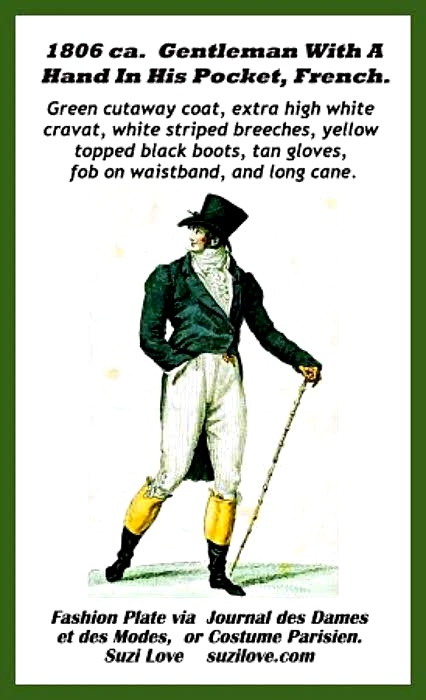
In 1806, the Journal des Dames et des Modes stated, ‘The informal outfit for a young man includes a coat of similar style, snug pantaloons which are probably knitted, and a striped waistcoat.’
Skirted coats were replaced with short-fronted, or cutaway, tailcoats worn over fitted waistcoats and plain, white linen shirts. Knee breeches were gradually replaced by tight-fitting pantaloons and later trousers, decorative shoes with buckles were replaced with a variety of boot styles, and fussy and ruffled neckwear gave way to intricately tied, white linen neck cloths. A Regency Era, or early 1800s, gentleman was outfitted in more practical fabrics, such as wool, cotton and buckskin rather than the fussy brocades and silks of the late 1700s.
Looking for a new holiday read? The Duke of Sherwyn to Lady Rebecca Jamison. “Did you just say you’ve been shot? Before tonight.” #HolidayRomance #HistoricalRomance #mystery https://books2read.com/suziloveES
1809 July Opera Dress Round convent robe of Egyptian brown tissue worn over white satin underdress, ornamented at feet, bosom and sleeves with broad Antique lace, out on full, and narrowing in front, white satin appliqued stomacher embellished with gold lattice work and continued in a straight line down to the hem. Headdress is a gold net caul, enclosing the hair at the back and finished in front with a Mechlin veil displaying the hair on the forehead and falling over the left shoulder. Necklace and armlets are a single row of Bohemian pearl with topaz or diamond snaps. Grecian scarf of rich Andalusian silk, contrasted with the robe and wrought at the ends in a deep Tuscan border of gold or colored silks. White satin slippers, trimmed with brown foil or gold, French kid gloves, opera fan of white crepe with a border of jessamine. Fashion Plate via Rudolph Ackermann’s ‘The Repository of Arts’. I can picture aristocratic women wearing this sort of gorgeous outfit to the opera or an evening event.
1820 ca. Typical Regency Wrap Corset.. Worn over a chemise. Cross-over fabric and lacing at the back. Tied around at the front. via Roger-Viollet Palais Galliera, Musée de la Mode de la Ville de Paris. Object number- GAL1957.16.17 Corsets changed at the e4nd of the Regency Era to fit well under clothing, give maximum support and comfort. Corsets pushed up breasts and showed off the bust line beneath a square-cut and low-cut neckline as in the early 1800s, or Regency years. Jane Austen and her female and friends would have worn this type of soft wrap corset. https://books2read.com/SuziLoveCorsetBook17.
Corsets worn during the early 1800s, or Regency Era, or Jane Austen’s lifetime, when dresses were low cut with square necklines. https://books2read.com/SuziLoveCorsetBook17
Somerset House, London, UK. London’s Best Places to Visit. Home to Royal Academy and The Great Institutions.
Demolition of the old house, between the Strand and the River Thames, began in 1775 and continued in stages as the new Somerset House was constructed around it. When the new building rose from the rubble, the Royal Academy, which had been one of the last occupants of the old Somerset House, became one of the first occupants of the apartments which fronted the Strand, providing tangible continuity between the old and the new.
Timeline
1547 Edward Seymour, Lord Protector and Duke of Somerset, starts building a palace for himself on the banks of the Thames
1552 Seymour is executed at the Tower of London; ownership of his palace, nearly complete, passes to the Crown
1553 Aged 20, Princess Elizabeth moves to Somerset House; she lives there until 1558, when she’s crowned Queen Elizabeth I
1603 Anne of Denmark, wife of James I of England (James VI of Scotland), moves to Somerset House, which is renamed Denmark House in her honour
1604 The Treaty of London, ending the 19-year Anglo-Spanish War, is negotiated and signed at Denmark House
1609 Anne of Denmark invites Inigo Jones and other architects to redesign and rebuild parts of the palace; work continues until her death in 1619
1625 Charles I is crowned king; his wife, Henrietta Maria of France, commissions Jones and others to undertake more construction and renovation work, including a lavish new Roman Catholic chapel completed in in 1636
1642 The English Civil War begins; soon afterwards, General Thomas Fairfax takes over the palace as the headquarters for the Parliamentary Army
1649 The Civil War ends and Charles I is executed; Parliament tries and fails to sell Denmark House, but successfully sells its contents for the then-huge sum of £118,000
1652 Inigo Jones dies at Denmark House
1660 After Charles II, her son, is crowned king at the start of the Restoration, Henrietta Maria returns to Denmark House; more new construction follows
1665 The Plague sweeps London; Henrietta Maria moves back to France, where she dies in 1669
1666 The Great Fire of London destroys much of the City of London, but stops just short of Denmark House
1685 Charles II dies and his wife, Catherine of Braganza, moves into Denmark House; Sir Christopher Wren oversees yet more construction and renovation work
1693 Catherine of Braganza leaves Denmark House, the last royal to live in the palace
early 1700s Denmark House is used as grace-and-favour apartments, offices, storage and stables
c.1750 Canaletto paints two views from the terrace
1775 After decades of neglect, the original Somerset House is demolished; architect William Chambers immediately starts work on its replacement
1779 The Royal Academy of Arts becomes the first resident of new Somerset House in what’s now known as the North Wing
1780 The Royal Society and the Society of Antiquaries take up residence in the North Wing; Somerset House hosts the first Royal Academy Exhibition
1786 The Embankment Building, known today as the South Wing, is completed; the East and West Wings are completed two years later
1789 The Navy Board completes its move to Somerset House and eventually occupies one-third of the site; the Stamp Office, responsible for taxing newspapers and other documents, joins the board in the South Wing
1795 William Chambers, then aged 72, retires; James Wyatt replaces him as the building’s architect
1801 The new Somerset House is deemed complete, its construction having cost a mammoth £462,323
1829 Sir Robert Smirke starts work on King’s College, which opens in 1831 and is finally completed in 1835
1836 The General Register Office, responsible for births, deaths and marriages, is established here
1837 One year after the final Royal Academy Exhibition at Somerset House, the academy moves to Burlington House on Piccadilly
1849 Having merged in 1834, the Stamp Office and the Board of Taxes join with the Board of Excise to form the Inland Revenue, which remains in residence for more than 150 years
1856 Seven years after James Pennethorne started work on its design, the New Wing is completed
1857 The Royal Society moves out of Somerset House to join the Royal Academy of Arts at Burlington House; the Society of Antiquaries follows 17 years later
1864 Work begins on the Victoria Embankment, designed by Sir Joseph Bazalgette; the embankment is completed in 1870
1873 The Admiralty leaves Somerset House; its offices are taken over by the Inland Revenue
1940s Near the start of World War II, the Inland Revenue temporarily moves out of Somerset House; the Ministry of Supply takes its place
1950 Sir Alfred Richardson starts a two-year project to rebuild the Navy Staircase, known today as the Nelson Stair, which had suffered terrible bomb damage in 1940
1970 After 134 years at Somerset House, the General Register Office moves out
1989 The Courtauld Institute of Art moves into the North Wing
1997 The Somerset House Trust is established to preserve and develop Somerset House for public use
2000 The River Terrace opens to the public for the first time in more than a century; the Hermitage Rooms and the Gilbert Collection both open; then, in December, Somerset House installs a temporary ice rink for the first time
2001 American band Lambchop plays the first gig in the Edmond J. Safra Fountain Court; a full programme of shows follows in 2002 and continues today as the Summer Series
2009 London Fashion Week takes place at Somerset House for the first time
2011 The HMRC (formerly the Inland Revenue) closes its offices at Somerset House
The Royal Academy of Arts
George III, described as an “enthusiastic if undiscriminating collector and patron of the arts”, provided invaluable patronage for the three learned societies. When old Somerset House was relinquished by the Crown, the King reserved to himself the right to appropriate sufficient space in the new building for the Royal Academy of Arts, the Royal Society, and the Society of Antiquaries.
The Great Exhibition Room
1808 The Exhibition Room at Somerset House.
The most important part of the building for the Royal Academy was its Exhibition Room. Situated at the top of the steep, winding staircase, it was roughly 53 x 43 feet and 32 feet high including the lantern, and was described by Joseph Baretti as, “undoubtedly at that date the finest gallery for displaying pictures so far built.” It was here that George III was given a preview of the first Royal Academy Exhibition held at his command in 1780.
Year by year, the exhibits increased. There were 547 in 1781, 1,037 in 1801, and 1,165 in 1821, so that the pictures had to be hung almost from floor to ceiling and with the frames touching one another. From 1832 onwards there was talk of the Royal Academy moving to more spacious rooms in what is now the National Gallery, which was being built at the north end of Trafalgar Square. Accordingly, the last exhibition at Somerset House was held in 1836.
When the Academy moved, the most valuable decorations were taken down and reused in their new quarters. Later they were moved to Burlington House, the Royal Academy’s present home, where the ceiling paintings by Benjamin West and Angelica Kauffmann can now be seen in the entrance hall. The Academy’s old rooms at Somerset House were occupied by the Department of Practical Art, or Government School of Design.
The Royal Society
In 1776, they discovered they were to share the building to the east of the Strand entrance with the Society of Antiquaries, and complained to William Chambers that the accommodation would be inadequate; that the library would be too small and that there would be no room for the Society’s museum.
One of the first discoveries announced to the Society in its new quarters was that of a new planet, first observed by William Herschel in 1781. He wished to call the new planet Georgium Sidus in honour of the King, but other astronomers disagreed and today we know the planet as Uranus. Fellows of the Royal Society were keen to prevent war and politics interfering with the advancement of scientific discovery.
During the Napoleonic Wars of 1796-1815, the President of the Royal Society, Sir Joseph Banks, used his influence both in England and France to ensure that explorers of the two nations were not obstructed by the conflicting armed forces, and that French scientists should continue to be elected Fellows of the Society. When Sir Humphry Davy became president in 1820, the Society became oriented more towards pure scientific enquiry, to which ends, George IV founded two Gold Medals.
After the Royal Academy left Somerset House in 1837, the Royal Society remained there until 1857 when it joined the Academy at Burlington House.
The Society of Antiquaries
In 1776, the Antiquaries heard about the proposed new building at Somerset House, they decided to apply to George III, their Patron, for rooms there. After some intense lobbying by the President, the Reverend Dr Milles, the Society’s request for accommodation was favourably considered, and the King was, “most graciously pleased to order that the Society be accommodated with apartments in the new buildings at Somerset House.”
The resident Secretary of the Society was accommodated in the attic with three rooms “with deal dadoes, and Sienna marble and Sicilian jasper chimney-pieces”. The basement was hotly contested between the Royal Society and the Antiquaries, who were eventually allowed a kitchen, cellar, two vaults, and a privy. However, the lobby, originally intended for the footman in waiting, had to accommodate the Antiquaries’ porter as the Royal Society had taken possession of the Porter’s Lodge!
In the 1850s there was a proposal to move the Royal Society and the Antiquaries from Somerset House but, when the Royal Society moved out in 1857, the Antiquaries decided to remain, taking the opportunity to secure sole use of the disputed rooms, until they joined the other two learned societies at Burlington House in 1874.
The Navy Board
When the Admiralty moved into new premises in Whitehall in 1725, it was decided that the Navy Board, over whom the Admiralty had responsibility, should move to a site much closer; from Seething Lane behind the Tower of London to new offices at Somerset House. Chambers proposed to house the Navy Board on the west side of the south wing of the new building, in the part facing the river, with the Seamen’s Waiting Hall in the centre of the building providing an imposing entrance.
The related Sick and Hurt, Navy Pay, and Victualling Offices were to occupy the range of buildings on the west side of the courtyard. By 1789 the move was completed and, for nearly a century, more than a third of Somerset House was home to the various branches of the Navy Board.
General Register Office
In 1836 the General Register Office was created to set up a comprehensive system for the registration of Births, Marriages and Deaths and appoint the first Registrar General based at Somerset House. It was not until 1970, after slightly less than a century and a half at Somerset House, that the General Register Office moved out.
Principal Probate Registry
The Inland Revenue Stamp duty on documents, including newspapers, was only one of many revenue-raising methods administered by the Stamp Office, one of the government departments which moved to the new Somerset House in 1789. In 1834 the Stamp Office united with the Affairs of Taxes and in 1849 Stamps and Taxes joined the Excise to form a new Board of Inland Revenue. The Board of Inland Revenue today still occupies the east and west wings of Somerset House.
To read more of the history of Somerset House, visit their fascinating site.
1818 Blue Pelisse, Or Coat, English. Short puffed sleeves over long straight sleeves, military style braiding to decorate. matching shoes and high bonnet with feathers. The short puffed sleeves over the long straight sleeves and the military style of braids across the vertical front opening became popular in the late Regency years when many countries, especially Britain and France, had been fighting wars for many years. It was seen as patriotic to wear military styled clothing in support the hundreds of thousands of soldiers wearing their uniforms in cities all across Europe. Aristocrats wearing uniforms were seen as romantic heroes and men who couldn’t fight in the battles wore coats, Redingotes, and Pelisses that looked military with capes, brass buttons and braids.
The type of outfit young Regency Era ladies would have worn if they were out shopping on Bond Street, walking in a park, or taking a carriage ride through Hyde Park. Fashion Plate John Belle’s La Belle Assemblée or, Bell’s Court and Fashionable Magazine, London.
Definition Redingote Or Pelisse Or Walking Dress Or Coat: French word developed from English words, riding coat. Long fitted outdoor coat worn over other garments for warmth. Often left open at the front to show off the dress underneath. Sometimes cut away in front. Originally made with several capes and trimmed with large buttons. French fashion plates call these coats Redingotes and they are designed for women, men and children. English fashion plates call them a Pelisse, a walking dress, Promenade dress, or Carriage dress.
1812 Man’s wool, linen, and cotton long coat with four shoulder capes, European. Also called a Carrick Coat, a Driving Coat, or a Redingote in France. via Metropolitan Museum, NYC, USA. ~ metmuseum.org Credit Line: Purchase, Irene Lewisohn Bequest, 1988. Accession Number: 1988.300
A Regency Era, or early 1800s, gentleman was outfitted in more practical fabrics, such as wool, cotton and buckskin rather than the fussy brocades and silks of the late 1700s. The men in Jane Austen’s life would have worn this sort of warm and practical coat like this when riding his horse in inclement weather or when driving his carriage.
1812 ca. Back View. Man’s Caped Coat, Or Carrick Coat, European.
Wool, linen, and cotton. via Metropolitan Museum New York City, U.S.A. metmuseum.org1812 ca. Front View. Man’s Caped Coat, Or Carrick Coat, European.
Wool, linen, and cotton. via Metropolitan Museum New York City, U.S.A. metmuseum.org1812 ca. Back View Black and White. Man’s Caped Coat, Or Carrick Coat, European.
Wool, linen, and cotton. via Metropolitan Museum New York City, U.S.A. metmuseum.org1812 ca. Front View Black and White. Man’s Caped Coat, Or Carrick Coat, European.
Wool, linen, and cotton. via Metropolitan Museum New York City, U.S.A. metmuseum.org1812 ca. Front View Black and White With Umbrella. Man’s Caped Coat, Or Carrick Coat, European.
Wool, linen, and cotton. via Metropolitan Museum New York City, U.S.A. metmuseum.org1812 Man's Wool, Linen, and Cotton Coat With Four Shoulder Capes, European. #RegencyEra #Fashion #Coat #MetMuseum https://books2read.com/SuziLoveFashionMen1800-1819 Share on X
From the finish of the 18th century until 1820, men’s fashions in European and European-influenced countries moved away from the formal wear of brocades, lace, wigs and powder to more informal and relaxed styles. Focus was on undress rather than formal dress. Typical menswear in the early 1800s included a tailcoat, a vest or waistcoat, either breeches, pants, or the newer trousers, stockings, shoes or boots, all worn with an overcoat and hat. This basic ensemble was accessorized with some form of neckcloth or cravat, gloves, walking stick, cane or riding crop, handkerchief, fobs, watch and perhaps a quizzing glass or eye glass.
Skirted coats were replaced with short-fronted, or cutaway, tailcoats worn over fitted waistcoats and plain, white linen shirts. Knee breeches were gradually replaced by tight-fitting pantaloons and later trousers, decorative shoes with buckles were replaced with a variety of boot styles, and fussy and ruffled neckwear gave way to intricately tied, white linen neck cloths. A Regency Era, or early 1800s, gentleman was outfitted in more practical fabrics, such as wool, cotton and buckskin rather than the fussy brocades and silks of the late 1700s.
1810 French Gentleman. Riding outfit of double-breasted brown coat, tight pants with a side button decoration, jaunty black hat, gloves, and a crop. Fashion Plate via Journal des Dames et des Modes, or Costume Parisien.
In the early 1800s, men no longer wore complicated styles and extravagant fabrics. Men’s fashion simplified and became more conservative. A well cut tailcoat, vest, pantaloons and an immaculate cravat of beautiful white linen in the style of George Bryan, or Beau, Brummell. Clothes were a status symbol and indicated a man’s social position. These clothing items were the sort worn by Jane Austen’s male family and friends.
The London To Louth Royal Mail, England, U.K. Print by Charles Cooper Henderson. (1803-1877)
How did Jane Austen and her family? Did they go by stagecoach? The dreadful condition of British roads caused great apprehension to all classes of travelers. Making a journey anywhere in the country was a big undertaking and often a gentleman composed his last will and testament before his departure. Traveling in vehicles was only possible during the day or on the nights with very bright moonlight with few vehicles attempting road travel in winter and any travel on a Sunday was frowned upon. books2read.com/SuziLoveTravel
Description of Stage Coach Travel in England. via 1815 Journal Tour of Great Britain. “The gentlemen coachmen, with half-a dozen great coats about them, immense capes, a large nosegay at the button-hole, high mounted on an elevated seat, with squared elbows, a prodigious whip, beautiful horses, four in hand, drive in a file to Salthill, a place about twenty miles from London, and return, stopping in the way at the several public-houses and gin-shops where stage-coachmen are in the habit of stopping for a dram, and for parcels and passengers on the top of the others as many as seventeen persons. These carriages are not suspended, but rest on steel springs, of a flattened oval shape, less easy than the old mode of leathern braces on springs. Some of these stage coaches carry their baggage below the level of the axletree.”
1809 October Blue Ball Dress, English. A light blue, or grey chemise robe, of gossamer net, imperial crape, worn over white satin, ornamented up the front with French bows and knots of silver. A full melon sleeve, formed of the same material as the dress, and alternate stripes of white satin, finished with bows and knots of silver. A double roll of white satin around the neck by way of a tucker. Hair falling in natural and irregular curls on the forehead, confined in a bow and curled ends, or in plaited braids, at the back of the head with a diamond comb. Diamond bandeau, with necklace, armlets, and drop earrings of the same. Slippers of white satin, with silver clasps, French kid gloves, just escaping the elbow. Fan of carved ivory. Fashion Plate via Rudolph Ackermann’s ‘The Repository of Arts’.
Definition Bandana Or Bandeau: Narrow strip or band worn around head to confine hair. Made of either twisted fabric, length of pearls, flowers, jewels or feathers. From the French word for “strip.