1812 December Mother and Child, English. Mother in a pink Pelisse, or Walking Dress, of Merino wool with an embroidered front and frogs and tassels to fasten it. Waist is of a moderate length and there is an elegant figured belt and tassels. Tight long sleeves finish at the cuff with embroidery, like the stand-up collar. York tan gloves and half-boots, small straw turned up hat with two short ostrich feathers. Child wears a blue and white suit and both wearing adorable hats.
Fashion Plate via John Belle’s La Belle Assemblée or, Bell’s Court and Fashionable Magazine, London. The child is not mentioned in the description. ‘This truly elegant and fashionable order of promenade costume was furnished by Mr. S. Clark, Ladies Pelisse and Habit Maker, No. 37 Golden Square, whose taste in articles of this description has been so generally admired.’
1806 Two Ladies In Walking Dresses, French. White cotton dresses with bodice trims, short puffed sleeves, orange and pink Fichus or shoulder shawls, pink poke bonnet and white turban, extra long gloves, cashmere shawl. Fashion Plate via Journal des Dames et des Modes, or Costume Parisien. These fashionable ensembles with a variety of fashionable and practical accessories would have been worn by Jane Austen and her family and friends during the day when out walking in the park or visiting village shops. Hats were a necessity to protect fair skin from the sun and scarfs and shawls added color and warmth to an outfit.
Definition Fichu: Draped scarf or shawl worn about shoulders and tied in knot at breast, with ends hanging down loosely. Word, meaning negligee or careless, first used to describe breaking away from stiff collar of the past.
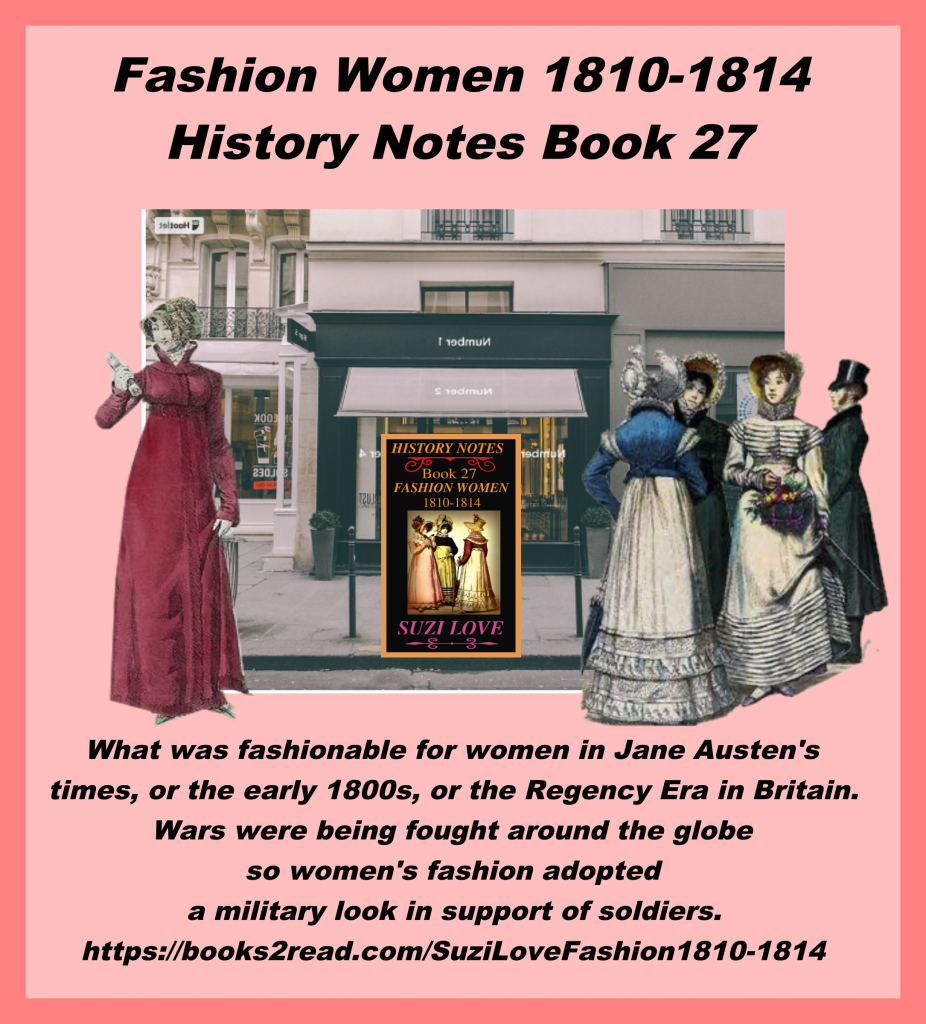
Fashion Women 1805-1809 History Notes Book 26 What did Jane Austen and friends wear? https://books2read.com/SuziLoveFashionWomen1805-1809
1816 Blue Riding Habit, French. High-waisted blue riding dress with a train, the long full skirt being necessary to cover a lady’s legs and preserve her modesty when riding side saddle. These riding habits were usually designed by men and were in two pieces, a jacket and a skirt, worn over a shirt. A military style bodice decoration, high pointed collar and a knotted pink dotted cravat worn underneath that imitate male styles, or even Dandy fashion. Sleeves are very long as was the trend in French riding habits. Yellow gloves and a masculine style beaver hat. This print was designed by Horace Vernet and engraved by Pierre Baquoy. Fashion Plate via Journal des Dames et des Modes, or Costume Parisien. Although, there are very similar riding habit fashion plates in other magazines.
The type of outfit Jane Austen and her friends would have worn when they went horse riding. https://books2read.com/SuziLoveFashionWomen1815-1819
1809 October Blue Ball Dress, English. A light blue, or grey chemise robe, of gossamer net, imperial crape, worn over white satin, ornamented up the front with French bows and knots of silver. A full melon sleeve, formed of the same material as the dress, and alternate stripes of white satin, finished with bows and knots of silver. A double roll of white satin around the neck by way of a tucker. Hair falling in natural and irregular curls on the forehead, confined in a bow and curled ends, or in plaited braids, at the back of the head with a diamond comb. Diamond bandeau, with necklace, armlets, and drop earrings of the same. Slippers of white satin, with silver clasps, French kid gloves, just escaping the elbow. Fan of carved ivory. Fashion Plate via Rudolph Ackermann’s ‘The Repository of Arts’.
Definition Bandana Or Bandeau: Narrow strip or band worn around head to confine hair. Made of either twisted fabric, length of pearls, flowers, jewels or feathers. From the French word for “strip.
Fashion Women 1805-1809 History Notes Book 26 What did Jane Austen and friends wear? https://books2read.com/SuziLoveFashionWomen1805-1809
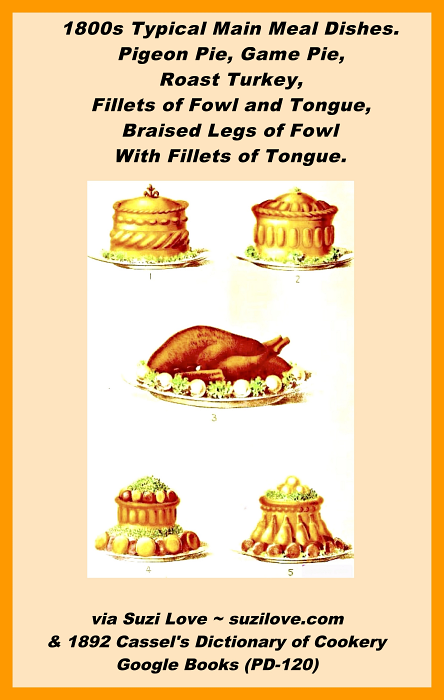
1800s Typical Cold Collation Dishes served during the 1800s. These are the sort of dishes Jane Austen’s family would have eaten on a regular basis. Pigeon Pie, Raised Game Pie, Cutlets and Peas, Prawn Bouquet, Creamed Chicken, Plover’s Eggs, Lamb Cutlets, Stuffed Larks, Piped Ham, Boned Capon. From: 1860 Mrs. Isabella Beeton’s Book of Household Management.
1812-1814 Ca. White Muslin Peignoir Or Dressing Gown, British. The sort of robe Jane Austen would have worn. Fabric made in India, Garment made in Britain. Wrap-over gown with round, slightly raised collar, gathered trimmings, narrow shoulder frills, excessively long sleeves with wristbands. Muslin dyed in the ikat technique, Malay term for complex tie-resist dyeing where warp threads dyed to form pattern before weaving. White with blue and red blurred warp.
via Victoria & Albert Museum, London, UK. collections.vam.ac.uk Credit: Given by Messrs Harrods Ltd.
1802-1812 ca. Dancing Or La Dansomanie Series. Four women being instructed in dancing before a mirror by a master playing a violin. Le Bon Genre Description Plate 12. Via British Museum, London, UK. britishmuseum.org (PD-Art)
19th Century Mid. The Music Room By George Goodwin Kilburne (1839-1924). Oil On Panel, 30.4 X 40.6cm. Via Wikimedia Commons commons.wikimedia.org (PD-ART)
1817 November Autumnal Carriage Walking Dress or Pelisse, or Redingote, English. Pelisse of Cashmere with a white background, trimmed with vermillion red, vermillion belt and a gold and Ceylon ruby broach or clasp. Lyonese shawl with a rich border of various colors. Bonnet of vermillion satin, embossed with straw, decorated with straw colored ribbons and a bouquet of full blown damask rose, buds, and ears of ripe corn and edge of the bonnet finished by blond lace. White kid half-boots, Limerick gloves, vermillion satin ridicule, or bag, with gold tassels and spring. Fichu frilled with fine lace and left open at the throat. Fashion Plate via John Belle’s La Belle Assemblée or, Bell’s Court and Fashionable Magazine, London.
Jane Austen: This is a fashionable ensemble as would have been worn by Jane Austen and her family and friends. Walking dress such as this would have been worn when out shopping, walking in a park or the country estate. This sort of outfit needed to be presentable and warm but not overly accessorized with jewelry etc..
Definition Coat, or Redingote Or Pelisse: Long fitted outdoor coat worn over other garments for warmth. Redingote is the French word developed from English words for riding coat. Usually called Walking Dress Or Pelisse in English fashion plates.
Definition Reticule: Bag or purse, often with a drawstring to pull closed and usually made of cloth or covered cardboard and often decorated with beading or embroidery. A reticule, or purse, or handbag, was usually carried by a woman during the Regency period to carry all their daily necessities. Earlier, women used pockets that tied at the waistline and were hidden in the folds of their skirts. Empire style, or early 1800s, high-waisted dresses made it impossible to either sewn in a pocket or to tie on a pocket. So women began carrying small, decorated bags called Reticules, or ridicules, which generally pulled close at the top with a drawstring.
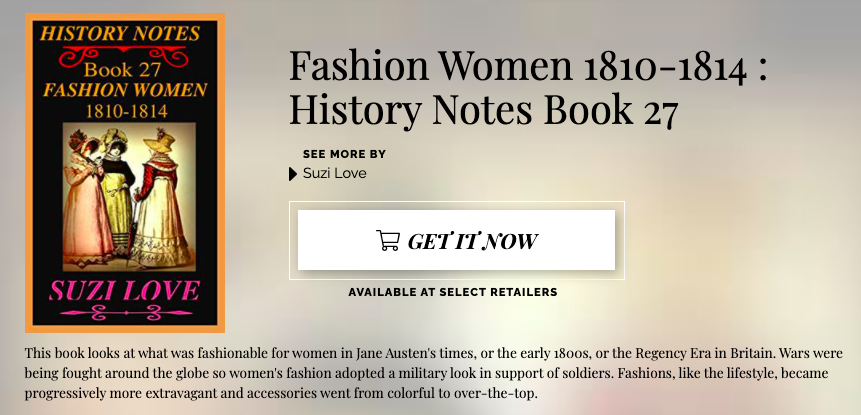
Fashion Women 1815-1819 History Notes Book 28 https://books2read.com/SuziLoveFashionWomen1815-1819
Drama and romance at the duke’s snowbound British country estate. Michael Brandon travels to introduce the woman he loves to family but is shocked when his missing brother arrives. December Scandal Book 3 Scandalous Siblings https://books2read.com/suziloveDS
Excerpt:1844 Martin House, England.
Michael Brandon strolled after Cayle St. Martin, the Duke of Sherwyn, when the duke strode to the hallway to greet the latest group of travelers. They’d be, like him, grateful to accept the duke’s hospitality because they’d all become stranded after heavy snowfalls had led to rapidly rising water levels and an impassable local bridge.
He leaned on a wall and watched Mason, the efficient butler at Martin House, ease open the massive front door while three footmen braced their shoulders against the door to stop it blowing fully open. The house had already been full of family members gathered for Christmas, but with the addition of several groups of half-frozen travelers arriving every hour during the afternoon, the house’s walls must be groaning under the excess number of guests needing beds.
Several massive rooms in Martin House had been opened and warmed for the weary travelers who had descended on the duke and his family, but those large fires needed constant feeding with logs of wood. Therefore, Sherwyn couldn’t risk a barrage of snow and sleet blowing inside his house from the courtyard because, in such inclement weather, his footmen might not be able to collect more firewood for another week. Little wonder then that the duke hovered near the front entrance and supervised each subsequent arrival, his charming duchess by his side to add her won welcome.
Michael and his party had been the first to beg assistance from Sherwyn this afternoon, as he’d known that Sherwyn had left London a week earlier and would already be in residence at his country home. There had been a flurry of social events in London over the past two weeks before the Ton left the city and retreated to their country estates to wait out the colder months. Though this extreme weather had caught everyone by surprise.
It was barely mid December and the nearby bridge usually served the locals well through that month and into the New Year. Water levels normally only rose and covered the bridge after the snowstorms of January. Michael and Cayle were long time friends and so he knew Cayle had loathed this house, his family seat, when his father and stepmother had been in residence, but now that Cayle was the duke, and a married man, he had decided to turn this house into a more welcoming family gathering place. Even with the influx of visitors, invited or not, the staff here were jolly and efficient, a rare combination in the serving ranks.