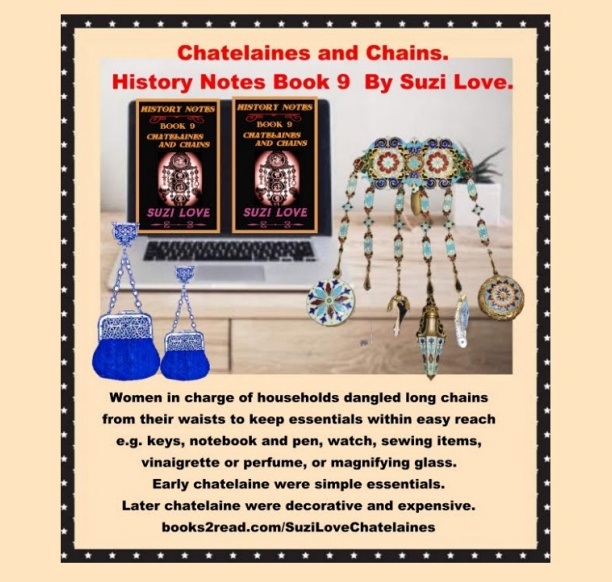
Jane Austen’s and the Bridgerton ladies personal necessities, keys, or chatelaines was a set of useful items hung from waist by decorative chain. Chatelaines and Chains. History Notes Book 9 By Suzi Love. Women in charge of households dangled long chains from their waists to keep essentials within easy reach e.g. keys, notebook and pen, watch, sewing items, vinaigrette or perfume, or magnifying glass. Early chatelaine were simple essentials. Later chatelaine were decorative and expensive. http://books2read.com/SuziLoveChatelaines
Definition Chatelaine: The word Chatelaine is French and means the keeper of the keys. Chatelaine” derives from the Latin word for castle. In Medieval times, the chatelaine was in charge of the day-to-day running of the castle. Women in charge of households dangled long chains from their waists to keep essentials within easy reach e.g. keys, notebook and pen, watch, sewing items, vinaigrette or perfume, or magnifying glass. Early chatelaine were simple essentials. Later chatelaine were decorative and expensive.books2read.com/SuziLoveChatelaines
What did a chatelaine do? Most important task was keeper of the keys. Also ordered supplies, did bookkeeping, supervised servants, taught castle children, and organized guests.
Chatelaines and Chains History Notes Book 9 By Suzi Love. What do you know about Chatelaines and Chains worn in Jane Austen’s and Bridgerton times? Women in charge of households carried important items with them. History Notes Book 9 Chatelaines and Chains. books2read.com/SuziLoveChatelaines
Personal Necessities, keys, or chatelaines was a set of useful items hung from waist by decorative chain. Chatelaines and Chains. History Notes Book 9 By Suzi Love. Women in charge of households dangled long chains from their waists to keep essentials within easy reach e.g. keys, notebook and pen, watch, sewing items, vinaigrette or perfume, or magnifying glass. Early chatelaine were simple essentials. Later chatelaine were decorative and expensive. http://books2read.com/SuziLoveChatelaines
Definition Chatelaine: The word Chatelaine is French and means the keeper of the keys. Chatelaine” derives from the Latin word for castle. In Medieval times, the chatelaine was in charge of the day-to-day running of the castle. Women in charge of households dangled long chains from their waists to keep essentials within easy reach e.g. keys, notebook and pen, watch, sewing items, vinaigrette or perfume, or magnifying glass. Early chatelaine were simple essentials. Later chatelaine were decorative and expensive.books2read.com/SuziLoveChatelaines
What did a chatelaine do? Most important task was keeper of the keys. Also ordered supplies, did bookkeeping, supervised servants, taught castle children, and organized guests.
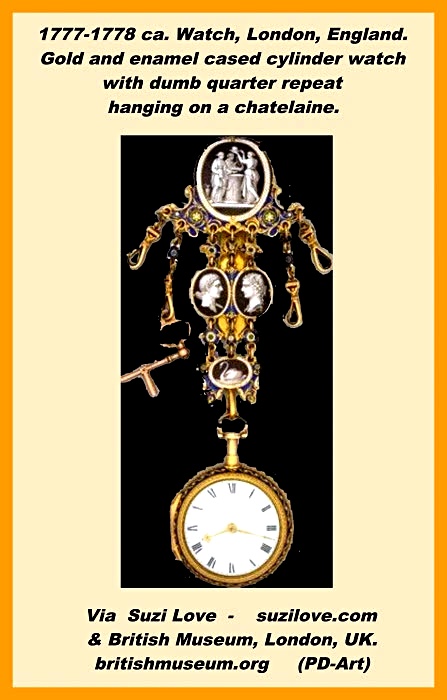
1777-1778 ca. Gold and enamel Cased Cylinder Watch with dumb quarter- repeat and en-suite Chatelaine, London, England. Via British Museum, London, UK. britishmuseum.org books2read.com/SuziLoveChatelaines
1756-1762 ca. Gold and Enamel Étui, French. Probably by Jean Ducrollay, 1756-62, Paris. via Metropolitan Museum New York City, U.S.A. metmuseum.org
books2read.com/SuziLoveWritingTools
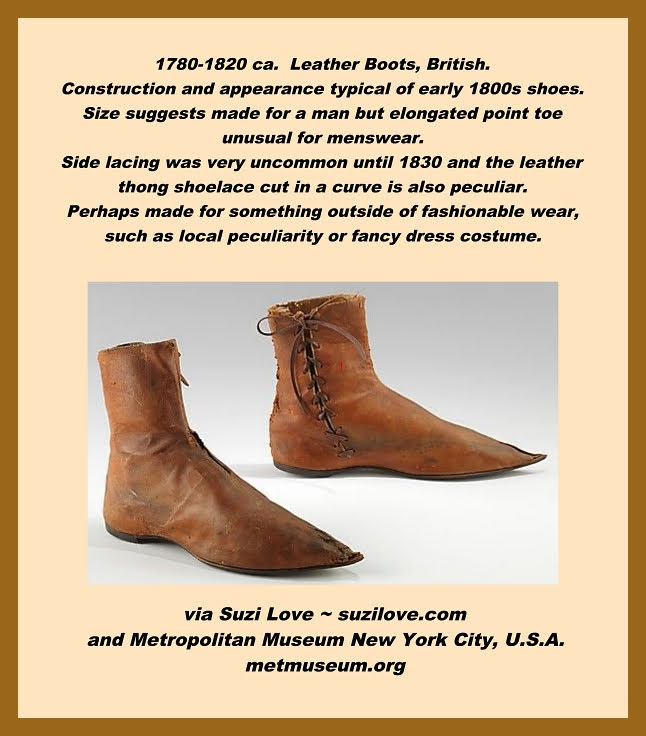
1780-1820 ca. Brown Leather Boots, British. Construction and appearance typical of early 1800s shoes. Size suggests made for a man but elongated point toe unusual for menswear. Side lacing was very uncommon until 1830 and the leather thong shoelace, cut in a curve, is also peculiar. Perhaps made for something outside of fashionable wear, such as local peculiarity or fancy dress costume. via Metropolitan Museum New York City, U.S.A. metmuseum.org
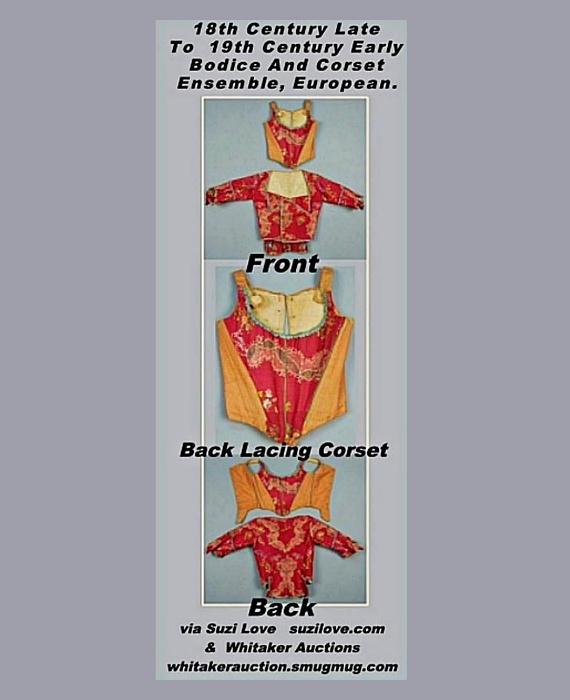
18th Century Late – 19th Century Early Bodice and Corset Ensemble, European. Cranberry silk faille with polychrome floral brocade, the square-neck bodice having folded front collar, narrow double breast and short sleeve with pleated and pointed cuff, peplum back. Corset front pieced with cranberry brocade and a tan dotted sawtooth stripe, the back in a similar dotted stripe. Both pieces trimmed in aqua ribbon and lined in linen. via Whitaker Auctions. whitakerauction.smugmug.com
The Assembly Rooms in Bath, UK. One of my favorite places to visit.
Bath had two assembly rooms in the lower part of the town but they weren’t large enough for the rapidly increasing population so on the 30th September, 1771, New Rooms were opened on the north east of the Circus, between Bennett and Alfred Streets. These Upper Rooms were designed by the architect, John Wood, and were in a better part of town so they became much more fashionable. They were called the New, or Upper Rooms, to distinguish them from the older Assembly Rooms in the lower part of the town.
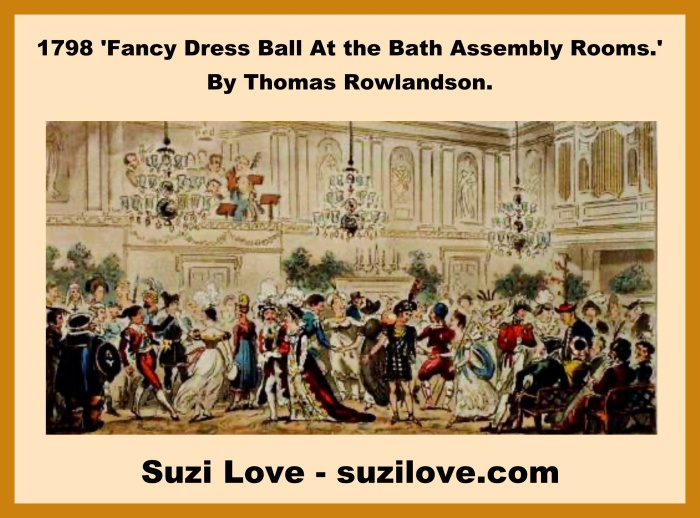
They were a set of public rooms purpose-built for the 18th century form of entertainment called an ‘assembly‘, where a large number of people came together to dance, drink tea, play cards, listen to music, or parade around the rooms and talk and flirt. The four rooms are the Ball Room, the Tea Room or Concert Room, the Octagon Room, and a Card Room. The Upper Rooms held two balls a week, a dress ball on Monday evenings and a fancy ball on Thursdays during the Bath season which was from October to early June. These balls were so popular they attracted between 800 and 1,200 guests at a time.
John Wood raised the money for the New Rooms by a “tontine” subscription, which was like a lottery. By April 1769, £14,000 was raised amongst 53 people. When a subscriber died, their shares were added to the holdings of the other subscribers, which meant that the last surviving subscriber inherited everything.
The exterior of the Upper Assembly Room looks typically Georgian, but the interior is very grand and the high ceilings gave good ventilation on crowded ball nights and windows set at a high level prevented outsiders from looking in. Two long rectangular rooms flank the entrance hall and are linked by an octagonal room at the far end to form a U-shape.
1798 Fancy Dress Ball at the Bath Assembly Rooms.’
By Thomas Rowlandson.Interior of Assembly Rooms, Bath.Entrance to Assembly Rooms,
Now Fashion Museum.
Bath, U.K.Entrance to Assembly Rooms,
Now Fashion Museum.
Bath, U.K.1805 Interior of Concert Room, Bath. By John Claude Nattes
‘Bath Illustrated by a Series of Views.’
Via Suzi Love – suzilove.com
& Wikimedia Commons commons.wikimedia.org1799 Richard Nash Esq. Master of Ceremonies, Assembly Rooms, Bath From- 1799 The New Bath Guide Printed by R. Cruttwell.1771 The New Assembly Rooms Opened,
Between Bennet and Alfred streets,
Bath, U.K.
via Suzi Love – suzilove.com
& 1835 The Historical and Local New Bath Guide
Published By C. Duffield.
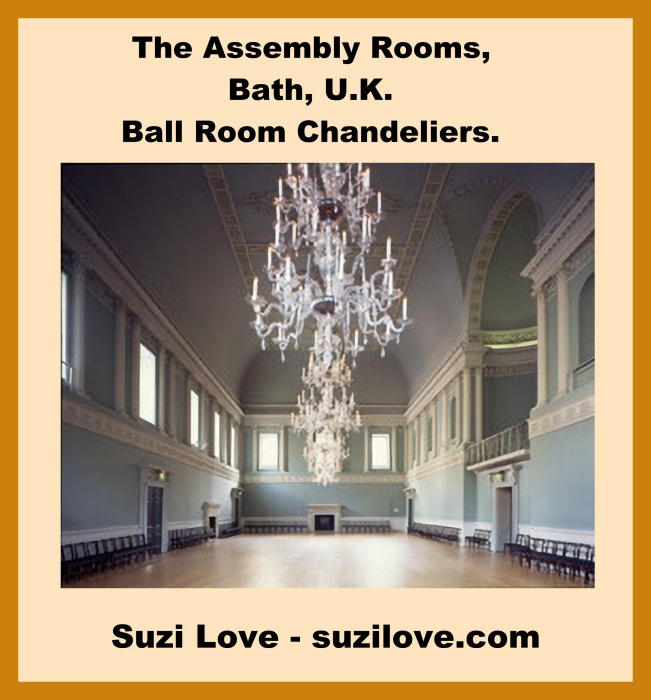
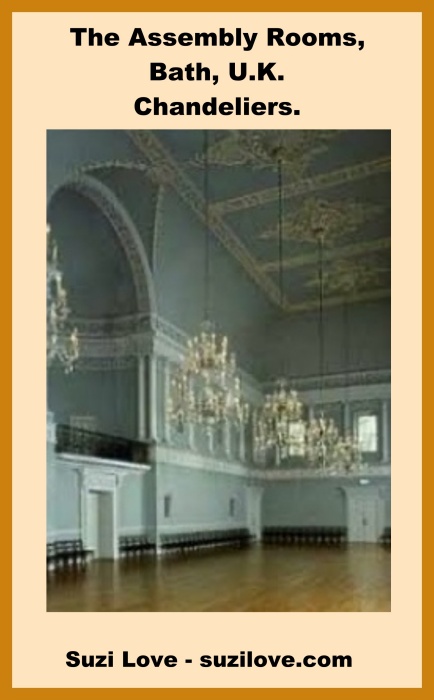
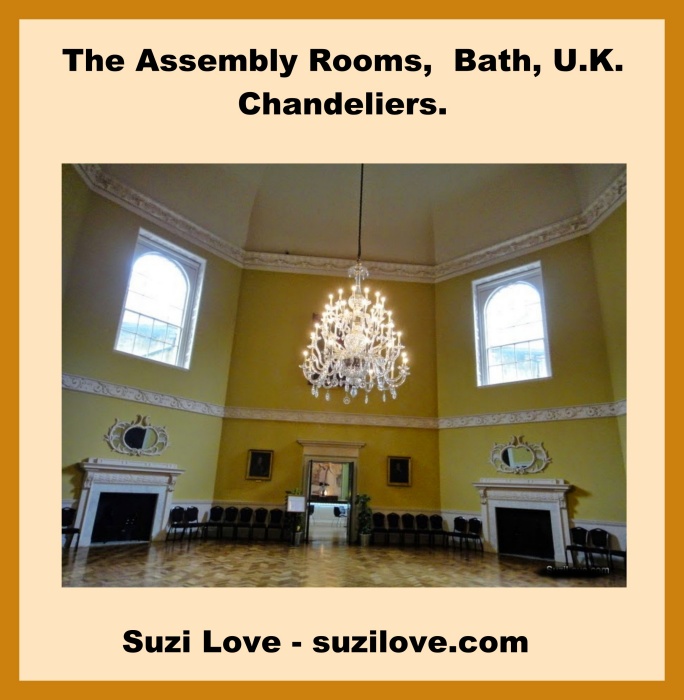
The Assembly Rooms are lit by a set of nine chandeliers, made for the building in 1771. Jonathan Collett of London originally provided a set of five chandeliers for the Ball Room when it opened in September 1771. Shortly afterwards the arm of one of the chandeliers fell off – narrowly missing the artist, Thomas Gainsborough, who lived nearby at the time. The Ball Room chandeliers were taken down and a new set was ordered from William Parker of London. Parker had already supplied three chandeliers for the Tea Room. It was agreed that Jonathan Collett should salvage the rejected set of Ball Room chandeliers and make one large chandelier to hang in the Octagon Room. The chandeliers in the three rooms had an average height of eight feet and they were made of Whitefriars crystal from the Whitefriars Glassworks in London and were originally lit by candles. The Ball Room and Tea Room chandeliers each had 40 lights and the Octagon chandelier had 48 lights.
During the 19th century, they were fitted for gas and were later converted to electric light. At the start of the Second World War, the chandeliers were put into storage and escaped destruction when the Assembly Rooms were bombed in 1942. During the extensive refurbishment of the building in 1988-1991, the chandeliers were restored by R. Wilkinson & Sons of London. The Bath Season ran from October to June. As the Season spanned the winter months and many activities took place in the evening it was essential to provide good artificial lighting.
The ball room is the largest of the three main rooms and is over 105 feet long and 42 feet wide and 42 feet high. It runs the whole length of the north side of the building and covers two storeys. The paint is called Ballroom Blue and was first created by David Mlinaric in the 1970s from an original colour swatch. “It is a stroke of luck that the colour sample of blue paint is still attached to the 1770s minute book of the Assembly Rooms Furnishing Committee.” said Lucy Powell, Assistant Archivist at Bath Record Office, “The building was bombed in 1942 so traces of the paint would never have survived otherwise.” From: Fashion Museum, Bath.
On the other side, the tea room is 70 feet long and 27 feet wide and all the rooms had huge chandeliers to give light. In 1777, a card room was added to the Octagonal Room. Before the Card Room was added, the Octagon Room became famous for card playing, the favorite leisure activity from the Georgian Era through to the Regency, as the Upper Rooms were open for card games every day except Sunday. The Octagon Room is dominated by Gainsborough’s portrait of the first Master of Ceremonies at the Upper Rooms, Captain William Wade. Bath’s most famous Master of Ceremonies, Richard “Beau” Nash, never knew this building as he died in 1761.
Bath_Octagon Room, The Assembly Rooms, Bath, U.K. Chandeliers. The Assembly Rooms,
Bath, U.K.
Ball Room Chandeliers. The Assembly Rooms,
Bath, U.K.
Chandeliers. The Assembly Rooms,
Bath, U.K.
Chandeliers. The Assembly Rooms,
Bath, U.K.
Chandeliers. The Assembly Rooms,
Bath, U.K.
Chandeliers. The Assembly Rooms,
Bath, U.K.
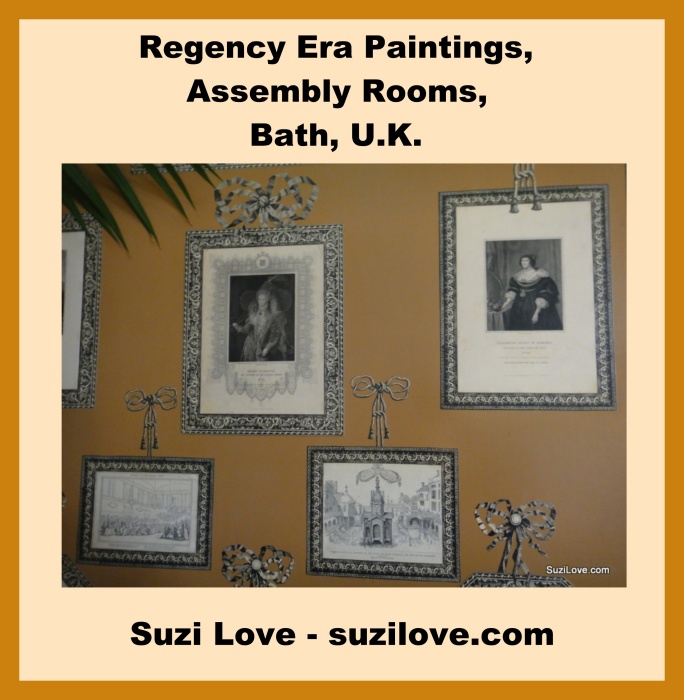
Chandeliers. Regency Era Paintings,
Assembly Rooms,
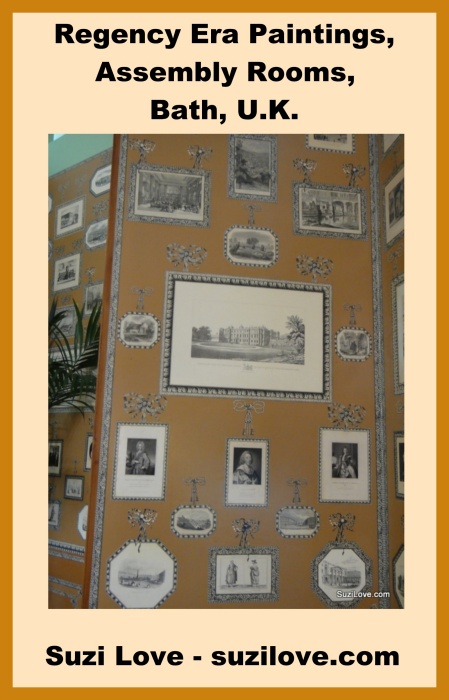
Bath, U.K.Regency Era Paintings,
Assembly Rooms,
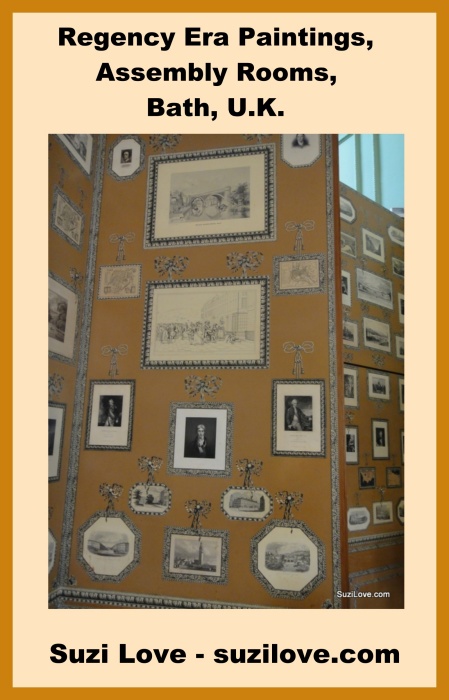
Bath, U.K.Regency Era Paintings,
Assembly Rooms,
Bath, U.K.Regency Era Paintings,
Assembly Rooms,
Bath, U.K.
The tea room was used for refreshments, with tea generally served weak and black or perhaps with arrack and lemon, and on Wednesday nights during the Season concerts were held there. Fashionable visitors to Bath could also hold breakfasts there for their friends.
Many famous people visited the Assembly Rooms in the 18th and 19th centuries. Jane Austen and Charles Dickens both mention the Assembly Rooms in their novels and the diarist, Francis Kilvert, described a reception there in 1873. Subscription concerts were popular and many well-known musicians also visited, the most distinguished being Joseph Haydn, Johann Strauss the Elder, and Franz Liszt.
Today, the Octagon Room, the Tea Room, and the Cloak room Landings all showcase beautiful paintings and prints as the Upper Rooms were given to the National Trust in 1931. You can see paintings by Thomas Gainsborough and John Simmons as well as an Original ticket to the Thirteenth Dress Ball at the Assembly Rooms, 24 January 1803.
Since 1963, the Upper Assembly Rooms have also housed the amazing Fashion Museum. The building is owned by the National Trust and is leased by Bath & North East Somerset Council.
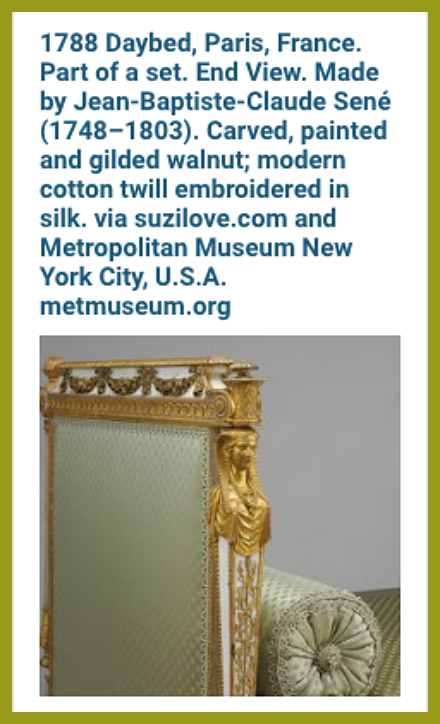
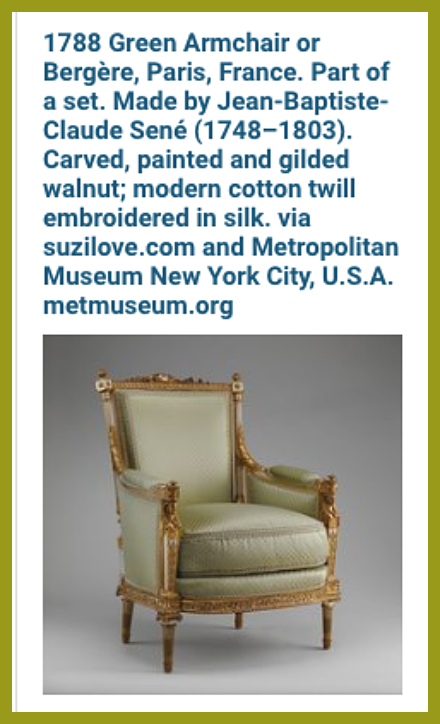
1788 Armchair or bergère en cabriolet. Part of a set by Jean-Baptiste-Claude Sené (French, 1748–1803). Made for Marie Antoinette, Queen of France, for her Cabinet de Toilette in Palace of Saint-Cloud, France. Carved, painted and gilded walnut; modern cotton twill embroidered in silk. Made for Marie-Antoinette’s dressing room at the château de Saint Cloud. The queen’s initials are carved on the top rail.
The Palace of St. Cloud belongs to the Duke of Orleans, is situated on the declivity of a mountain washed by the Seine. . . . The view from the house is delightful. By Harry Peckham, A Tour through Holland and Part of France
Louis XVI purchased the country residence of the duc d’Orléans a few miles west of Paris for Marie-Antoinette in 1785. Being in need of renovation, the palace was enlarged and altered for the queen, and many pieces of furniture were commissioned from Jean-Baptiste-Claude Sené. A member of an important dynasty of Parisian chairmakers, Sené had been appointed menuisier to the Crown in 1784.
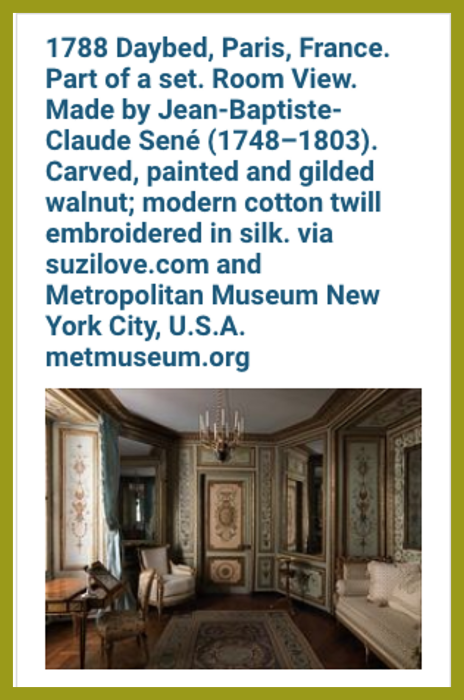
A 1788 description of this set, four matching armchairs and a stool, shows that it was for one of Marie-Antoinette’s private rooms at Saint-Cloud, her Cabinet Particulier. Frame of the daybed embellished with carving of ivy and garlands of roses, ionic capitals on the short legs and Egyptian female half-figures on tapering supports. These figures express the queen’s taste for ornaments from ancient Egyptian art, well before Napoléon’s North African campaign made it fashionable. The bergère, or armchairs, has a medallion on top with Marie-Antoinette’s initials framed by myrtle branches and roses. The matching screen has classical female figures on its feet and top rail.
The 1789 inventory of Saint-Cloud records the entire suite in the queen’s Cabinet de Toilette, or dressing room. The set is upholstered in white cotton twill, embroidered with a small floral ornament in silk. Known to have worked on needlepoint projects all her life, Marie-Antoinette did the embroidery herself. The colorful floral embroidery on the light cotton ground conveys a sense of summer, the season Marie-Antoinette preferred to spend at Saint-Cloud. via Epigraph. Peckham 1788, p. 199.
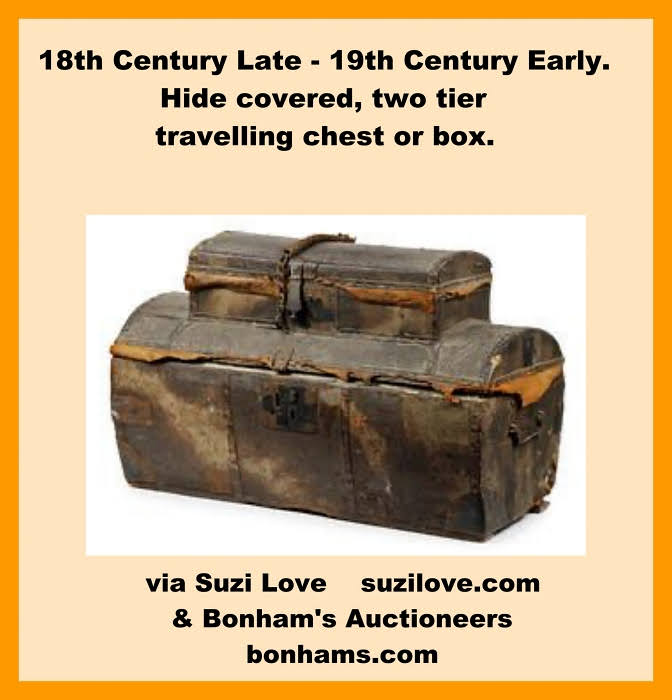
1930-1939 ca. Louis Vuitton Wardrobe Trunk. Monogrammed coat hangers, leather handle.1930-19391930-1939 ca. Louis Vuitton Steamer Trunk.18th Century Late – 19th Century Early. Hide covered, two tier traveling chest or box. Via Bonham’s Auctions.17th Century Iron Trunk With Locking Mechanism. 1900s Early Bags and Suitcases.
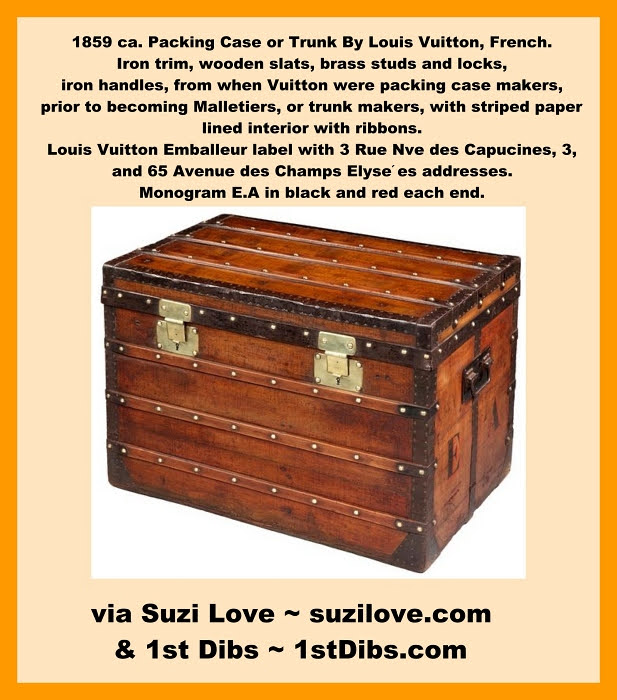
1st Dibs Auctions. 1859 ca. Packing Case or Trunk By Louis Vuitton, French. Iron trim, wooden slats, brass studs and locks.17th – 20th Centuries Luggage For Travel. #RegencyEra #VictorianEra #EdwardianEra books2read.com/SuziLoveTravel Share on XHN_10_D2D_RetailerBuyLink_ History Notes Book 10 books2read.com/SuziLoveTravel