1840s Opera Boots, British. Black leather with suede leg and silk bow, hand and machine sewn. via
Victoria and Albert Museum, London, UK. collections.vam.ac.uk.



1840s Opera Boots, British. Black leather with suede leg and silk bow, hand and machine sewn. via
Victoria and Albert Museum, London, UK. collections.vam.ac.uk.
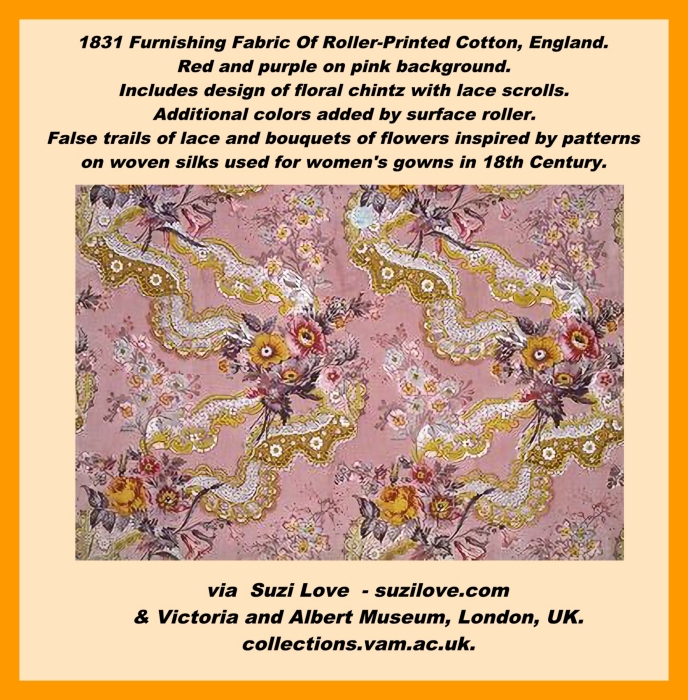
Between 1820 and 1840 textile printers began to produce designs that were based on the woven silk dress fabrics of the 1750’s. Designs showing curving trails of lace or ribbons between bouquets of flowers became as popular in the 1830s as they had been in the 18th century.
Roller Printed Cotton.
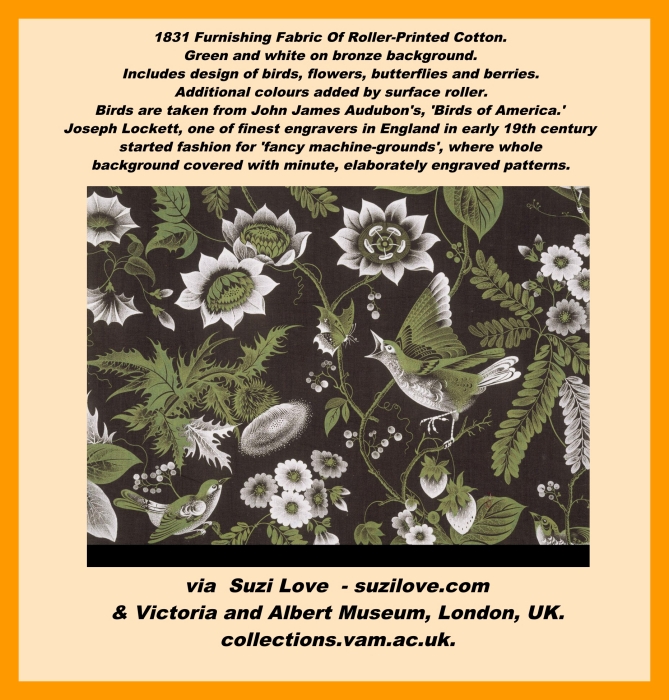
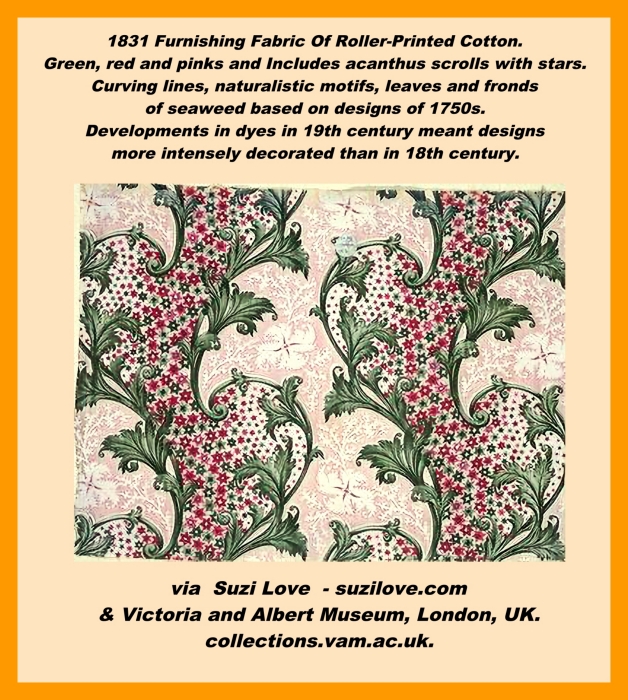
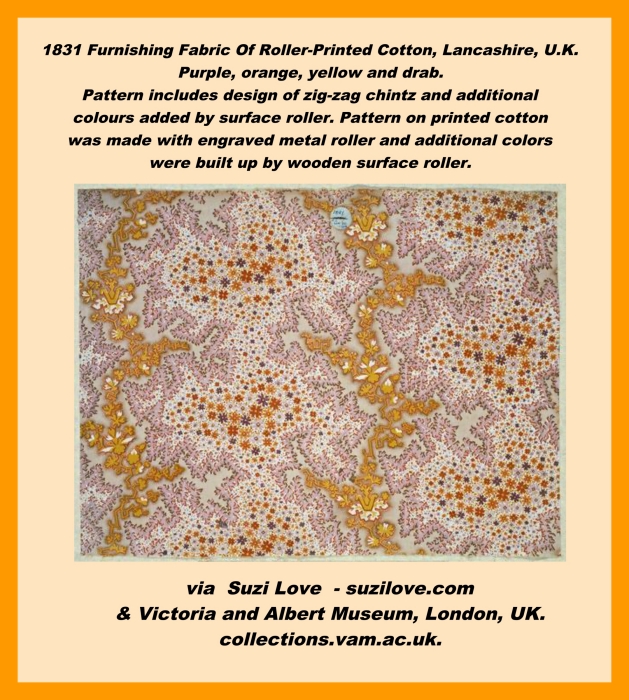
The pattern on printed cotton was made with an engraved metal roller and additional colors were built up by wooden surface roller. Roller printing on textiles was introduced in the late 18th century and at first used mainly for small-patterned dress fabrics. By the 1830s, roller printing was highly mechanized process and had largely replaced block printing for fashionable furnishings.
Materials and Making
The development of roller printing coincided with a radical transformation in the dyestuffs available for printing on cotton. Until the beginning of the 19th century printing had been based on the use of vegetable dyes. In Britain, France and Germany new chemical processes were developed and mineral colors produced that transformed the palette of colors available to the printer and made combinations such as shades of pink and orange possible.
Design and Designing
The false trails of lace and bouquets of flowers in the fabric are inspired by the patterns of woven silks from nearly a century earlier. Changing taste made this design suitable for furnishing a room in the 1830s, while the 18th-century silk that was its inspiration would have been intended for a woman’s gown.
Time
The styles considered fashionable in 1830s furnishings were widely diverse. Among the more recognisable historical references were Rococo, Elizabethan and Gothic. A design such as this seems to be relying on novelty of effect for its success.
Information via Curator of Victoria and Albert Museum, London, UK. collections.vam.ac.u Victoria and Albert Museum, London, UK.

1820-1830 ca. Mother Of Pearl sewing casket with a painted view of Weilburg near Baden in Austria. Painting by Balthasar Wigand.
From The Curator: The mother-of-pearl industry in Vienna reached its apogee during the 1820s and 1830s, when numerous luxury items such as candle screens and desk sets were embellished with the iridescent material. Balthasar Wigand, responsible for the miniature on the lid of this box, specialized in views of the city and its surroundings, painted especially for use on small pieces of furniture and caskets. via Metropolitan Museum New York City, U.S.A. metmuseum.org


1826 January Promenade Dress, English. Green walking dress with wide lace hem, zigzag white collar edge, white buttons on front vertical, large fur muff with pink lining, large hat with pink ribbons and black bows on crown. Fashion Plate via Rudolph Ackermann’s ‘The Repository of Arts’, London, U.K.
Definition: Promenade Dress, Walking Dress, Pelisse Or Redingote. Woman’s long, fitted overdress or coat often worn open in front to show off the dress underneath. Sometimes cut away in front. Originally made with several capes and trimmed with large buttons. French word developed from English words, riding coat. reefer. Single- or double-breasted, fitted, tailored, over-all coat usually made from sturdy fabric. In England, this sort of coat was generally called a pelisse, walking dress, carriage dress or promenade dress. In France, these coats were called a Redingote.


1830 ca. Collection of Four Tiny Purses, or Reticules with drawstrings to close. via Ruby Lane Antiques. As would have been carried by ladies in Jane Austen and Bridgerton years.
Definition Of A Reticule; Bag or purse, often with a drawstring to pull closed and usually made of cloth or covered cardboard and often decorated with beading or embroidery. A reticule, or purse, or handbag, was usually carried by a woman during the Regency period to carry all their daily necessities. Earlier, women used pockets that tied at the waistline and were hidden in the folds of their skirts. Empire style, or early 1800s, high-waisted dresses made it impossible to either sewn in a pocket or to tie on a pocket, so women began carrying small, decorated bags called Reticules, or ridicules, which generally pulled closed at the top with a drawstring. These Reticules, or bags, were the forerunners of our modern day purses.


19th Century Early Women’s Cotton Caps. Worn as morning caps, night caps, or under other hats. With lappets, hanging ties, or tails, which were also called ‘follow me lads’, or ‘flirtation ribbons’. via Museum of Fine Arts, Boston, U.S.A. mfa.org. via Museum of Fine Arts, Boston, U.S.A. mfa.org
Definition Caps: Worn as morning caps, night caps, or under other hats. Jane Austen and her family and female friends would have worn caps like these, sometimes during the morning at home, to bed to keep their long hair from becoming knotted, or under a bonnet to hold a hairstyle in place.
Caps sometimes had hanging ties, or tails, were also called ‘follow me lads’, or ‘flirtation ribbons’.
Definition Lappets: Two long strips of material, often lace, hanging from top of head down back or over shoulders. Sometimes extensions of a headdress and a requirement for court dress.

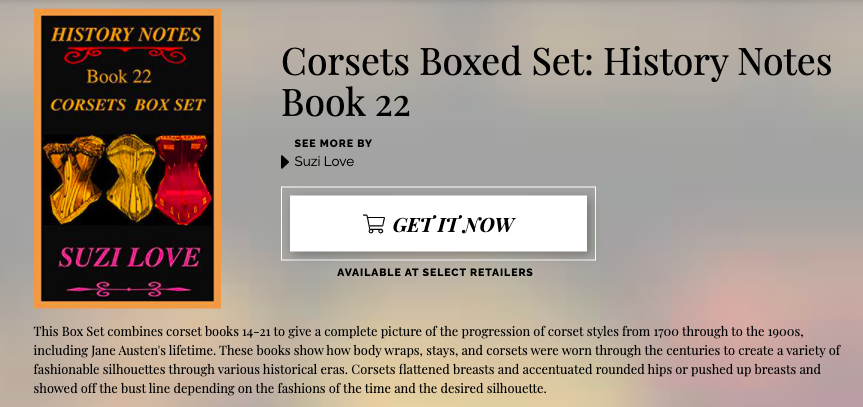
Box Set combining Corset books 14-21 to give a complete picture of the progression of corset styles from 1700 through to the 1900s, including Jane Austen’s lifetime. https://books2read.com/SuziLoveCorsetBook22
This Box Set combines corset books 14-21 to give a complete picture of the progression of corset styles from 1700 through to the 1900s, including Jane Austen’s lifetime and the Bridgerton years. These books show how body wraps, stays, and corsets were worn through the centuries to create a variety of fashionable silhouettes through various historical eras. Corsets flattened breasts and accentuated rounded hips or pushed up breasts and showed off the bust line depending on the fashions of the time and the desired silhouette.

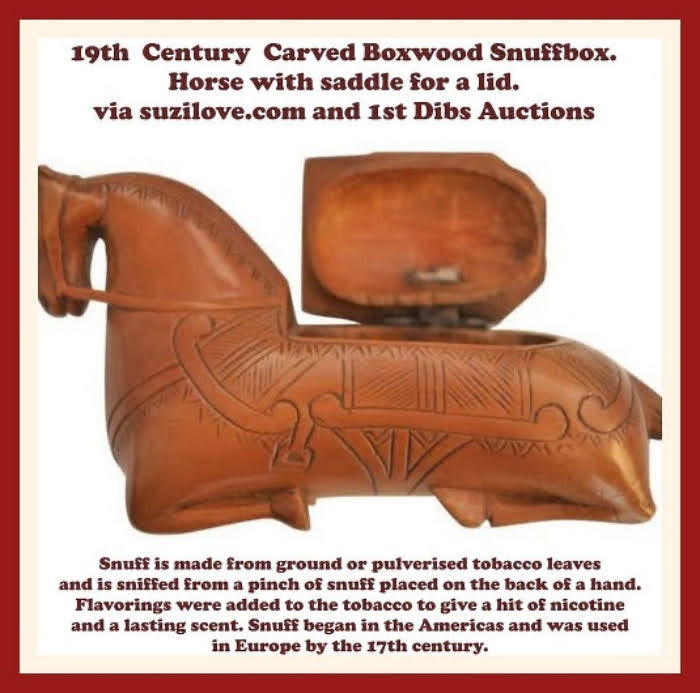
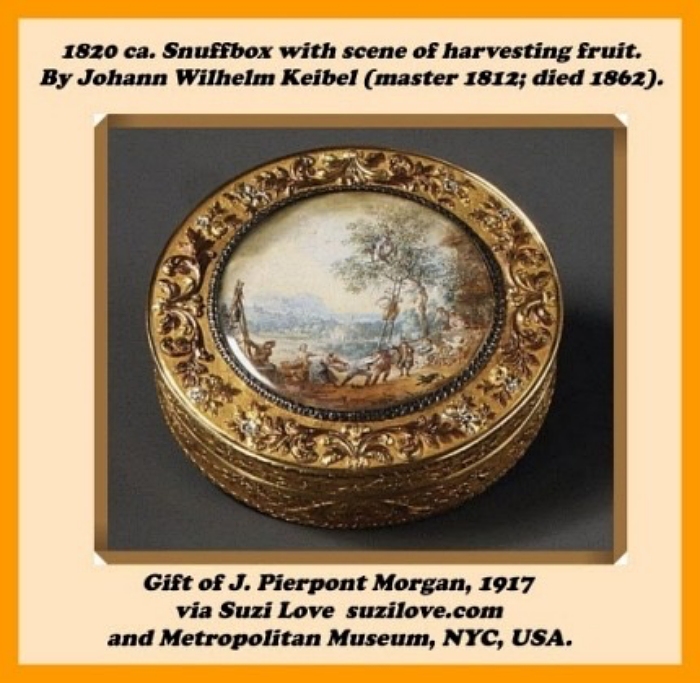
19th Century Snuff Boxes. Not only were boxes made to serve a purpose, but decorative boxes of all types were prized, especially in the 18th-19th Centuries when everything decorative and extravagant was in vogue and taking a pinch of snuff was fashionable. Snuff is made from ground or pulverized tobacco leaves and is sniffed from a pinch of snuff placed on the back of the hand.Flavorings were added to the tobacco to give a fast hit of nicotine and a lasting scent. Snuff began in the Americas and was used in Europe by the 17th Century.
Snuff became popular from the mid 1600s to the mid 1800s and was more popular than smoking. Inhaling snuff, or snuffing, was first seen by a European missionary in 1493 in Christopher Columbus’s new world within Haiti’s indigenous Taino. Until then, tobacco had been unknown to Europeans, but its use spread quickly throughout Europe during the 1500s. By the second half of the 17th century, ornate boxes started being produced to keep the precious powder dry and an entire industry making accessories blossomed around the fashion of taking snuff. Noblemen, and some women, carried extravagantly decorated snuff boxes with them at all times and would offer a pinch of their own particular blend to friends and family. Therefore, these boxes were always on display and so it became a competition to see who could have the most bejeweled or expensive box possible. By the mid 1800s, snuff taking was no longer popular so these exquisite and expensive snuff boxes became decorative, rather than functional.




This book shows how corsets changed to both provide support and also fit well under clothing to give a fashionable silhouette. Corsets started being a fashion item, rather than simply underclothing to be hidden. Romantic Era women’s fashionable corsets. Corsets worn from 1830-1850, or the Romantic Era of fashion. https://books2read.com/SuziLoveCorsetBook18 Corsets 1830-1850 History notes Book 18


1840 ca. The York To London Royal Mail. By A. Anson Martin. Mailcoach in the village of Bedale, Yorkshire, U.K. Church at the end of the wide country road and thatched cottages behind the coach. Signed and Inscribed ‘(All Right)’. Via British Postal Museum, London, U.K. ~ postal museum.org
The dreadful condition of British roads caused great apprehension to all classes of travelers. Making a journey anywhere in the country was a big undertaking and often a gentleman composed his last will and testament before his departure. Traveling in vehicles was only possible during the day or on the nights with very bright moonlight with few vehicles attempting road travel in winter and any travel on a Sunday was frowned upon. books2read.com/SuziLoveTravel
Description of Stage Coach Travel in England. via 1815 Journal Tour of Great Britain. “The gentlemen coachmen, with half-a dozen great coats about them, immense capes, a large nosegay at the button-hole, high mounted on an elevated seat, with squared elbows, a prodigious whip, beautiful horses, four in hand, drive in a file to Salthill, a place about twenty miles from London, and return, stopping in the way at the several public-houses and gin-shops where stage-coachmen are in the habit of stopping for a dram, and for parcels and passengers on the top of the others as many as seventeen persons. These carriages are not suspended, but rest on steel springs, of a flattened oval shape, less easy than the old mode of leathern braces on springs. Some of these stage coaches carry their baggage below the level of the axletree.”

