↓
 

Suzi Love

Making history fun, one year at a time.

Header_
  • Home
  • Newsletter
  • Pre order form
  • Shop
    • Cart
    • Checkout
    • My account
    • Refund and Returns Policy
  • Blog
  • BOOKS
    • History Events
    • Kelly’s Justice
    • Outback Arrival
    • Irresistible Aristocrats
    • History Notes
    • Scandalous Siblings
    • Love After Waterloo
    • Regency Life Series
  • Privacy Policy
  • EVENTS
Home » household » Page 4 << 1 2 3 4 5 6 7 8 >>

Tag Archives: household

Post navigation

← Previous Post
Next Post→

Christmas: Boxing Day History #Christmas #holidays #BritishHistory

Suzi Love Posted on December 26, 2025 by Suzi LoveDecember 20, 2025

The 26th December was St. Stephen’s Day, the first Christian martyr and patron saint of horses, so Boxing Day became associated with horse racing and sports. It was also when the English churches alms boxes were opened and the contents given to the poor of the parish. In the song Good King Wenceslas, the king gave the poor man meat, wine and wood “on the feast of Stephen.” Written by John Mason Neale and first published in 1853, the lyrics celebrate the spirit of Boxing Day which was generosity. King Wenceslas watches a poor man “gath’ring winter fuel. and he then brings the peasant food and logs for his fire.  In parts of Europe, St. Stephen’s Day is considered the second day of Christmas.

On the Boxing Day holiday, servants, apprentices, and the poor were presented with gifts. The origin of the holiday is unknown, but was probably first observed in the Middle Ages and the name may come from the opening of alms boxes that had been placed in churches over the holidays for distribution to the poor. It may also be because servants opened their gift boxes on the day after Christmas because on Christmas Day they were busy cooking and serving a large festive meal for their employers. December 26th is also the feast day of St. Stephen, the first Christian martyr and patron saint of horses, so Boxing Day has now become associated with horse racing and sports.

One of the earliest records of these box gifts dates from 1663. In an entry in his diary, English Parliamentarian Samuel Pepys writes that he sent a coach and messenger to his shoemaker to deliver “something to the boys’ box against Christmas” in addition to funds to cover his bill. During Queen Victoria’s reign, Boxing Day became a chance for church parishioners to deposit donations into a box that was put out for the purpose by the clergyman. The money in the boxes was given to the poor.

Some villages followed the custom of the Hunting of the Wren, where small boys captured a wren, killed it, and then mounted it on a pole and carry to every house in the village while singing a song. Money collected was used for a village dance. In London, and in many other parts of Europe, large families and establishments keep regular lists of tradesman’s servants, apprentices, and other persons, who come about making a sort of annual claim on them for a Christmas box on this day.’

‘The custom of annual donations at Christmas, and on New Year’s-day, is very ancient, being copied by the Christians from the Polytheists of Rome, at the time the public religion was changed. These presents, now-a-days, are more commonly made on the morrow of Christmas. From this circumstance the festival of St. Stephen has got the nickname of Christmas Boxing-day, and by corruption, Boxing-day.’ From:- The Lady’s Monthly Museum, Vernor & Hood: Christmas-boxes, 1824.

‘On the day after Christmas, tradespeople are visited by persons in the employment of their customers for a “Christmas-box,” and every man and boy who thinks he is qualified to ask, solicits from those on whom he calculates as likely to bestow.
A writer, in 1731, describes Boxing-day at that time from his own experience. ” By that time I was up, my servants could do nothing but run to the door. Inquiring the meaning, I was answered, the people were come for their Christmas-box : this was logic to me; but I found at last, that, because I had laid out a great deal of ready-money with my brewer, baker, and other tradesmen, they kindly thought it my duty to present their servants with some money for the favor of having their goods.
This provoked me a little; but being told it was ‘ he custom,’ I complied. These were followed by the watch, beadles, dustmen, and an innumerable tribe; but what vexed me the most was the clerk, who has an extraordinary place, and makes as good an appearance as most tradesmen in the parish; to see him come a boxing, alias begging, I thought was intolerable: however I found it was ‘ the custom’ too, so I gave him half-a-crown; as I was likewise obliged to do to the bellman, for breaking my rest for many nights together.’ From The Every-day book and table book by William Hone, 1839

Boxing Day is one of the many customs and traditions associated with Christmas that is featured in History of Christmases Past (Book 1 History Events) by Suzi Love.

Xmas_Boxing Day

Posted in Australia, Canada, Christmas, Customs & Manners, England, Europe, Food and Drink, Google Books, Suzi Love Images | Tagged British history, Christmas, Customs and Traditions, drinks, Food, household, Suzi Love Images

Christmas: Yule Log

Suzi Love Posted on December 24, 2025 by Suzi LoveDecember 24, 2025

Christmas: Yule Log

Pagans burned a great log and a mammoth candle on the 21st of December, the shortest day in the year, because it was seen as the turning-point in the conflict between the contending forces of winter and spring.

From Harpers Bazaaar “The Yule-block, or Christmas-log, with its warm welcome, extending even to the poor and the stranger as they gathered around the hospitable board is being gradually supplanted by the Christmas-tree.”

Formerly the Yule-log, a huge section of the birch, was cut from a tree selected on Candlemas-day, which so late as the time of Queen Elizabeth was the last day of the Christmas holidays. On the following Christmas-eve it was dragged in and placed upon the hearth with great ceremony, the merry-makers pulling with a will, and singing the while the modernized Christmas carol commencing,

“Come, bring with a noise,

My merrie, merrie boys,

The Christmas-log to the firing.”

It was then kindled with a brand from last year’s Christmas fire, which, if it was not thus kept continually burning, still linked the merrymaking of one Christmas-time to that of another.

In Ramsgate, Kent, and the Isle of Thanet, the custom styled “hodening” is still in vogue. The “hoden,” which appears to be a cross between the “white horse” and the Klapperbock of the Germans, is accompanied by a number of youths in fantastic dress, who go round from door to door ringing bells and singing Christmas carols.

Xmas_Yule Log
Posted in 1700s, 1800s, 1900s, Australia, Canada, Christmas, Customs & Manners, Edwardian Era, England, Europe, Georgian Era, History Of Christmases Past, Regency Era, Romantic Era, South Pacific, U.S.A, Victorian Era | Tagged Christmas, Customs and Traditions, holidays, household, Jane Austen, Regency Era

Christmas: Bring In The Boar’s Head. #Christmas #holidays #customs #BritishHistory #RegencyEra

Suzi Love Posted on December 15, 2025 by Suzi LoveDecember 15, 2025

The Boar’s head At Christmas.

Christmas in the Olden Time by Walter Scott. 

Then was brought in the lusty brawn

By old blue-coated serving man;

Then the grim boar’s head frowned on high,

Crested with bays and rosemary.

Well can the green-garbed ranger tell

How, when and where the monster fell;

What dogs before his death he tore,

And all the baitings of the boar.

The wassal round, in good brown bowls,

Garnished with ribbons, blithely trowls.

There the huge sirloin reeked: hard by

Plum-porridge stood, and Christmas pye;

Nor failed old Scotland to produce,

At such high-tide, her savory goose.

Because wild boar was the most feared animal, serving it at a meal represented the victory of good over evil. During the 17th century, wild boar became extinct in Britain so a pig’s head was used instead. The head was often presented on a decorated platter with an apple in its mouth and carried in by bearers in a dramatic manner. The tradition of serving ham for Christmas lunch or dinner probably came from the idea of serving boar’s head or roasted boar joints to guests at Christmas.

To say nothing of the roast beef and plum-pudding, Christmas pies, furmity, and snap-dragons, the Yule-log and the mistletoe have not finally abdicated, while the boar’s head, decorated with rosemary or prickly holly, maintains its place at the English Christmas dinner, and is still served up in great state at the royal Christmas table. At Oxford, U.K., the boar’s head was carried in by the strongest of the guardsmen, singing a Christmas carol, and preceded by a forester, a huntsman, and a couple of pages dressed in silk and carrying the mustard which was regarded as a great luxury and  an infallible digester.

Xmas_Boar's Head
Xmas_Boar's Head
Xmas_Boar's Head

The following celebrated carol of the Boar’s Head is found in the book of  ‘Christmasse Carolles’ published in 1521 by Wynkyn de Warde: 

The boar’s head in bande bring I,     

With garlandes gay and rosemary,

I pray you all synge merely,

Qui estis in convivio.

“The bore’s head, I understande,

Is the chefe servyce in this lande.

Loke wherever it be fande,

Servite cum cantico.

“Be gladde, lordes, both more and lasse,

For this bath ordayned our stewarde,

To chere you all this Christmasse,

The bore’s head with mustarde.”

At Oxford, U.K., the boar’s head was carried in by the strongest of the guardsmen, singing a Christmas carol, and preceded by a forester, a huntsman, and a couple of pages dressed in silk and carrying the mustard which was regarded as a great luxury and  an infallible digester. A similar custom appears to have prevailed in Genoa in the times of the Dorias when a boar decorated with branches of laurel and accompanied by trumpeters was annually presented to the Doria family by the Abbot of San Antonio at Pré at midday on the 24th of December.

Posted in 1700s, 1800s, Christmas, Customs & Manners, England, Europe, Food and Drink, Georgian Era, Regency Era, Romantic Era, Suzi Love Images, Victorian Era | Tagged Christmas, Customs and Traditions, europe, Food, Great Britain, household, Suzi Love Images

Christmas: Twelve Days Of Christmas and Twelfth Night.

Suzi Love Posted on December 13, 2025 by Suzi LoveDecember 11, 2025

Twelve Days of Christmas

Days and nights used to be counted separately, so the important night was often the night before rather than the night of, which is why some parts of the world celebrate Christmas on Christmas Eve. Therefore, the twelve days of Christmas actually begin on the eve of December 25th, the first night, and end on January 6th, which is Epiphany. The day of December 26 is the first day and the eve of December 26 the second night.

The famous Twelfth Night is the eve of Epiphany and the twelfth day is Epiphany itself. During these twelve days, traditional roles were relaxed or turned upside down so that masters waited on their servants, men were allowed to dress as women and women as men. These crazy antics can also be seen in modern Christmas pantomimes in which authority is mocked, women play male leads and the leading older female character is played by a man.

Twelfth Night

The Twelfth Night festival marked the onset of the winter solstice, the point in late December when the sun, whose daily arc had reached its lowest and darkest. 

Twelfth Night is the eve before the twelfth day of Christmas or the Epiphany celebration, which commemorates the adoration of the Magi before the infant Jesus and marks the final night of the Christmas season. Twelve Nights,” which extended from the 25th of December to the 6th of January. The Twelve Nights were religiously observed by numerous feasts, and were regarded by the ancient Germans as among the holiest and most solemn of their festivals.

In Tudor England, the Twelfth Night marked the end of a winter festival that started on All Hallows Eve. A King or Lord of Misrule would be appointed to run the Christmas festivities, and the Twelfth Night was the end of his period of rule. Shakespeare’s play, Twelfth Night, or What You Will, was originally written to be performed as a Twelfth Night entertainment. After Twelfth Night, the Carnival season starts and lasts until Mardi Gras. In some places, Twelfth Night celebrations include food traditions such as the king cake or tortell.

In the Bavarian and Styrian Alps the Twelve Nights are called “Rumor Nights,” on account of their visions of ghosts and hobgoblins, when priests and prudent housewives, with prayer and invocation, holy-water and burning incense, fumigate dwelling and outhouse, and sprinkle their cattle with salt. Hence these nights were also called “Fumigating Nights.” As an additional protection against “witches’ feet” and “devils’ paws,” the initials of the holy magicians were formerly inscribed upon the door-posts. On the dreaded Twelfth-night, when Frau Holle, or Berchta, issues with her fearful train from her wild mountain home, where she dwells among the dead, she is generally preceded by the faithful Eckhart, an old man with a long beard and a white wand, who warns every one of her terrible approach.

Xmas_Twelth Night
Xmas_Twelth Night
Xmas_Twelth Night
Posted in Christmas, Customs & Manners, England, Europe, Food and Drink, History, household, Suzi Love Images | Tagged British history, Christmas, Customs and Traditions, drinks, Food, household, Suzi Love Images

Christmas Greenery: Holly, Ivy and Evergreen Boughs. #Christmas #Holidays #customs #Europe

Suzi Love avatarPosted on December 12, 2025 by Suzi LoveDecember 11, 2025

Christmas Greenery: Holly, Ivy and Evergreen Boughs. #Christmas #Holidays #customs #Europe https://books2read.com/suziloveHOCP

Continue reading →
Posted in Australia, Canada, Christmas, Customs & Manners, Edwardian Era, England, Europe, Georgian Era, History, household, Regency Era, Romantic Era, South Pacific, Suzi Love Images, U.S.A, Victorian Era | Tagged Christmas, Customs and Traditions, History Events, History Of Christmases Past, household

Christmas: How did they celebrate Christmas in Bridgerton and Jane Austen times? #Christmas #Christianity #Bridgerton #JaneAusten #holidays

Suzi Love Posted on December 10, 2025 by Suzi LoveDecember 9, 2025

How did they celebrate Christmas in Bridgerton and Jane Austen times? Historical information about the traditions of Christmas through the centuries, including the religious aspects, decorations, games, food and plays. History Of Christmases Past has lots of information and images about Christmas through the centuries, including religious aspects, decorations, games, food and plays. Historic images show how some traditions have changed while many have remained the same through the centuries. books2read.com/suziloveHOCP

How did they celebrate Christmas in Bridgerton and Jane Austen times? Historical information about the traditions of Christmas through the centuries, including the religious aspects, decorations, games, food and plays. #holidays #Christmas #Christianity #Bridgerton #JaneAusten http://books2read.com/suziloveHOCP


Posted in 1700s, 1800s, 1900s, Australia, Bridgerton, Canada, Christmas, Customs & Manners, Edwardian Era, England, Europe, Events, Food and Drink, Georgian Era, History Of Christmases Past, household, Jane Austen, Music, Regency Era, Romantic Era, Royalty, South Pacific, Suzi Love Books, Suzi Love Images, U.S.A, Victorian Era | Tagged Book 1, Bridgerton, British history, Christmas, Customs and Traditions, drinks, Edwardian Era, Food, Georgian era, History Events, History Of Christmases Past, household, Jane Austen, music, Queen Victoria, Regency Era, Regency Royalty, Suzi Love Books, Victorian Era

Christmas: Typical Christmas Food Eaten By the Bridgerton and Jane Austen Families. #Christmas #Food #JaneAusten #Bridgerton

Suzi Love Posted on December 9, 2025 by Suzi LoveDecember 9, 2025

Christmas: Typical Christmas Food Eaten By the Bridgerton and Jane Austen Families. #Christmas #Food #JaneAusten #Bridgerton

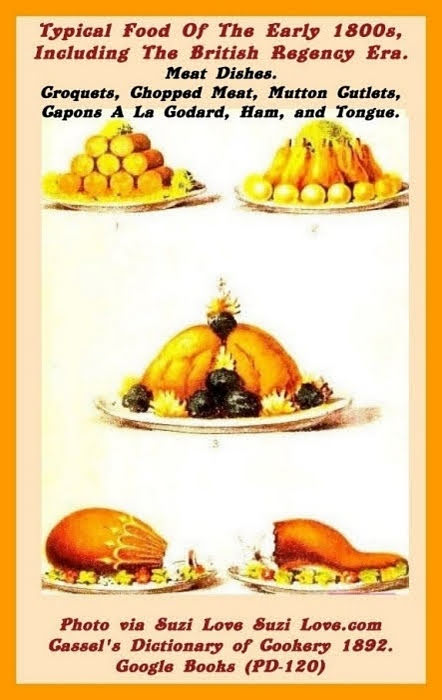
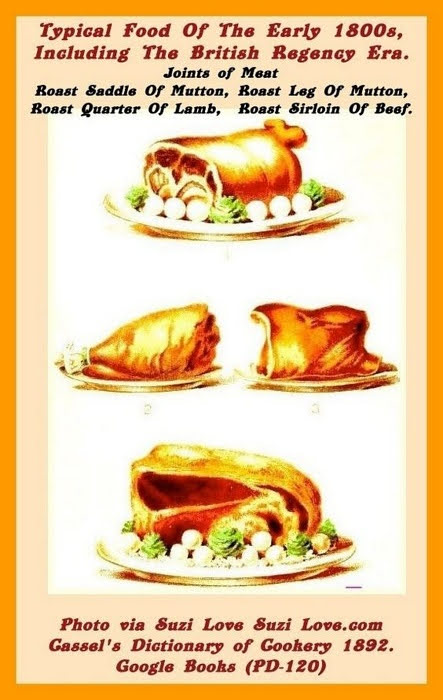
On the Christmas menu was generally mince pies and perhaps a goose or a piece of beef, depending on the family’s wealth and status. Mince pies were not made of fruit mince as we do now, but of offal or meat such as bullock’s tongue cooked with spices, orange peel, and wine and then used to fill pastry cases.

Another Christmas specialty was a Yorkshire Christmas pie which would be filled with turkey, goose, a hen, or perhaps woodcocks, partridge, or pigeons. And after the main courses, came the Plum Pudding, mixed on Stir-Up Sunday according to each family’s recipe and then boiled in a cloth.

Xmas_food_1800s_Typicalchristmasdesserts_1892cassells
Xmas_food_1800s_TypicalPies-and-Puddings_MrsBeeton
Food_1800s_Typical Food of the Early 1800s Including the British Regency Era. Meat Dishes- Croquettes, chopped meat, mutton cutlets, capons A la Godard, Ham and Tongue. 1892 Cassell_Sml
Food_1800s_Typical Food of the Early 1800s. Including the Regency Era. Joints Of Meat_Sml
food_1800s_Typical Historical Christmas Meal. Boars Head, Wassail Bowl, Punch Bowl, Roast Swan, Punch Jelly, Lamb_s Wool, and Truffles. Plate via Cassell_s Dictionary of Cookery_Sml
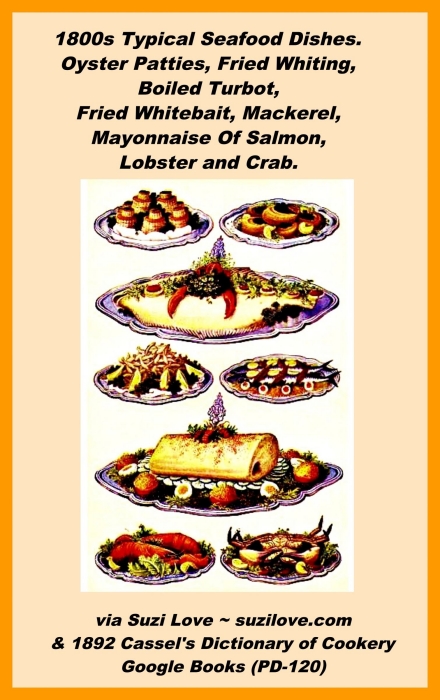
Food_1800s_TypicalFishDishes_OysterPattties_FriedWhiting_BoiledTurbot_friedWhitebait_Mackera=el_MayonaiseOfsalmon_Lobster_Crab_From1892Cassells
food_1800s_TypicalGame and Poultry (1). Snipe On Toast, Larks On Toast, Roast Pheasant, Roast Pigeons, Roast Fowl, Roast Goose, Roast Duck, Boiled Fowl, Roast Turkey_1860s_Mrs. Beeton_Sml
Food_1800s_TypicalJoints_SirloinofBeef, Boiled Beef, Leg Of Mutton, Roast Ribs Of Beef. From- 1861 Mrs. Beeton_Sml
Posted in 1700s, 1800s, Australia, Bridgerton, Canada, Christmas, Customs & Manners, England, Europe, Food and Drink, Georgian Era, History, History Of Christmases Past, household, Jane Austen, Regency Era, Romantic Era, Suzi Love Images, U.S.A, Victorian Era | Tagged Bridgerton, British history, Christmas, europe, Food, google books, History Of Christmases Past, household, Jane Austen, Suzi Love Images

Christmas: Games and Snap Dragon played at a Bridgerton and Jane Austen Christmas. #Christmas #Holidays #JaneAusten #Bridgerton #RegencyEra

Suzi Love Posted on December 9, 2025 by Suzi LoveDecember 8, 2025

Games

At Christmas time, households had guests to stay and games were played to either fill in the time inside when the weather was too bad to venture out with sleds or skates, or to keep tradition. Blind man’s bluff, forfeits, and snap dragon were all played.

A list of some entertainments for Christmas…From The book Of Christmas by Thomas kibble Hervey. “jugglers, and jack-puddings, scrambling for nuts and apples, dancing the hobby-horse, hunting owls and squirrels, the fool-plough, hot-cockles, a stick moving on a pivot, with an apple at one end and a candle at the other, so that he who missed his bite burned his nose, blindman’s buffs, forfeits, interludes and mock plays :” — also of ” thread my needle, Nan,” ” he can do little that can’t do this,” feed the dove, hunt the slipper, shoeing the wild mare, post and pair, snap dragon, the gathering of omens….

Snap Dragon A favorite game was Snap Dragon, often played on Christmas Eve. Raisins were put into a large, shallow bowl and brandy was poured over them and then ignited.  Lights were extinguished to increase the eerie effect of the blue flames playing across the liquor. The object of the game was to reach through the blue flames and grab as many raisins as possible from the flaming brandy and pop them into your mouth. The risk of burning yourself increased the excitement.

Samuel Johnson’s Dictionary of the English Language in 1755 describes the. game as “a play in which they catch raisins out of burning brandy and, extinguishing them by closing the mouth, eat them”. According to an eighteenth-century article in Richard Steele’s Tatler magazine, “the wantonness of the thing was to see each other look like a demon, as we burnt ourselves, and snatched out the fruit.”

Snap-dragon was played in England, Canada, U/S.A, and probably other countries with British backgrounds. The words snap-dragon and flap-dragon can refer to the game, the raisins used in the game, or the bowl with brandy and raisins.

The first reference to Snap-dragon as a game is in Francis Grose’s Dictionary of the Vulgar Tongue  in 1811. “Christmas gambol: raisins and almonds being put into a bowl of brandy, and the candles extinguished, the spirit is set on fire, and the company scramble for the raisins.” Snap-dragon as a Christmas parlour game was mentioned in 1836 in Charles Dickens’ The Pickwick Papers and in 1861, in Anthony Trollope’s novel Orley Farm.  Lewis Carroll, in Through the Looking-Glass, and What Alice Found There in 1871 describes “A snap-dragon-fly. Its body is made of plum pudding, its wings of holly-leaves, and its head is a raisin burning in brandy.”

Agatha Christie’s book Hallowe’en Party describes a children’s party during which a child’s murder causes Hercule Poirot to be brought in to solve the case and at which Snap-dragon is played at the end of the evening.

A song went with the game….

“Here he comes with flaming bowl,

Don’t be mean to take his toll.

Snip! Snap! Dragon!

Take care you don’t take too much

Be not greedy in your clutch.

Snip! Snap! Dragon!

With his blue and lapping tongue

Many of you will be stung.

Snip! Snap! Dragon!

For he snaps at all that comes

Snatching at his feast of plums.

Snip! Snap! Dragon!

But Old Christmas makes him come

Though he looks so fee! Fa! Fum!

Snip! Snap! Dragon!

Don’t `ee fear him, be but bold.

Out he goes, his flames are cold.

Snip! Snap! Dragon!

Xmas_Christmas: Games and Snap Dragon
Posted in Christmas, Customs & Manners, England, Europe, History, household, Pastimes, Suzi Love Images, U.S.A | Tagged Christmas, Customs and Traditions, games, History Of Christmases Past, household, pastimes, Suzi Love Images, Suzi Love Research

Christmas: Crackers And Their Fascinating History #Christmas #Customs #BritishHistory #Holidays

Suzi Love Posted on December 8, 2025 by Suzi LoveDecember 8, 2025

Christmas Crackers And Their Fascinating History

First made in 1850 by a London sweet maker called Tom Smith who decided it would a fun idea if his sweets and toys opened with a crack when their fancy wrappers were pulled in half. In early 1830, Tom Smith started work in a bakers and ornamental confectioners shop in London, selling sweets such as fondants, pralines and gum pastilles. He worked hard and took particular interest in the wedding cake ornaments and decorations, experimenting and creating new, more exciting and less crude designs in his spare time. Before long he was successful enough to leave and start up his own business in Goswell Road, Clerkenwell, East London. On a trip to Paris in 1840, he discovered the ‘bon bon’, a sugared almond wrapped in a twist of tissue paper.  He brought the ‘bon bon’ to London and they sold extremely well, but in January demand virtually ceased and once again he was reliant on sales of cake and table decorations and ornaments.

Anxious to stimulate sales, Tom placed a small love motto in the tissue paper and encouraged his regular customers to take supplies. Tom took a risk and concentrated on developing it further, while still running the wedding cake ornament and confectionery business. The majority of ‘bon bons’ were sold at Christmas so Tom thought up ways to capitalize on this short, but very profitable, season. It was the crackle of a log as he threw it on his fire that gave him the flash of inspiration which eventually led to the crackers we know today. A ‘ crackle’ added excitement to his novelty ‘bon bon’ so he experimented to find a compound which gave a satisfactory bang. He perfected his chemical explosion to create a ‘pop’ caused by friction when the wrapping was broken and the trade jumped at Tom Smith’s latest novelty.

He quickly refined his product by dropping the sweet and the ‘bon bon’ name, calling his new crackers Cosaques, but he kept the motto and added a surprise gift. Delighted at his overnight success, Tom took his cracker abroad but an Eastern manufacturer copied his idea and delivered crackers to Britain just before Christmas. So Tom designed 8 different kinds of cracker, working his staff day and night and distributing stocks in time for Christmas. He lived to see the new branch of his firm grow to swamp the original premises in Goswell Road and the company moved to Finsbury Square in the City of London where it remained until 1953. When he died he left the business to his three sons, Tom Henry and Walter. A few years later, a drinking fountain was erected in Finsbury Square by Walter Smith in memory of his mother, Mary, and to commemorate the life of the man who invented the great British Cracker.

His three sons developed the cracker designs, contents and mottoes. Walter Smith, the youngest son, introduced a topical note to the mottoes which had previously been love verses. Special writers were commissioned to compose snappy and relevant maxims with references to every important event or craze at the time from greyhounds to Jazz, Frothblowers to Tutankhamen, Persian Art to The Riviera. The original early Victorian mottoes were mainly love verses. Eventually these were replaced by more complicated puzzles and cartoons, and finally by the corny jokes and riddles which characterise our crackers today. 

Walter also introduced the paper hats, many of which were elaborate and made of best tissue and decorative paper on proper hatmakers stands and he toured the world to find new, relevant and unusual ideas for the surprise gifts, such as bracelets from Bohemia, tiny wooden barrels from America, and scarf pins from Saxony. Some were assembled in the factory, like the thousands of tiny pill boxes filled with rouge complete with powder puff.

A six foot cracker decorated Euston Station in London, and in 1927 a gentleman wrote to the Company enclosing a diamond engagement ring and 10 shilling note as payment for the ring to be put in a special cracker for his fiancee. Unfortunately he did not enclose an address and never contacted the Company again; the ring, letter and 10 shilling note are still in the safe today. In the early days, there was a large variety of specialist boxes, including Wedgwood Art Crackers from original designs by permission of Josiah Wedgwood and Sons, and designs such as Japanese Menagerie crackers containing the latest novelties from Japan, including animals, birds, reptiles and mottoes in Japanese.  

Crackers were created for the War Heroes, Charlie Chaplin, The Wireless, Motoring, The Coronation and even the Channel Tunnel in 1914.  Exclusive crackers were also made for members of the Royal Family and still are to this day. During the Second World War restrictions were placed on the production of cracker snaps.

The Ministry of Defence commissioned Tom Smith to fold and tie bundles of three to six snaps together with special string and regulation knots. These bundles were then used by soldiers in training as, when the string was pulled, they mimicked the noise of machine gun fire. After the war, vast quantities of these surplus cracker snaps were released back into the cracker trade. As the demand for crackers increased, Tom Smith merged with Caley Crackers in 1953 taking over their headquarters and factory in Norwich, East Anglia.

Tom Smith Group Limited currently hold a royal warrant from: HM QUEEN ELIZABETH II Ê 1906: Tom Smith were granted their first Royal Warrant by the then Prince of Wales which entitled them in 1909 to become members of the Royal Warrant Holders Association. 1910: In December, the reigning monarch, King George V granted Tom Smith his warrant as suppliers of Christmas Crackers. Tom Smith still holds the honour of producing special crackers each year for the Royal Household.

In the countries that now use them, a cracker is set next to each plate on the Christmas dinner table and a colourful party hat, a toy or gift and a festive joke falls out when the cracker is pulled in half with a loud bang! The party hats look like crowns, supposedly to symbolise the crowns worn by the Wise Men.

Another British company strongly associated with the cracker business was Batger and Co. Like Tom Smith, they sold a wide variety of crackers in highly decorated boxes and once again many were themed or in commemoration of a special event. Batger’s Gretna Green Crackers for the famous place for eloping lovers where couples in the Regency period ran off in a carriage to Scotland to be married at the blacksmiths forge at Gretna Green.

Xmas_Christmas Crackers And Their Fascinating History

Crackers were an incredibly expensive luxury at the time costing from 14 shillings to 30 shillings a box. Others were Peerless Crackers and Mead and Field Crackers. Cabaret Girl from the Peerless series of Christmas crackers, from 1933, which promises that each cracker contains ‘both a juvenile costume and fancy hat or cap, amusing joke or riddle, a good snap.

Xmas_Christmas Crackers And Their Fascinating History

Posted in 1800s, Australia, Canada, Christmas, Customs & Manners, Edwardian Era, England, Europe, History, household, London, Suzi Love Images, U.S.A, Victorian Era | Tagged British history, Christmas, Customs and Traditions, England, europe, household, Suzi Love Images

Christmas Pudding #Christmas #holidays #Food #Traditions #Customs

Suzi Love Posted on December 6, 2025 by Suzi LoveDecember 6, 2025

Christmas pudding originated as a 14th century porridge called ‘frumenty’ , made of beef and mutton with raisins, currants, prunes, wines and spices. Often more like soup, it was eaten as a fasting meal in preparation for Christmas festivities. By 1595, frumenty changed into a plum pudding thickened with eggs, breadcrumbs, dried fruit and flavoured with beer and spirits. It became the customary Christmas dessert around 1650, but in 1664 the Puritans banned it as a bad custom. In 1714, King George I re-established it as part of the Christmas meal, having tasted and enjoyed Plum Pudding.

“In December, the principal household duty lies in preparing for the creature comforts of those near and dear to us, so as to meet old Christmas with a happy face, a contented mind, and a full larder; and in stoning the plums, washing the currants, cutting the citron, beating the eggs, and mixing the pudding, a housewife is not unworthily greeting the genial season of all good things.” Via 1861 Beeton’s Book of Household Management. 

The Sunday closest to St. Andrew’s Day was Stirring-up Sunday, and the day to prepare the family’s Christmas pudding.  The eldest member of the household or a visitor would give the first stir and charms were stirred into the pudding. A ring meant a coming marriage, a button was bachelorhood, a thimble meant spinsterhood, and a sixpence was good luck. Puddings were steamed in a pudding bag and stored in a cool place until Christmas Day. 

Christmas Pudding
Christmas Pudding
Christmas Pudding
Christmas Pudding
Christmas Pudding
Christmas Pudding
Christmas Pudding
Christmas Pudding
Christmas Pudding

Posted in 1700s, 1800s, 1900s, Australia, Canada, Christmas, Edwardian Era, England, Europe, Food and Drink, Georgian Era, household, Regency Era, Romantic Era, Suzi Love Images, U.S.A, Victorian Era | Tagged British history, Christmas, Customs and Traditions, Food, History Of Christmases Past, household

Post navigation

← Previous Post
Next Post→

SUBSCRIBE TO SUZI LOVE'S NEWSLETTER.

Recent Posts

  • 1823 Blue Silk Pelisse, or Coat, Decorated With Rouleaux and Vandyke Points. #Regency #Fashion #Pelisse
  • 1817 Bridgerton and Jane Austen Style High-Waisted Pink Morning Walking Dress, French. #RegencyFashion #JaneAusten #Bridgerton
  • 1804 Gentleman’s Daily Ensemble with blue cutaway coat in the time of Jane Austen. #RegencyFashion #HistoricalFashion #JaneAusten
  • Love family saga’s in Historical Romance? Michael’s missing brother appears at Duke of Sherwyn’s home during snowstorm. #HistoricalRomance #FamilySaga #Mystery
  • 1819 January Mourning Winter Carriage and Evening Dresses. #Regency #Mourning #Fashion

Recent Comments

  1. Suzi Love on Book Hooks: Captain Belling said in a cold voice, “The only thing I don’t know is why the hell you and that child are still near Waterloo.” #MilitaryRomance #RegencyRomance #BattleofWaterloo
  2. Bianca White on Book Hooks: Captain Belling said in a cold voice, “The only thing I don’t know is why the hell you and that child are still near Waterloo.” #MilitaryRomance #RegencyRomance #BattleofWaterloo
  3. Suzi Love on Book Hooks: Captain Belling said in a cold voice, “The only thing I don’t know is why the hell you and that child are still near Waterloo.” #MilitaryRomance #RegencyRomance #BattleofWaterloo
  4. Suzi Love on Book Hooks: Captain Belling said in a cold voice, “The only thing I don’t know is why the hell you and that child are still near Waterloo.” #MilitaryRomance #RegencyRomance #BattleofWaterloo
  5. Suzi Love on Book Hooks: Captain Belling said in a cold voice, “The only thing I don’t know is why the hell you and that child are still near Waterloo.” #MilitaryRomance #RegencyRomance #BattleofWaterloo

Login

  • Log in

Archives

  • August 2026
  • July 2026
  • June 2026
  • May 2026
  • April 2026
  • March 2026
  • February 2026
  • January 2026
  • December 2025
  • November 2025
  • October 2025
  • September 2025
  • August 2025
  • July 2025
  • June 2025
  • May 2025
  • April 2025
  • March 2025
  • February 2025
  • January 2025
  • December 2024
  • November 2024
  • October 2024
  • September 2024
  • August 2024
  • July 2024
  • June 2024
  • May 2024
  • April 2024
  • March 2024
  • February 2024
  • January 2024
  • November 2023
  • October 2023
  • September 2023
  • August 2023
  • July 2023
  • April 2023
  • March 2023
  • June 2022
  • April 2022

Categories

  • 1700s
  • 1700s Mens fashion
  • 1700s Womens Fashion
  • 1800s
  • 1800s Mens Fashions
  • 1800s women's fashion
  • 1900s
  • art
  • Australia
  • Bath
  • bedroom fashion
  • Book Hooks
  • Box Or Container
  • Bridgerton
  • Bus Trips
  • Canada
  • Carriage
  • cartoon
  • Celebrity
  • Chatelaine
  • children
  • Children
  • Christmas
  • Coat or Pelisse Or Redingote
  • Contemporary
  • Corset
  • Couple
  • Customs & Manners
  • dancing
  • December Scandal
  • Decorative Item
  • Dress Or Robe
  • Easter
  • Edwardian Era
  • Embracing Scandal
  • England
  • Ester In Images
  • Europe
  • Events
  • Fashion
  • fashion accessories
  • Food and Drink
  • Four Times A Virgin
  • France
  • furniture
  • Georgian Era
  • Georgian Fashion
  • Google Books
  • Grand Tour
  • Group
  • hats
  • History
  • History Events
  • History Notes
  • History Of Christmases Past
  • household
  • Hygiene
  • Irresistible Aristocrats
  • Jane Austen
  • Keanu Reeves
  • Kellys Justice
  • Legal
  • London
  • Love After Waterloo
  • Loving Lady Katharine
  • medical
  • military
  • money
  • mourning
  • Music
  • Outback Arrival
  • pants
  • Pastimes
  • peerage
  • People
  • Places
  • Pleasure House Ball
  • postal
  • Queensland
  • Quotations
  • Regency Era
  • Regency Fashion
  • Regency Life Series
  • Reticule or Bag
  • riding
  • Romantic Era
  • Royalty
  • Russia
  • Scandalous Siblings Series
  • Scenting Scandal
  • Self Publishing
  • sewing
  • Shirt
  • shoes
  • Shopping
  • South Pacific
  • Spencer
  • sports
  • Suit
  • Sunday Snippet
  • Suzi Love
  • Suzi Love Books
  • Suzi Love Images
  • Suzi Love Writing
  • Swain Cove
  • THe Viscount's Pleasure House
  • travel
  • U.S.A
  • underclothing
  • Vest or Waistcoat
  • Victorian Era
  • Victorian Fashion
  • weapons
  • weddings
  • Writing Tools

1800s men fashion 1800s women's fashion antiques Bridgerton British history Cartoons Corset cravat decorative Dress Or Gown England europe fashion accessories Fashion Plate France Georgian era Georgian Fashion gloves google books Hats And Hair historical romance History Notes household Jane Austen jewelry Journal des Dames et des Modes London Metropolitan Museum NYC pants Redingote Or Pelisse Or Coat Regency Era Regency Fashion Regency London reticule or bag riding Romantic Era sewing shawls Shoes Suzi Love Books Suzi Love Images Tailcoat The Repository Of Arts underclothing Vest or Waistcoat

©2026 - Suzi Love - Weaver Xtreme Theme Privacy Policy
↑