1818 ‘The Stamford Dandy or A Modern Peeping Tom’. Lord Stamford rides past a row of houses looking through his glass at a woman who stands at an open first-floor window. Other women watch him from the two other windows. Dressed as a dandy with red tailcoat, high white collar and cravat, black top hat and wearing loose white trousers. Artist not known. Via British Museum, London, UK. britishmuseum.org (PD-Art)
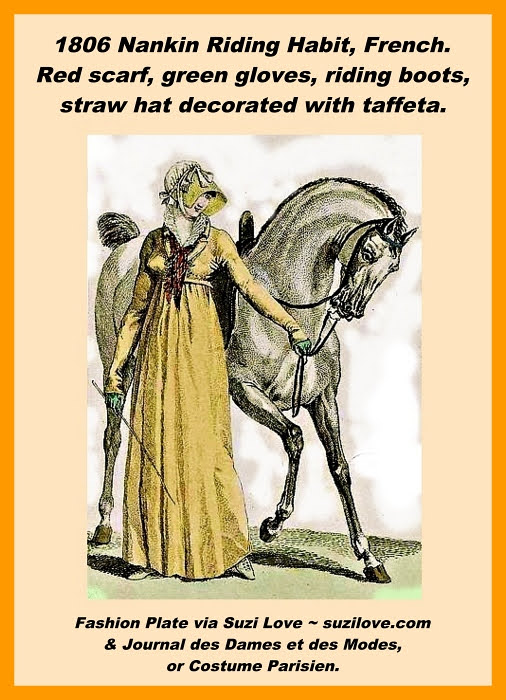
1806 Nankin Riding Habit, French. Red scarf, green gloves, riding boots, straw hat decorated with taffeta. The type of outfit Jane Austen and her friends would have worn if they went horse riding. Nankeen Or Nankin Fabric: Durable, buff colored cloth, made of Chinese cotton which is naturally brownish yellow. Originally brought from Nanking.
1806 Nankin Riding Habit, French. Red scarf, green gloves, riding boots, straw hat decorated with taffeta. Nankeen Or Nankin Fabric: Durable, buff colored cloth, made of Chinese cotton which is naturally brownish yellow. Originally brought from Nanking.HN_26_D2D_FsshionWomen1805-1809
1819 Typical Gentleman’s Outfit, French. The type of outfit worn by Jane Austen’s male family and friends. Brown cutaway coat with extra long tails, white trousers, high white cravat, heeled black boots with spurs, gloves, black top hat and a cane. Fashion Plate via Journal des Dames et des Modes, or Costume Parisien.
Trousers: The word Trouser came into usage in the late 1600’s, so we’ve had trousers around for a long time. But at first, they were mostly for lower classes. Revolutionary France started a trend for sans-culottes, which meant trousers or pantaloons instead of culottes, or knee breeches, which were associated with the aristocracy. The styles of the revolution moved across to England and were taken up by those who either sided with revolutionary ideals or who took them up as part of a protest against the establishment set. Early on, trousers were generally a bit looser than pantaloons or breeches and ended at the ankles, often with side slits to get the foot through or straps under the foot straps to keep the trousers in place.
1815 White Walking Dress, English. Lady reading outside. Aqua pelisse, or coat, open to reveal a yellow lining, yellow gloves, high bonnet with feathers and blue shoes. Jane Austen and her family and friends would have worn this style of walking ensemble and as Jane Austen was very fond of reading, it’s easy to picture her looking like this. Fashion Plate via Rudolph Ackermann’s ‘The Repository of Arts’.
Fashion Women 1815-1819 History Notes Book 28 https://books2read.com/SuziLoveFashionWomen1815-1819
1815 March Brown Promenade Dress, English. High-waisted dress with decorative hem, white sleeves, white fichu, blue scarf, brown hat decorated with flowers. Jane Austen and her contemporaries would have worn this style of outdoor walking outfit and flowered hat. Fashion Plate via The Lady’s Magazine Or Entertaining Companion for the Fair Sex.
Definition Redingote: Woman’s long, fitted coat often worn open in front to show off the dress underneath. Sometimes cut away in front. Originally made with several capes and trimmed with large buttons. French word developed from English words, riding coat. reefer. Single- or double-breasted, fitted, tailored, over-all coat usually made from sturdy fabric.
Definition Fichu: A piece of lace, muslin, or other cloth worn about the neck and cleavage to preserve a lady’s modesty. From French word meaning neckerchief.
Fashion Women 1815-1819 History Notes Book 28 https://books2read.com/SuziLoveFashionWomen1815-1819
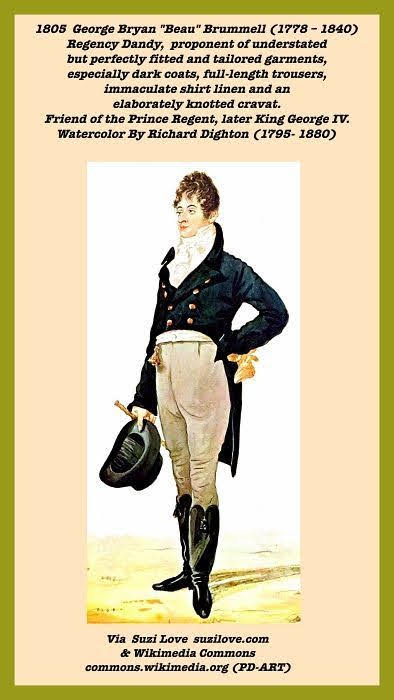
George Bryan “Beau” Brummell (June 7th 1778 – March 30th 1840) Arbiter of men’s fashion and friend of the Prince Regent, the future King George IV. Established mode of dress for men that rejected overly ornate fashions for understated but perfectly fitted and tailored clothing. Look based on dark coats, full-length trousers rather than knee breeches and stockings, with immaculate shirt linen and an elaborately knotted cravat. 1855 Engraving of Beau Brummell from an article in Harper’s New Monthly Magazine.
1805 Beau Brummell (1778-1840) Regency Dandy, proponent of understated but perfectly fitted and tailored garments, especially dark coats, full-length trousers, immaculate shirt linen and an elaborately knotted cravat. Friend of the Prince Regent, later King George IV. Watercolor By Richard Dighton (1795- 1880) Via Wikimedia Commons commons.wikimedia.org (PD-ART) https://books2read.com/SuziLoveFashionMen1800-1819
1823 Couple In Walking Dress, French, as worn in Europe and England in the Regency Era. Redingote, or Coat, with matching hat, neck frill of Gros de Nice lace. Gentleman in tailcoat, short length brown trousers, yellow vest, high white cravat, top hat and black shoes. via Modes Françaises L’Indiscret, France.
What did an older lady do in the Bridgerton family’s and Jane Austen’s times, or the early 1800s. An easy to read overview of what an older lady did, wore, and how she lived in the early 19th Century. Information for history buffs and pictures for readers and writers of historical fiction. Older Lady’s Day, Regency Life Series, Book 5, by Suzi Love. books2read.com/suziloveOLD
Through historic images, historical information, and funny anecdotes, it shows how an older lady in Jane Austen’s times fills her day, where she goes, and with whom she spends her time. This light-hearted look at the longer Regency years is an easy to read overview of what people did and wore, and where they worked and played. There is plenty of information to interest history buffs, and lots of pictures to help readers and writers of historical fiction visualize the people and places from the last years of the 18th Century until Queen Victoria took the throne.
1787 December Yellow striped dress, red hat with a white feather and a large fur muff, French. via Magasin des Modes.
HN_1 Fashion Women Late 1700s History Notes Book 1 by Suzi Love.
What was fashionable for women in the late 1700s? Extravagant colors and fabrics and outrageous styles were all seen in these flamboyant fashions.
books2read.com/suziloveFashWomen1700s
1815 Arundel Fete Dress and Baronial Helmet, English. White dress with purple bodice and hem with matching shawl and plumed headdress. Skirt of white crape over white satin, a double row of novel and elegant trimmings on the bottom, two falls of the crape, set on full, are edged with silk. Body comes high on each side of the bosom and is shaped so as to display the neck and shoulders, and both body and sleeves are formed and trimmed in the most exquisitely tasteful manner. A superb cord and tassels confines the waist and ties in front. The Baronial Helmet is striking and made of white sarsnet or satin and white lace and superbly ornamented with feathers. Jewelry set, or Grand Parure, of necklace, bracelets. ear-rings, and small French locket of pearl. White kid slippers and gloves. Full Dress for evening would most likely be a dress of silk or satin, perhaps with a transparent overlay of netting, tulle etc., embellished with taffeta, ruffles and ribbons, and with a full range of accessories including a Grand Parure of tiara and other matching jewelry. https://books2read.com/SuziLoveFashionWomen1815-1819
La Belle Assemblee: Fashion Plate via John Belle’s La Belle Assemblée or, Bell’s Court and Fashionable Magazine, London. Many of the fashion plates seen in La Belle Assemblée and The Repository of Arts were designed by Mrs. Bell who had her dressmaking showroom in Bedford Square, London, and was related to John Bell who published La Belle Assemblée. It seems that she designed for at least two fashion magazines and so there is a cross-over of designs in different magazines.
Grand Parure: A Parure is a matched set of jewelry, including a necklace, bracelet, earrings, pin etc. and a Grand Parure often includes a tiara or other headdress.
Fashion Women 1815-1819 History Notes Book 28 https://books2read.com/SuziLoveFashionWomen1815-1819