“No, she was a very sober- minded young lady, sufficiently well-read in novels to supply her imagination with amusement, but not at all
unreasonably influenced by them.” Jane Austen ~ Sanditon (1817)



“No, she was a very sober- minded young lady, sufficiently well-read in novels to supply her imagination with amusement, but not at all
unreasonably influenced by them.” Jane Austen ~ Sanditon (1817)
1808 Gentleman’s Ball Outfit, French. Long tailcoat, black knee breeches, white stockings, high white cravat, white stockings, black shoes and gloves. Fashion Plate via Journal des Dames et des Modes, or Costume Parisien. Typical Gentleman’s outfit as worn by men to balls and evening events in Jane Austen’s Times.

From the finish of the 18th century until 1820, men’s fashions in European and European-influenced countries moved away from the formal wear of brocades, lace, wigs and powder to more informal and relaxed styles. Focus was on undress rather than formal dress. Typical menswear in the early 1800s included a tailcoat, a vest or waistcoat, either breeches, pants, or the newer trousers, stockings, shoes or boots, all worn with an overcoat and hat. This basic ensemble was accessorized with some form of neckcloth or cravat, gloves, walking stick, cane or riding crop, handkerchief, fobs, watch and perhaps a quizzing glass or eye glass.
Skirted coats were replaced with short-fronted, or cutaway, tailcoats worn over fitted waistcoats and plain, white linen shirts. Knee breeches were gradually replaced by tight-fitting pantaloons and later trousers, decorative shoes with buckles were replaced with a variety of boot styles, and fussy and ruffled neckwear gave way to intricately tied, white linen neck cloths. A Regency Era, or early 1800s, gentleman was outfitted in more practical fabrics, such as wool, cotton and buckskin rather than the fussy brocades and silks of the late 1700s.
1804 Men's Fashions In The Time Of Jane Austen. #Regency #Fashion #JaneAusten Share on X
1807 June Couple In Morning Dress, English. Lady in white dress with lemon cape and an interesting white hat with a tassel. Gentleman in black tailcoat, white shirt and cravat, breeches tucked into high black boots with tan tops, fob and watch chain at his waist, black top hat and cane. via Le Beau Monde, or Literary and Fashionable Magazine, London, U.K.
Definition Morning Dress: Comfortable outfits worn either at home, out shopping, or for walking in the park or country. Presentable but not overly accessorized. For women it was often an Empire style, high-waisted, gown made from sprigged or plain muslin, cotton, or wool and either a Spencer or a coat to cover it for warmth, plus shoes and a bonnet. For men it was breeches or trousers, shirt, cravat, coat, boots and hat. This couple is dressed as a lady and gentleman of Jane Austen’s acquaintance would dress for a morning outing to a village, for shopping, or visiting friends.


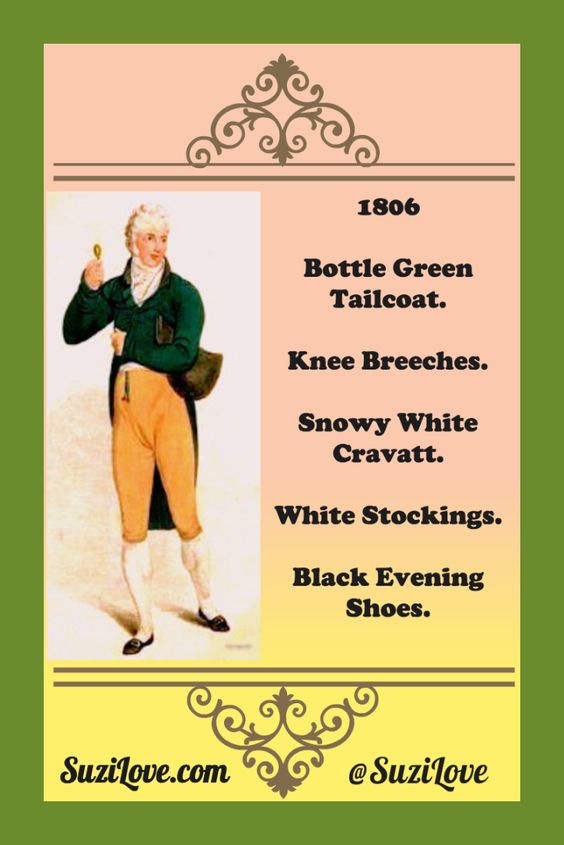
1806 Gentleman’s Daily Outfit, French. Bottle green tailcoat, knee breeches, snowy white cravat, white stockings, flat black shoes. Fashion Plate via Journal des Dames et des Modes, or Costume Parisien. French fashions and Georgian and Regency Era fashions from Great Britain were copied around the world. This is the normal daily outfit for a gentleman in the early 1800s, or in the times of Jane Austen, for daily city and country life. https://books2read.com/SuziLoveFashionMen1800-1819

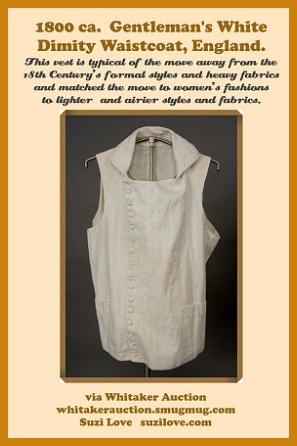
1800 ca. Gentleman’s White Dimity Waistcoat, England. This vest is typical of the move away from the 18th Century’s formal styles and fussy fabrics and matched the shift of women’s fashions towards lighter and airier styles and fabrics. via Whitaker Auction whitakerauction.smugmug.com
Waistcoats worn at the very beginning of the early 19th century generally had a straight bottom, double-breasted and with wide lapels. Not long after this, waistcoats began to be cut higher up to the waist in front so men during Jane Austen’s lifetime would have worn both styles.
1817 September Glengary Riding Habit, English, as would have been worn during Bridgerton and Jane Austen’s times. Pale blue cloth, richly ornamented with frogs and braiding, front braided on each side and fastens under the body of the habit, which slopes down on each side to define the figure. Epaulettes and jacket are braided to correspond with the front as is the bottom of the sleeve which is braided nearly half-way up the arm. Habit shirt is of cambric with a high standing collar and trimmed with lace. Cravat of soft muslin is richly worked at ends, tied in a bow, narrow lace ruffles at the wrists. Headdress is a Glengary cap of blue satin, trimmed with plaited ribbon of various shades of blue and a plume of feathers. Blue kid gloves are worn and half-boots. Fashion Plate via Rudolph Ackermann’s ‘The Repository of Arts’.
Male tailors made most women’s riding habits during the Regency years and they were constructed similarly to men’s riding outfits. Generally in two pieces, a jacket and a skirt, and with a shirt with a frilled collar or front opening underneath. The trains of a habit could be caught up for walking, usually with a button and loop, and unhooked and let down so that the skirt flowed over the woman’s legs when she rode side saddle. Due to the numerous wars during the early 1800s, it was seen as patriotic for women to add military style touches to outfits in support of military men. The shoulder and cuff trims resemble the epaulettes and coat trims of a military uniform.


1818 September 18th Le Palais Royal de Paris. ‘A Peep at the French Monstrosities’. Two English tourists dressed as dandies walk arm-in-arm under the arcade of the Palais Royal, interested in the promenading courtesans. Their dress is rather similar to that of the Englishmen, but the latter wear bell-shaped top-hats, while the Frenchmen have flower-pot shaped hats. By George Cruikshank. Via British Museum, London, UK. britishmuseum.org (PD-Art)

1890 ca. Ivory, Enamel, and Gold Carnet de Bal, or Dance Card. Formerly in the collection of lady Mairi Bury. Ribs are of ivory, numbered front to back from 1 to 24, either end decorated with polychrome enamel with a lotus flower motif, attached by chain to a ring. Maker’s marks, fitted case, Payne and Sons. via Sotheby’s Auctions. sothebys.com


1819 Gardens of the Tuileries Near the Rue de Rivoli, Paris, France. Woman in a red walking dress, or Redingote, or Pelisse, modeled after British riding dresses and worn with a high white bonnet with feathers, or plumes. The skirt remains fairly narrow and the waist is fairly low, indicating the transition into 1820 styles. In the background are women walking with children. From Illustrations by François Courboin from Octave Uzanne’s Les Modes de Paris.
Variations du goût et de l’esthétique de la femme, 1797-1897, L. Henry May, Paris, 1898, or from the English translation of the same work: Fashion in Paris : the various phases of feminine taste and aesthetics from 1797 to 1897, William Heinemann, London, 1898.

1809 February Walking or Carriage Dress, English. Polanese coat, Saragossa mantle of spring green Virgnia cloth, trimmed round the edges and up the front of the coat with black velvet bindings, and edgings of gold lace. High puckered collar, confined round the throat with a gold cord and acorn tassels. Belt of black velvet, and rich gold clasp. Military cap formed of the same material, and trimmed also with black velvet and gold. Short white lace veil falling from the edge of the cap just below the chin. Half-boots of green kid or cloth, calashed and bound with black, and laced with gold cord. Fashion Plate via John Belle’s La Belle Assemblée or, Bell’s Court and Fashionable Magazine, London.
