1802-1812 ca. Dancing Or La Dansomanie Series. Four women being instructed in dancing before a mirror by a master playing a violin. Le Bon Genre Description Plate 12. Via British Museum, London, UK. britishmuseum.org (PD-Art)
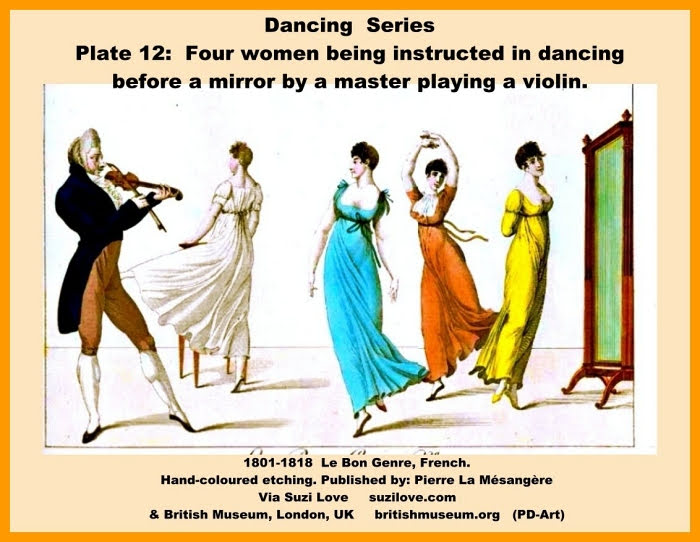


1802-1812 ca. Dancing Or La Dansomanie Series. Four women being instructed in dancing before a mirror by a master playing a violin. Le Bon Genre Description Plate 12. Via British Museum, London, UK. britishmuseum.org (PD-Art)
1817 December Black Walking Mourning Dress, English. Black bombazine dress with a black crepe hem, with tight bodice wrapping across to the right side, trimmed with a piping of black crape that looks like braiding and finished by rosettes of crape, in the center of each of which is a small jet ornament. Long sleeves trimmed similarly at the wrists, half-sleeve of a new form trimmed with crape, high standing collar displaying a mourning ruff. Claremont bonnet, named because it is the same shape as one worn by the Princess, whose home with her husband, Prince Leopold, was called Claremont. Black crape over black sarsnet and lined with double white crape. Low crown but large front and tastefully finished by black crape with a bunch of crape flowers on one side. Black shamois gloves, and black shoes. “We have again to acknowledge our obligations to the lady who favored us last month; and we understand that the dresses from which our prints this month have been taken were also purchased from Mrs. Bell of St. James’s-street.” Fashion Plate via Rudolph Ackermann’s ‘The Repository of Arts’.
Mrs. Bell ‘invented’ fashion plates and as well as publishing in La Belle assemblee, she also sold them to other magazines. Hence the crossover we often see where the same plate, or a similar version, appears in different magazines.


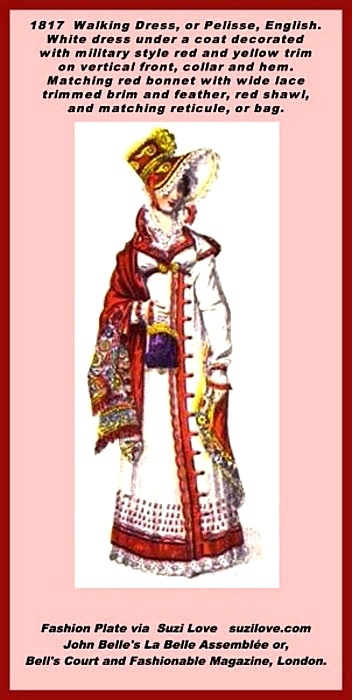
1817 November Autumnal Carriage Walking Dress or Pelisse, or Redingote, English. Pelisse of Cashmere with a white background, trimmed with vermillion red, vermillion belt and a gold and Ceylon ruby broach or clasp. Lyonese shawl with a rich border of various colors. Bonnet of vermillion satin, embossed with straw, decorated with straw colored ribbons and a bouquet of full blown damask rose, buds, and ears of ripe corn and edge of the bonnet finished by blond lace. White kid half-boots, Limerick gloves, vermillion satin ridicule, or bag, with gold tassels and spring. Fichu frilled with fine lace and left open at the throat. Fashion Plate via John Belle’s La Belle Assemblée or, Bell’s Court and Fashionable Magazine, London.
Jane Austen: This is a fashionable ensemble as would have been worn by Jane Austen and her family and friends. Walking dress such as this would have been worn when out shopping, walking in a park or the country estate. This sort of outfit needed to be presentable and warm but not overly accessorized with jewelry etc..
Definition Coat, or Redingote Or Pelisse: Long fitted outdoor coat worn over other garments for warmth. Redingote is the French word developed from English words for riding coat. Usually called Walking Dress Or Pelisse in English fashion plates.
Definition Reticule: Bag or purse, often with a drawstring to pull closed and usually made of cloth or covered cardboard and often decorated with beading or embroidery. A reticule, or purse, or handbag, was usually carried by a woman during the Regency period to carry all their daily necessities. Earlier, women used pockets that tied at the waistline and were hidden in the folds of their skirts. Empire style, or early 1800s, high-waisted dresses made it impossible to either sewn in a pocket or to tie on a pocket. So women began carrying small, decorated bags called Reticules, or ridicules, which generally pulled close at the top with a drawstring.
1805 Breeches, part of the Royal Naval Uniform of surgeon Joshua Horwood , who served as surgeon’s mate in HMS ‘Prince’ at Trafalgar, and was promoted to surgeon in 1807. via Royal Museums Greenwich, London, U.K. collections.rmg.co.uk


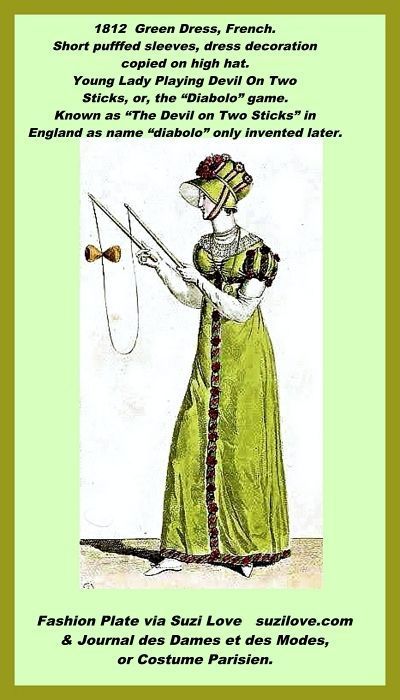
1812 Young Lady Playing Devil On Two Sticks, or, the “diabolo” game. The game was known as “The Devil on Two Sticks” in England at the time as the name “diabolo” was only invented later. Green dress with short puffed sleeves, dress decoration copied on high hat. Fashion Plate via Journal des Dames et des Modes, or Costume Parisien.
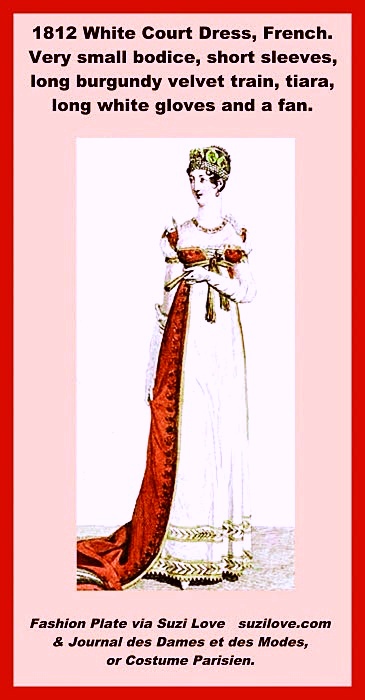
1812 White Court Dress, French. Very small bodice, short sleeves, long burgundy velvet train, tiara, long white gloves and a fan. Fashion Plate via Journal des Dames et des Modes, or Costume Parisien.
Definition Court Dress: Usually, the difference between a court dress and a ball dress was in the quality of fabrics used, how elaborate the design, and the number and quality of the accessories. Plus, in England in the early 1800s court dresses were required by Queen Charlotte to have hoops and in France and other European countries court dresses a long train, usually expensively decorated. During the Regency Era, white cotton dresses were considered suitable for many evening events, but definitely not for an evening event in a palace.
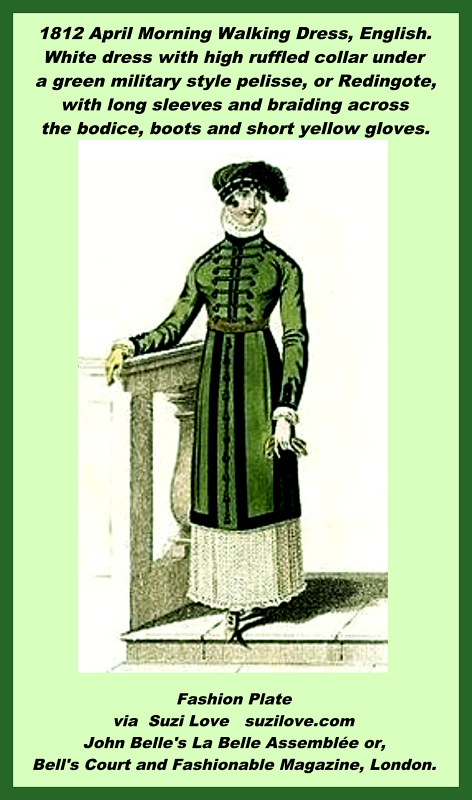
1812 April Morning Walking Dress, English, in Jane Austen style. White dress with high ruffled collar under a green military style coat, or pelisse, or Redingote, with long sleeves and braiding across the bodice, boots and short yellow gloves.
Definition Redingote, Pelisse, Walking Dress: The term, Redingote, was used more in France and other parts of Europe and Pelisse or Walking Dress was used more in England. While the terms Redingote and Pelisse are often used interchangeably, the Redingote usually features a close fitted top and flares out at the hemline with a more tailored or military look than a Pelisse. Redingotes or Pelisses were needed to cover the flimsy dresses made of lightweight fabrics of the Regency years to provide warmth and some protection from windy conditions when gowns might lift and cause modesty issues. Jane Austen and her contemporaries often walked to places and so would have needed the warmth of a Pelisse or coat in the cold British winters.
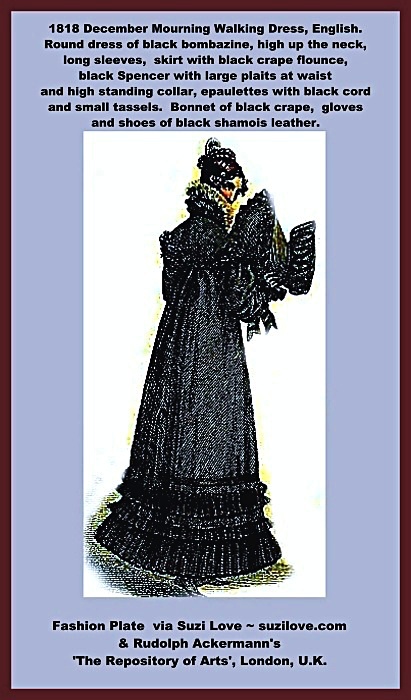
1818 December Mourning Walking Dress. Round dress of black bombazine, body tight to the shape and up to the throat but without a collar, long sleeves, with white crape weepers, skirt is finished at the bottom with a broad black crape flounce, disposed in large plaits. Over this is a very narrow flounce, which is also plaited to correspond; a little above this is a third flounce, which is quilled in the middle to correspond, and the whole is surmounted by a broad band of bias crape. The spencer worn with this dress is composed of black clothing; it is cut without a seam, and ornamented with a fullness of black crape, disposed in large plaits at the bottom of the waist: a high standing collar rounded in front, made to stand out from the neck, and edged with a light trimming of black crape: long loose sleeves, finished at the hands with black crape trimming, and surmounted by epaulettes draperied with black cord and ornamented with small tassels. Head-dress, a bonnet of black crape of a moderate size; the edge of the brim is finished with a row of large hollow plaits; the crown is trimmed to correspond. A white crape frill stands up round the throat. Gloves and shoes black shamois leather. Fashion Plate via Rudolph Ackermann’s ‘The Repository of Arts’, London, U.K.
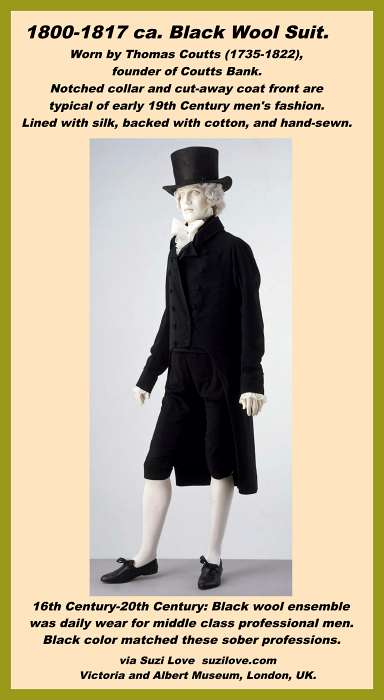
1800-1817 ca. Black Wool Suit, British. An ensemble made from black wool has been the uniform of the middle-class professional – doctor, lawyer, clergyman, academic, merchant, businessmen – since the late 16th century. This tradition continued through the 19th century and well into the 20th. The sombre color of this suit befits the sober profession of its wearer, Thomas Coutts (1735-1822), the founder of Coutts Bank. The notched collar and cut-away front of the coat reflect early-19th-century fashions. via Victoria and Albert Museum, London, UK. collections.vam.ac.uk. https://books2read.com/SuziLoveFashionMen1800-1819
This is the sort of suit that professional men in Jane Austen’s times would have worn, doctors, lawyers and clergymen. https://books2read.com/SuziLoveFashionMen1800-1819
1800s Typical Game Bird Dishes Served during the 1800s. These are the sort of dishes Jane Austen’s family would have eaten on a regular basis. Banded Partridges, Roast Partridges, Roast Surrey Fowl, Larded Guinea Fowl, Roast Plovers, Stuffed Capons, Roast Gosling and Roast Pigeons. From: 1850s- 1860s Mrs. Beeton’s Books of Household Management. via Google Books (PD-150)

