1807-1817 ca. Man’s Leather Breeches, American. These are the sort of pants that the men Jane Austen knew would have worn for riding or in the country. Drop front buttoned flap at the waist, a drawstring at the back waist to adjust waist size, and drawstrings and buttons at the calves to keep the breeches secure when worn with high boots. via Metropolitan Museum New York City, U.S.A. metmuseum.org
19th Century Cross Letter or Cross Writing or Cross Hatching. The writer reached the bottom of the page, turned the paper sideways and adds a second layer of text. During the 19th century, paper was expensive and postal delivery was charged per page, or by the size of the paper. Cross-writing was a way to save paper and postage in Jane Austen and Bridgerton times, and many of Jane Austen’s letters were written this way. Once it becomes familiar, the mind adapts easily and cross-writing letters are surprisingly legible. Charles Darwin also favored this technique.
Rates of Postage of single Letters in Pence.
From any post-office in England or Wales, to any place not exceeding 15 miles from such office – – – 3
For any distance above 15, and not exceeding 30 miles — — 4
For any distance above 30, and not exceeding 50 miles — 5
For any distance above 50, and not exceeding 80 miles – 6
For any distance above 80, and not exceeding 12O miles — 7
For any distance above 120, and not exceeding 170 miles – 8
For any distance above 170, and not exceeding 230 miles — 9
For my distance above 230, and not exceeding 300 miles — — 10
For any distance above 300, and not exceeding 400 miles – 11
For any distance above 400, and nut exceeding 500 mites — 12
1802 Picture of London Printed for R. Phillips via Google Books (PD-180)
And so in proportion; the postage increasing progressively one penny for a single letter for every like excess ok distance of 100 miles. 1802 Picture of London Printed for R. Phillips via Google Books (PD-180)
The Twopenny Post- Office.
There are two principal offices, one in the General Post—office yard, Lombard—street and the other in Gerrard-street, Soho. There are also numerous receiving houses in both the town and country.
There are SI X collections and deliveries of letters in town daily, (Sundays excepted) and there are two dispatches from, and three deliveries at, most places in the country, within the limits of this office.
1802 Picture of London Printed for R. Phillips via Google Books (PD-180)
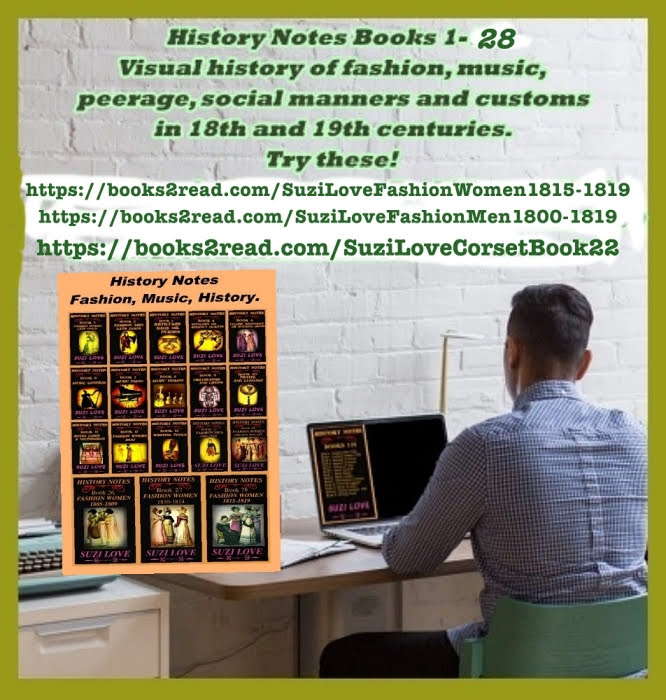
Do you need more factual and visual information for your historical fiction? Try History Notes Books 1-28. Non-fiction Series: Fashion, corsets, Regency Era, music and social manners in the 18th and 19th centuries e.g.
1819 White Percale Dress, French. Deep hem of bubbly muslin, matching Percale Spencer or jacket, pink parasol and flowered straw hat. Spencer has short puffed sleeves over long straight sleeves and military style trimmings. Fashion Plate via Journal des Dames et des Modes, or Costume Parisien. Even though this a French fashion plate, this is typical of the outdoor outfit worn by Jane Austen and her contemporaries when going outside. An Empire style, or high-waisted white cotton dress worn under a Spencer, or jacket, for warmth and with a parasol to protect fair complexions from the sun.
Description Spencer: Short jackets worn for warmth over the high-waisted Empire style gowns that were popular after the French Revolution, where there was a shift away from opulence and decadence to simpler fashion. This jacket with very short bodice and long sleeves was known as a Spencer and was named after the male coat made famous by the Earl Spencer and said to have originated in accident to Lord Spencer in hunting when coat tails torn off and a cropped jacket was invented. The dresses in the early 1800s therefore became looser, lighter, and flowing and women became cold due to their very low cut and short bodices. Short fitted jackets that went easily over the dresses and provided extra modesty and some warmth. As Europe and many other parts of the world were deep in wars in the late 1700s and early 1800s, men in uniform were found everywhere. In support of these military men, fashions leaned towards military style shoulder paddings, shoulder embellishments, loops, buttons, and braids.
Definition Percale or Perkale: From the Persian word pargalah. Fine cotton fabric, or cambric muslin of good quality, originally from India, generally bleached, printed and finished without gloss. Contains more dressing than ordinary muslin, but without the glossy finish of cambric and is printed in fancy patterns on white and colored grounds. In May 1816, Percale was commented on in Rudolph Ackermann’ Repository Of Arts, “Perkale, as they call cambric muslin, is now almost the only thing worn in the morning costume: you must not, however, fancy that this proceeds from a wish to encourage English manufacture, but partly from a love for novelty, and partly because it is less expensive than cambric, and equally fashionable.”
1810-1820 ca. Double Breasted Red Hunting Coat, English.
1810-1820 ca. Red Hunting Coat, English. Hunting was both a popular sport and an essential part of social success. Double-breasted tailcoat of woolen superfine, lined with sateen and cotton, M-notch lapels, nine gold buttons with heraldic crest, cuffs with three smaller matching buttons. via Collection from Castle Howard, Yorkshire, U.K. Victoria and Albert Museum, London, UK. Hunting coats, or colors, often red coats called pinks, were worn by hunt masters and hunters. In Bridgerton and Jane Austen times, or the early 1800s, gentlemen wore red coats like this while riding to the hounds.
Historically, hunt members wore ‘colors’ to distinguish between types of hunters and their level of experience. Traditional red coats were worn by huntsmen, masters, former masters, whippers-in, regardless of sex, while other hunt staff members and male members invited by masters wore colors and hunt buttons as a mark of appreciation for their involvement in the organization and running of the hunt. After the Hunting Act in England and Wales, only Masters and Hunt Servants wore red coats or hunt livery. Gentleman subscribers usually wore black coats, with or without hunt buttons and in some countries, women wore colored collars on their black or navy coats to help them stand out from the rest of the field. Some hunts, including most harrier and beagle packs, wear green rather than red jackets, and some hunts wear other colors such as mustard.
Are you a Bridgerton fan? Love Jane Austen? Love history? Take a look at a Young Gentleman’s Day in early 1800s. Young Gentleman’s Day Regency Life Series Books 2 by Suzi Love. Easy to read books on what a young gentleman did, wore, and lived during the early 1800s, or the Regency Era when King George 3rd was mad and his son, Prince George, was the Regent in Britain. #Regency #JaneAusten #amwriting books2read.com/suziloveYGD
19th Century Mid-Late Five Desk Seals. L-R Carnelian seal with silver mounts set with colored stones; malachite urn seal: gilt-bronze seal with winged cherub heads: Silver-gilt seal eagle, Silver-gilt seal as eagle’s leg below a blue glass ball. via Sotheby’s Auctions. sothebys.com
In the Bridgerton family, or Jane Austen’s household, and during the Regency Era, sealing wax was not only impressed onto the back of a letter with a seal to protect against tampering, but also to identify the sender of the letter. People, especially aristocrats, kept personal and family seals to be used for many different purposes e.g. A letter to a government official would be sealed with an aristocrat’s crest or title. Personal seals for identification have been since early civilizations. The rubber stamps and embossers we use today serve the same purpose, identifying the sender.
Definition: Wax Seals: Pressed onto a letter or envelope to show that a document is unopened or to verify the sender’s identity. A signet ring or was seal is pressed into a dollop of hot wax to seal a letter or envelope closed.
Do you need more factual and visual information for your historical fiction? History of fashion, music, peerage and customs in 18th and 19th centuries. Non-fiction series full of gorgeous pictures and engraved fashion plates. A visual history of fashion, music, peerage, social manners and customs from late 1700s to late 1800s, or 18th and 19th centuries.
1815-1825 ca. Pink Leather Slippers. Probably French but worn in America. via Museum of Fine Arts, Boston. mfa.org. In Jane Austen’s years, fragile slippers were worn for balls and evening events but for walking sturdier shoes were needed, In the early 1800s, slippers were made of fabric such as satin or from leather, were flat or had a very small heel, slightly rounded toes and were laced up on the top. They were usually not made in right or left but instead one shoe shape and in multiples so that when one slipper wore out, another was on hand to replace it.
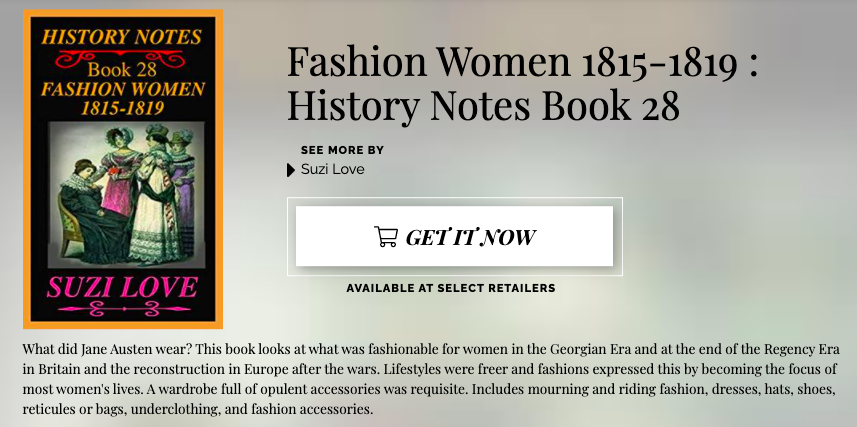
Fashion Women 1815-1819 History Notes Book 28 https://books2read.com/SuziLoveFashionWomen1815-1819
1800s Early Tattersall’s Horse Auctions, London, U.K.. Top sporting venue for Regency Life in London. ‘A mixture of persons of nearly all ranks’. By Pierce Egan. Via Wikimedia Commons (PD-ART)
In Jane Austen’s and Bridgerton times, or the Regency Era, horse riding was a vital mode of transport and Tattersall’s was the best place to buy and sell horses. Tattersall’s was established in 1773 near Hyde Park Corner for the sale by auction of horses, carriages, hounds and harnesses. Sales during the winter months were every Monday and Thursday, and on Mondays only during the spring and summer. On the mornings when there was no sale, Tattersall’s was a meeting place for fashionable sporting gentlemen.
Pierce Egan’s Description of Tattersall’s
A masquerade could scarcely exhibit more motley groups than the attendants of this place of fashionable resort. There were Peers, Baronets, Members of Parliament, Turf gentlemen and Turf-servants, Jockies, Grooms, Horse-dealers, Gamblers, &c. There you might see the oldest and some of the best blood in England, disguised like coachmen.
From: 1820 Sporting Anecdotes by Pierce Egan via Google Books (PD-150)