I'm an Australian author of contemporary and historical romances, plus history non-fiction.
My books range from sexy to erotic, late 1700s to the mid 1800s, and with a dash of Australia thrown into the mix. My heroes and heroines challenge tradition and my stories often expose the seamier levels of life.
I now live in a sunny part of Australia after spending many years in developing countries in the South Pacific. My greatest loves are traveling, anywhere and everywhere, meeting crazy characters, and visiting the Australian outback.
I hope my books bring history alive and you have fun adventuring with my roguish heroes and feisty heroines.
1800 Gentleman In Morning Dress French. Looking In Mirror, Double breasted, long coat high black boots with tan tops red cravat walking stick. Fashion Plate via Journal des Dames et des Modes, or Costume Parisien.
During the early 1800s skirted coats were replaced with short-fronted, or cutaway, tailcoats worn over fitted waistcoats and plain, white linen shirts. Knee breeches were gradually replaced by tight-fitting pantaloons and later trousers, decorative shoes were replaced with boot, such as the tan topped boots worn here, and fussy neckwear gave way to intricately tied, white linen neck cloths. A Regency Era, or early 1800s, gentleman was outfitted in more practical fabrics, such as wool, cotton and buckskin rather than the fussy brocades and silks of the late 1700s. The men in Jane Austen’s life would have worn an elegant outdoor ensemble like this for everyday excursions around the countryside.
HN_23_D2D_Fashion Men 1800-1819 History Notes Book 23
https://books2read.com/SuziLoveFashionMen1800-1819
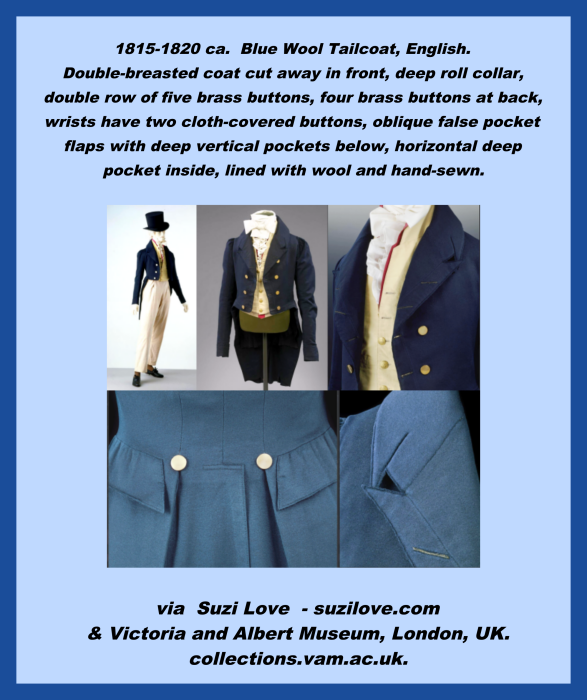
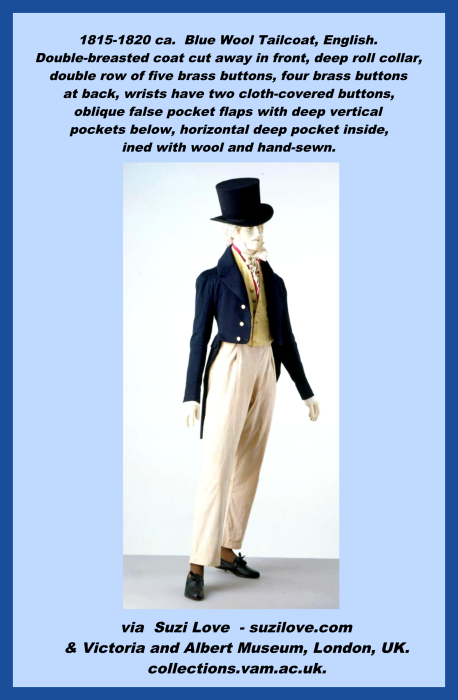
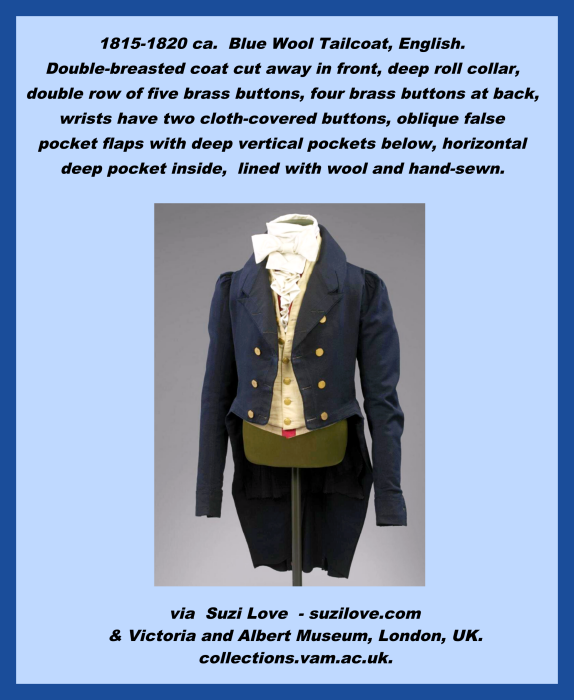
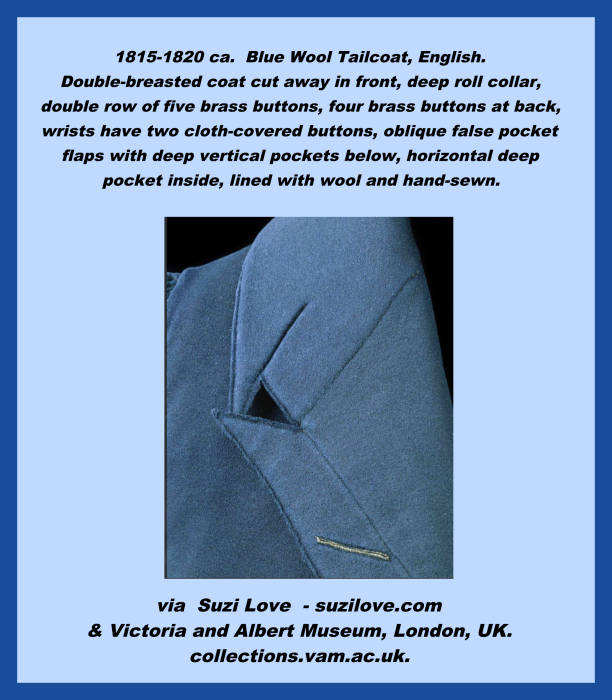
1815-1820 ca. Blue Wool Tailcoat As Worn By Bridgerton Gentlemen and the Men In Jane Austen’s Life.
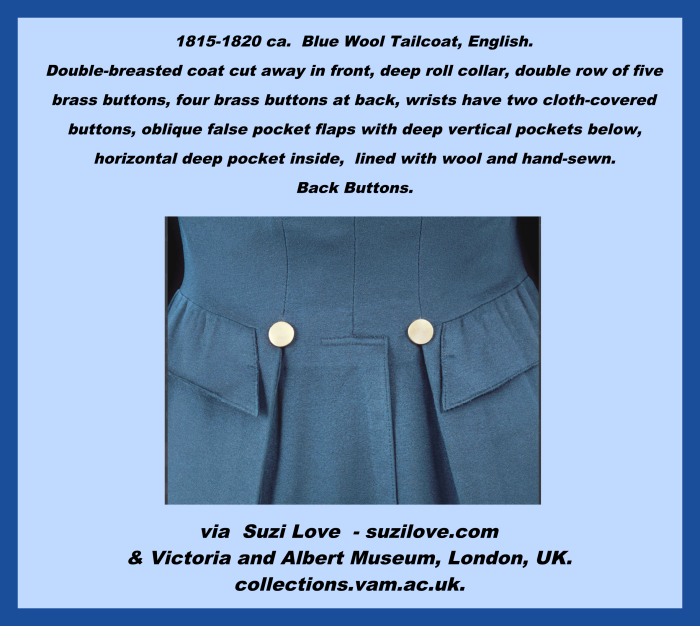
1815-1820 ca. Man’s Blue Wool Tailcoat, English. Chest View. Blue wool, lined with wool, brass buttons, and hand sewn. Double-breasted coat of blue wool, cut away in the front. With a fairly deep roll collar, a double row of five brass buttons, and four further brass buttons at the back. The wrists fasten with two cloth-covered buttons. With oblique false pocket flaps, one on each side, with deep pockets below them entered vertically, and another deep pocket inside entered horizontally. Lined with wool. Hand-sewn. Marks and Inscriptions: ‘Hammond Turner & Sons, Extra Superfine’ (Stamped behind the brass buttons) The cut-away coat remained formal daywear for men until the 1850s. This example has long tight sleeves, puffed at the shoulder, a style typical of the period 1815-1820. The roll collar has an M-shape notch, introduced about 1803, and a waist seam. via Victoria and Albert Museum, London, UK. Given by Lady Osborn.
Kelly’s Justice. I lived in Vanuatu, South Pacific, for 9 years and loved setting my book there.
Blurb: Kelly normally needs no help solving international security problems, but when someone from her past damages her reputation and threatens her life, she needs assistance. Joining forces with her old friend from the Australian army, now an expert on South Pacific politics, they destroy an island drug cartel and rescue kidnapped teenagers. https://books2read.com/SuziLoveKellysJustice
Excerpt
Grant stared at Kelly, disbelief written all over his face. “I can’t believe it’s really you. I tried to find you when I came back from Afghanistan, but it was if you disappeared off the face of the earth.” He winced. “To be honest, I wasn’t sure you’d want to see me. According to Ronnie, you hated all of us. Blamed us all for your problems with the higher ups.”
“What?” She groaned. “Damn! I might have known Ronnie would blame everyone but himself.”
“We all had our suspicions,” Grant said with a sigh. “But when your Lieutenant tells you something, you’re expected to believe it. No questions asked. Especially when that Lieutenant warned us that the brass had been so disgusted with your behavior, they’d spoken of taking legal action. We were ordered to have no interaction with you while they debated legal action, despite none of us believing those trumped up charges. We knew you’d never steal from the army and given how much you loathed drugs, we also knew you’d never get into bed with traffickers.”
“I tried to give my side of the story about all of that, but no one believed me. And despite the army being unable to produce enough legitimate evidence to instigate legal proceedings against me, they decided to force me out. Sweep it all under the carpet.”
Kelly looked her old friend in the eyes. “Did you believe I cheated on Ronnie? And with a commanding officer?”
“No! Hell no! I never believed that rubbish.” He met her eyes, his gaze open and honest, willing her to accept his words as the truth. “We had that conversation, remember? You and I agreed to ignore whatever attraction we felt between us, despite how much I wanted to do exactly the opposite. You’ve no idea how many times I wanted to drag you as far away from that bastard as possible. Get you completely out of that situation.”
She nodded. “But there was no point stirring Ronnie up. Everyone suspected that Ronnie was doing something illegal, so if I’d publicly split from him at that stage, I would have been involved. Our time with the army was coming to an end anyway and I’d already planned on getting away from him.”
She remembered very well that neither of them would take that step towards each other when she was already supposedly in a relationship with Ronnie. And Grant was far too honorable to ever come between two people who, to the outside world, appeared to be a perfect couple. In public, Ronnie claimed her as his girlfriend. In private, she saw very little of him, which was why she had suspected that he was doing more than simply cheating on her.
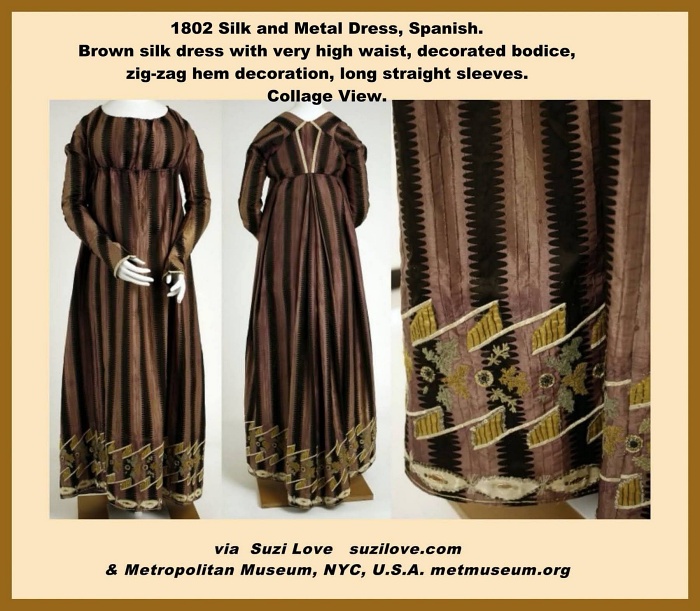
1802 Silk and Metal Dress, Spanish. Brown silk dress with very high waist, decorated bodice, zig-zag hem decoration, long straight sleeves. I can picture Jane Austen and her female friends and family wearing this sort of dress to a dinner party or musical evening. via Metropolitan Museum, NYC, U.S.A. metmuseum.org
1802 Silk and Metal Dress, Spanish. 1802 Silk and Metal Dress, Spanish. Front View. 1802 Silk and Metal Dress, Spanish. Back View. 1802 Silk and Metal Dress, Spanish. Fabric View. HN_25_D2D_fashwomen1801-1804 https://books2read.com/SuziLoveFashionWomen1801-1804
What did the lady of the house use to pen notes in Bridgerton and Jane Austen’s years? What sat on the desk of Jane Austen’s male contemporaries when they managed household and estate accounts? books2read.com/SuziLoveWritingTools. Writing Tools, History Notes Book 13.
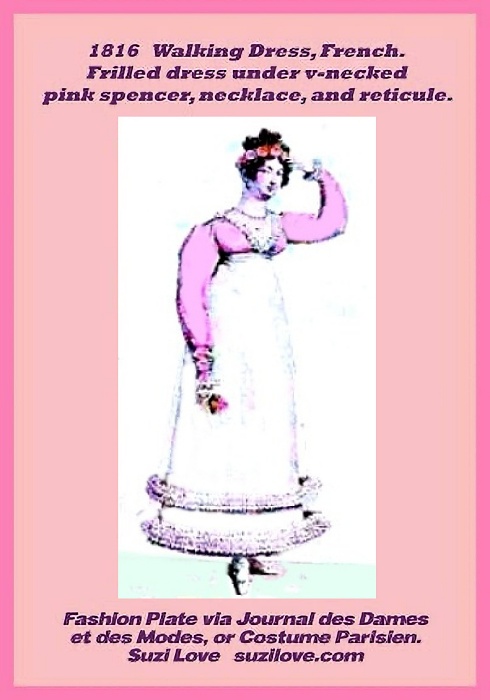
1816 White Walking Dress of short length and double row of frills at the hem. With pretty pink V-necked Spencer and carrying a reticule, walking shoes and floral wreath in her hair. Fashion Plate via Journal des Dames et des Modes, or Costume Parisien. Jane Austen and her contemporaries often walked to places and so would have needed the warmth of a Spencer over her dress in the cold British winters. https://books2read.com/SuziLoveFashionWomen1815-1819
Definition Spencer: Short jacket, cropped at the waist, worn over a dress, or gown. These close-fitting, tight sleeved, waist length jackets were modeled on a gentleman’s riding coat, but without tails. Delicate and regency dresses provided so little protection from the cold, so over garments were essential for warmth, modesty and good health.
Definition Ridicule, Reticule, Indispensable, or Handbag: From the late 1700s, pockets could no longer be sewn into gowns, as skirts fell from just under the bust and were full and flowing. Instead, women began carrying small bags, known at first as ridicules and later as reticules, to keep necessary items on their person e.g. handkerchiefs, coins, vinaigrettes, calling cards, glasses etc.
Definition Empire Style Dress: Named after the First Empire in France. Empire dresses had a low neckline and skirts started directly under the bust and flowed into the classical relaxed wide styles of Greece and Rome. This style of dress is associated with Jane Austen and her contemporaries as a high-waisted dress was worn most days. Cotton, silk or taffeta were the popular fabrics. Only the very wealthy could afford white dress in this style as the cottons were imported from India and had to be carefully cleaned, usually by a lady’s maid.
Fashion Women 1815-1819 History Notes Book 28 https://books2read.com/SuziLoveFashionWomen1815-1819
1809 Messrs. Harding Howell and Co., London, UK. View of interior of Harding Howell and Co., draper’s shop on Pall Mall. Ladies examine latest fashions and fabrics which they could then request of their dressmakers. This house extended 150 feet from front to back and was divided by glass petitions into four departments, furs and fans, haberdashery, jewellery, ornaments and perfumes, and millinery. bl.uk
1809 Interior of Messrs. Harding Howell and Co. Draper’s Shop, Pall Mall, London, U.K.
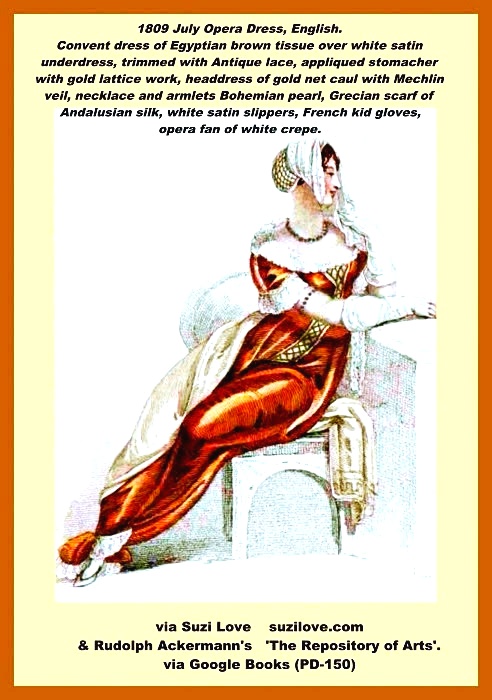
1809 July Opera Dress. I can picture aristocratic women wearing this sort of gorgeous outfit to the opera or an evening event.
Round convent robe of Egyptian brown tissue worn over white satin underdress, ornamented at feet, bosom and sleeves with broad Antique lace, out on full, and narrowing in front, white satin appliqued stomacher embellished with gold lattice work and continued in a straight line down to the hem. Headdress is a gold net caul, enclosing the hair at the back and finished in front with a Mechlin veil displaying the hair on the forehead and falling over the left shoulder. Necklace and armlets are a single row of Bohemian pearl with topaz or diamond snaps. Grecian scarf of rich Andalusian silk, contrasted with the robe and wrought at the ends in a deep Tuscan border of gold or colored silks. White satin slippers, trimmed with brown foil or gold, French kid gloves, opera fan of white crepe with a border of jessamine. Fashion Plate via Rudolph Ackermann’s ‘The Repository of Arts’.
Fashion Women 1805-1809 History Notes Book 26 What did Jane Austen and friends wear? https://books2read.com/SuziLoveFashionWomen1805-1809
1800 ca. Chemisette, English. In Jane Austen’s times, there were several ways for women to keep their modesty when the fashion trend was for low cut bodices and loose flowing dresses e.g. Chemisette, Fichu, Pelerine etc. DefinitionChemisette: Sleeveless under-bodice covering neck, shoulders and breast, usually of muslin or lace and worn to fill in the neckline of a dress. French term for vestee, gilet, etc. via Killerton House, U.K. & National Trust.
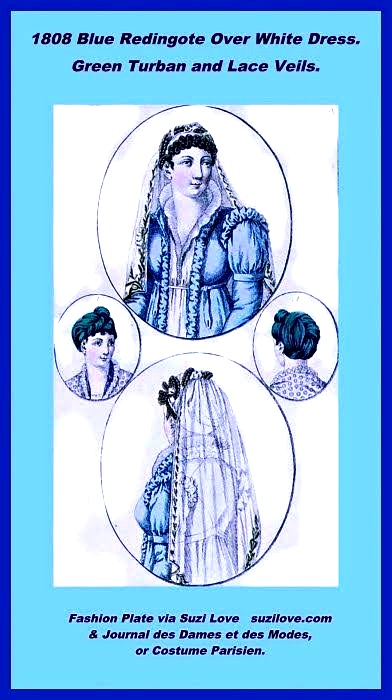
1808 Jane Austen Style Blue Redingote Over A White Dress. Green turban and lace veils. Bodice. Fashion Plate via Journal des Dames et des Modes, or Costume Parisien.
French fashions like this were copied by English magazines so these styles of hats would have been worn by Jane Austen and her contemporaries.