I'm an Australian author of contemporary and historical romances, plus history non-fiction.
My books range from sexy to erotic, late 1700s to the mid 1800s, and with a dash of Australia thrown into the mix. My heroes and heroines challenge tradition and my stories often expose the seamier levels of life.
I now live in a sunny part of Australia after spending many years in developing countries in the South Pacific. My greatest loves are traveling, anywhere and everywhere, meeting crazy characters, and visiting the Australian outback.
I hope my books bring history alive and you have fun adventuring with my roguish heroes and feisty heroines.
1800s Typical Breakfast and Tea China, England. Tea cups, Bread and Butter plates, Teapot, Butter Dish, Coffee Cups, Tea Set, Milk Jug, Water Jug, Bread Dish, Sardine Dish, Bacon Dish, Marmalade Jar and Breakfast Cups. From: 1860 Mrs. Isabella Beeton’s Book of Household Management. These are the sort of salads that Jane Austen’s family would have eaten to accompany main dishes during the early 1800s, or Regency Era.
Travel and Luggage By Suzi Love History Notes Book 10. How did people travel in Jane Austen’s times. In past centuries? What did they take with them to make their long journeys easier? Travel by road, ship, canal, or railway all took a long time and had dangers so people learned to prepare. And then, in the nineteenth century, road improvements, inventions, and scientific developments made travel more pleasurable. books2read.com/SuziLoveTravel
“There is nothing I would not do for those who are really my friends. I have no notion of loving people by halves, it is not my nature.” Jane Austen ~ Northanger Abbey (1817) #JaneAusten #RegencyEra #Quotation
Fashion Women 1815-1819 History Notes Book 28 https://books2read.com/SuziLoveFashionWomen1815-1819
What salads were served in Jane Austen and the Bridgerton households? Salads “Persons in health, who feel a craving for salad, may indulge in the enjoyment of it to a great extent with perfect impunity, if not with positive benefit. Oil, when mixed in salad, appears to render the raw vegetables and herbs more digestible. Vinegar likewise promotes the digestion of lettuce, celery, and beet-root.
“Endive is very wholesome, strengthening, and easy of digestion; but when strong seasoning is added to it, it becomes an epicurean sauce. — Mayo.”
Recipe for a Winter Salad, by the late Rev. Sydney Smith. Two large potatoes, passed through kitchen sieve, Unwonted softness to the salad give, Of mordent mustard add a single spoon; To add a double quantity of salt; Three times the spoon with oil of Lucca crown, And once with vinegar, procured from town. True flavor needs it, and your poet begs The pounded yellow of two well-boiled eggs. Let onion atoms lurk within the bowl, And, scarce suspected, animate the whole; And, lastly, on the flavored compound toss A magic teaspoon of anchovy sauce. Then, though green turtle fail, though venison’s tough, And ham and turkey are not boiled enough, Serenely full the Epicure may say,- Fate cannot harm me—I have dined to-day!
The Spanish proverb says four persons are wanted to make a good salad: a spendthrift for oil, a miser for vinegar, a counsellor for salt, and a madman to stir all up.
1859 Hints for the Table by John Timbs.
1800s Typical Salads: Cucumber, Beetroot and Potato, Macedone Salad, Tomato Salad, Jellied Russian and Italian Salads, Prawn Salad, Egg and Lettuce, Lobster Salad and Salad Dumas. From: Mrs. Beeton’s Book of Household Management. via Google Books (PD-150)
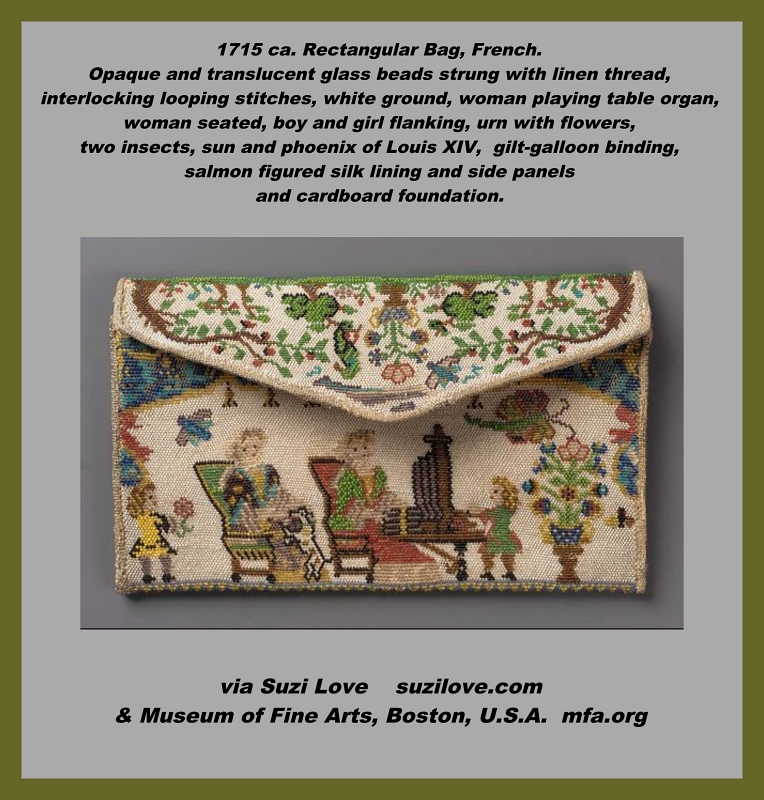
1715 ca. Rectangular Envelope Style Bag, French. Polychrome opaque and translucent glass beads strung with linen thread, held together by interlocking looping stitches (sablé). Design on white ground: woman playing table organ, woman seated, boy and girl flanking, urn with flowers right, two insects and curtain above (obv.); sun and phoenix of Louis XIV, ribbon above inscribed IE VIS SANS MOURIR, inscribed at bottom and right SI IE MEURS CE NEST QUE POVR REVIVRE (rev.); vegetative scene (flap). Gilt-galloon binding. Salmon figured silk lining and side panels. Cardboard foundation. via Los Angeles County Museum of Art, California, USA. collections.lacma.org
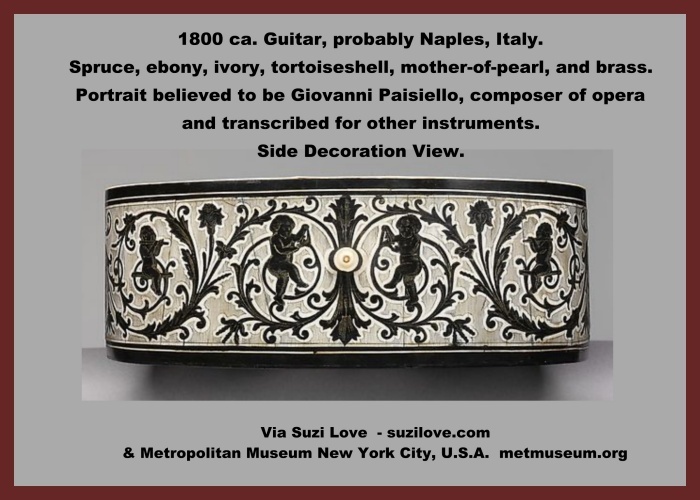
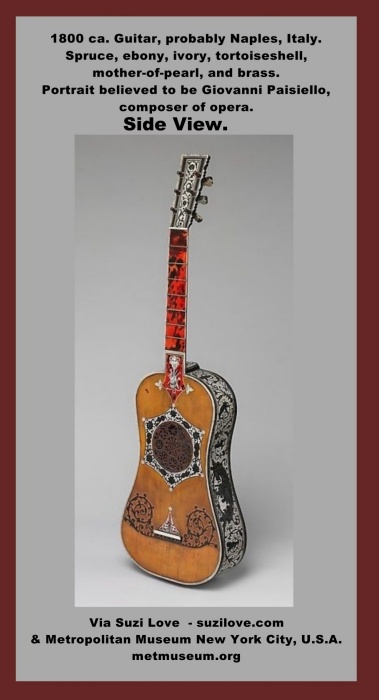
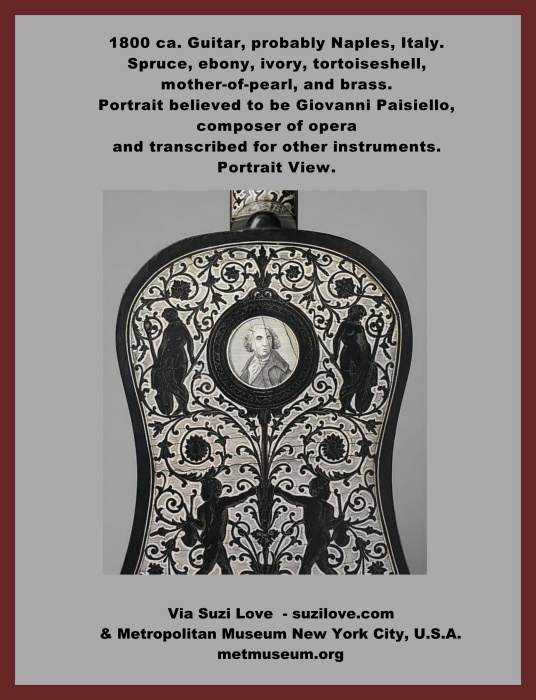
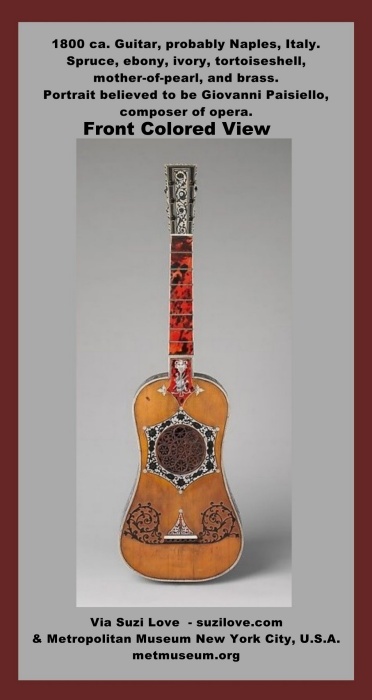
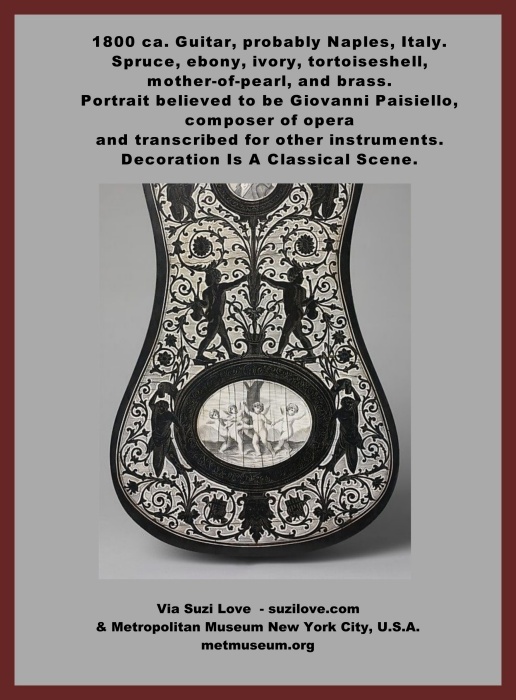
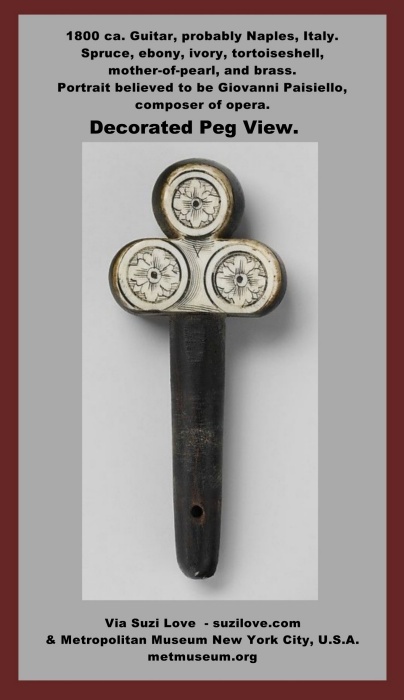
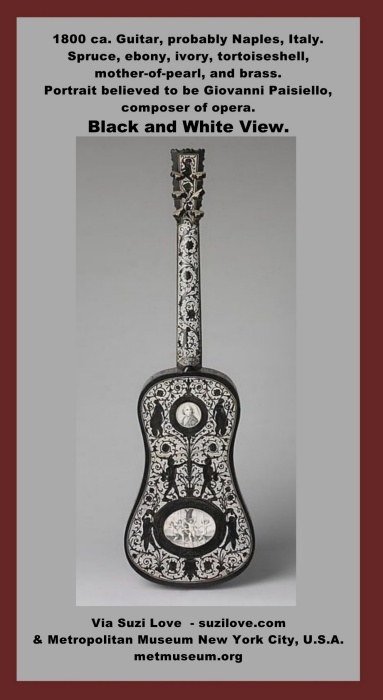
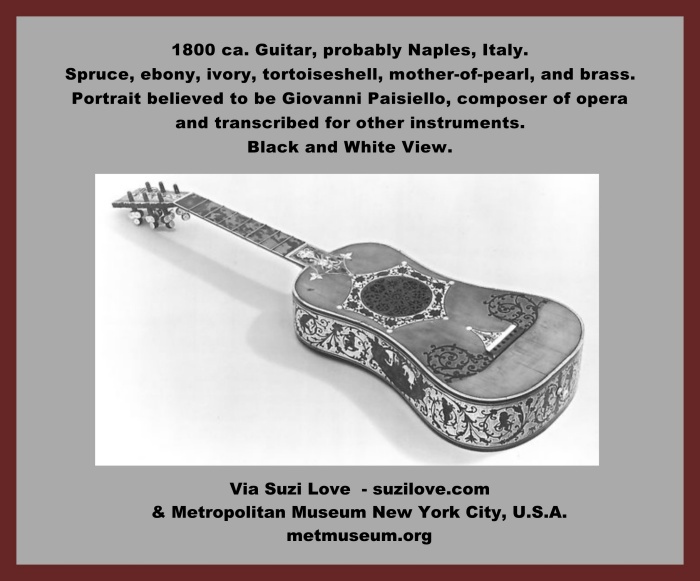
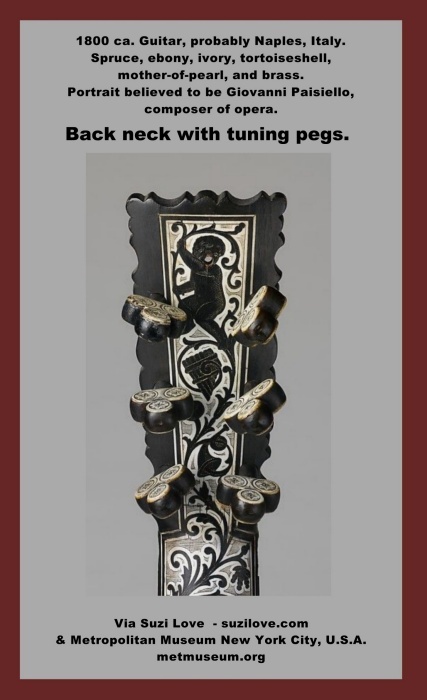
1800 Guitar, Probably Naples, Italy. The sort of guitar people in Jane austen’s era would have played in their homes. Spruce, ebony, ivory, tortoiseshell, mother-of-pearl, and brass. This highly decorated guitar is an early example of a six-string, single-course guitar. The elaborate decoration features classical figures, musical instruments, and floral motifs made from ebony and fit into an ivory ground covering the back, sides, neck, and headstock of the guitar.
A second guitar at the Yale Collection of Musical Instruments features the same decoration, only in reverse, indicating that the decoration was made at the same time by cutting through thin layers of stacked ebony and ivory. A portrait in the center of the upper back is believed to be of Giovanni Paisiello based on his 1791 portrait. Paisiello was a composer of opera and many of his works were transcribed for use on other instruments and his pieces were a favorite of guitarists.
The fingerboard is covered with tortoiseshell over read paint with an ivory satyr inlaid where the neck meets the body. A carved wooden rosette may be a replacement and is surrounded by an ivory hexagon with ebony inlaid instruments and flowers matching the back. The decorative style is evocative of so-called Baroque guitars of the seventeenth century. The six-string, single-course guitar became popular in Naples at the end of the eighteenth century and then spread throughout the rest of Europe replacing the earlier five and six double-course guitars. via Metropolitan Museum New York City, U.S.A. books2read.com/suziloveMusicGeneral
HN_7 D2D Retailer Buy Link Music Piano History Notes
1804 Fawn Drap Riding Habit in Jane Austen style. High-waisted dress with a full skirt and train, skirt buttoned at the side, long straight sleeves, velvet snug hat, Fichu around her neck, riding crop, two views of hairstyles. Fashion Plate via Journal des Dames et des Modes, or Costume Parisien.
Male tailors made most women’s riding habits during the Regency years and they were constructed similarly to men’s riding outfits. Generally in two pieces, a jacket and a skirt, and with a shirt with a frilled collar or front opening underneath. The trains of a habit could be caught up for walking, usually with a button and loop, and unhooked and let down so that the skirt flowed over the woman’s legs when she rode side saddle. Due to the numerous wars during the early 1800s, it was seen as patriotic for women to add military style touches to outfits in support of military men. The shoulder and cuff trims resemble the epaulettes and coat trims of a military uniform.
1817 May Pink Evening Dress, English. A white lace dress over a blush-coloured satin slip. The dress is disposed round the bottom of the skirt in festoons, which display a little of the slip; each festoon is ornamented with a bouquet of blue-belles, pinks, and rose-buds. The festoons are surmounted by a rollio of intermingled pink and white saton. We refer to our print for the form of the body, which is novel and tasteful. The sleeve is very short and full; it is finished at the bottom by quillings of blond. The hair is dressed in a plain braid across the face, and a few loose ringlets at the sides. The hind hair forms a tuft, which is concealed by the head-dress, a high wreath of fancy flowers. Pearl necklace. White kid slippers and gloves. Fashion Plate via Rudolph Ackermann’s ‘The Repository of Arts’.
Fashion Women 1815-1819 History Notes Book 28 https://books2read.com/SuziLoveFashionWomen1815-1819