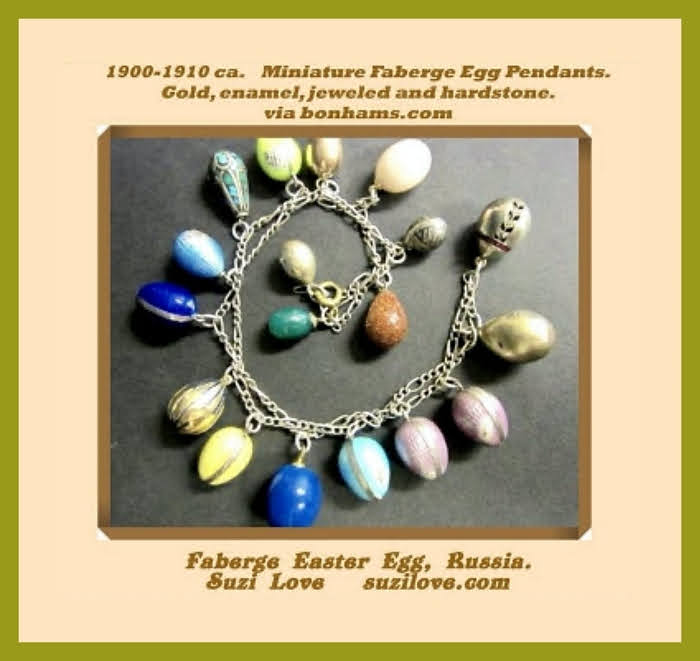
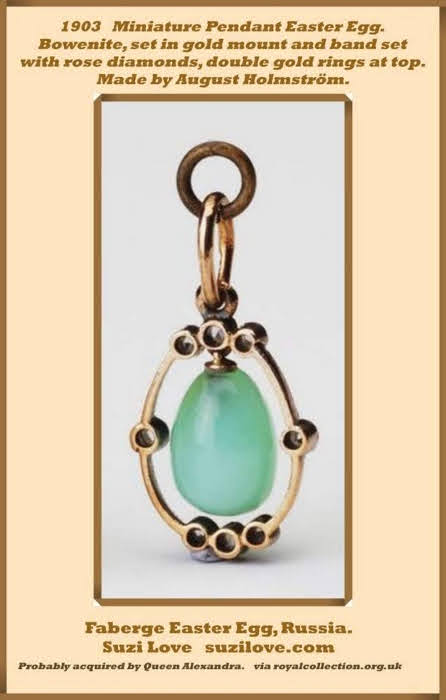
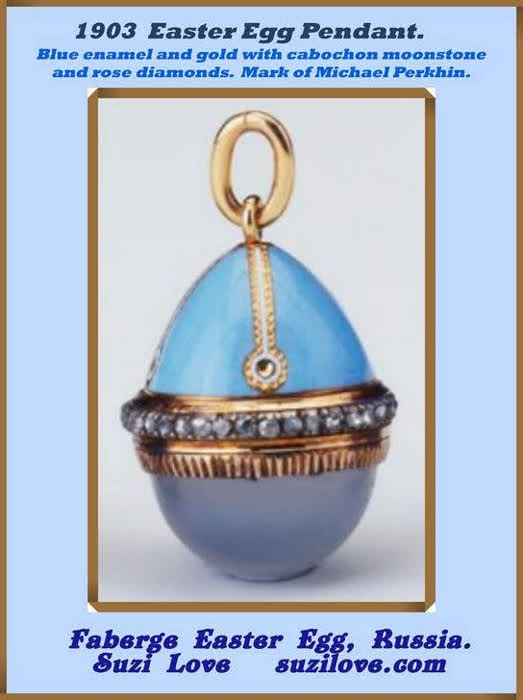
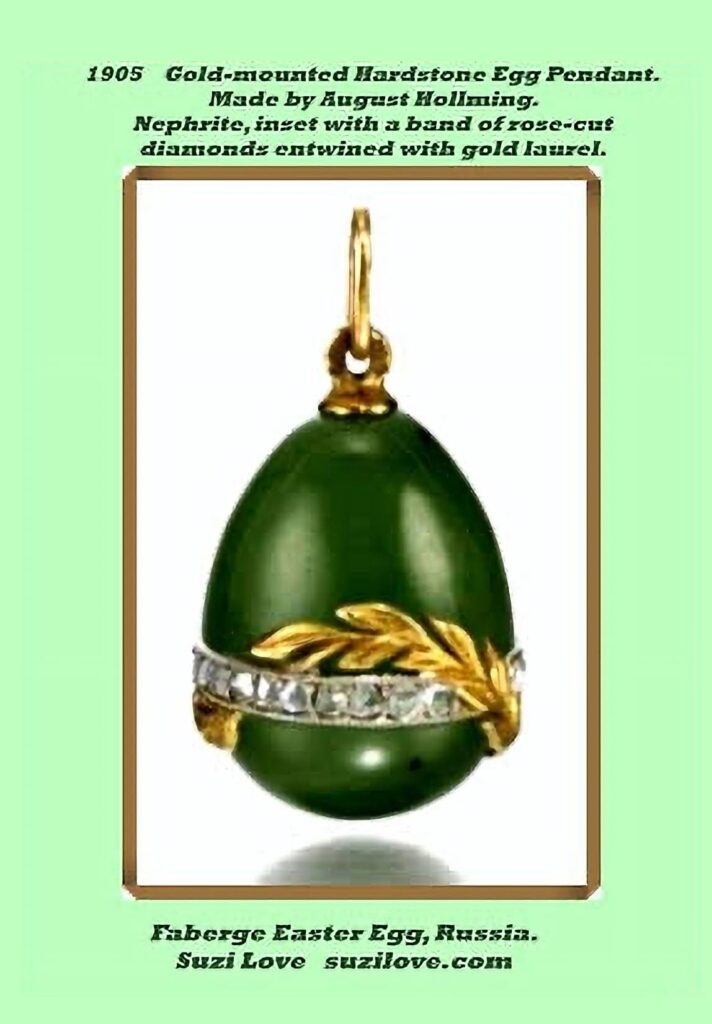
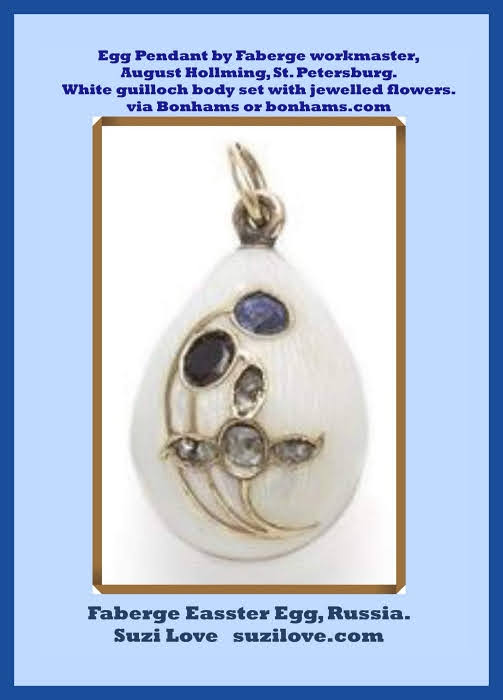
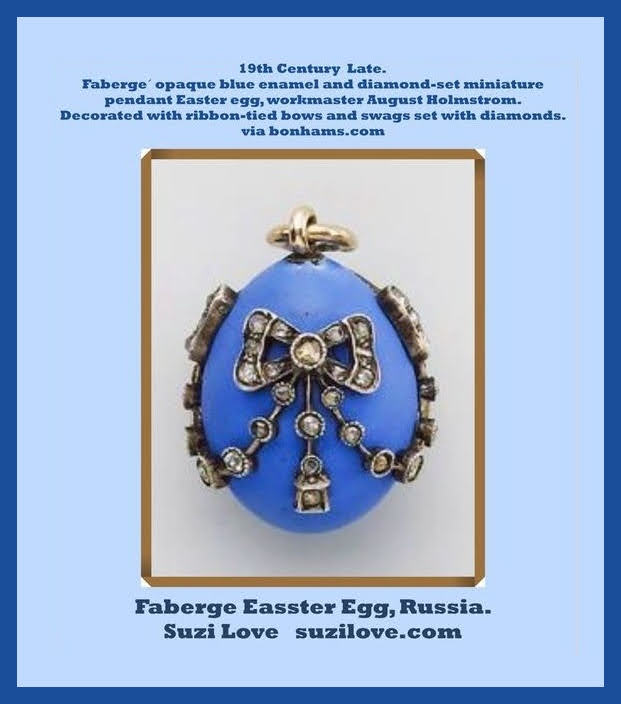
1900s Early Gorgeous Faberge Egg Pendants From Russia. Giving Eggs in spring was a pagan tradition adopted by early Christians. The old tradition was to give dyed chicken eggs and later it became chocolate eggs. The act of Egg giving is popular in Eastern Europe and this tradition indicated the birth of something new. As the Russian monarchy were Russian orthodox Christians, the Tsar wanted to surprise his wife with a jewelled Egg as a symbol of his love and affection. The gift pleased the Tsar’s family so much that his immediate circle, and the wider public, began the tradition of a Faberge from 1885 to 1917 until the revolution destroyed the Royalty.
1890s Gold Faberge Easter Egg Pendant, Russia. Made by Michail Perchin. via hermitagemuseum.org1890s Pendant Shaped like an Amphora. The Fabergé firm, St Petersburg. hermitagemuseum.org1890 ca. Diamond and sapphire egg pendant by Fabergé. via bonhams.com19th-20th Century Fabergé Miniature Easter Egg Pendant. Gold, sapphires, emerald, ruby, via vmfa.museum19th-20th Century Faberge Miniature Easter Egg Pendant. Silver, gilt, emerald. via vmfa.museum. 1900 ca. Miniature Faberge Egg Pendant By Henrik Wigstrom, St. Petersburg. Body with white opaque and translucent green enamel sections surrounding four pink circular rose-cut diamond and enamelled panels. via Bonhams Auctions. 1900s Early Gorgeous Faberge Egg Pendants Made In Russia. 1. #Faberge #Easter #Russia #Jewelry https://books2read.com/suziloveEaster Share on X
1900s Early Gorgeous Faberge Egg Pendants Made In Russia. 2.
The name Faberge is associated with the Russian Imperial family for whom most of the world’s most famous eggs were created. In 1870, Faberge inherited his father’s jewelry business and quickly became known for his brilliant designs. A display of his work and the gold medal he was awarded in Moscow’s Pan-Russian Exhibition of 1882 brought him to the attention of the Russian nobility.
In 1885, Faberge was commissioned by Tsar Alexander III of Russia to create an Easter egg for his wife, the Empress Maria Fedorovna. This became known as The Hen Egg, the first Imperial Faberge Egg, and is made of gold. The Empress was so happy with the gift that Alexander appointed Fabergé a ‘Goldsmith by Special Appointment to the Imperial Crown’ and the following year commissioned another egg. From then on, Faberge was given complete freedom with future Imperial designs which become even more elaborate every year. A famous Fabergé egg is one of sixty eight jeweled eggs made by Fabergé and his assistants for the Russian Tzars and private collectors between 1885 and 1917.
After the Russian Revolution, the House of Faberge was nationalized by the Bolsheviks and the Faberge family fled to Switzerland where Peter Carl Faberge died in 1920. Several of the Faberge Imperial eggs are still missing.
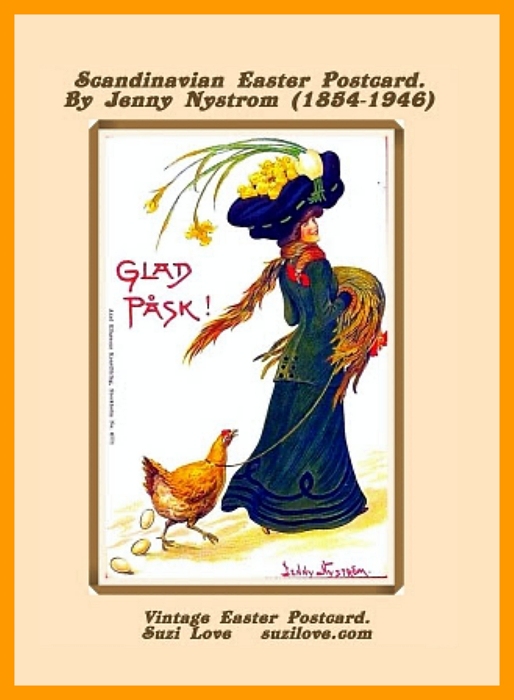
Jenny Nystrom (1884-1946) Vintage Easter Cards. Jenny Eugenia Nyström (1854 – 1946) was a Swedish painter and illustrator who illustrated Easter postcards for, and about, children and happy images.
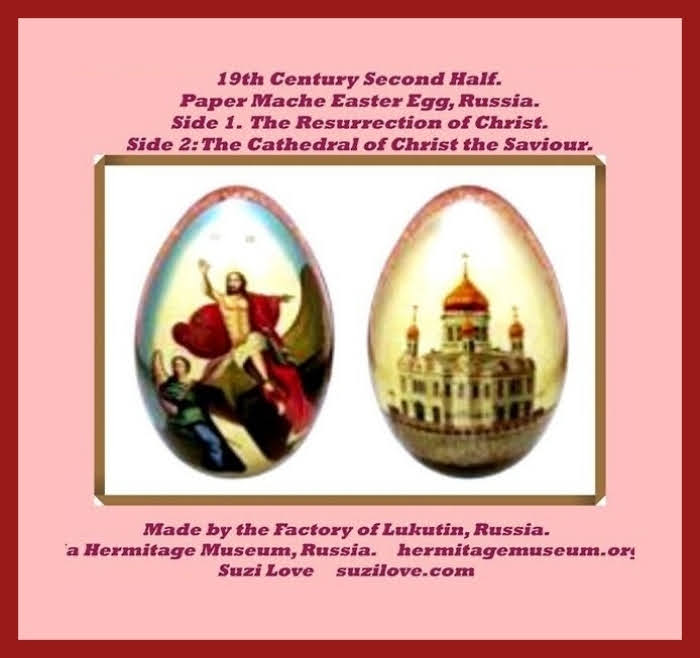
19th Century Second Half. Paper Mache Easter Egg, Russian.#Easter Resurrection of Christ, Cathedral of Christ the Savior. via Hermitage Museum, Russia. hermitagemuseum.org
1885 The Hen Egg, Imperial Faberge egg, Russia. Gold, rubies and enamel. Height: 6.4 cm. Made by The Fabergé firm, St Petersburg
An imperial Easter egg presented by Alexander III to his wife, Empress Maria Fiodorovna, for Easter 1885. The Hen, was made by Faberge at the behest of Emperor Alexander III for Empress Maria Fedorovna in 1885, possibly to mark the 20th anniversary of their betrothral. It imitates a natural egg and is golden, covered with a white opaque enamel. Inside there is a surprise in the form of a chicken figurine which held in its beak a ruby egg (presently lost). Via The Hermitage Museum, Russia.
1890-1900s Porcelain Easter Egg. Inscription “Christ is risen!”. The Kornilov Brothers Factory, St Petersburg. Via Hermitage Museum Faberge Easter Egg, Russia. books2read.com/suziloveEaster
A porcelain Easter egg from the 1890–1900s featuring the inscription “Christ is risen!” was a traditional Russian Orthodox Easter gift. They were produced by both the Kornilov Brothers Factory and the Imperial Porcelain Factory in St. Petersburg. The State Hermitage Museum in St. Petersburg has a large collection of Imperial-era porcelain Easter eggs. These eggs were exchanged, hung on ribbons, or placed on stands during Easter as a symbol of life’s renewal. The words “Christ is Risen!” was a traditional Russian Easter greeting.
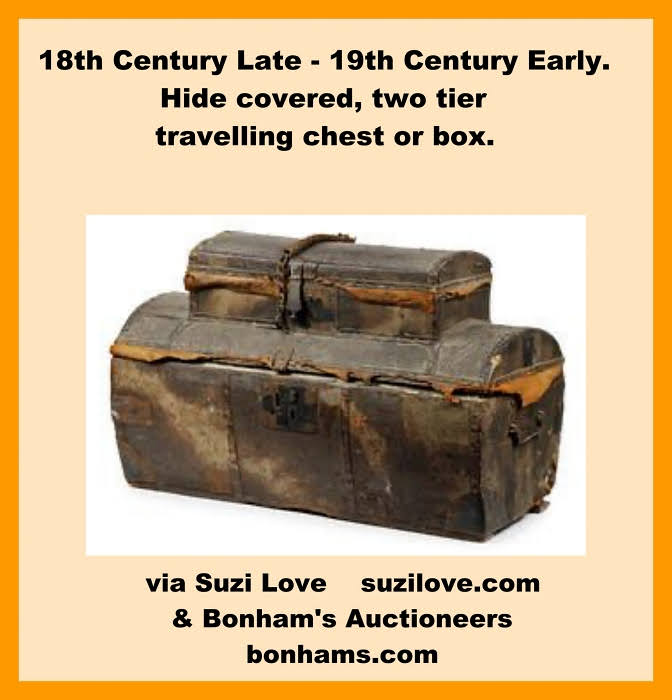
1930-1939 ca. Louis Vuitton Wardrobe Trunk. Monogrammed coat hangers, leather handle.1930-19391930-1939 ca. Louis Vuitton Steamer Trunk.18th Century Late – 19th Century Early. Hide covered, two tier traveling chest or box. Via Bonham’s Auctions.17th Century Iron Trunk With Locking Mechanism. 1900s Early Bags and Suitcases.
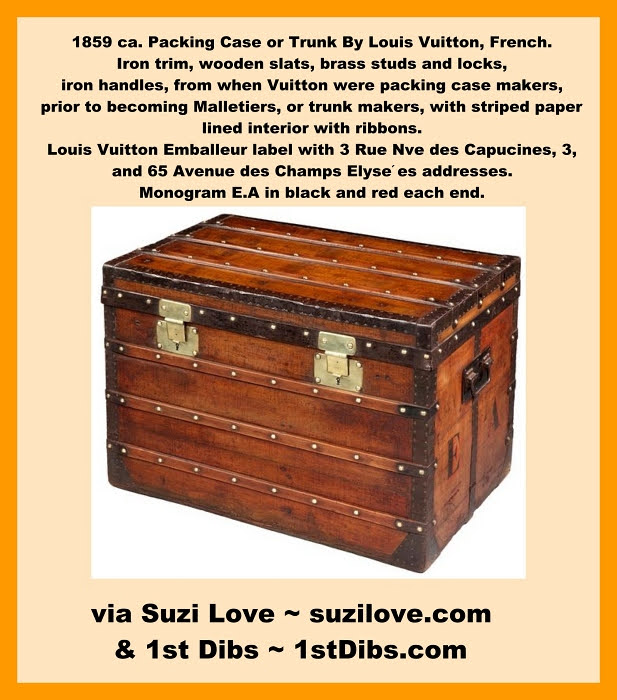
1st Dibs Auctions. 1859 ca. Packing Case or Trunk By Louis Vuitton, French. Iron trim, wooden slats, brass studs and locks.17th – 20th Centuries Luggage For Travel. #RegencyEra #VictorianEra #EdwardianEra books2read.com/SuziLoveTravel Share on XHN_10_D2D_RetailerBuyLink_ History Notes Book 10 books2read.com/SuziLoveTravel
1900 Friendship, or, Hoof Faberge Egg, Russia. Presented by Tzarina Alexandra to one of her friends. Red gold bowenite, diamonds, rubies and pearls.
The name Faberge is associated with the Russian Imperial family for whom most of the world’s most famous eggs were created. In 1870, Faberge inherited his father’s jewelry business and quickly became known for his brilliant designs. A display of his work and the gold medal he was awarded in Moscow’s Pan-Russian Exhibition of 1882 brought him to the attention of the Russian nobility. In 1885, Faberge was commissioned by Tsar Alexander III of Russia to create an Easter egg for his wife, the Empress Maria Fedorovna. This became known as The Hen Egg, the first Imperial Faberge Egg, and is made of gold. The Empress was so happy with the gift that Alexander appointed Fabergé a ‘Goldsmith by Special Appointment to the Imperial Crown’ and the following year commissioned another egg. From then on, Faberge was given complete freedom with future Imperial designs which become even more elaborate every year. A famous Fabergé egg is one of sixty eight jeweled eggs made by Fabergé and his assistants for the Russian Tzars and private collectors between 1885 and 1917. After the Russian Revolution, the House of Faberge was nationalized by the Bolsheviks and the Faberge family fled to Switzerland where Peter Carl Faberge died in 1920. Several of the Faberge Imperial eggs are still missing.1900 Friendship, or, Hoof #Faberge #Easter Egg. Presented by Tzarina Alexandra to one of her friends. Red gold bowenite, diamonds, rubies and pearls. Faberge Easter Egg, Russia.