1808 Richard Trevithick’s Steam Circus, Bloomsbury, London, U.K. Site where Trevithick ran his locomotive ‘Catch Me Who Can’. Trevithick wanted to prove that traveling by train was faster than on horseback. Locomotive ran at top speed of 19 km per hour and people paid a shilling to sit in an attached car and be pulled around. Via Wikimedia Commons commons.wikimedia.org (PD-ART) This was the start of the railway expansions across England in Jane Austen’s time.
1808 Richard Trevithick’s Steam Circus, Bloomsbury, London, U.K. Site where Trevithick ran his locomotive ‘Catch Me Who Can’. Trevithick wanted to prove that traveling by train was faster than on horseback. Locomotive ran at top speed of 19 km per hour and people paid a shilling to sit in an attached car and be pulled around. Via Wikimedia Commons commons.wikimedia.org (PD-ART)
D2D_RetailerBuyLink_HN_10.books2read.com/SuziLoveTravel
1800s French Palais Royal Sewing Box and Twelve Mother of Pearl Enamel Tools. This is the style of sewing box Jane Austen and her family would have used in the early 1800s, or Regency years. via via suzilove.com and 1st Dibs Auctions 1stdibs.com
Definition: Palais Royal: Name of an area around the Royal Palace in Paris, France, that specialized in making small and exquisite works of art during the 18th and 19th centuries. Palais Royal sewing tools were elaborate and usually feature mother-of-pearl, often intricately carved or engraved. During the 19th century, workboxes were often works of art with engravings, carvings, mother-of-pearl, and elaborate gilt metal mounts. Most popular were scissors with steel blades and gilt mounts, thimbles and needle cases which were often shaped like animals or other natural forms. Workmanship was exceptional and the tools almost too fragile to use.
1800s French Palais Royal Sewing Box and Twelve Mother of Pearl Enamel Tools. via via suzilove.com and 1st Dibs Auctions 1stdibs.comHN_11_D2D_Craftsmen created containers of precious metals, leather, silks, and decorated them with jewels to make exquisite and expensive items as well as practical carrying cases. books2read.com/suziloveBoxesCases
Early 1800s Typical Regency Couple in a Curricle. The sort of vehicle Jane Austen and her contemporaries would have driven in. Young men loved them and occasionally women drove them.
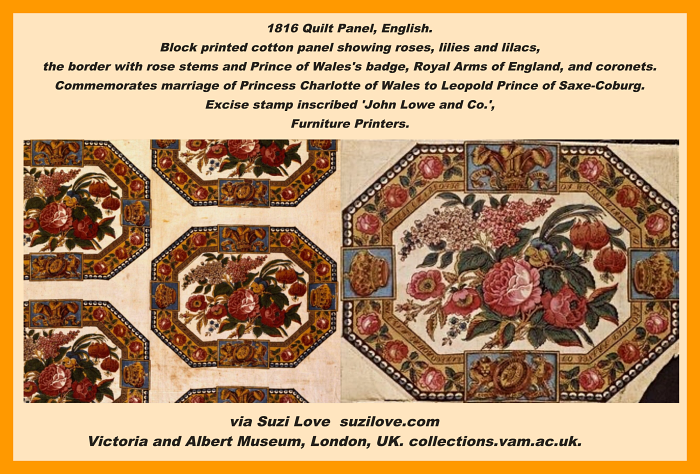
1816 Block Printed Quilt Panel made to celebrate the Marriage of Princess Charlotte to Prince Leopold of Saxe-Coburg.
Textile of block-printed white cotton in madder colours with pencilled blue. The cotton is printed with 9.5 octagonal panels intended to be cut out and applied to patchwork quilts. Each panels contains a bunch of flowers. Around the inner border is an inscription of Princess Charlotte of Wales married to Leopold Prince of Saxe-Coburg May 2, 1816. In the borders are three Prince of Wales feathers, the Royal Arms, and a crown on each side. At the end of the textile is printed a rectangular panel containing the manufacturers name and in a corner is the name ‘G. Swindels’.
This quilt has an excise stamp for 1816 and is inscribed ‘John Lowe and Co. Furniture Printers, Shepley Hall’, providing the name of the only identifiable manufacturer of these panels, although there are likely to have been others. John Lowe was a well-known firm of calico printers with large cotton factories and extensive bleaching grounds close to the River Tame near Ashton-under-Lyne in Lancashire.
Hand-quilting is done on a frame using needles called ‘betweens’. The stitches are executed with one hand; the other hand is kept underneath the quilt to feel for the needle. Small, uniform stitches (usually a ‘running stitch’) are taken through the three layers to form a decorative design. In ‘piecing’ or ‘patchwork’, small pieces of fabric are sewn together to produce a decorative design. The most enduring method in Britain is done by hand, and is known as ‘piecing over paper’. The pattern is first drawn onto paper and then accurately cut. Small pieces of fabric are tacked round each of the shapes, and then joined together from the back using overstitch. Most of the quilt top visible here has been pieced over paper, but in some areas the fabrics have been applied directly on to the earlier quilt that forms the wadding.
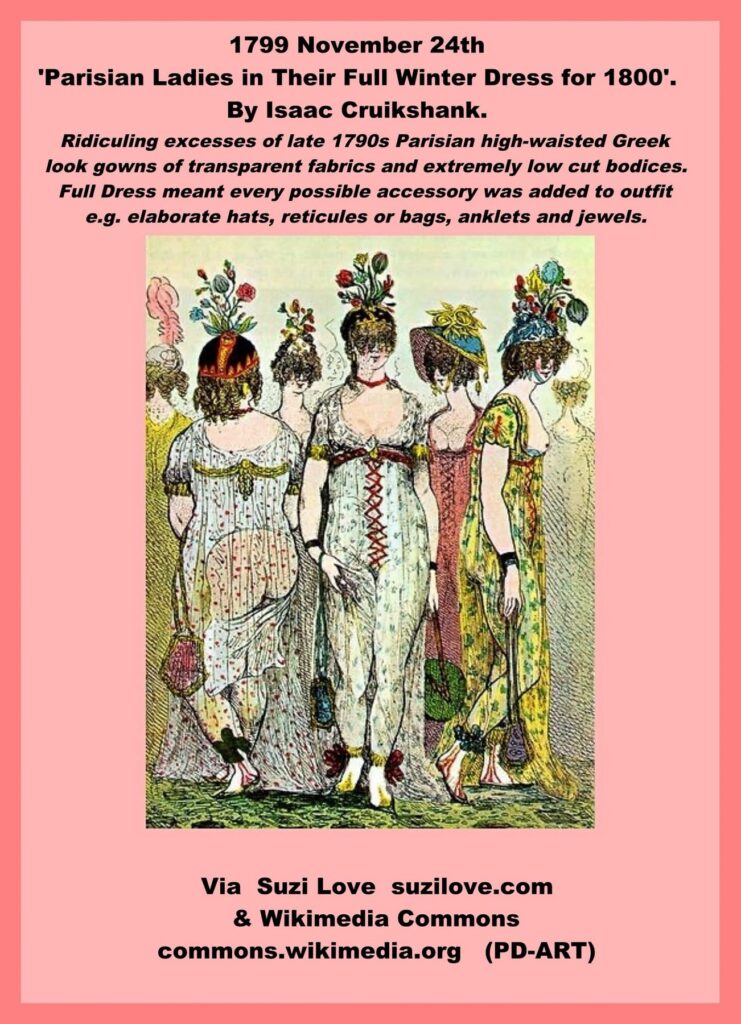
1799 November 24th ‘Parisian Ladies in Their Full Winter Dress for 1800’. By Isaac Cruikshank. Ridiculing excesses of late 1790s Parisian high-waisted Greek look gowns of transparent fabrics and extremely low cut bodices.Full Dress meant every possible accessory was added to outfits.g. elaborate hats, reticules or bags, anklets and jewels. Via British Museum, London, UK. britishmuseum.org (PD-Art)
1799 November 24th ‘Parisian Ladies in Their Full Winter Dress for 1800’. By Isaac Cruikshank. Ridiculing excesses of late 1790s Parisian high-waisted Greek look gowns of transparent fabrics and extremely low cut bodices.Full Dress meant every possible accessory was added to outfits.g. elaborate hats, reticules or bags, anklets and jewels. Via Suzi Love – suzilove.com & British Museum, London, UK. britishmuseum.org (PD-Art)HN_1 Fashion Women Late 1700s History Notes Book 1 by Suzi Love.
What was fashionable for women in the late 1700s? Extravagant colors and fabrics and outrageous styles were all seen in these flamboyant fashions.
books2read.com/suziloveFashWomen1700s
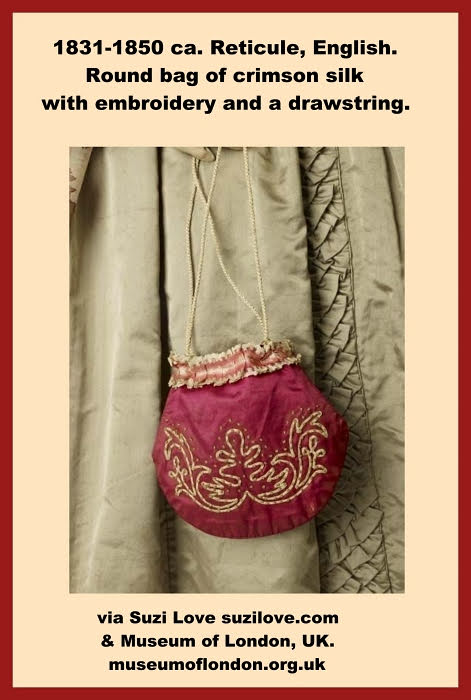
1831-1850 ca. Reticule, English. Round bag of crimson silk with embroidery and a drawstring. via Museum Of London.
1831-1850 ca. Reticule, English. Round bag of crimson silk with embroidery and a drawstring. via Museum Of London. D2D_RetailerBuyLink_HN_3 http://books2read.com/suziloveReticules
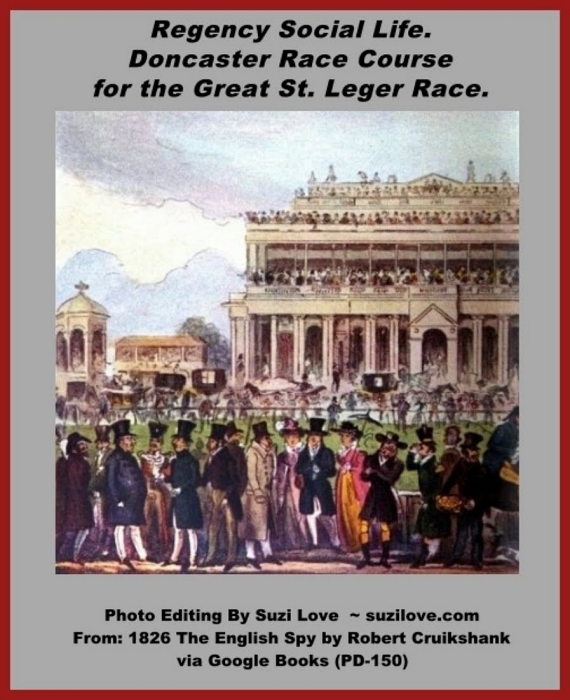
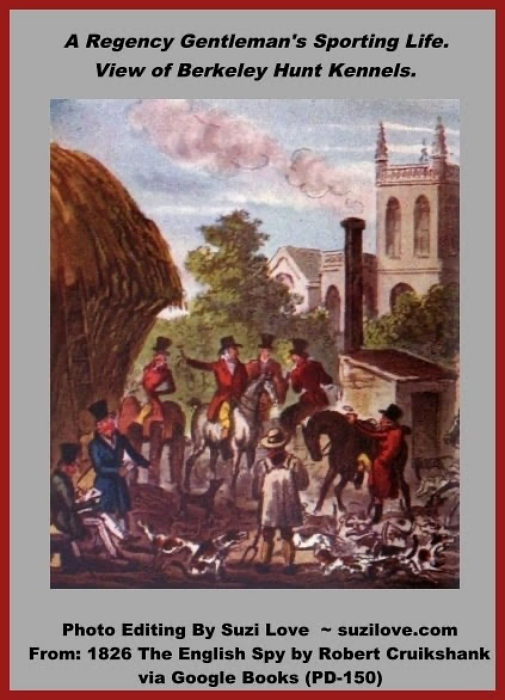
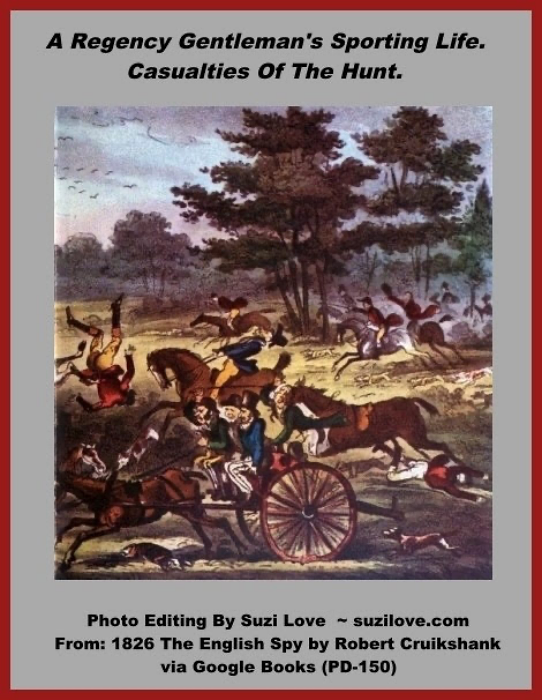
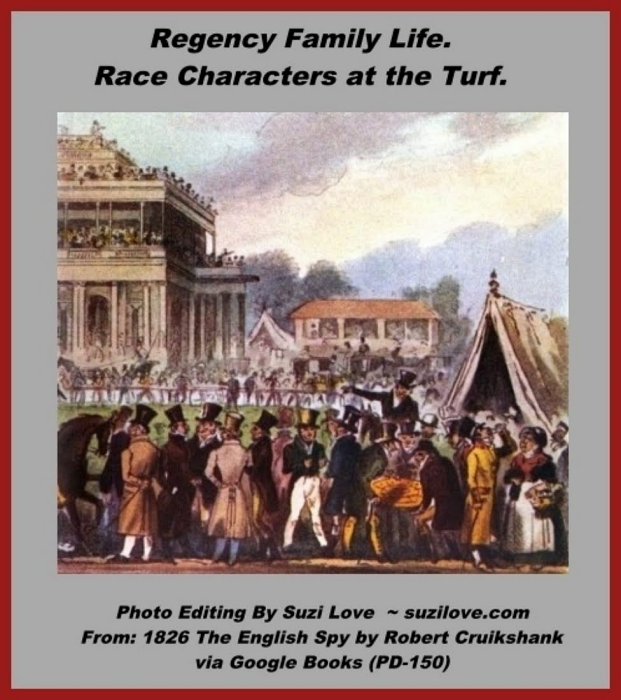
Regency Gentleman’s Sporting Life in the times of Jane Austen. By Robert Cruikshank via Google Books Races, bowls, sailing, fox hunting… all the sports enjoyed by people in Regency Era. From: 1826 The English Spy by Robert Cruikshank via Google Books (PD150)
1826 Doncaster Race Course for the Great St. Leger Race. Regency Sporting Life. via 1826 The English Spy By English Cartoonist, Robert Cruikshank.1826 Bowling Alley at Worcester, England. Regency Sporting Life. via 1826 The English Spy By English Cartoonist, Robert Cruikshank.1826 View of Berkeley Hunt Kennel, England. Regency Sporting Life. via 1826 The English Spy By English Cartoonist, Robert Cruikshank.1826 Casualties Of The Hunt.A Regency Gentleman’s Sporting Life. Regency Sporting Life. via 1826 The English Spy By English Cartoonist, Robert Cruikshank.1826 Race characters at the turf, Regency Sporting Life. via 1826 The English Spy By English Cartoonist, Robert Cruikshank.RL_2_D2D_RetailerBuyLink_RL_2
https://books2read.com/suziloveYGD
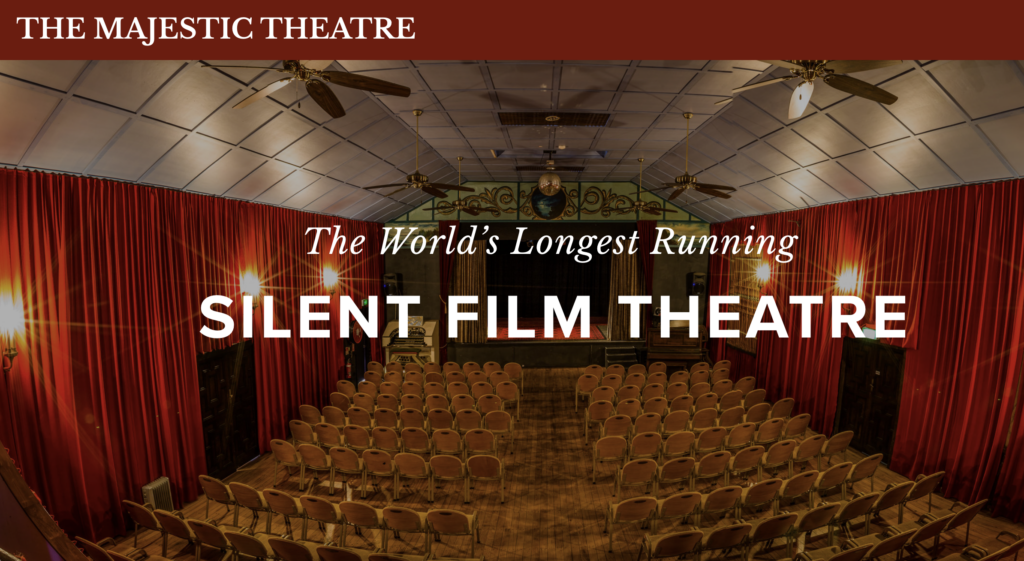
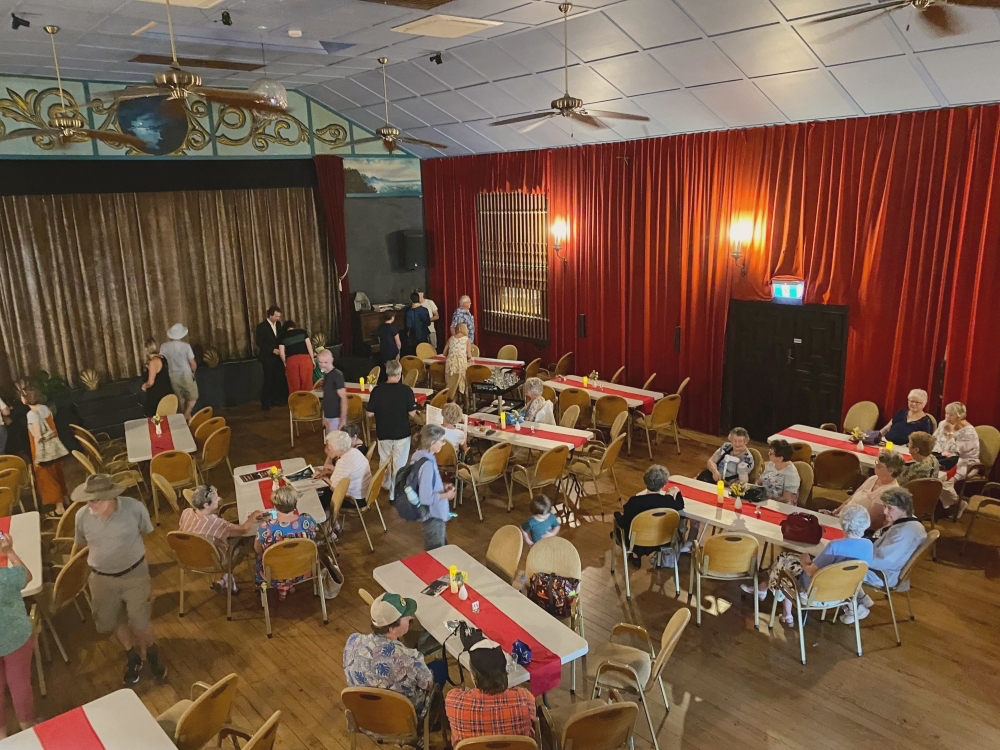
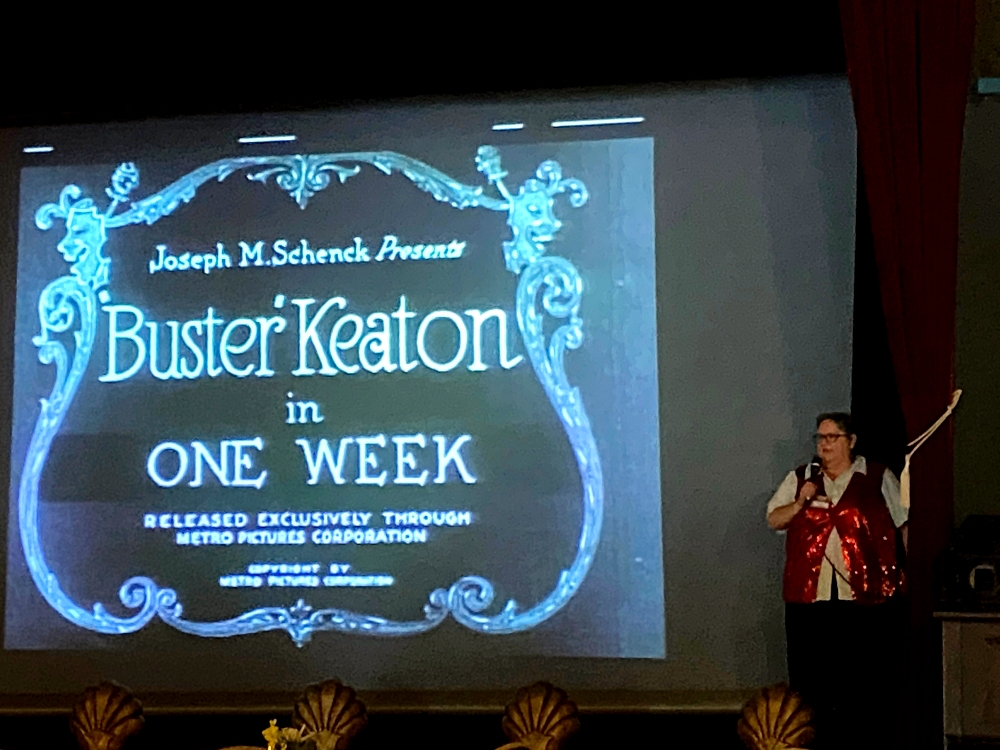
The Majestic Silent Theatre in Pomona, Sunshine Coast, Queensland, Australia was far from silent when movie goers were treated to two short movies, One Week and Haunted House, by the hilarious Buster Keaton who was famous for doing all his own stunts. The Theatre was originally built as a social hall with attached shops in 1921 and is the oldest authentic silent movie theatre in the world and the longest continuously operating movie theatre in Australia.
The hall was designed to serve several functions: to show silent movies, for vaudeville productions, and to act as a social centre for the town. Over time it served as a venue for dances, balls, concerts, and wedding functions, roller skating, boxing, and church services. Constructed of unseasoned milled hardwood, the hall was about 12 metres wide by 18 metres long, with seating for 198 people and included a sprung dance floor of ¾ inch crow’s ash timber and was raised on stumps to avoid flooding. On the left hand side was the Majestic Café, which also served as general store and the right hand side’s shop accommodated at various times a dentist, radio shop, and a mechanic. https://www.themajestictheatre.com.au
The theatre’s busiest period was during World War II, when a Tank Attack (anti-tank gun) Regiment was stationed near Pomona. The troops had priority for seats and local civilians were irate when they could not get in. Often people would watch from outside, standing in the middle of the road, which was the State’s main north to south highway. The theatre remained popular after the war, and throughout the 1940s to the 1960s films were shown on Wednesday and Friday evenings and Saturday afternoon, with a cartoon and two movies for four shillings and sixpence.
The electrical 1937 Compton organ is the only one in a Queensland theatre and comes from the Regal Cinema in South Shields, Chester England. The pipe chamber contains 1930s electrical organ switches from the Theatre Royal in Halifax. Three ranks of Christie pipes in the chamber were originally from a theatre in Dunedin, New Zealand, and were owned by a church in Sydney before they were acquired by West in 1985. Other ranks of pipes have been obtained, with the hope of eventually having 12 ranks. West did not just collect pipe organ parts – the timber organ grill that separates the organ room from the auditorium is made of Oregon pine, and comes from the Roxy Theatre in Parramatta. It took six and a half years to restore the organ and was launched on 6th July 2019. Stage drapes, furnishings and equipment were salvaged from the Regent, Wintergarden, Her Majesty’s theatres in Brisbane, and the Wintergarden in Ipswich.
Joseph Frank “Buster” Keaton (October 4, 1895 – February 1, 1966) was an American actor, comedian, and director best known for his silent film work, in which his trademark was physical comedy accompanied by a stoic, deadpan expression that earned him the nickname “The Great Stone Face”.Critic Roger Ebert wrote of Keaton’s “extraordinary period from 1920 to 1929” when he “worked without interruption” as having made him “the greatest actor-director in the history of the movies”. In 1996, Entertainment Weekly recognized Keaton as the seventh-greatest film director, writing that “More than Chaplin, Keaton understood movies: He knew they consisted of a four-sided frame in which resided a malleable reality off which his persona could bounce. A vaudeville child star, Keaton grew up to be a tinkerer, an athlete, a visual mathematician; his films offer belly laughs of mind-boggling physical invention and a spacey determination that nears philosophical grandeur.” In 1999, the American Film Institute ranked him as the 21st-greatest male star of classic Hollywood cinema.
‘One Week’ is the story of a newly-wed couple given a kit house as a wedding present and Buster Keaton and his long-suffering wife try to erect the house by following numbers on the boxes, except that a rejected suitor tries to foil their attempts. ‘Haunted House’ has Keaton as a bank teller whose manager and his gang are trying to pull off a bank heist and hide in an old house that has been booby-trapped to make it appear haunted. Both these short and silent features have the audience laughing uproariously. The movies may be silent but the audience isn’t.
1820 ca. Writing Box, English. Rosewood and brass inlaid writing box by William Dobson, The Strand, London. Makers label, gilded candle holders, ink wells. via antiques-atlas.com. Portable boxes for writing materials existed for many centuries but in the last decades of the 18th century socio-economic circumstances in England necessitated the wide use of a portable desk in the form of a box which could be used on a table or on one’s lap. Hence “Lap Desk”.
HN_13_D2D_WritingTools Book 13 What did the lady of the house use to pen notes? What sat on the desk of the man of the house when managing his accounts? #History #Nonfiction #travel books2read.com/SuziLoveWritingTools