1804 Royal Mint, Stamping Room, London, U.K. As Jane Austen would have known it. From Ackermann’s Microcosm of London by A.C. Pugin and Thomas Rowlandson.



1804 Royal Mint, Stamping Room, London, U.K. As Jane Austen would have known it. From Ackermann’s Microcosm of London by A.C. Pugin and Thomas Rowlandson.
1813 Yellow Redingote Or Coat, French. Hooded coat with gorgeous white trim, yellow boots, yellow velvet bonnet with a white plume. Jane Austen and her female family and friends wore fashions like these. Fashion Plate via Journal des Dames et des Modes, or Costume Parisien.
Redingote, or Pelisse, or Walking Dress, or Promenade Dress: Going by many names, this is a coat copied from men’s overcoats but worn by both men and women. Generally, opens down the front, worn for warmth over a dress or coat and breeches, and has a military look with front vertical buttoning or decoration. Called a Redingote in French periodicals but English magazines called them by many other names: pelisse, carriage dress, walking dress, promenade costume.

19th Century Brass Travelling Inkwell and Quill Holder, Turkey. Carried by scribes as they travelled from one settlement to another and carried these held in their belts. Would have come from Turkey. The type of inkwell that travellers in Jane Austen’s times might have carried for writing letters when away from home. Many of these exotic and decorative items were brought to England by gentlemen doing their Grand Tour through Europe and Asia.via Ruby Lane Antiques.


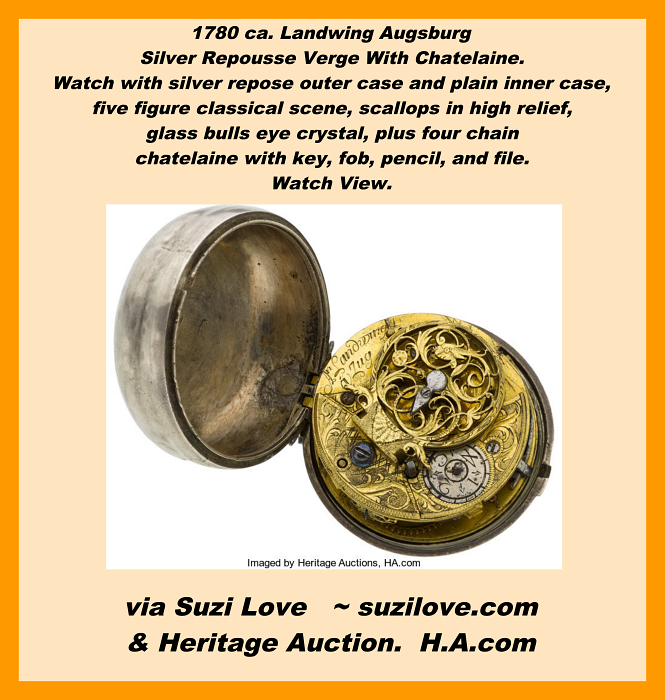
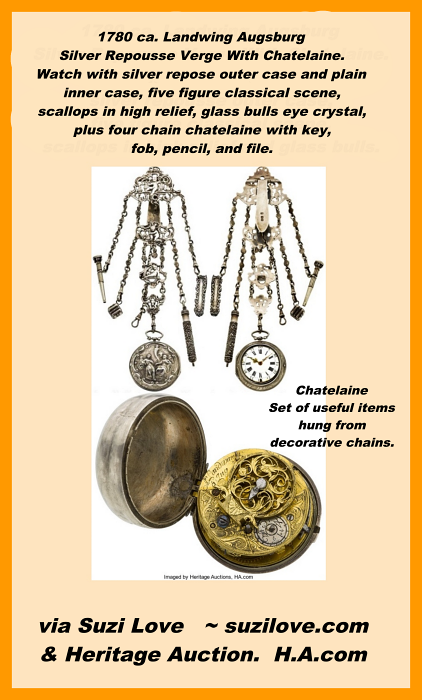
1780 Watch on a Chatelaine, Germany. Silver Repousse Verge With four chain chatelaine. via Heritage Auction H.A.com.
Definition Chatelaine: The word Chatelaine is French and means the keeper of the keys. Chatelaine” derives from the Latin word for castle. In Medieval times, the chatelaine was in charge of the day-to-day running of the castle. What did a chatelaine do? Most important task was keeper of the keys. Also ordered supplies, did bookkeeping, supervised servants, taught castle children, and organized guests. books2read.com/SuziLoveChatelaines
What were chatelaines used for?



1810-1820 ca. Pantaloons, Probably Military, British. The type of pants worn by men in Jane Austen’s times when wars were being fought all over the world, especially in Europe. Machine-knitted white cotton decorated with cream silk braid on sides and fronts as seen on Hussar uniforms. Cut to fit the leg and button bottom at waist with three buttons. Front fall buttons over five buttoned fly, two horizontal pockets at front below waistband and fob pocket in waistband. Four metal buttons for braces, two front and two back. Cotton ‘puff’ centre back waist and two linen tapes for waist adjustment. via Victoria and Albert Museum, London, UK. collections.vam.ac.uk.
Pair of men’s pantaloon trousers made of machine-knitted white cotton and decorated with cream silk braid applied down the sides and on the fronts. This imitates the hussar uniforms of the period and appeared on fashionable men’s dress. The pantaloons are cut to fit the leg and button at the bottom with three buttons. The pantaloons fasten at the front with front falls buttoning over a five buttoned fly. There are two horizontal pockets at the front below the waistband and a fob pocket in the waistband. There are four metal buttons for braces, two at the front and two at the back. These probably are original. There is a cotton ‘puff’ at the centre back waist and two linen tapes for waist adjustment.
Pantaloons also brought the glamour of military uniform into men’s fashionable dress, especially when teamed with Hessian boots. Uniforms worn by the various armies during the Napoleonic Wars (1793-1815) were often very colourful and lavishly adorned with braid and tassels. It is hardly surprising that some of these attractive trimmings should have infiltrated fashion, particularly when nationalistic feelings ran high. Civilian pantaloons were often ornamented with military-style braid that was applied in a vertical band of topside Russia braiding. They were not, however, generally decorated on the front, which suggests that this pair was for military use. The silk braid is applied in the form of an Austrian knot, which was a popular motif on pantaloons of the light cavalry such as the hussars and light dragoons.


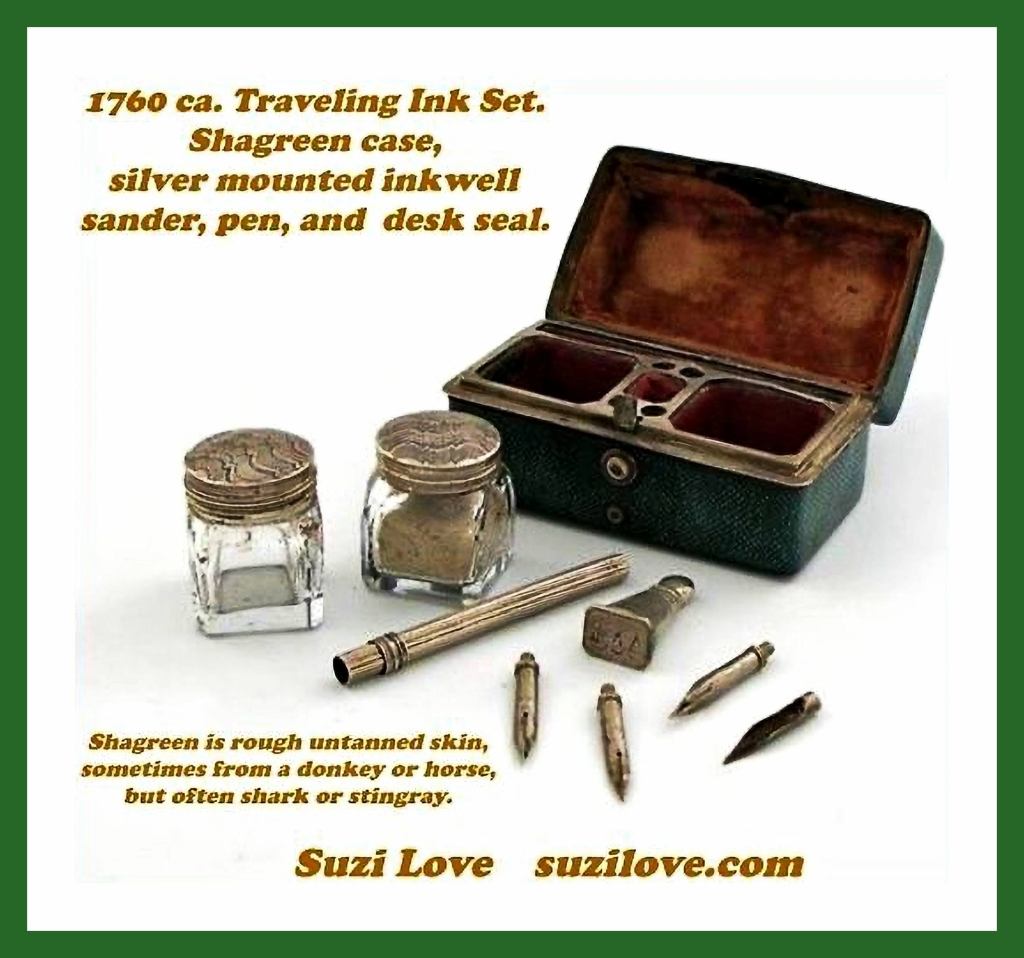
1760 ca. Traveling Ink Set. Rectangular Shagreen case with hinged cover which opens to reveal an unmarked silver mounted inkwell and sander, a pen, and a desk seal.
Definition Shagreen: Type of rough untanned skin, sometimes made from a donkey or a horse, but often from a shark or a stingray.

1800 North Side Of Cavendish Square, London, U.K. By Thomas Malton (1748-1804) British. Aquatint of the north side of the square. (PD-Art)

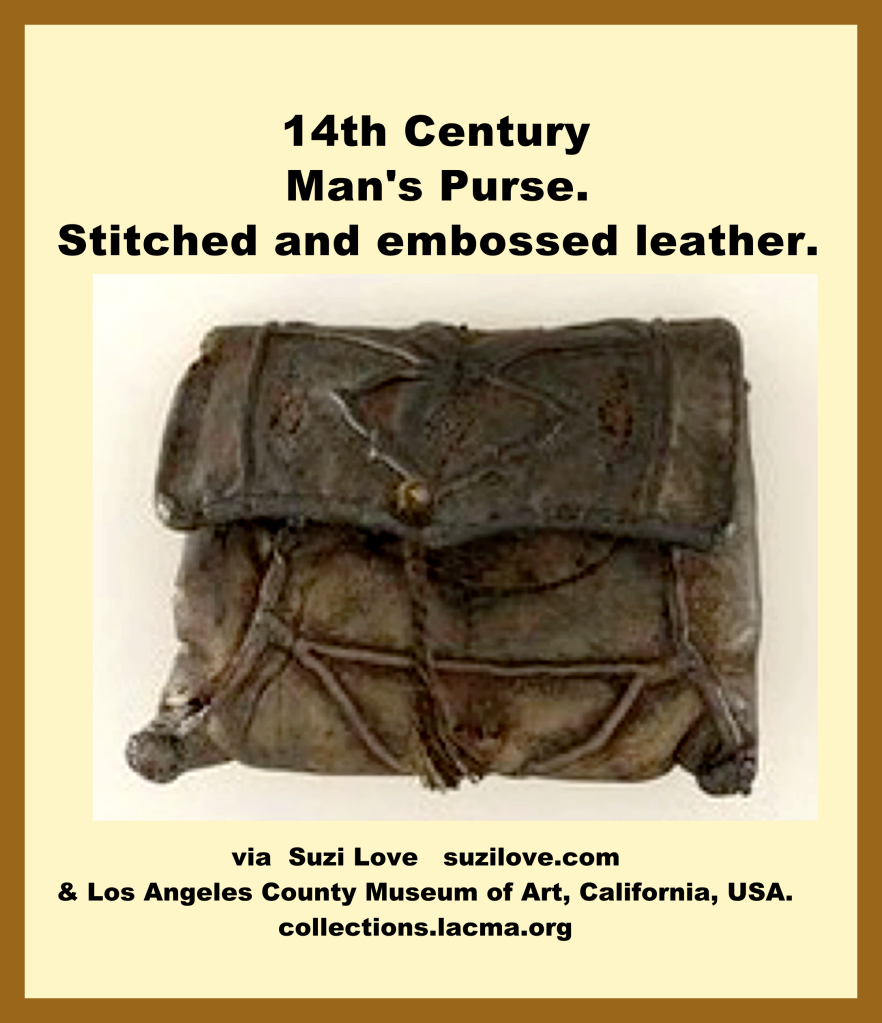
14th Century Man’s Purse. Stitched and embossed leather. via Los Angeles County Museum of Art, California, USA. collections.lacma.org

1801 November 9th Playing Cards. Men and women play cards at round table. Supreme Bon Ton Plate 2. Published by S W Fores. Men and women play cards at round table. Man and woman talk to players. Woman sleeps in upright chair, two others, one with parasol and other fan, walk off arm-in-arm.Men: High-waisted coats, high collars, huge neck-cloths, with pumps or Hessian boots. Women: High-waisted dresses, short sleeves, long trains, very low necklines, short ringlets, two in caps. Via British Museum, London, UK. britishmuseum.org (PD-Art)
In Jane Austen’s times, cartoons posted in the windows of shops were one of the main ways people found news. Common people couldn’t afford newspapers so cartoonists ridiculed the people and the places with cartoons of the daily events happening in London and other cities. The ridiculous fashion trends of the late 1700s and early 1800s were easy targets for satirical cartoons as was the addiction to gambling by women and men alike.

“It is particularly incumbent on those who never change their opinion, to be secure of judging properly at first.” Jane Austen Pride and Prejudice (1813) .#JaneAusten #Regency #Quote