1827 ca. Gentleman’s Dressing Box, London. Mahogany box with brass carrying handles, lid opens to velvet and leather interior with twelve engraved silver topped bottles, all with an engraving of an oak tree engraving, ivory handled cut throat razors, scissors, boot pulls, tongue scraper, section for letters etc. Top tray lifts out to another tray of tools. via Antique Tea Caddies, U.K.
1827 ca. Mahogany Gentleman’s Dressing Box With Silver Topped Bottles, London. #RegencyEra #Antiques #London books2read.com/suziloveBoxesCases
HN_11_D2D_Craftsmen created containers of precious metals, leather, silks, and decorated them with jewels to make exquisite and expensive items as well as practical carrying cases. books2read.com/suziloveBoxesCases
Craftsmen created containers of precious metals, leather, and silks and decorated them with jewels and engraving. Jane Austen and her contemporaries would have used writing boxes, linen boxes when travelling, boxes to hold their food and drink supplies while traveling by carriage, and decorative boxes to keep letters, ribbons, gloves, hairpins etc. Boxes, Cases, and Necessaires By Suzi Love, History Notes Book 11. books2read.com/suziloveBoxesCases.
HN_11_Craftsmen created containers of precious metals, leather, silks, and decorated them with jewels to make exquisite and expensive items as well as practical carrying cases. books2read.com/suziloveBoxesCases
Jane Austen and the Bridgerton family used boxes of metal, leather, or silks, decorated with jewels and engraving. #Bridgerton #Travel #JaneAusten #RegencyEra #Antiques books2read.com/suziloveBoxesCases
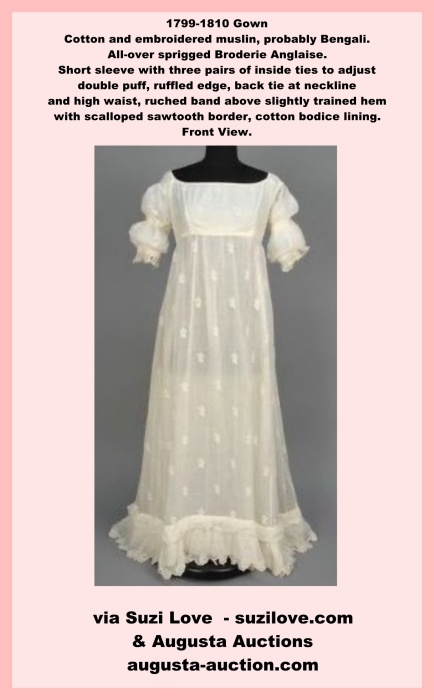
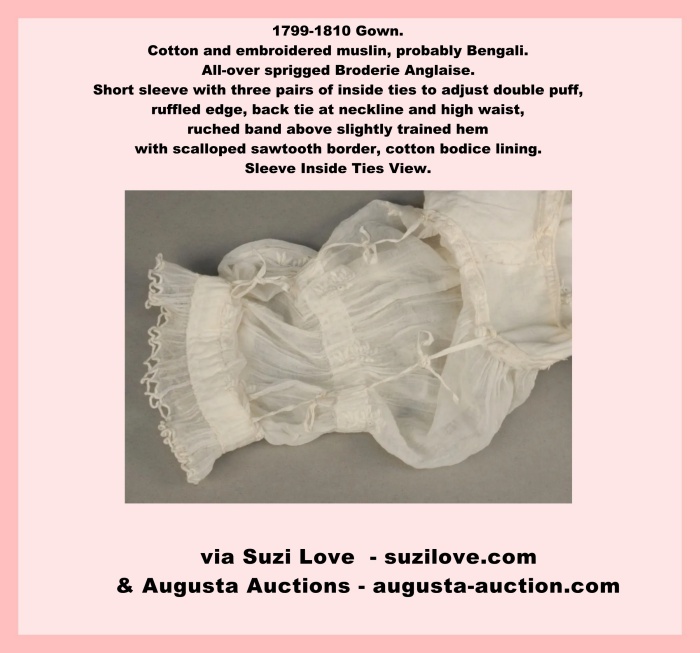
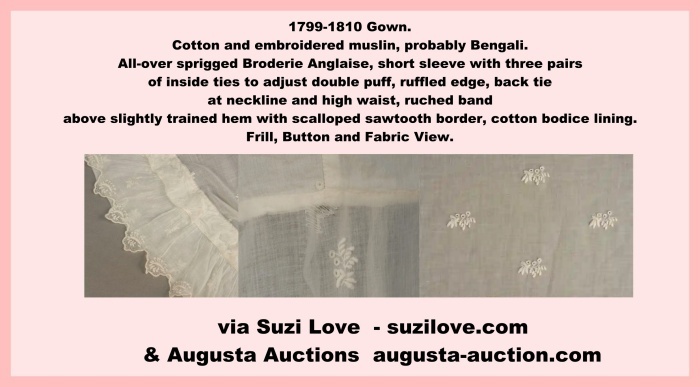
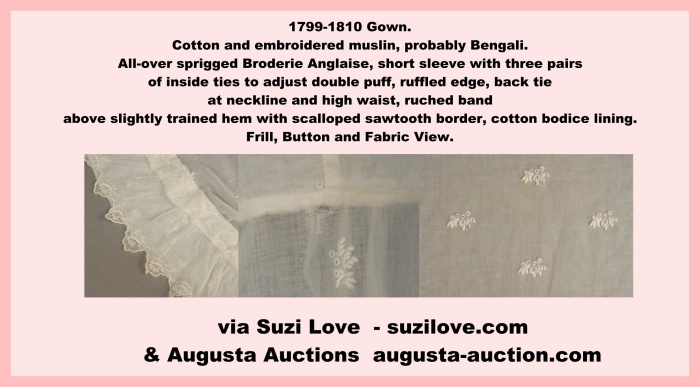
1799-1810 ca. Cotton Muslin Gown, Probably American. White cotton embroidered muslin, probably Bengal, all over sprigged broderie anglaise decoration,short sleeve with three pairs of inside ties to adjust the double-puff, ruffled edge, back tie at neckline and waist, ruched band above the slightly trained hem with scalloped sawtooth border and with cotton bodice lining. via whitakerauction.smugmug.com
These lightweight white cotton dresses were fashionable in Jane Austen’s times, but they were certainly not warm when a lady was out walking or when riding in a carriage. Numerous outer layers could be added for warmth and to brighten and personalize an outfit. These might be an overdress, pelisse or redingote, hat, shawl, gloves, or large fur muff.
The Empire dress which evolved in the late 1790s began as a chemise shift gathered under the breasts and at the neck. Named after the First Empire in France, by 1800 Empire dresses had a very low décolleté, or neckline and a short narrow backed bodice attached to a separate skirt. Skirts started directly under the bust and flowed into the classical relaxed wide styles of Greece and Rome. This style of dress is associated with Jane Austen and her contemporaries as a simple cotton high-waisted dress was worn most days and accessorized according to the importance of the occasion.
1799-1810 ca. Jane Austen Style White Cotton Muslin Dress With Sprigged Broderie Anglaise. #RegencyFashion #JaneAusten #GeorgianFashion books2read.com/SuziLoveFashionWomen1800
Spencers Or Regency Jackets By Suzi Love. History Notes Book 4. What was fashionable for outer wear in past centuries? Call them what you like: Spencers, short jackets, or Regency jackets were very popular. Take a look at the jackets being worn by women in the early 1800s or the times of Jane Austen. books2read.com/suziloveSpencers
Definition: Spencer – Short, bodice hugging, usually long sleeved, outer jacket. For warmth and for fashion.
Definition Caroline Spencer: Worn during the Directoire and First Empire (1790-1815 C.E.). Spencer with pelerine cape that was made of white kerseymere and trimmed with light blue satin cut on bias.
Spencers were short jackets cut to match the high waistlines of Empire dresses. They often copied military styling, such as braiding, shoulder decoration, buttons and loop fasteners, and wrist adornments. They were generally of complex construction, often with a diamond shaped piece in the back.
Take a Look at Spencers, or Jackets Worn By Women In Bridgerton and Jane Austen’s Times, or Early 1800s. #Bridgerton#RegencyFashion #HistoricalFashion #History books2read.com/suziloveSpencers
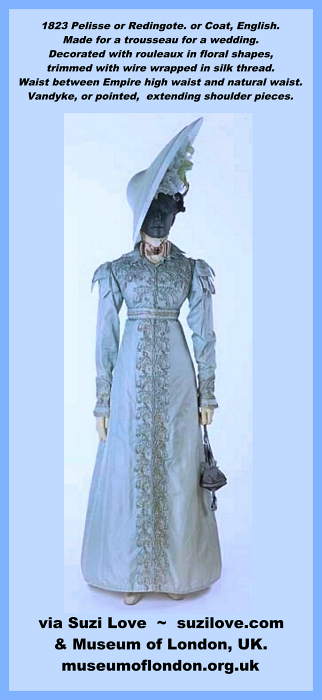
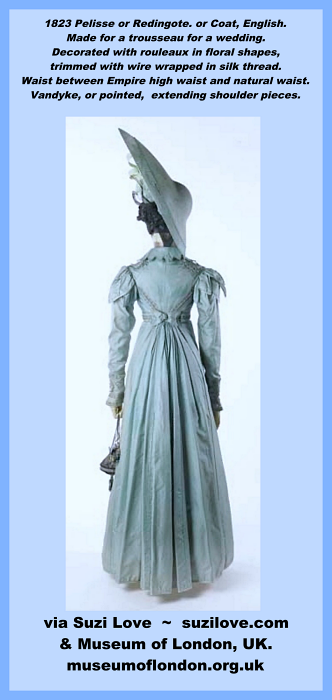
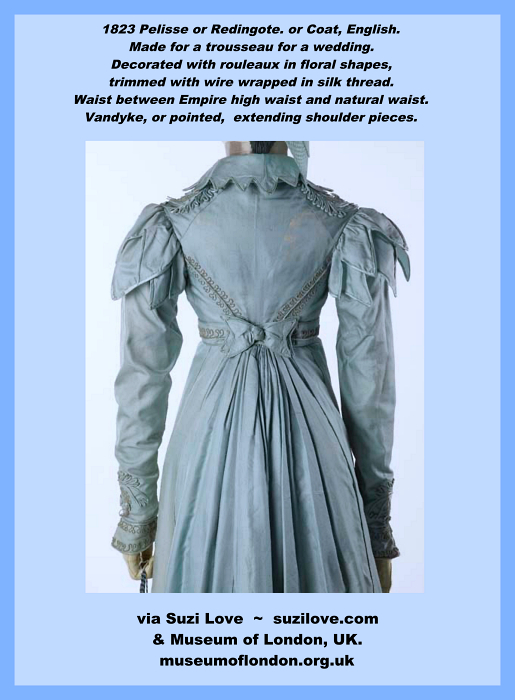
1823 Pelisse or Redingote or Walking dress, or Coat, English. Made for a wedding trousseau in 1823. Intricate decoration from rouleaux applied in floral shapes, and trimmed with wire wrapped in silk thread which stands out from the garment in loops at the ends. ‘Vandyke’ style of pointed shoulder pieces were fashionable at the time. Via Museum Of London, UK.
Definition Redingote Or Pelisse Or Walking Dress Or Coat: French word developed from English words, riding coat. Long fitted outdoor coat worn over other garments for warmth. Often left open at the front to show off the dress underneath. Sometimes cut away in front. Originally made with several capes and trimmed with large buttons. French fashion plates call these coats Redingotes and they are designed for women, men and children. English fashion plates call them a Pelisse, a walking dress, Promenade dress, or Carriage dress. books2read.com/suzilovePelisse
Definition Vandyke: Edging of v-shaped points, the name coming from the Flemish painter, Sir Anthony Vandyke, who was known for his short pointed beard.
1823 Blue Pelisse Or Redingote, British. Made for a trousseau for a wedding. via Museum of London.1823 Blue Pelisse Or Redingote, British. Made for a trousseau for a wedding. via Museum of London.1823 Blue Pelisse Or Redingote, British. Made for a trousseau for a wedding. via Museum of London.1823 Blue Pelisse Or Redingote, British. Made for a trousseau for a wedding. via Museum of London.1823 Blue Pelisse Or Redingote, British. Made for a trousseau for a wedding. via Museum of London.1823 Blue Pelisse Or Redingote, British. Made for a trousseau for a wedding. via Museum of London.1823 Blue Pelisse Or Redingote, British. Made for a trousseau for a wedding. via Museum of London.1823 Blue Pelisse Or Redingote, British. Made for a trousseau for a wedding. via Museum of London.1823 Blue Pelisse Or Redingote, British. Made for a trousseau for a wedding. via Museum of London.
1823 Blue Silk Pelisse, or Coat, Decorated With Rouleaux and Vandyke Points. #RegencyFashion #Pelisse #RomanticEra books2read.com/suzilovePelisse
1817 Pink Morning Walking Dress, French. High-waisted,high frilled neckline, long straight sleeves, triple layer of frills above the hem, bonnet with plumes, or feathers to decorate, and tied under the chin with pink ribbon, pink shoes and gloves. Most likely has white muslin dress with the white neck frill underneath the dress. Fashion Plate via Journal des Dames et des Modes, or Costume Parisien.
Definition Morning Walking Dress: Worn out shopping, walking in a city park or the country estate. Presentable and warm, more fashionable than Morning Dress but not overly accessorized.
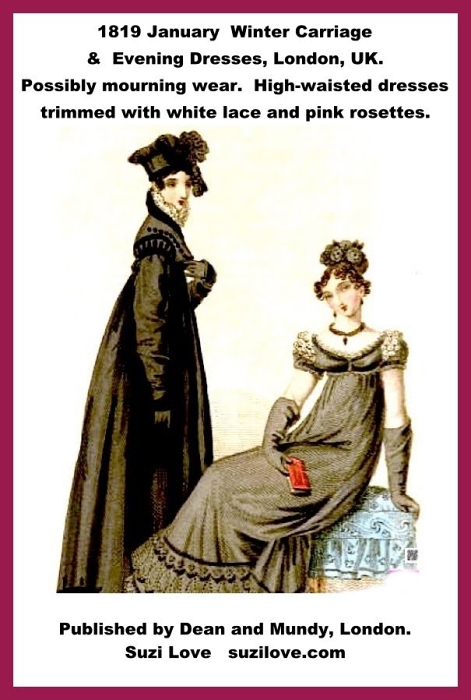
1819 January Two Fashion Plates By Dean and Mundy For Mourning: Winter Carriage and Evening Dresses. High-waisted carriage dress, cuffs edged with white lace and trimmed with gray frog closures, matching plumed hat and shawl. Empire style evening dress with short sleeves and wide neckline trimmed with scallops of white lace, skirt trimmed with white rosettes, evening upswept hairstyle. Fashion Plates Published by Dean and Munday, 1819, London.
Mourning wear was worn in Britain during the regency Era, firstly for Princess Charlotte who died in England on November 6th, 1817, or then for Queen Charlotte, wife of King George III and grandmother of Princess Charlotte, who died on November 17th, 1818. All the fashion magazines featured numerous outfits in black suitable for mourning, followed by many for half mourning in colors of grey, black with touches of white, and later mauve or lavender.
Black was worn for full mourning with various other colors were worn during the months of half mourning, including grey and mauve. However, as black dresses, black tunics, and black lace shawls were popular throughout the Regency years, it is often hard to decide what was definitely made for mourning and what was simply fashionable wear.
After the death of H.R. H. Princess Charlotte on November 7th, 1817, official court mourning was ordered. ‘The ladies to wear black bombazines, plain muslin or long lawn crape hoods, shamoy shoes and gloves, and crape fans. The gentlemen to wear black cloth without buttons on the sleeves or pockets, plain muslin or long lawn cravats and weepers, shamoy shoes and gloves, crape hat bands, and black swords and buckles.’ Two months later, a change of mourning attire was ordered.
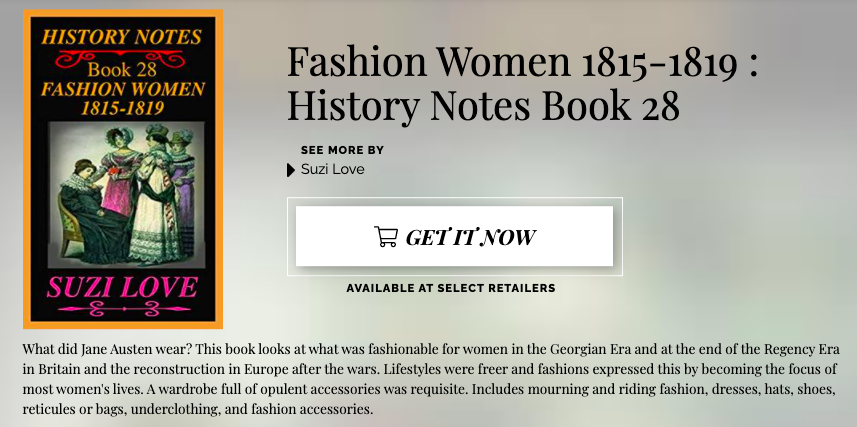
1819 January. Winter Carriage and Evening Dresses. High-waisted carriage dress, cuffs edged with white lace and trimmed with gray frog closures, matching plumed hat and shawl. Empire style evening dress with short sleeves and wide neckline trimmed with scallops of white lace, skirt trimmed with white rosettes, evening upswept hairstyle. Mourning wear for Princess Charlotte who died in England in 1817 or for another member of the Royal family. Fashion Plate Published by Dean and Munday, London. 1819 January. Winter Carriage and Evening Dresses, London, U.K. High-waisted carriage dress, trimmed with front closures, matching plumed hat. Empire style evening dress with tiny sleeves and wide neckline trimmed with white lace on sleeves, skirt trimmed with rows of frills. Fashion Plate Published by Dean and Munday, 1819, London.
1819 January Mourning Winter Carriage and Evening Dresses in Bridgerton years. #Bridgerton #RegencyFashion #Mourning #HistoricalFashion https://books2read.com/SuziLoveFashionWomen1815-1819
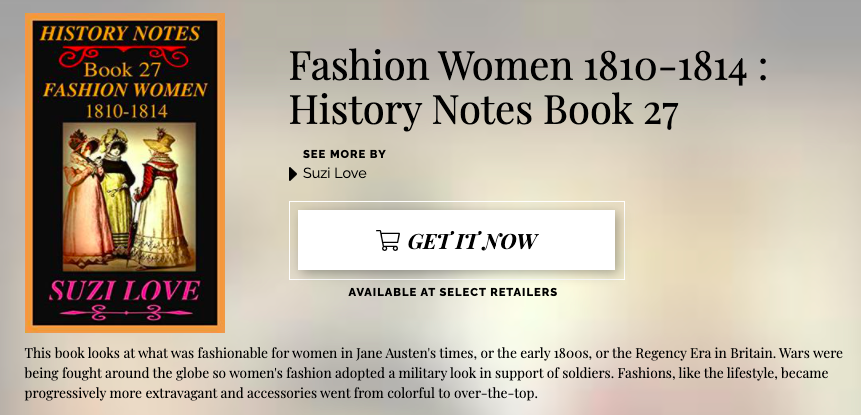
What was fashionable for women in Jane Austen’s times? Mourning, riding, daytime, evening clothing, plus underclothing, corsets and accessories. Fashion Women 1810-1814 History Notes Book 27 This book looks at what was fashionable for women in Jane Austen’s times, or the early 1800s, or the Regency Era in Britain. Wars were being fought around the globe so women’s fashion adopted a military look in support of soldiers. Fashions, like the lifestyle, became progressively more extravagant and accessories went from colorful to over-the-top. https://books2read.com/SuziLoveFashion1810-1814
The Lady’s Magazine said of the basis of women’s fashion that was popular for the first twenty years of the 1800s, ‘White is still the prevailing color for robes. For morning dresses, linen gowns, in large diamonds or squares, are fashionable. Indian muslins, plain or embroidered, are preferred to Florence and satins. The designs of embroidery for shawls are of infinite variety. Long gloves, which reach above the elbow, are not yet laid aside. Medallions are hung around the neck from crossed chains and some of these medallions are shaped like the bags, called ridicules. These reticules are of the lozenge or hexagon shape, with a small tassel at each angle. Reticules, or ridicules, are in lozenge or hexagon shapes with a small tassel at each angle. In capotes, or hats, and ribbands, the violet and dark green prevail over jonquil. Bracelets in hair, pear-shaped ear-rings, medallions on square plates, saltiers of colored stones, are still in fashion.’
These are the types of outfits worn by Jane Austen and contemporaries in English magazines, where French fashions were obsessively copied despite the two countries being at war for many years. In Jane Austen’s years, she and her contemporaries spent a lot of time walking outdoors. People were encouraged to partake in outdoor pursuits to maintain good health. Fragile slippers were worn for balls and evening events but for walking sturdier shoes were needed, In the early 1800s, these were typically made of leather, had a very small heel, slightly rounded toes and were laced up on the top.
What was fashionable in Bridgerton and Jane Austen’s times? Mourning, riding, daytime, evening fashion plus underclothing. #Bridgerton #JaneAusten #RegencyFashion https://books2read.com/SuziLoveFashion1810-1814
Are you a reader or writer of Regency Romance? Love Jane Austen’s books? Want to know more about the mourning, riding, underclothing and other Regency Era women’s fashions in Regency romances? What was fashionable for women in Jane Austen’s times? Mourning, riding, daytime, evening clothing, plus underclothing, corsets and accessories. This book looks at what was fashionable for women in Jane Austen’s times, or the early 1800s, or the Regency Era in Britain. Wars were being fought around the globe so women’s fashion adopted a military look in support of soldiers. Fashions, like the lifestyle, became progressively more extravagant and accessories went from colorful to over-the-top.
Love Bridgerton and Jane Austen fashions? Mourning, riding, daytime, evening fashions plus corsets and underclothing. #Bridgerton #JaneAusten #RegencyFashion https://books2read.com/SuziLoveFashion1810-1814
1808 Silver Wax Jack, Irish. By Robert Breading (active 1775–1822) Dublin. via suzilove.com and Metropolitan Museum New York City, U.S.A. metmuseum.org
How did Jane Austen seal her letters? Wax was melted by lighting the tip of a coiled wax length. This is called a wax jack. The melted wax blob was placed on the outside of a letter or document. A personal desk seal or a fob seal was pressed into the wax to identify the sender or owner of the document. Aristocrat families had their own coat of arms and others may have had their initials or their name on the seal.
How did Jane Austen seal her letters? 1808 Silver Wax Jack With Coil Of Red Wax, Irish. #JaneAusten #RegencyEra #writing #postal books2read.com/SuziLoveWritingTools
HN_13_D2D_WritingTools Book 13 What did the lady of the house use to pen notes? What sat on the desk of the man of the house when managing his accounts? #History #Nonfiction #travel books2read.com/SuziLoveWritingTools