1800s Typical Puddings and Pastries.These are the sort of puddings and pastries Jane Austen’s family would have eaten on a regular basis during the early 1800s, or Regency Era. Open Apple Tart, Galette, Apricot Fritters, Pancakes and Apricot Jam, Charlotte Russe, Macaroni Cheese, Cherry Tart, Mince Pies, Almond Puddings, Tartlets, Compote Of Fruit, Fruit Pudding, Fruit Tart, Christmas Plum Pudding, Milk Pudding and Roly Poly Jam Pudding. From: 1850s- 1860s Mrs. Beeton’s Books of Household Management. via Google Books (PD-150). 1800s Typical Puddings and Pastries Served In Households Like Jane Austen’s. https://books2read.com/suziloveOLD
Why shouldn’t Lady Lillian take the chance of a night’s fun and freedom, hidden from high-society an out of reach of the duke’s continual criticisms? She’d lost enough of her life while married to a man who didn’t deserve either her patience or her fortitude. Starting tonight, she’d take control of herself and rebirth the confident and happy person that only appeared now when she was staying at her father’s country estate.
She’d been excited about this night for weeks and she’d no intention of running away before she’d explored and widened her experience, though only visually. Not even if Brenton threatened to expose her, or worse, visit her father and reveal where she’d been. Stiffening her spine, she took Brenton’s hand and, after muttering a quick apology to her cluster of admirers, led him straight to one of the balcony doors. She didn’t stop until they were in a darkened section of the balcony where no one could overhear their conversation.
She dropped his hand and turned to lean on the veranda rail and stared out at the garden. ‘What are you doing here?’ She spoke without turning to face him, both mortified and terrified that he’d discovered her here.
‘Michael dragged me here.’ He caught her wrist and tugged her around to face him. ‘Who is that woman you are with? Did she bring you here?’ He ran his hand through his hair, trying to calm himself and dampen down his anger. ‘Of course she brought you here. You wouldn’t have known to come to a place like this otherwise. Did she coerce you in some way?’
Lillian chuckled. ‘Do you truly believe me such an innocent that I don’t know the location of brothels or the estate houses that hold balls where the main guests are ladies of the night? I’m not that naïve, Brent. When I was a married woman, the other married ladies spoke constantly about the state of their marriages. Those conversations included such things as where their husbands, fathers, or brothers went to visit paid women, and what happened in those places.’ She snorted. ‘They’d no idea that my own marriage was so dismal that the only times my husband touched me in bed was those rare occasions when he remembered he was supposed to breed a son and so made an appointment for the next night to visit my bedchamber. Even during those ten dreadful minutes he spent with me, he never thought to explain what happened between a man and a woman, or about how children were conceived. My mother, the duchess, gave me a one sentence explanation on my wedding day of how to act with my husband and the need to create a child, but she unfortunately never gave me the information I needed about what physical intimacy entailed, so the first time my husband lifted the hem of my night dress, I panicked.’
1814 Jane Austen, Mansfield Park. “Give a girl an education and introduce her properly into the world, and ten to one but she has the means of settling well, without further expense to anybody.”
1814 Jane Austen, Mansfield Park. “Give a girl an education and introduce her properly into the world, and ten to one but she has the means of settling well, without further expense to anybody.”
“Happiness in marriage is entirely a matter of chance.” #JaneAusten #Regency Jane Austen’s Pride and Prejudice (1813)
“Happiness in marriage is entirely a matter of chance.” #JaneAusten #Regency
Jane Austen’s Pride and Prejudice (1813) HN_27_D2D_fashwomen1810-1814
https://books2read.com/SuziLoveFashion1810-1814
Love After Waterloo by Suzi Love. Despite Wellington’s victory over Napoleon four days earlier, soldiers, to use the term loosely, still lingered around Waterloo. They and deserters from both sides had joined local famers in picking through the remains of bodies, uniforms, and armory to pilfer anything of value. There’d been nowhere safe to hide her and her son, Daniel, so Lady Melton’s’ brothers had packed what remained of their equipment and taken them, along with a few wounded British soldiers, to the Captain’s quarters, knowing that his orders were to protect whoever remained of French stragglers and deserters.
Anne’s twin brothers hadn’t lingered, because Wellington and what was left of his British troops were marching back towards Brussels and Brendon’s skills as a physician were urgently needed. Benjamin, an aide to Wellington, had stayed to organize the repatriation of their soldiers and the departure of their sister and nephew. Neither twin had understood her reluctance to join Captain Belling and his group and had ignored her pleas to stay with them in Europe, stating firmly that it was time that she and Daniel returned to London.
They hoped that Anne could reopen their townhouse in London and prepare for when they could join her, optimistically within a few weeks. She wasn’t quite so optimistic. Napoleon was an egotist. He wasn’t the type to accept defeat easily, and she imagined he’d already be making plans for a triumphant return in the future, despite the carnage left behind at Waterloo when he and his remaining troops retreated. Her brothers had reported that the plains had been covered with the dead and the dying, both men and horses.
“There is a stubbornness about me that never can bear to be frightened at the will of others. My courage always rises at every attempt to intimidate me.” Jane Austen Pride and Prejudice (1813) #JaneAusten #RegencyEra #Quote https://books2read.com/SuziLoveFashion1810-1814
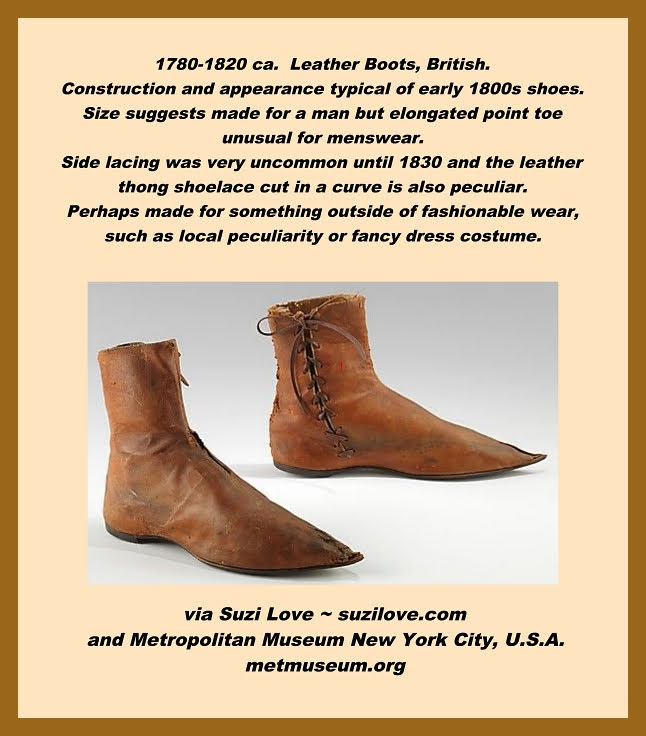
1780-1820 ca. Brown Leather Boots, British. Construction and appearance typical of early 1800s shoes. Size suggests made for a man but elongated point toe unusual for menswear. Side lacing was very uncommon until 1830 and the leather thong shoelace, cut in a curve, is also peculiar. Perhaps made for something outside of fashionable wear, such as local peculiarity or fancy dress costume. via Metropolitan Museum New York City, U.S.A. metmuseum.org
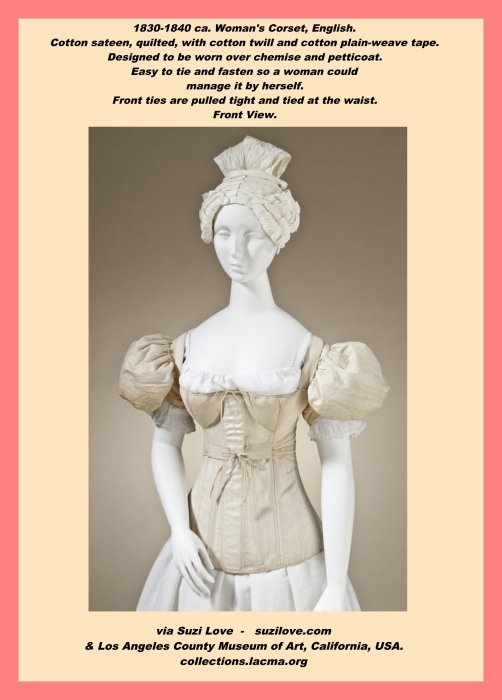
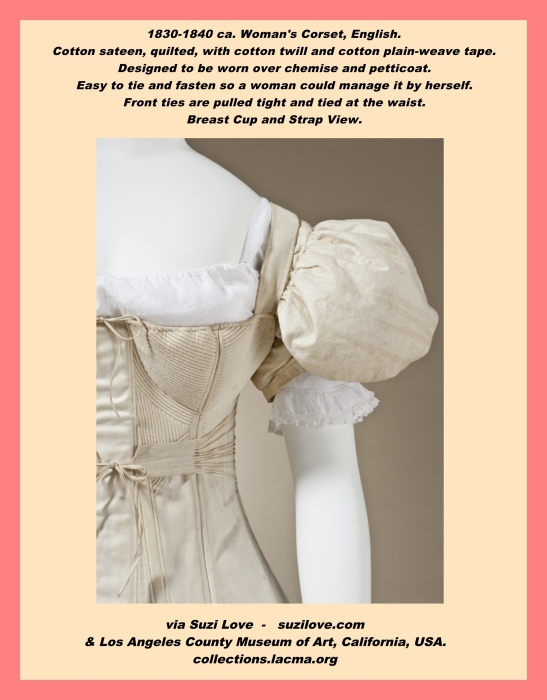
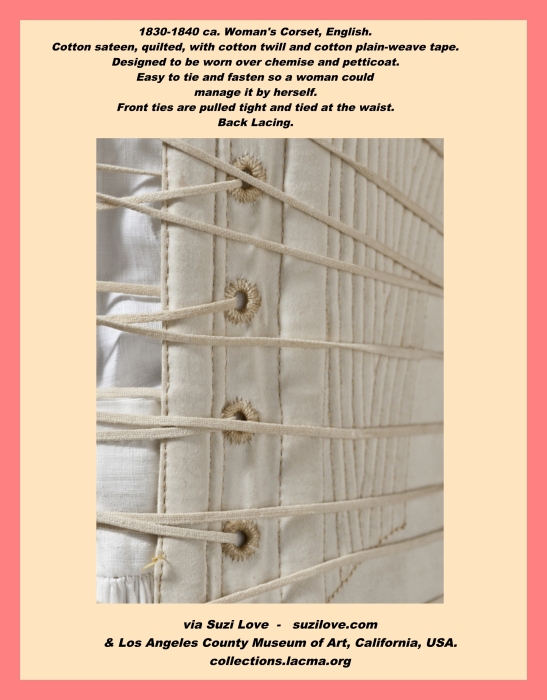
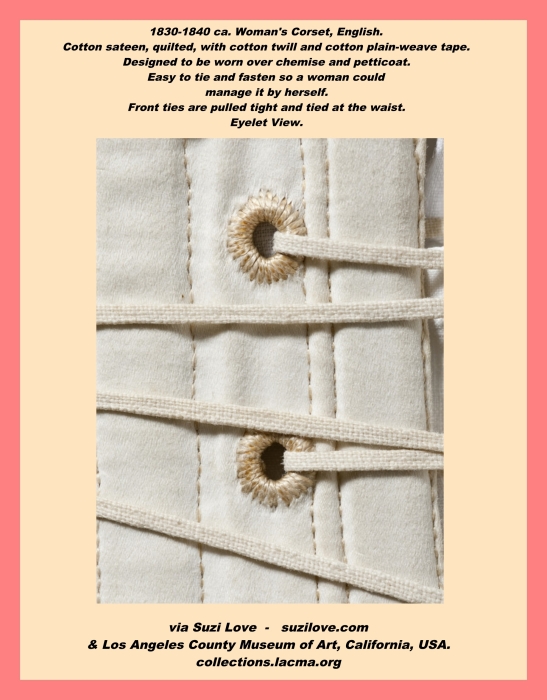
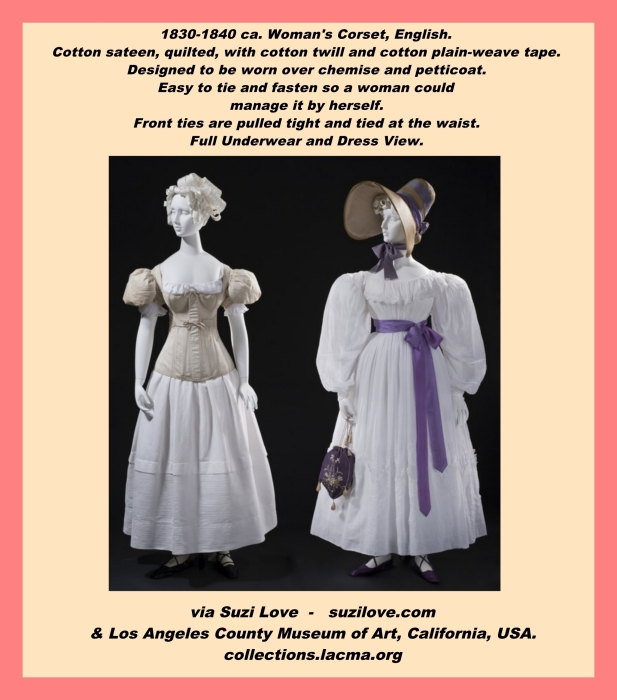
1830-1840 ca. Woman’s Corset, English. Cotton sateen, quilted, with cotton twill and cotton plain-weave tape. Designed to be worn over a chemise and petticoat. This corset is designed to be easy to tie and fasten so a woman could manage it by herself. The front ties are pulled tight and tied at the waist. Center back length: 15 7/8 in. (40.32 cm) via Los Angeles County Museum of Art, California, USA. via Los Angeles County Museum of Art. via Los Angeles County Museum of Art, California, USA.
. 1830-1840 ca. Woman’s Corset, English. Cotton sateen, quilted, with cotton twill and cotton plain-weave tape. Designed to be worn over a chemise and a petticoat. This corset is designed to be easy to tie and fasten so a woman could manage it by herself. The front ties are pulled tight and tied at the waist. Center back length: 15 7/8 in. (40.32 cm) via Los Angeles County Museum of Art, California, USA. HN_18_D2D_Corsets 1830-1850. https://books2read.com/SuziLoveCorsetBook18
1813 April Carriage Dress, English. Green coat over white Empire style dress of jaconet or cambric muslin, plaited bodice, long sleeve, deep frill, with a vandyke of needle-work. Russian mantle is made of Pomona or spring green sasnet, lined with white satin, trimmed with a rich frog fringe and closed with a cord or tassel. Close-fitting cottage slouch bonnet of the same material and edged with scalloped lace, tied on the left under the chin with ribbon, and decorated with a small cluster of spring flowers. Reticule, or bag, of the sam fabric, slippers of green kid, and gloves of primrose kid. Fashion Plate via Rudolph Ackermann’s ‘The Repository of Arts’.