↓
 

Suzi Love

Making history fun, one year at a time.

Header_
  • Home
  • Newsletter
  • Pre order form
  • Shop
    • Cart
    • Checkout
    • My account
    • Refund and Returns Policy
  • Blog
  • BOOKS
    • History Events
    • Kelly’s Justice
    • Outback Arrival
    • Irresistible Aristocrats
    • History Notes
    • Scandalous Siblings
    • Love After Waterloo
    • Regency Life Series
  • Privacy Policy
  • EVENTS
Home » England » Page 53 << 1 2 … 51 52 53 54 55 … 62 63 >>

Category Archives: England

Post navigation

← Previous Post
Next Post→

1700-1800 ca. Women’s Pockets With Waist Ties. #Georgian #Regency #JaneAusten #Underclothing

Suzi Love Posted on May 29, 2024 by Suzi LoveMay 29, 2024

From 1700 until the early 1800s, pockets with waist ties were worn by women to keep essential items on their person. Generally of linen or some other cotton fabric, they were often quilted, or embroidered and gifted or handed down to others. In the 18th century, women’s pockets were not sewn into their gowns. Instead they were attached to a tape and tied around the waist as separate garments. Worn under the hoops and petticoats, they were accessed through openings in the gown and petticoat seams. By the early 1800s, round gowns were both flowing and almost transparent so pockets could no longer be worn under dresses, so ridicules, or bags, or reticules were carried instead. Jane Austen and her female friends and family would have worn pockets under their out layers.

From the Curator Victoria and Albert Museum, London: Quilting was a popular form of decoration for a variety of garments including pockets. However, hand-quilting was a time-consuming method of decoration. The increased demand for quilted petticoats, waistcoats and pockets led to the invention of woven quilting.

1700-1725 ca. Pair of Linen Twill Women’s Pockets With Crewel Embroidery and Waist Ties, British. Embroidered in yellow, green and pink worsted thread with chain and stem stitches, design of flower pot with flowering plant, bound with green worsted tape and sewn to linen tape tie. Designs are similar but not identical, suggesting both hand-drawn and possibly work of an amateur. Pockets may have been handed down to another person who found them too small as each pocket has been extended at top by 4 cms. via Victoria and Albert Museum, London, UK.
collections.vam.ac.uk.

1700-1725 ca. Pair of Linen Twill Women's Pockets With Crewel Embroidery and Waist Ties, British. Embroidered in yellow, green and pink worsted thread with chain and stem stitches, design of flower pot with flowering plant, bound with green worsted tape and sewn to linen tape tie. Designs are similar but not identical, suggesting both hand-drawn and possibly work of an amateur. Pockets may have been handed down to another person who found them too small as each pocket has been extended at top by 4 cms. via Victoria and Albert Museum, London, UK. collections.vam.ac.uk.
by 4 cms. via Victoria and Albert Museum, London, UK. collections.vam.ac.uk.

1750-1800 ca. Woman’s Pocket With Waist Ties, New England, America. Linen plain weave, cotton plain weave, wool embroidery. Dimensions 39.5 cm x 27.5 cm. Polychrome crewels on cotton and linen, vine with buds, flowers and leaves and initials M.W. in center. In 18th century, women’s pockets were tied around waist with tape as separate garments, worn under hoops and petticoats, accessed through openings in gown and petticoat seams. via Museum of Fine Arts, Boston, U.S.A. mfa.org

1750-1800 ca. Woman's Pocket With Waist Ties, New England, America. Linen plain weave, cotton plain weave, wool embroidery. Dimensions 39.5 cm x 27.5 cm. Polychrome crewels on cotton and linen, vine with buds, flowers and leaves and initials M.W. in center. In 18th century, women’s pockets were tied around waist with tape as separate garments, worn under hoops and petticoats, accessed through openings in gown and petticoat seams. via Museum of Fine Arts, Boston, U.S.A. mfa.org
1750-1800 ca. Woman’s 1750-1800 ca. Woman’s Pocket With Waist Ties, New England, America. Linen plain weave, cotton plain weave, seams. via Museum of Fine Arts, Boston, U.S.A. mfa.org
1700-1800 ca. Women's Pockets With Waist Ties. #Georgian #Regency #JaneAusten #Underclothing books2read.com/suziloveFashWomen1700s Share on X
HN_1_D2D_Fashion Women 1700s
books2read.com/suziloveFashWomen1700s
HN_1 Fashion Women Late 1700s History Notes Book 1 by Suzi Love. What was fashionable for women in the late 1700s? Extravagant colors and fabrics and outrageous styles were all seen in these flamboyant fashions. books2read.com/suziloveFashWomen1700s
Posted in 1700s, 1700s Womens Fashion, 1800s, 1800s women's fashion, Australia, Canada, England, Europe, fashion accessories, Georgian Era, Georgian Fashion, Jane Austen, Regency Era, Regency Fashion, Suzi Love Images, U.S.A | Tagged 1700s Women's Fashion, 1800s women's fashion, fashion accessories, Georgian Fashion, Jane Austen, Museum Of Fine Arts, Regency Fashion, underclothing, Victoria and Albert Museum

“For the sake of propriety,” Lady Jamison informed the Earl. “I was ensuring your garments were intact.” #HistoricalRomance #VictorianRomance #Mystery #RomCom

Suzi Love Posted on May 28, 2024 by Suzi LoveMay 26, 2024

“For the sake of propriety,” Lady Jamison informed the Earl. “I was ensuring your garments were intact. You’ve a reputation for disappearing into dark corners and re-emerging with your clothing askew.” https://books2read.com/suziloveSS The Earl says he has no time for their family friend and mad scientist, Lady Laura, yet when he’s with her, passion and desire explode. Can Richard resist Laura’s obvious charms and choose instead a passive and pleasing wife? Probably not!

SS_For the sake of propriety,” Lady Jamison informed the Earl. “I was ensuring your garments were intact. You’ve a reputation for disappearing into dark corners and re-emerging with your clothing askew.” https://books2read.com/suziloveSS
“For the sake of propriety,” Lady Jamison informed the Earl. “I was ensuring your garments were intact." #HistoricalRomance #VictorianRomance #Mystery #RomCom https://books2read.com/suziloveSS Share on X
SS_D2D_ https://books2read.com/suziloveSS
Posted in 1800s, England, London, Scandalous Siblings Series, Scenting Scandal, Suzi Love Books, Victorian Era | Tagged Book 2, Historical Mystery, historical romance, mystery, Regency romance, Romantic Comedy, Scandalous Siblings Series, Scenting Scandal, Victorian Romance

18th-19th Century Sedan Chair Travel In Jane Austen’s Times. #JaneAusten #BritishHistory #Travel #GeorgianEra

Suzi Love Posted on May 25, 2024 by Suzi LoveMay 25, 2024

A sedan chair is a portable enclosed chair for a single passenger. It was generally carried by two “chairmen” holding poles attached to either side of the chair. Sedan chairs were fashionable in England and Europe during the 17th, 18th and early 19th centuries and were an important part of the social life of the times. They were very useful for negotiating crowded, unsafe, narrow, winding and often filthy streets and were particularly used by “invalids, ladies and party goers”. Sedan chairs had the advantage of being able to be carried up and down stairs and could deliver the passenger from inside their own home to inside their destination without having to step outside.

1784 Sedan Chair. ‘The return from a masquerade. A morning scene.’ A young lady dressed as shepherdess with staff slumps in a sedan chair. Asleep or drunk her head and shoulders hang outside window. Two porters smile and dwarf chimney sweep carries a mask.’ By Robert Dighton and Cari.

1784 Sedan Chair. ‘The return from a masquerade. A morning scene.' A young lady dressed as shepherdess with staff slumps in a sedan chair. Asleep or drunk her head and shoulders hang outside window. Two porters smile and dwarf chimney sweep carries a mask.’ By Robert Dighton and Cari.
1784 Sedan Chair. ‘The return from a masquerade. A morning scene.’ A young lady dressed as shepherdess with staff slumps in a sedan chair. Asleep or drunk her head and shoulders hang outside window. Two porters smile and dwarf chimney sweep carries a mask.’ By Robert Dighton and Cari.

The 19th century English author, Elizabeth Gaskell, described the use and function of the sedan perfectly in her novel “Wives and Daughters” when she reminisced how the Browning sisters chose to be transported to a ball by sedan chair, which ‘came into the parlor, and got full of the warm air, and nipped you up, and carried you tight and cosy into another warm room, where you could walk out without having to show your legs by going up steps, or down steps.’

The Bath Chair was invented in Bath, England, in the mid 18th Century to transport the wealthy and the sick around the city.  It could be steered by the passenger and rivaled and then outdid the Sedan Chair as only one chairman was needed to operate it. The last Bath Chairman retired in 1949. 

Typical 1700s, or Eighteenth Century Sedan Chair. Portable enclosed chair for single passenger usually carried by two chairmen holding poles attached to either side of chair. Fashionable during 17th, 18th and early 19th centuries when needed to negotiate crowded, unsafe, narrow, and dirty streets. Used by invalids, ladies and party goers. The sedan chair comprises a small kiosk with a curved timber roof which is covered with leather and studded with brass nails. The front and side panels are painted in green with floral decorations of cherubs and flowers. The back panel is of plain timber. Access to the chair was via a hinged door at the front. Inside, the chair is upholstered in silk and features padded upholstered arm rests. The windows have raw silk curtains which are gathered with tassels. The present brackets and poles are reproductions made in 1986 prior to display in the Transport exhibition. The total length of the new poles are 80 inches. The sedan chair door lock features the initials “V.F.” and a set of crossed keys with the wording “PARIS” and the number “34”. Via Powerhouse Museum, Sydney, Australia.

Typical 1700s, or Eighteenth Century Sedan Chair. Portable enclosed chair for single passenger usually carried by two chairmen holding poles attached to either side of chair. Fashionable during 17th, 18th and early 19th centuries when needed to negotiate crowded, unsafe, narrow, and dirty streets. Used by invalids, ladies and party goers. The sedan chair comprises a small kiosk with a curved timber roof which is covered with leather and studded with brass nails. The front and side panels are painted in green with floral decorations of cherubs and flowers. The back panel is of plain timber. Access to the chair was via a hinged door at the front. Inside, the chair is upholstered in silk and features padded upholstered arm rests. The windows have raw silk curtains which are gathered with tassels. The present brackets and poles are reproductions made in 1986 prior to display in the Transport exhibition. The total length of the new poles are 80 inches. The sedan chair door lock features the initials "V.F." and a set of crossed keys with the wording "PARIS" and the number "34". Via Powerhouse Museum, Sydney, Australia.
Typical 1700s, or Eighteenth Century Sedan Chair. Portable enclosed chair for single passenger usually carried by two chairmen holding poles attached to either side of chair. Fashionable during 17th, 18th and early 19th centuries when needed to negotiate crowded, unsafe, narrow, and dirty streets. Used by invalids, ladies and party goers. The sedan chair comprises a small kiosk with a curved timber roof which is covered with leather and studded with brass nails. The front and side panels are painted in green with floral decorations of cherubs and flowers. The back panel is of plain timber. Access to the chair was via a hinged door at the front. Inside, the chair is upholstered in silk and features padded upholstered arm rests. The windows have raw silk curtains which are gathered with tassels. The present brackets and poles are reproductions made in 1986 prior to display in the Transport exhibition. The total length of the new poles are 80 inches. The sedan chair door lock features the initials “V.F.” and a set of crossed keys with the wording “PARIS” and the number “34”. Via Powerhouse Museum, Sydney, Australia.

Typical 1700s, or Eighteenth Century Sedan Chair. Portable enclosed chair for single passenger usually carried by two chairmen holding poles attached to either side of chair. Fashionable during 17th, 18th and early 19th centuries when needed to negotiate crowded, unsafe, narrow, and dirty streets. Used by invalids, ladies and party goers. The sedan chair comprises a small kiosk with a curved timber roof which is covered with leather and studded with brass nails. The front and side panels are painted in green with floral decorations of cherubs and flowers. The back panel is of plain timber. Access to the chair was via a hinged door at the front. Inside, the chair is upholstered in silk and features padded upholstered arm rests. The windows have raw silk curtains which are gathered with tassels. The present brackets and poles are reproductions made in 1986 prior to display in the Transport exhibition. The total length of the new poles are 80 inches. The sedan chair door lock features the initials “V.F.” and a set of crossed keys with the wording “PARIS” and the number “34”. Via Powerhouse Museum, Sydney, Australia. 

The longest journey recorded in a sedan chair was made by Princess Amelia, youngest daughter of King George III, who in 1728 was carried by 8 chairmen working in reliefs from London to Bath, a distance of 172 kms (107 miles). This sedan chair door lock features the initials “V.F.” and a set of crossed keys with the wording “PARIS” and the number “34”.

18th-19th Century Sedan Chair Travel In Jane Austen's Times. #JaneAusten #BritishHistory #Travel #GeorgianEra books2read.com/SuziLoveTravel Share on X
HN_10_D2D_RetailerBuyLink

books2read.com/SuziLoveTravel
HN_10_D2D_RetailerBuyLink_ History Notes Book 10 books2read.com/SuziLoveTravel
Posted in 1700s, 1700s Mens fashion, 1700s Womens Fashion, 1800s, Box Or Container, Carriage, cartoon, Customs & Manners, England, Europe, fashion accessories, France, Georgian Era, Georgian Fashion, hats, History, Jane Austen, London, Regency Era, Romantic Era, Suzi Love Books, Suzi Love Images, travel, U.S.A | Tagged 1700s Mens Fashion, 1700s Women's Fashion, British history, carriages, Customs and Traditions, europe, Georgian era, Georgian Fashion, google books, Jane Austen, Regency Era, travel

1845-1865 ca. Cream Silk Evening Slippers With Ankle Ties, British. #Shoes #Victorian #Fashion

Suzi Love Posted on May 20, 2024 by Suzi LoveMay 20, 2024

1845-1865 ca. Cream Silk Evening Slippers, British. Cream evening shoes with ankle ties and lace trim. Trim is unusual because mid 19th Century ladies’ shoes were often plain as only toes showed beneath fashionable long skirts. Designed By Hobbs, famous London shoemaker, and with a label attached to lining with a regal crest to show maker’s royal patronage. via Metropolitan Museum, NYC, U.S.A. metmuseum.org

1845-1865 ca. Cream Silk Evening Slippers, British. Cream evening shoes with ankle ties and lace trim. Trim is unusual because mid 19th Century ladies’ shoes were often plain as only toes showed beneath fashionable long skirts.
1845-1865 ca. Cream Silk Evening Slippers With Ankle Ties, British. #Shoes #Victorian #Fashion https://books2read.com/SuziLoveFashionWomen1815-1819 Share on X
HN_28_D2D_Fashion Women 1815-1819
https://books2read.com/SuziLoveFashionWomen1815-1819
Fashion Women 1815-1819 History Notes Book 28 https://books2read.com/SuziLoveFashionWomen1815-1819
Posted in 1800s, 1800s women's fashion, dancing, England, London, shoes, Suzi Love Images, Victorian Era | Tagged 1800s women's fashion, London, Metropolitan Museum NYC, Romantic Era, Shoes, Suzi Love Images, Victorian fashion

1823 Hackney Cab, London, built by coach builder, David Davies. #Regency #London #Carriage #Travel

Suzi Love Posted on May 12, 2024 by Suzi LoveJune 4, 2024

1823 Hackney Cab, London, U.K. This small cabriolet was built by coach builder, David Davies, and licensed for public convenience. Name ‘hackney’ derived from village of Hackney, Middlesex, famous for horse drawn carriages. French word cabriolet was shortened to cab, hence ‘Hackney Cab’. In 1813, there were 1100 hackney coaches for hire in London. Designs changed constantly and in 1834 Joseph Hansom registered his design for a cabriolet named ‘Hansom Cab’.

1823 Hackney Cab, London, U.K. This small cabriolet was built by coach builder, David Davies, and licensed for public convenience. Name 'hackney' derived from village of Hackney, Middlesex, famous for horse drawn carriages. French word cabriolet was shortened to cab, hence 'Hackney Cab'.
1823 Hackney Cab, London, U.K. This small cabriolet was built by coach builder, David Davies, and licensed for public convenience. Name ‘hackney’ derived from village of Hackney, Middlesex, famous for horse drawn carriages. French word cabriolet was shortened to cab, hence ‘Hackney Cab’.
1823 Hackney Cab, London, built by coach builder, David Davies. #Regency #London #Carriage http://books2read.com/SuziLoveTravel Share on X
HN_10_D2D_RetailerBuyLink_HN_10.books2read.com/SuziLoveTravel
D2D_RetailerBuyLink_HN_10. books2read.com/SuziLoveTravel
Posted in 1800s, Carriage, England, History, London, Regency Era, Suzi Love Images, travel | Tagged carriages, London, Regency Life, Regency London, Suzi Love Images, transport, travel

1819 White Dress With Short Sleeves Styled after the Court of France. #Bridgerton #RegencyEa #JaneAusten #HistoricalFashion

Suzi Love Posted on April 27, 2024 by Suzi LoveApril 22, 2024

1819 White Dress With Short Sleeves, English. Styled after the Court of France. Yellow skirt with long train decorated with flowers. Flowered headdress, long white gloves, necklace.Fashion Plate via John Belle’s La Belle Assemblée or, Bell’s Court and Fashionable Magazine, London.


1819 White Dress With Short Sleeves, English. Styled after the Court of France. Yellow skirt with long train decorated with flowers. Flowered headdress, long white gloves, necklace.Fashion Plate via John Belle's La Belle Assemblée or, Bell's Court and Fashionable Magazine, London.

1819 White Dress With Short Sleeves Styled after the Court of France.#RegencyEra #JaneAusten #Fashion https://books2read.com/SuziLoveFashionWomen1815-1819

HN_28_D2D_Fashion Women 1815-1819
https://books2read.com/SuziLoveFashionWomen1815-1819
Fashion Women 1815-1819 History Notes Book 28 https://books2read.com/SuziLoveFashionWomen1815-1819
Posted in 1800s, 1800s women's fashion, Bridgerton, Dress Or Robe, England, fashion accessories, hats, Jane Austen, London, Regency Era, Regency Fashion, sewing | Tagged 1800s women's fashion, Bridgerton, court clothing, Dress Or Gown, fashion accessories, Fashion Plate, gloves, Jane Austen, La Belle Assemblee, Regency Fashion, Shoes

1833 ca. Typical Lady’s and Gentleman’s Ensemble, British. #RomanticEra #Fashion #men #Metmuseum

Suzi Love Posted on April 22, 2024 by Suzi LoveApril 22, 2024

1833 ca. Typical Gentleman’s Ensemble, British. #RomanticEra #Fashion #men #Metmuseum
https://books2read.com/SuziLoveFashionMen1800-1819

Continue reading →
Posted in 1800s, 1800s Mens Fashions, 1800s women's fashion, Coat or Pelisse Or Redingote, Dress Or Robe, England, London, Romantic Era, Suit, Suzi Love Images, Vest or Waistcoat | Tagged 1800s men fashion, 1800s women's fashion, cravat, Dress Or Gown, gloves, Hats And Hair, Metropolitan Museum NYC, Romantic Era Fashion, Tailcoat, Vest or Waistcoat

1815 March Evening Full Dress For the Opera or Theatre With Vandyke Points, English. #Regency #JaneAusten #Fashion

Suzi Love Posted on April 22, 2024 by Suzi LoveApril 21, 2024

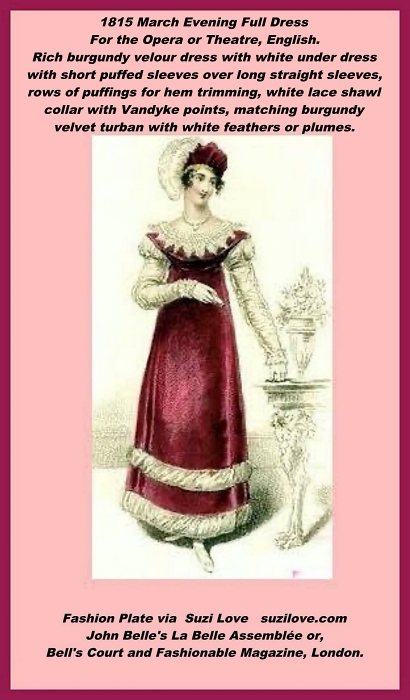
1815 March Evening Full Dress For the Opera or Theatre, English. Rich burgundy velour dress with white under dress with short puffed sleeves over long straight sleeves, rows of puffings for hem trimming, white lace shawl collar with Vandyke points, matching burgundy velvet turban with white feathers or plumes. Fashion Plate via John Belle’s La Belle Assemblée or, Bell’s Court and Fashionable Magazine, London.
Definition Van Dyke Points: V-shaped lace and trims named after a 17th Century Flemish painter, Sir Anthony Van Dyck, known for painting V-shaped lace collars and scalloped edges on sitters.

Definition Evening Dress: There were minute distinctions between ball, dinner, evening and opera gowns meant different quality of fabrics and designs. A Ball Gown differed from an evening dress as expensive silk fabrics were usually worn, light or heavy, decorated with lace, embroidery or beading, with low-cut bodice, short or no sleeves, and full skirts. In the early 1800s, white cotton dresses were considered suitable for many evening events, but not for balls. And definitely not for an evening event in a palace or at the opera or theatre.

Dress Full Dress:  The most formal and complete ensemble, worn for day or night events, and includes the fullest range of accessories that could be added to the outfit to make the most impressive display. 

1815 March Evening Full Dress For the Opera or Theatre, English. Rich burgundy velour dress with white under dress with short puffed sleeves over long straight sleeves, rows of puffings for hem trimming, white lace shawl collar with Vandyke points, matching burgundy velvet turban with white feathers or plumes. Fashion Plate via John Belle's La Belle Assemblée or, Bell's Court and Fashionable Magazine, London. Definition Van Dyke Points: V-shaped lace and trims named after a 17th Century Flemish painter, Sir Anthony Van Dyck, known for painting V-shaped lace collars and scalloped edges on sitters.
1815 March Evening Full Dress For the Opera or Theatre, English. Rich burgundy velour dress with white under dress with short puffed sleeves. Fashion Plate via John Belle’s La Belle Assemblée or, Bell’s Court and Fashionable Magazine, London.

1815 March Evening Full Dress For the Opera or Theatre With Vandyke Points. #Regency #JaneAusten #Fashion. https://books2read.com/SuziLoveFashionWomen1815-1819 Share on X
HN_28_D2D_ https://books2read.com/SuziLoveFashionWomen1815-1819
Fashion Women 1815-1819 History Notes Book 28
What did Jane Austen wear? This book looks at what was fashionable for women in the Georgian Era and at the end of the Regency Era in Britain and the reconstruction in Europe after the wars. Lifestyles were freer and fashions expressed this by becoming the focus of most women’s lives. A wardrobe full of opulent accessories was requisite. Includes mourning and riding fashion, dresses, hats, shoes, reticules or bags, underclothing, and fashion accessories.

Posted in 1800s, 1800s women's fashion, Dress Or Robe, England, fashion accessories, hats, Jane Austen, Regency Era, Regency Fashion, shoes, Suzi Love Images | Tagged 1800s women's fashion, Dress Or Gown, fabrics, fashion accessories, Fashion Plate, feathers or aigrette, gloves, Hats And Hair, Jane Austen, jewelry, La Belle Assemblee, muff, Regency Fashion, sewing, shawls, Shoes

1812-1814 ca. White Muslin Peignoir Or Dressing Gown. #Regency #JaneAusten #Fashion

Suzi Love Posted on April 3, 2024 by Suzi LoveApril 29, 2024

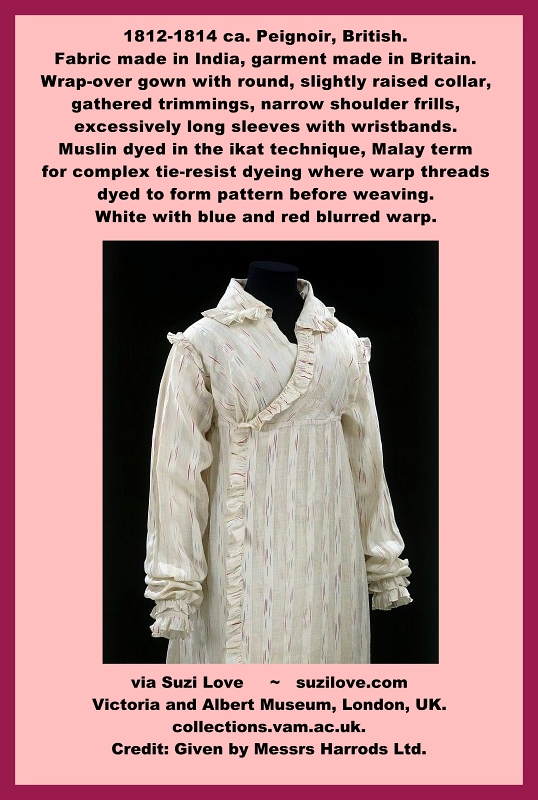
1812-1814 Ca. White Muslin Peignoir Or Dressing Gown, British. The sort of robe Jane Austen would have worn. Fabric made in India, Garment made in Britain. Wrap-over gown with round, slightly raised collar, gathered trimmings, narrow shoulder frills, excessively long sleeves with wristbands. Muslin dyed in the ikat technique, Malay term for complex tie-resist dyeing where warp threads dyed to form pattern before weaving. White with blue and red blurred warp.

via Victoria & Albert Museum, London, UK. collections.vam.ac.uk Credit: Given by Messrs Harrods Ltd.

1812-1814 Ca. White Muslin Peignoir Or Dressing Gown. Fabric made in India, Garment made in Britain. Wrap-over gown with round, slightly raised collar, gathered trimmings, narrow shoulder frills, excessively long sleeves with wristbands. Muslin dyed in the ikat technique, Malay term for complex tie-resist dyeing.
1812-1814 ca. White Muslin Peignoir Or Dressing Gown. #RegencyFashion #JaneAusten #HistoricalFashion https://books2read.com/SuziLoveFashion1810-1814 Share on X
HN_27_D2D_fashwomen1810-1814
https://books2read.com/SuziLoveFashion1810-1814
HN_27_D2D_fashwomen1810-1814 https://books2read.com/SuziLoveFashion1810-1814
Posted in 1800s, 1800s women's fashion, bedroom fashion, England, Regency Era, Regency Fashion, sewing, Suzi Love Images | Tagged 1800s women's fashion, bedroom fashion, British history, Jane Austen, Regency Fashion, sewing, Victoria and Albert Museum

1800 ca. Pair of Flintlock Duelling Pistols Owned by Captain William Waller (active 1794-1807) #Regency #Weapon #JaneAusten #duel

Suzi Love Posted on March 28, 2024 by Suzi LoveMarch 27, 2025

1800 ca. Pair of Flintlock Duelling Pistols. Owned by Captain William Waller (active 1794-1807). Walnut stock, chequered grips, rounded butts, fitted with two silver pipes containing ramrods. Silver trigger guards engraved and end in pineapple shaped finials, each with flintlock containing flints. Lock plates engraved with leaf design, octagonal barrels browned with narrow gold bands near lock. via Royal Museums Greenwich collections.rmg.co.uk

During the Regency Era and Jane Austen’s writing years, dueling was illegal, although secret duels still happened. Courts were made up of peers and they rarely charged another peer for anything illegal. Honor and gentlemanly behavior were the most important things to men so if there was an offense committed, a dawn duel was arranged with seconds to check the weapons used and a doctor in case of injuries.

1800 ca. Pair of Flintlock Duelling Pistols. Owned by Captain William Waller (active 1794-1807). Walnut stock, chequered grips, rounded butts, fitted with two silver pipes containing ramrods. Silver trigger guards engraved and end in pineapple shaped finials, each with flintlock containing flints. Lock plates engraved with leaf design, octagonal barrels browned with narrow gold bands near lock. via Royal Museums Greenwich collections.rmg.co.uk
1800 ca. Pair of Flintlock Duelling Pistols Owned by Captain William Waller (active 1794-1807) #Regency #Weapon #JaneAusten #duel https://books2read.com/suziloveYGD Share on X
RL_2_D2D_RetailerBuyLink_RL_2
RL_2_D2D_RetailerBuyLink_RL_2 https://books2read.com/suziloveYGD
RL_1_D2D_Regency Overview RetailerLinks
https://books2read.com/suziloveROver
RL_1_D2D_Regency Overview RetailerLinks https://books2read.com/suziloveROver
Posted in 1800s, Customs & Manners, England, History, Jane Austen, Pastimes, Regency Era, Suzi Love Images, weapons | Tagged duelling, Jane Austen, London, Pistols, Regency Life, Regency Men, Royal Museums Greenwich, Suzi Love Images, Suzi Love Research, weapons

Post navigation

← Previous Post
Next Post→

SUBSCRIBE TO SUZI LOVE'S NEWSLETTER.

Recent Posts

  • 1812 April White Morning Walking Dress n Jane Austen style Under Green Military Style Coat. #RegencyFashion #JaneAusten #HistoricFashion
  • 1818 December Mourning Walking Dress As Worn In Bridgerton Times. #Bridgerton #RegencyFashion #Mourning
  • 1780 Red Wool Stays, Or Corset, and Panniers, British. #Georgian #Corset #Underclothing
  • 1800-1817 ca. Professional Man’s Black Wool Suit As Worn in Times Of the Bridgerton Family and Jane Austen. #Bridgerton #JaneAusten #RegencyFashion #RegencyEra
  • 1800s Typical Game Bird Dishes Served In Households During Bridgerton and Jane Austen Years. #Bridgerton #Food #RegencyEra #BritishHistory #JaneAusten

Recent Comments

  1. Suzi Love on Book Hooks: “Help,” a voice yelled before all hell broke loose. #MilitarySuspense #ContemporaryRomance #kellysjustice #SouthPacific #Vanuatu
  2. Lisabet Sarai on Book Hooks: “Help,” a voice yelled before all hell broke loose. #MilitarySuspense #ContemporaryRomance #kellysjustice #SouthPacific #Vanuatu
  3. Suzi Love on Book Hooks: “Help,” a voice yelled before all hell broke loose. #MilitarySuspense #ContemporaryRomance #kellysjustice #SouthPacific #Vanuatu
  4. Suzi Love on Book Hooks: “Help,” a voice yelled before all hell broke loose. #MilitarySuspense #ContemporaryRomance #kellysjustice #SouthPacific #Vanuatu
  5. Jana Richards on Book Hooks: “Help,” a voice yelled before all hell broke loose. #MilitarySuspense #ContemporaryRomance #kellysjustice #SouthPacific #Vanuatu

Login

  • Log in

Archives

  • June 2026
  • May 2026
  • April 2026
  • March 2026
  • February 2026
  • January 2026
  • December 2025
  • November 2025
  • October 2025
  • September 2025
  • August 2025
  • July 2025
  • June 2025
  • May 2025
  • April 2025
  • March 2025
  • February 2025
  • January 2025
  • December 2024
  • November 2024
  • October 2024
  • September 2024
  • August 2024
  • July 2024
  • June 2024
  • May 2024
  • April 2024
  • March 2024
  • February 2024
  • January 2024
  • November 2023
  • October 2023
  • September 2023
  • August 2023
  • July 2023
  • June 2023
  • April 2023
  • March 2023
  • February 2023
  • June 2022
  • April 2022
  • March 2022

Categories

  • 1700s
  • 1700s Mens fashion
  • 1700s Womens Fashion
  • 1800s
  • 1800s Mens Fashions
  • 1800s women's fashion
  • 1900s
  • art
  • Australia
  • Bath
  • bedroom fashion
  • Book Hooks
  • Box Or Container
  • Bridgerton
  • Bus Trips
  • Canada
  • Carriage
  • cartoon
  • Celebrity
  • Chatelaine
  • children
  • Children
  • Christmas
  • Coat or Pelisse Or Redingote
  • Contemporary
  • Corset
  • Couple
  • Customs & Manners
  • dancing
  • December Scandal
  • Decorative Item
  • Dress Or Robe
  • Easter
  • Edwardian Era
  • Embracing Scandal
  • England
  • Ester In Images
  • Europe
  • Events
  • Fashion
  • fashion accessories
  • Food and Drink
  • Four Times A Virgin
  • France
  • furniture
  • Georgian Era
  • Georgian Fashion
  • Google Books
  • Grand Tour
  • Group
  • hats
  • History
  • History Events
  • History Notes
  • History Of Christmases Past
  • household
  • Hygiene
  • Irresistible Aristocrats
  • Jane Austen
  • Keanu Reeves
  • Kellys Justice
  • Legal
  • London
  • Love After Waterloo
  • Loving Lady Katharine
  • medical
  • military
  • money
  • mourning
  • Music
  • Outback Arrival
  • pants
  • Pastimes
  • peerage
  • People
  • Petunia and Pearl Diver
  • Places
  • Pleasure House Ball
  • postal
  • Queensland
  • Quotations
  • Regency Era
  • Regency Fashion
  • Regency Life Series
  • Reticule or Bag
  • riding
  • Romantic Era
  • Royalty
  • Russia
  • Scandalous Siblings Series
  • Scenting Scandal
  • Self Publishing
  • sewing
  • Shirt
  • shoes
  • Shopping
  • South Pacific
  • Spencer
  • sports
  • Suit
  • Sunday Snippet
  • Suzi Love
  • Suzi Love Books
  • Suzi Love Images
  • Suzi Love Writing
  • Swain Cove
  • THe Viscount's Pleasure House
  • travel
  • U.S.A
  • underclothing
  • Vest or Waistcoat
  • Victorian Era
  • Victorian Fashion
  • weapons
  • weddings
  • Writing Tools

1800s men fashion 1800s women's fashion antiques Bridgerton British history Cartoons Corset cravat decorative Dress Or Gown England europe fashion accessories Fashion Plate France Georgian era Georgian Fashion gloves google books Hats And Hair historical romance History Notes household Jane Austen jewelry Journal des Dames et des Modes London Metropolitan Museum NYC pants Redingote Or Pelisse Or Coat Regency Era Regency Fashion Regency London Regency Men reticule or bag riding sewing shawls Shoes Suzi Love Books Suzi Love Images Tailcoat The Repository Of Arts underclothing Vest or Waistcoat

©2026 - Suzi Love - Weaver Xtreme Theme Privacy Policy
↑