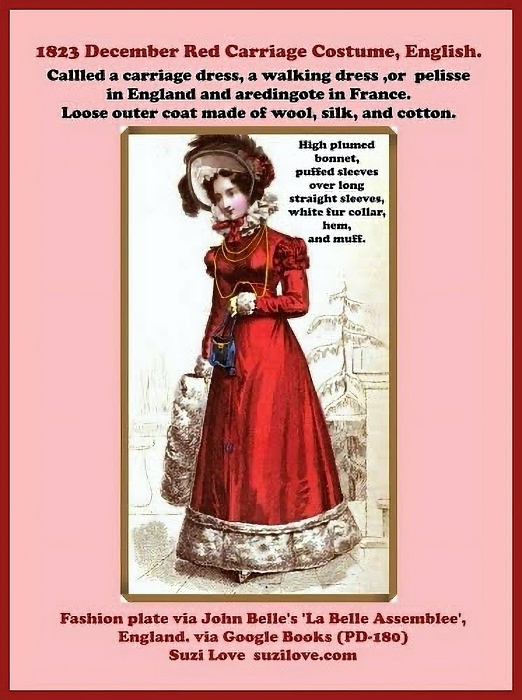
1823 December Red Carriage Costume, English. Gorgeous red dress with waistline a couple of inches below the bust, puffed short sleeves over long straight sleeves, wide white fur hem trim to match the white fur muff, white ruffle at the neck. High bonnet with a feather tied under the chin with a red bow. Fashion plate via John Belle’s ‘La Belle Assemblee’, England.
Definition Redingote Or Pelisse Or Walking Dress Or Carriage Dress Or Coat: French word developed from English words, riding coat. Long fitted outdoor coat worn over other garments for warmth. Often left open at the front to show off the dress underneath. Sometimes cut away in front. Originally made with several capes and trimmed with large buttons. French fashion plates call these coats Redingotes and they are designed for women, men and children. English fashion plates call them a Pelisse, a walking dress, Promenade dress, or Carriage dress. books2read.com/suzilovePelisse
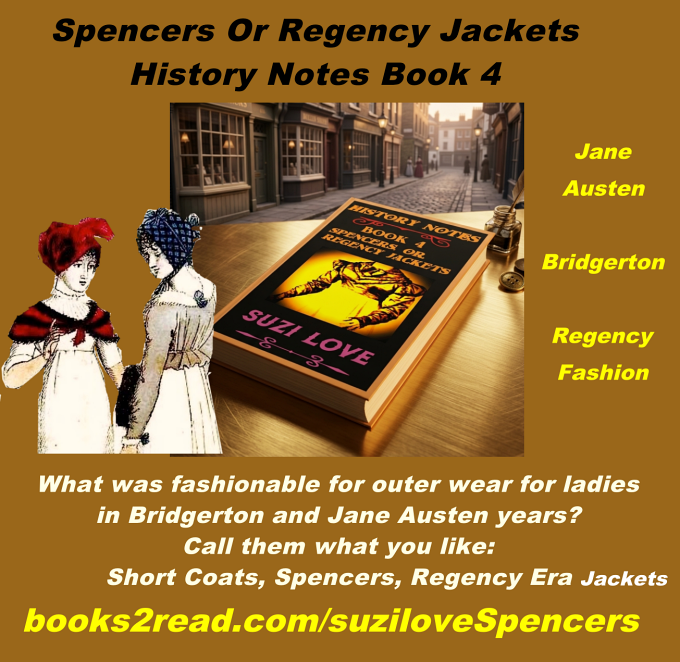
Spencers Or Regency Jackets By Suzi Love. History Notes Book 4. What was fashionable for outer wear in past centuries? Call them what you like: Spencers, short jackets, or Regency jackets were very popular. Take a look at the jackets being worn by women in the early 1800s or the times of Jane Austen. books2read.com/suziloveSpencers
Definition: Spencer – Short, bodice hugging, usually long sleeved, outer jacket. For warmth and for fashion.
Definition Caroline Spencer: Worn during the Directoire and First Empire (1790-1815 C.E.). Spencer with pelerine cape that was made of white kerseymere and trimmed with light blue satin cut on bias.
Spencers were short jackets cut to match the high waistlines of Empire dresses. They often copied military styling, such as braiding, shoulder decoration, buttons and loop fasteners, and wrist adornments. They were generally of complex construction, often with a diamond shaped piece in the back.
HN_4_Spencers, Or Jackets. #Regency #Georgian #Victorian #Fashion History Notes Book 4 By Suzi Love.
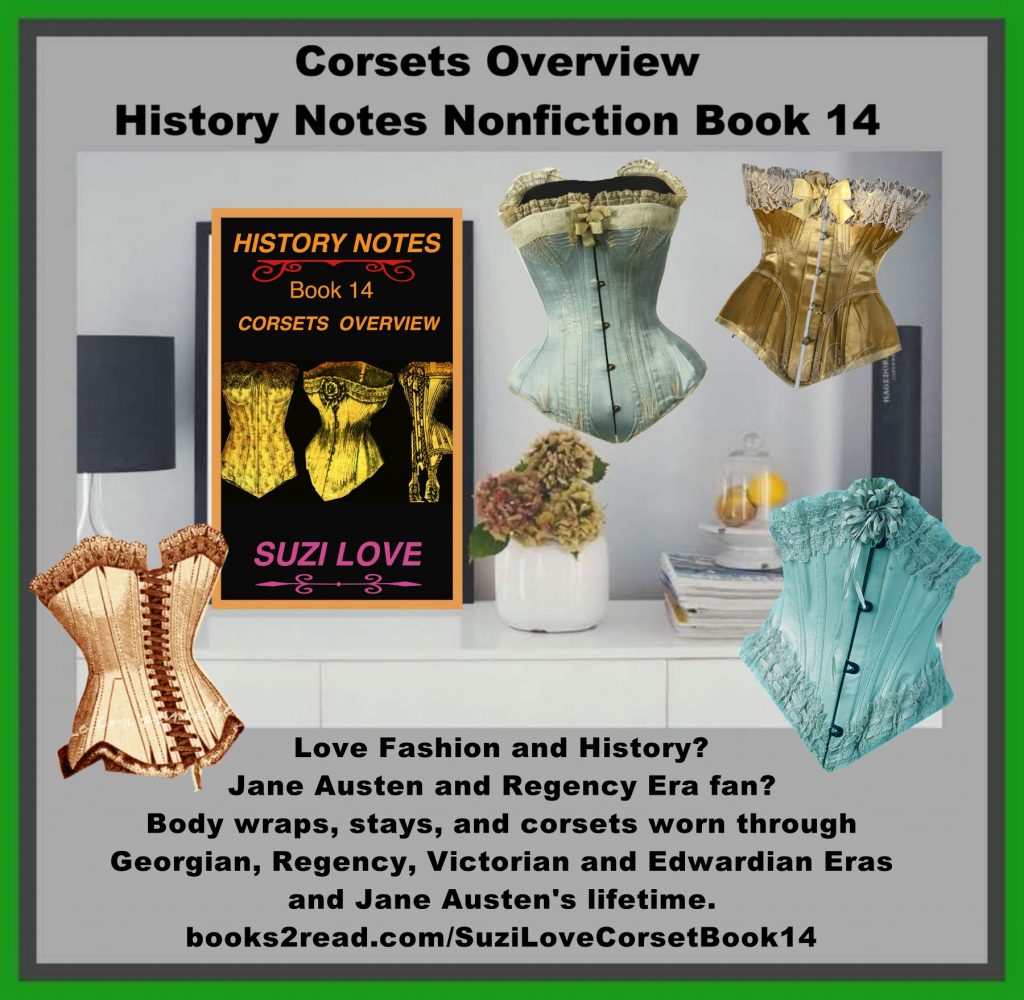
This book shows how body wraps, stays, and corsets were worn to create a variety of fashionable silhouettes through past centuries. Corsets flattened breasts and accentuated rounded hips or pushed up breasts and showed off the bust line depending on the fashions of the time and the desired silhouette. Overview of corsets through history, including the Georgian, Regency, Victorian and Edwardian Eras, and the Bridgerton and Jane Austen’ years. History Notes Book 14.
The name stays probably comes from the French estayer meaning to support. The word corset, which comes from the French word corps for body, had been in use centuries earlier, though often with not quite the same meaning. By the beginning of the 19th century when these undergarments took on more shape and form, the word corset was generally used instead of stays.
During the 1820s, fashions changed from the loose and flowing Regency Era or Empire style gowns and the waistline lowered back to almost the natural position. Towards the mid 1800s, breast cups were added to corsets to give more support and breast comfort. Corsets were lengthened to the hip and gussets added in both the bust area and over the hips. Therefore corsets had more shaping but with less boning.
From the 1820s onwards, menbegan to wear corsets and this continued through the Romantic Era, though the men who wore corsets usually claimed they needed them for back pain.
Queen Victoria ruled England from 1837 to 1901 and at the beginning of her reign, dress waists were around their natural line. But as the years of her reign progressed, fashionable waists became thinner and corsets were redesigned to give more of an hourglass figure.
Early Victorian Era corsets were cotton, boned with mainly whale bone, laced at the back and with tiny hooks and eyes up the front for front fastening. By the middle of the century, corsets were beginning to be more decorative with embroidery and ribbons and then later made of colorful silks and satins.
Wedding ring customs that originated in long ago history.
Betrothal ring – An old Roman custom confirming that the marriage contract would be carried out. It was the first part of a dowry given, and it meant the woman was no longer for sale as the first part of the monetary settlement had been paid.
Wedding ring – many primitive peoples who believed in magic used a rope around the waist or the hand and feet, and later a ring, to symbolise that the bride was captured and spoken for, and also to ward off any evil spirits hovering around the bride and ensure marital bliss.
The ring hand– a symbol of the humiliating tradition of the man as the master – the right hand of the family – and the woman being the slave . The right hand stood for power and authority while the left hand expressed submission and serfdom.
The ring finger – Ancient Greek and Roman anatomists believed a vein or nerve led from the heart to the third finger – the healing finger – so they romantically linked this finger to the heart. There are also some more practical reasons the third finger continues to be used. It’s the most prominent for displaying a ring, and it cannot be extended to its full length on its own and usually remains slightly bent, preventing the ring slipping off.
So next time you look at a wedding ring, you can think back to how it came to be on someone’s left third finger,
Rituals of courting and marriage from ‘How Did it Begin’ by R. Brasch first published in 1965. In the word ‘Wedlock’, the lock isn’t a lock and chain but the Anglo-Saxon for gift, as wed means a promise. Wedlock pledged the gift of the happiness of a man and a woman. Nearly all courtship rituals can be traced back to early practises designed to ensure the fertility of a union. Kissing is thought to have started because primitive man believed exhaled air had magic power.
Signing an X for a kiss began in the Middle Ages when people were illiterate and used an X to sign and would then kiss the parchment to affirm their sincerity, like kissing the Bible to take an oath. The word ‘Spooning’ to describe courting came for the custom of young men in Wales to carve an elaborate spoon to give as a love token to the girl of their choice in the place of an engagement ring. Leap year proposals by women to men were a rare chance for women to correct an unjust state of affairs, just as the extra day in a leap year was a topsy-turvy day, a leapt over day in other years. In a time when there was a surplus of women, it was a chance of ensuring they were not left on the shelf.
Looking for a new Historical Mystery? Lady Rebecca Jamison invests in railway stocks to save family from ruin. #ReadARegency #VictorianRomance #HistRomance #HistoricalMystery https://books2read.com/suziloveES
In Jane Austen’s times craftsmen created boxes and containers of precious metals, leather, silks, and decorated them with jewels. Boxes, Cases, Etui, Necessaire and everything else that was used to carry essential items for travel, sewing, medicine, writing, and toiletries. Containers were engraved to make exquisite and expensive items as well as practical carrying cases. books2read.com/suziloveBoxesCases
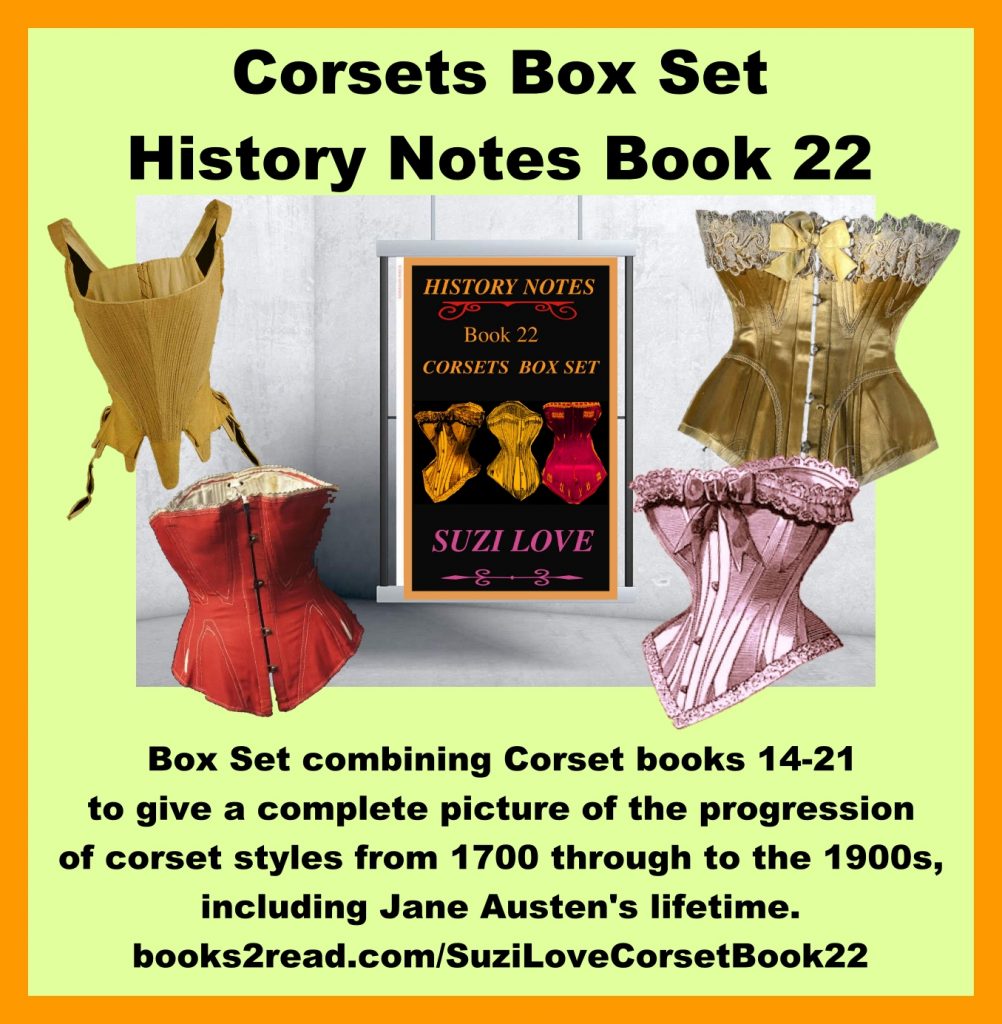
Fascinated with historical fashion? Treat yourself to a nonfiction Box Set on corsets, including Bridgerton and Jane Austen years. Corsets Box Set History Notes Book 22. This Box Set combines corset books 14-21 to give a complete picture of the progression of corset styles from 1700 through to the 1900s, including Jane Austen’s lifetime. These books show how body wraps, stays, and corsets were worn through the centuries to create a variety of fashionable silhouettes through various historical eras. Corsets flattened breasts and accentuated rounded hips or pushed up breasts and showed off the bust line depending on the fashions of the time and the desired silhouette. https://books2read.com/SuziLoveCorsetBook22
Music history from the 17th, 18th, and 19th Centuries. Pianos, pianofortes, harps, viols, violins played during Jane Austen’s times. Musical Instruments were so important in most of the more affluent households in history that large industries grew all around the world to manufacture instruments, musical accessories, and to print sheet music. Musical instruction and encouragement could be found everywhere and both young ladies and gentlemen were encouraged to have musical appreciation. And of course, playing music was on the list of social requirements for all young ladies desirous of becoming a wife and homemaker.
London became Europe’s leading centre for the manufacture of scientific instruments and this led to the manufacture of more musical instruments as well as factories developed and rail transport helped the faster distribution of goods to regional areas. One of the first places that music was used to tell stories and to share enjoyment was in Christmas music. Because music was such an integral part of households, music was always a feature in Magazines. There were advertisements everywhere for musical instruments for sale, for sheet music, and for music lessons. And of course, of most interest to the ladies were the hundreds of fashion plates included in magazines where people were depicted with their musical instruments.
1825 Brown stays with center front busk, back lacing, hip shaping, breast gussets, widely spaced straps, cotton embroidered in ivory silks with hearts. via Kerry Taylor Auctions. kerrytaylorauctions.com https://books2read.com/SuziLoveCorsetBook17
The main purpose of corsets was to support and shape the breasts. Though they still slimmed the midriff, this was not the prime purpose of a corset in the 1820s. The waistline of dresses had lowered to below the bust line and nearer to the true waist so corsets were longer and were given added shaping by stitching and cording and by shaping the breasts with pleated or gathered cups.
Looking For A Fun Historical Romance? Lady Laura Jamison to the earl: “For the sake of propriety, I was ensuring your garments were intact.” #HistoricalMystery #VictorianRomance #RomCom https://books2read.com/suziloveSS