I love Pinterest for keeping thousands of historical images in some sort of order.And I love using Pinterest Boards as inspiration for my romance books.What about you? Do you use Pinterest for planning something, or just for fun?Need more hints for what to do with your boards and pins? Take a look at these fascinating articles on Pinterest. if you want even more Pinterest information and tips for becoming a power user, check out my Suzi Love Pinterest Boards
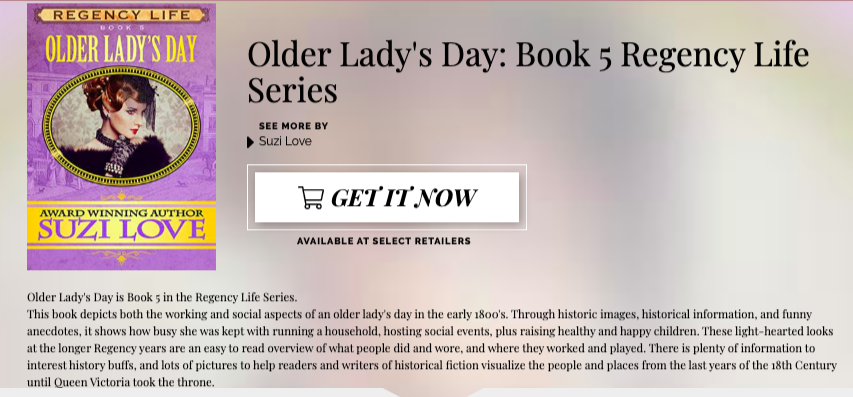
Light-Hearted look at an Older Lady’s Life In Jane Austen’s Times, or early 1800s. An easy to read overview of what an older lady did, wore, and how she lived in the early 19th Century. Information for history buffs and pictures for readers and writers of historical fiction.
The older lady’s day usually started with her toilette in her bedroom, where her maid helped her dress for the day and styled her hair. After that, she would join her family downstairs for breakfast unless she preferred a tray with either tea or hot chocolate in her bedroom as she prepared for her busy day. Her day would be made up of speaking with the housekeeper and the cook about the week’s menus, assuring that the servants were all available that day and no one was ill, and checking the list of foods needed. She would also enquire if the laundry was up to date and that they had enough good linen to make up all the beds before extended family members and guests arrived. If she was in the country and hosting a weekend house party, she would assign rooms to the guests on her lists and query that all was in readiness for their arrival.
1826 The Cyprian’s Ball At the Argyll Rooms. A Regency Gentleman’s Life. From The English Spy By Robert Cruikshank.
1826 The Cyprian’s Ball At the Argyll Rooms. A Regency Gentleman’s Life. From The English Spy By Robert Cruikshank. RL_2_D2D_RetailerBuyLink_RL_2
https://books2read.com/suziloveYGD
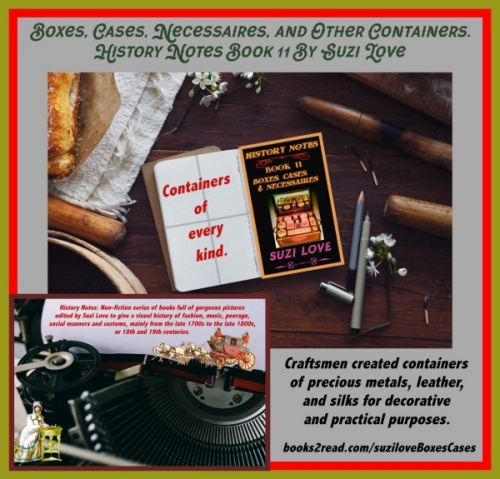
In Jane Austen’s times craftsmen created boxes and containers of precious metals, leather, silks, and decorated them with jewels. Boxes, Cases, Etui, Necessaire and everything else that was used to carry essential items for travel, sewing, medicine, writing, and toiletries. Containers were engraved to make exquisite and expensive items as well as practical carrying cases. books2read.com/suziloveBoxesCases
Craftsmen created containers of precious metals, leather, and silks and decorated them with jewels and engraving. Jane Austen and her contemporaries would have used writing boxes, linen boxes when travelling, boxes to hold their food and drink supplies while traveling by carriage, and decorative boxes to keep letters, ribbons, gloves, hairpins etc. Boxes, Cases, and Necessaires By Suzi Love, History Notes Book 11. books2read.com/suziloveBoxesCases.
HN_11_Craftsmen created containers of precious metals, leather, silks, and decorated them with jewels to make exquisite and expensive items as well as practical carrying cases. books2read.com/suziloveBoxesCases
Jane Austen and the Bridgerton family used boxes of metal, leather, or silks, decorated with jewels and engraving. #Bridgerton #Travel #JaneAusten #RegencyEra #Antiques books2read.com/suziloveBoxesCases
Craftsmen created containers of precious metals, leather, and silks and decorated them with jewels and engraving. Jane Austen and her contemporaries would have used writing boxes, linen boxes when travelling, boxes to hold their food and drink supplies while traveling by carriage, and decorative boxes to keep letters, ribbons, gloves, hairpins etc. Boxes, Cases, and Necessaires By Suzi Love, History Notes Book 11. books2read.com/suziloveBoxesCases.
Jane Austen, the Bridgerton family, and contemporaries used jeweled boxes of metal, leather, or silks. #Bridgerton #Travel #JaneAusten #RegencyEra #Antiques books2read.com/suziloveBoxesCases
Almack’s Assembly Rooms often appear in Regency Era romances as they were a well known gathering place for those in the Ton looking for wives or husbands. 1770-1840 . Almack’s or Willis’s Rooms, King Street, St James, London, UK. Almack’s Assembly Rooms, founded by William Almack at No. 26-28, were on the site of the present Almack House. The club was originally a gaming establishment but moved from Pall Mall. The Assembly rooms were on the South side of King Street in St James’s and were opened on February 12, 1765. At the time the subscription was ten guineas for which there was a ball and supper each week for the twelve weeks of the season.
Assemblies were held on Tuesdays and Thursdays, but only four or five times a season. Dates were listed in the paper along with the names of the Patronesses. When Lady Jersey took over Almack’s around 1815, assemblies were changed to Wednesdays. Many aristocrats were reportedly offended by something that happened at Almack’s but Lord Jersey is reported to have refused to duel over any inferred slights because it would have meant he was forever involved in a duel. The other well-known Patronesses were Lady Bathurst and Lady Downshire.
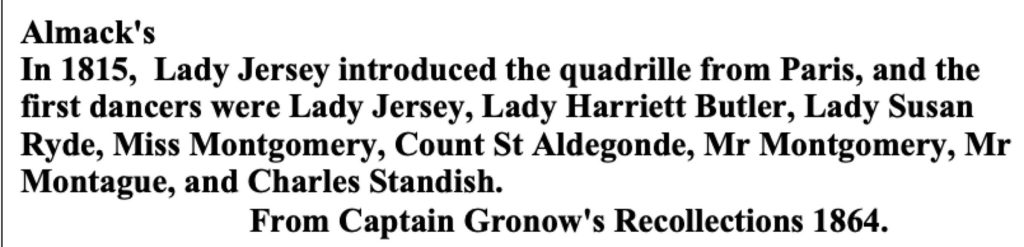
1826 Almack’s Revisited by Charles White.: ‘It was what most correct persons called ‘horrid bad Almack’s’. #RegencyEra #London #BritishHistory1817 April Ladies’ Voucher for all the Wednesday balls at Almack’s in April 1817. via The Huntington Library, San Marino, California, U.S.A.1815 The First Quadrille at Almack’s Assembly Rooms, London. Left to Right: Marquis of Worcester, Lady Jersey, Clanronald MacDonald and Lady Worcester. “It was not until 1815 that Lady Jersey introduced from Paris the favourite quadrille, which has so long remained popular. I recollect the persons who formed the very first quadrille that was ever danced at Almack’s: they were Lady Jersey, Lady Harriett Butler, Lady Susan Ryde, and Miss Montgomery; the men being the Count St Aldegonde, Mr Montgomery, Mr Montague, and Charles Standish.” From The Reminiscences of Captain Gronow 1810-1860.
1765-1840 ca. Almack’s, or Willis’s, Assembly Rooms, South Side Of King Street, St James, London. commons.wikimedia.org
1800s Early Exterior of Almack’s Assembly Rooms, London, UK.
Captain Gronow, an army officer in London around 1814, wrote about the rules of Almack’s in Captain Gronow’s Recollections and Anecdotes, 1864 , but only gives his views on a few years of Almack’s history.
In 1814, the dances were Scotch reels and the old English country-dance; and the orchestra, being from Edinburgh, was conducted by the then celebrated Neil Gow. From Captain Gronow’s Recollections 1864.Screenshot
1800s Almack’s Assembly Rooms, London, and Regency Vouchers in Jane Austen and Bridgerton years. #JaneAusten #Bridgerton #regencyera #almacks #london books2read.com:suziloveYLD
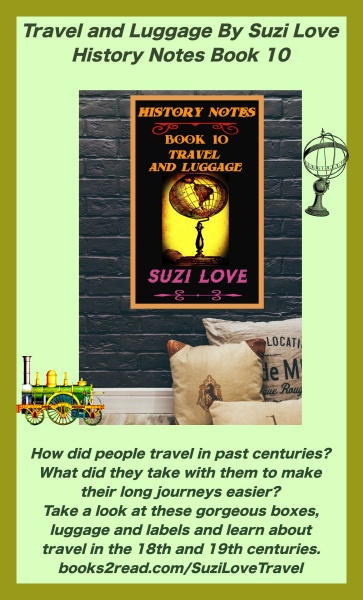
How did people travel in Jane Austen and Bridgerton years? What did they take with them to make their long journeys easier? Travel by road, ship, canal, or railway all took a long time and had dangers so people learned to prepare. And then, in the nineteenth century, road improvements, inventions, and scientific developments made travel more pleasurable. Travel and Luggage By Suzi Love History Notes Book 10 books2read.com/SuziLoveTravel
Horse Power To Steam. Various alternatives to horse power were tested in London’s streets during the 19th century. Steam powered road engines and trams proved too heavy and damaged the roads. Stationary steam engines were used to haul trams attached to a cable but these were only really effective on hills that we too steep for horses. There were also experiments with trams driven gas engines and battery electric power. but was successfully developed. Petrol engines were still primitive and unreliable in the 1890s. In 1900 the reliable horse still dominated the streets of London but new technology was to revolutionize road transport.
Travel and Luggage By Suzi Love History Notes Book 10. How did people travel in Jane Austen’s times. In past centuries? What did they take with them to make their long journeys easier? Travel by road, ship, canal, or railway all took a long time and had dangers so people learned to prepare. And then, in the nineteenth century, road improvements, inventions, and scientific developments made travel more pleasurable. books2read.com/SuziLoveTravel HN_10_D2D_RetailerBuyLink_Travel and Luggage By Suzi Love History Notes Book 10 #History #travel How did people travel in past centuries? What did they take with them to make their long journeys easier? books2read.com/SuziLoveTravel
1800s Typical Cold Collation Dishes served during the 1800s. These are the sort of dishes Jane Austen’s family would have eaten on a regular basis. Pigeon Pie, Raised Game Pie, Cutlets and Peas, Prawn Bouquet, Creamed Chicken, Plover’s Eggs, Lamb Cutlets, Stuffed Larks, Piped Ham, Boned Capon. From: 1860 Mrs. Isabella Beeton’s Book of Household Management.