1812 Woman wearing an extraordinary hat, flounced dress and a cashmere shawl. 1801-1818 Le Bon Genre Fashion Series Plate 50. Published by: Pierre La Mésangère. Via British Museum, London, UK. britishmuseum.org (PD-Art)


1812 Woman wearing an extraordinary hat, flounced dress and a cashmere shawl. 1801-1818 Le Bon Genre Fashion Series Plate 50. Published by: Pierre La Mésangère. Via British Museum, London, UK. britishmuseum.org (PD-Art)
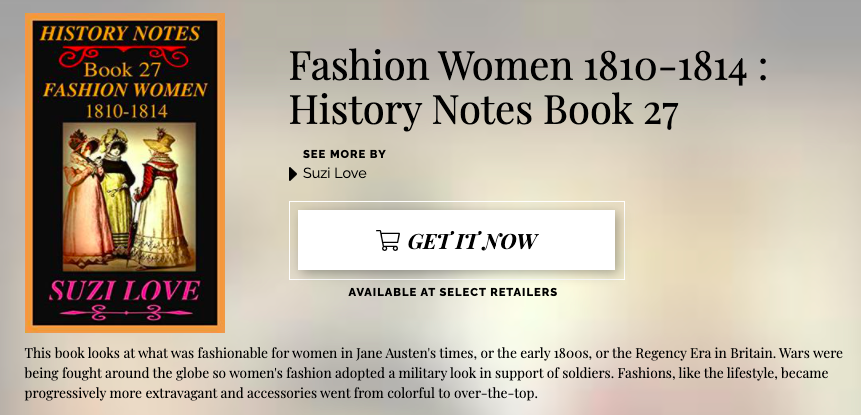
Fashion Women 1810-1814 History Notes Book 27 This book looks at what was fashionable for women in Jane Austen’s times, or the early 1800s, or the Regency Era in Britain. Wars were being fought around the globe so women’s fashion adopted a military look in support of soldiers. Fashions, like the lifestyle, became progressively more extravagant and accessories went from colorful to over-the-top. https://books2read.com/SuziLoveFashion1810-1814
What was fashionable for women in Jane Austen’s times? Mourning, riding, daytime, evening clothing, plus underclothing, corsets and accessories. Fashion Women 1810-1814 History Notes Book 27 This book looks at what was fashionable for women in Jane Austen’s times, or the early 1800s, or the Regency Era in Britain. Wars were being fought around the globe so women’s fashion adopted a military look in support of soldiers. Fashions, like the lifestyle, became progressively more extravagant and accessories went from colorful to over-the-top. https://books2read.com/SuziLoveFashion1810-1814
The Lady’s Magazine said of the basis of women’s fashion that was popular for the first twenty years of the 1800s, ‘White is still the prevailing color for robes. For morning dresses, linen gowns, in large diamonds or squares, are fashionable. Indian muslins, plain or embroidered, are preferred to Florence and satins. The designs of embroidery for shawls are of infinite variety. Long gloves, which reach above the elbow, are not yet laid aside. Medallions are hung around the neck from crossed chains and some of these medallions are shaped like the bags, called ridicules. These reticules are of the lozenge or hexagon shape, with a small tassel at each angle. Reticules, or ridicules, are in lozenge or hexagon shapes with a small tassel at each angle. In capotes, or hats, and ribbands, the violet and dark green prevail over jonquil. Bracelets in hair, pear-shaped ear-rings, medallions on square plates, saltiers of colored stones, are still in fashion.’
What was fashionable for women in Jane Austen’s times? Mourning, riding, daytime, evening clothing, plus underclothing, corsets and accessories. Wars were being fought so women adopted military looks in support of soldiers. https://books2read.com/SuziLoveFashion1810-1814 History Notes Book 27 Women’s Fashions 1810-1814.


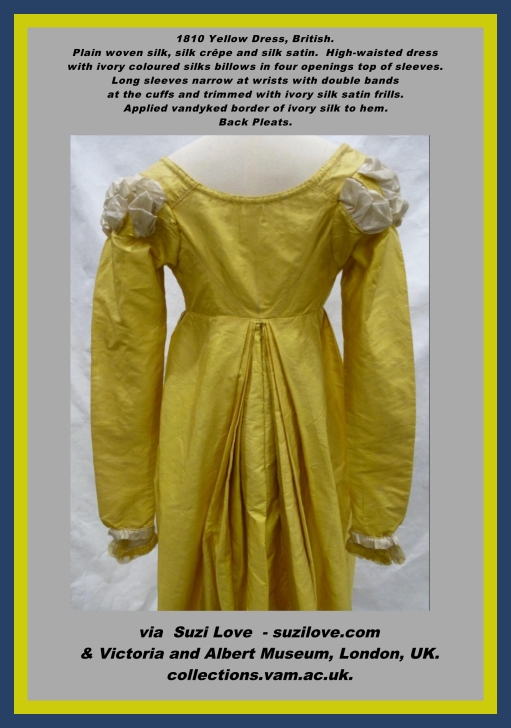
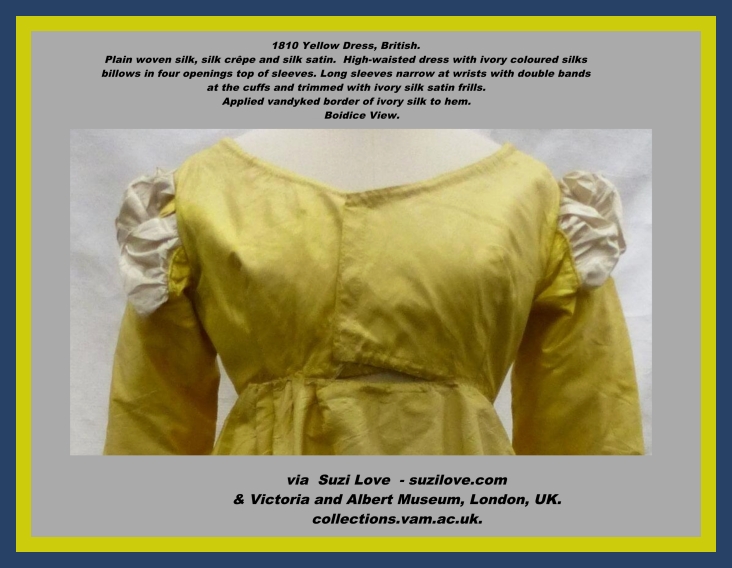
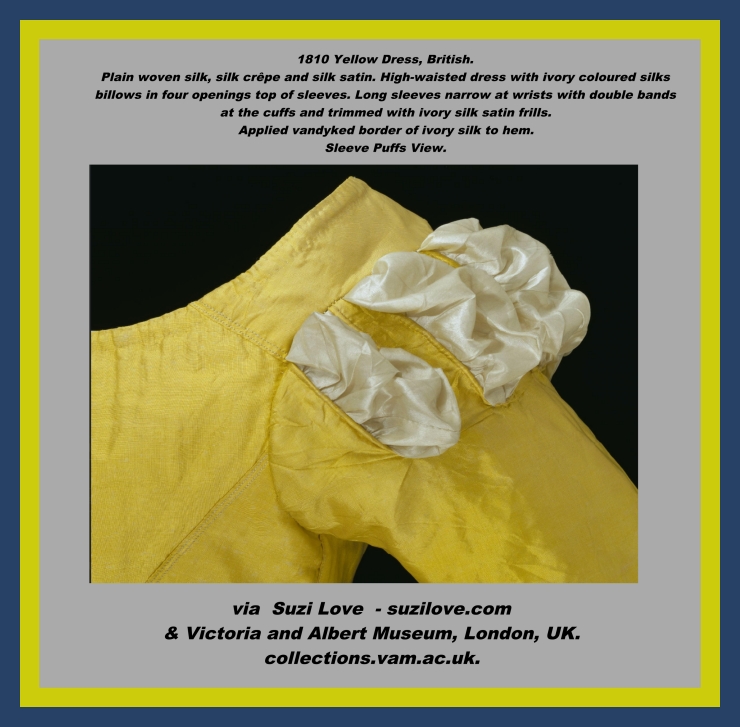
1810 Yellow Dress, British. Plain woven silk, silk crêpe and silk satin. High-waisted dress of yellow silk, ivory colored silks billow out of four openings at sleeve tops. The puffed trimmings are inspired by the fashionable slashing of garments in the Renaissance period when the top fabric was cut to reveal a colored lining or garment worn underneath. A long rectangular strip of ivory silk on inside of sleeve head and excess gathered into pudds through openings. The 19th-century version of slashing is much more controlled by cut, stitching and piped edges, rather than the raw cuts in fabric seen in the 16th century.
Long sleeves narrow at wrists with double bands at cuffs and trimmed with ivory silk satin frills, yellow silk crêpe, cream ribbon and cording. Trimming around lower hem of skirt of applied vandyked border of ivory silk.
Length center back neckline to hem of train length: 158cm Front length shoulder to hem length: 139cm
via Victoria and Albert Museum, London, UK. collections.vam.ac.uk.




1817 June Morning Dress as worn in Bridgerton and Jane Austen’s times in England. A round dress composed of jaconet muslin; the bottom of the skirt is trimmed with an intermixture of tucks and embroidery. The body is perfectly novel, it is a three-quarter height, and displays the whole of the throat and a little of the neck: it is composed of the same material as the dress, and is formed to the shape, in a manner at once singular and becoming, by bands of letting-in lace; it is also profusely ornamented with lace, which is set on very full. Long full sleeve, the fullness confined by a tasteful cuff, which is finished by a lace ruffle. Head-dress the Marlborough cap, composed of white lace, ornamented with full-blown roses and blush colored satin ribbon. For the form of this elegant cap, which is perfectly in the English style, we refer our readers to our print. The hair is parted in front so as to display a little of the forehead, and curled lightly over the temples. Necklace and ear-rings white cornelian mixed with gold. White kid slippers and gloves. We are indebted to the elegant taste of Mrs. Marchant of 40, Gerrard-street, Soho, for both our dresses this month. Fashion Plate via Rudolph Ackermann’s ‘The Repository of Arts’.
Definition Morning or At-Home Dress: Loose and comfortable dress and soft lace cap to be worn at home for reading, painting, sewing or for walking in the garden. To be seen by family, servants and close friends. Not accessorized enough to be out in the wider public, although the pretty pink roses and trim on the cap suggest this outfit may have been worn for receiving visitors at home.


1806 Red Velvet Redingote, French. Short puffed sleeves over long straight sleeves, white fur Fichu, or shoulder shawl, interesting matching hat with white satin trim. Fashion Plate via Journal des Dames et des Modes, or Costume Parisien.
Redingotes or Pelisses were needed to cover the flimsy dresses made of lightweight fabrics of the Regency years to provide warmth and some protection from windy conditions when gowns might lift and cause modesty issues. Jane Austen and her contemporaries often walked to places and so would have needed the warmth of a Pelisse or coat in the cold British winters. https://books2read.com/SuziLoveFashionWomen1805-1809

What was fashionable in the late 1700s? Extravagant colors and fabrics and outrageous styles were all seen in these flamboyant fashions. Take a look at their dresses, suits, hats, shoes and bedroom fashions. books2read.com/suziloveFashWomen1700s
books2read.com/suziloveFashMen1700s

18th Century Late Women’s Fashions. A conical body shape was still fashionable while the shape of the skirts changed. The wide panniers which held the skirts out at the sides mostly disappeared by 1780 for all but the most formal court functions and false rumps, or bum-pads or hip-pads were worn for a time. A low-necked gown, usually called in French a robe, was worn over a petticoat and most gowns had skirts that opened in front to show the petticoat worn beneath. As part of the general simplification of dress, the open bodice with a separate stomacher was replaced by a bodice with edges that met center front. Strapless stays which still were cut high at the armpit, to encourage a woman to stand with her shoulders slightly back, a fashionable posture. The fashionable shape was a rather conical torso, with large hips. The waist was not particularly small. Stays were usually laced snugly, but comfortably. Shoes had high, curved heels (the origin of modern “louis heels”) and were made of fabric or leather. Shoe buckles remained fashionable until they were abandoned along with high-heeled footwear and other aristocratic fashions in the years after the French Revolution,
18th Century Late Men’s Fashions. A man’s outfit consisted of a knee-length coat, knee breeches, a vest or long waistcoat, a linen shirt with frills and linen under drawers. Lower legs showed and were an important part of life. Men wore stockings and leather shoes with stacked heels of low or medium height. The whole ensemble would have been topped by a shoulder-length wig and a tricorne, or three-cornered, hat an upturned brim. By end of the 18th century, wigs were out of fashion except for the most formal occasions. Undergarments and knee breeches did not change very much. Coats gradually became less full and die front was cut in a curve towards the back. Waistcoats became shorter. The upper leg began to show more and more and by the end of the century breeches fitted better because they were often made of knitted silk. Shoes became low-heeled with pointed toes and were fastened with a detachable strap or ribbon on the front.

1850 ca. Beaded Crochet Reticule, or Coin Purse. #VictorianFashion #HistoricalFashion #Reticule. http://books2read.com/suziloveReticules
Continue reading →1810 ca. Silk Dress, Probably French. High-waisted, or Empire line, dress with long straight sleeves, back opening, embroidery on neck frill and multiple rows of embroidery on the hem. via Metropolitan Museum New York City, U.S.A. ~ metmuseum.org


