1814 Statistics On Classes, Properties and Population In Great Britain. From: 1814 A Treatise On Wealth and Power. By Patrick Colquhoun. These are the statistics for England in Jane Austen’s time, or the early 1800s, or Regency Era.


1814 Statistics On Classes, Properties and Population In Great Britain. From: 1814 A Treatise On Wealth and Power. By Patrick Colquhoun. These are the statistics for England in Jane Austen’s time, or the early 1800s, or Regency Era.


Craftsmen created containers of precious metals, leather, and silks and decorated them with jewels and engraving. Jane Austen and her contemporaries would have used writing boxes, linen boxes when travelling, boxes to hold their food and drink supplies while traveling by carriage, and decorative boxes to keep letters, ribbons, gloves, hairpins etc. Boxes, Cases, and Necessaires By Suzi Love, History Notes Book 11. books2read.com/suziloveBoxesCases.


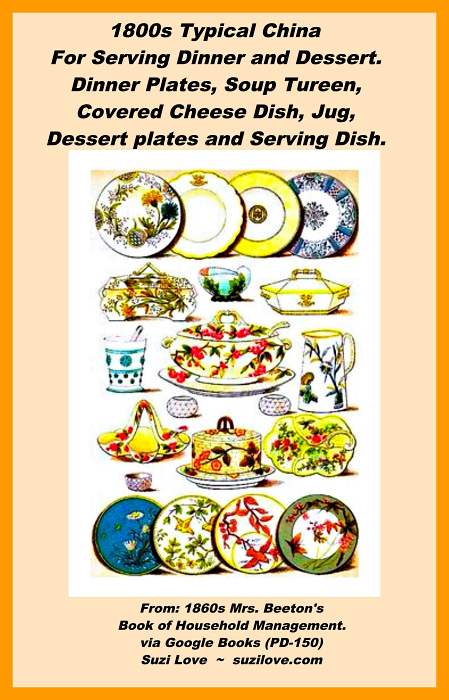
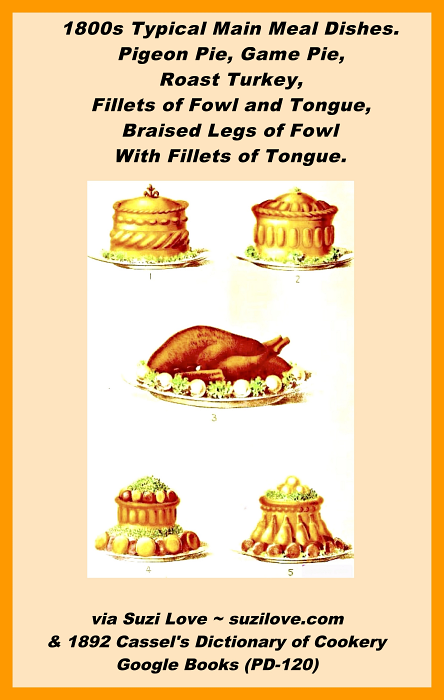
1800s Typical Game Bird Dishes Served during the 1800s. These are the sort of dishes Jane Austen’s family would have eaten on a regular basis. Banded Partridges, Roast Partridges, Roast Surrey Fowl, Larded Guinea Fowl, Roast Plovers, Stuffed Capons, Roast Gosling and Roast Pigeons. From: 1850s- 1860s Mrs. Beeton’s Books of Household Management. via Google Books (PD-150)

1800ās Flat menās shoes, presumably part of the livrĆ©e-like Rƶmer servantās uniform of the type worn until 1866. via historisches-museum.frankfurt.de


Textile of block-printed white cotton in madder colours with pencilled blue. The cotton is printed with 9.5 octagonal panels intended to be cut out and applied to patchwork quilts. Each panels contains a bunch of flowers. Around the inner border is an inscription of Princess Charlotte of Wales married to Leopold Prince of Saxe-Coburg May 2, 1816. In the borders are three Prince of Wales feathers, the Royal Arms, and a crown on each side. At the end of the textile is printed a rectangular panel containing the manufacturers name and in a corner is the name ‘G. Swindels’.
This quilt has an excise stamp for 1816 and is inscribed ‘John Lowe and Co. Furniture Printers, Shepley Hall’, providing the name of the only identifiable manufacturer of these panels, although there are likely to have been others. John Lowe was a well-known firm of calico printers with large cotton factories and extensive bleaching grounds close to the River Tame near Ashton-under-Lyne in Lancashire.
Hand-quilting is done on a frame using needles called ‘betweens’. The stitches are executed with one hand; the other hand is kept underneath the quilt to feel for the needle. Small, uniform stitches (usually a ‘running stitch’) are taken through the three layers to form a decorative design. In ‘piecing’ or ‘patchwork’, small pieces of fabric are sewn together to produce a decorative design. The most enduring method in Britain is done by hand, and is known as ‘piecing over paper’. The pattern is first drawn onto paper and then accurately cut. Small pieces of fabric are tacked round each of the shapes, and then joined together from the back using overstitch. Most of the quilt top visible here has been pieced over paper, but in some areas the fabrics have been applied directly on to the earlier quilt that forms the wadding.
Victoria and Albert Museum, London, England.


1808 Silver Wax Jack, Irish. By Robert Breading (active 1775ā1822) Dublin. via suzilove.com and Metropolitan Museum New York City, U.S.A. metmuseum.org
How did Jane Austen seal her letters? Wax was melted by lighting the tip of a coiled wax length. This is called a wax jack. The melted wax blob was placed on the outside of a letter or document. A personal desk seal or a fob seal was pressed into the wax to identify the sender or owner of the document. Aristocrat families had their own coat of arms and others may have had their initials or their name on the seal.


Craftsmen created containers of precious metals, leather, and silks and decorated them with jewels and engraving. Jane Austen and her contemporaries would have used writing boxes, linen boxes when travelling, boxes to hold their food and drink supplies while traveling by carriage, and decorative boxes to keep letters, ribbons, gloves, hairpins etc. Boxes, Cases, and Necessaires By Suzi Love, History Notes Book 11. books2read.com/suziloveBoxesCases.


1811 Woman Carrying Cloth and a Package. Sewing a dress? Green dress with a white bodice, green spotted cornet for a hat. Fashion Plate via Journal des Dames et des Modes, or Costume Parisien. Even though this a French fashion plate, this is typical of the Empire dresses worn by Jane Austen and her contemporaries. Low necklines and skirts that started directly under the bust and flowed into the classical relaxed wide styles of Greece and Rome. These high-waisted dresses were worn most days and cotton, silk or taffeta were the popular fabrics.


1800-1820 ca. Small Pieces Of Drawing Room Furniture as would have been used in houses where Jane Austen lived. Side tables, book tables, chest and foot stool. Collage by Suzi Love.

1800-1820 ca. Small Pieces Of Drawing Room Furniture As Jane Austen Would Have Used. #Regency #Furniture #BritishHistory
Tweet
19th Century Set of Damascened Calligrapher’s Tools, Turkey. via Sotheby’s Auctions. sothebys.com
books2read.com/SuziLoveWritingTools