How did people travel in past centuries? What did they take with them to make their long journeys easier? Travel by road, ship, canal, or railway all took a long time and had dangers so people learned to prepare. And then, in the nineteenth century, road improvements, inventions, and scientific developments made travel more pleasurable. Travel and Luggage By Suzi Love History Notes Book 10 books2read.com/SuziLoveTravel
Horse Power To Steam. Various alternatives to horse power were tested in London’s streets during the 19th century. Steam powered road engines and trams proved too heavy and damaged the roads. Stationary steam engines were used to haul trams attached to a cable but these were only really effective on hills that we too steep for horses. There were also experiments with trams driven gas engines and battery electric power. but was successfully developed. Petrol engines were still primitive and unreliable in the 1890s. In 1900 the reliable horse still dominated the streets of London but new technology was to revolutionize road transport.
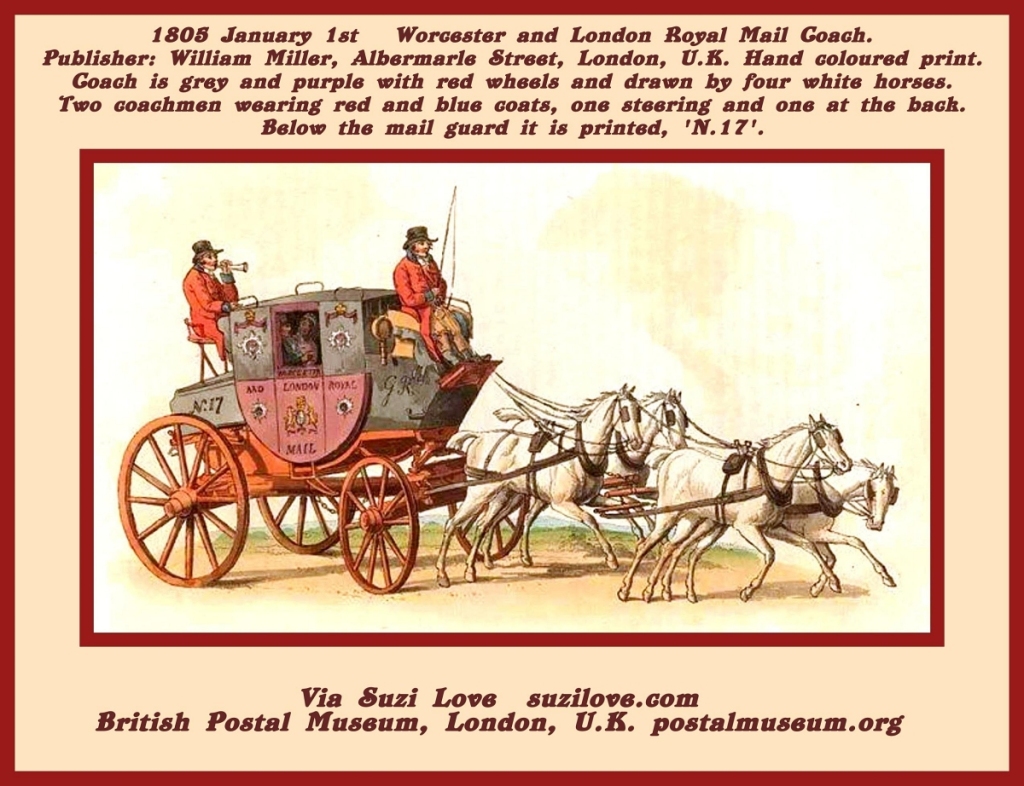
How did Jane Austen and her family? Did they go by stagecoach? The dreadful condition of British roads caused great apprehension to all classes of travelers. Making a journey anywhere in the country was a big undertaking and often a gentleman composed his last will and testament before his departure. Traveling in vehicles was only possible during the day or on the nights with very bright moonlight with few vehicles attempting road travel in winter and any travel on a Sunday was frowned upon.
Description of Stage Coach Travel in England. via 1815 Journal Tour of Great Britain. “The gentlemen coachmen, with half-a dozen great coats about them, immense capes, a large nosegay at the button-hole, high mounted on an elevated seat, with squared elbows, a prodigious whip, beautiful horses, four in hand, drive in a file to Salthill, a place about twenty miles from London, and return, stopping in the way at the several public-houses and gin-shops where stage-coachmen are in the habit of stopping for a dram, and for parcels and passengers on the top of the others as many as seventeen persons. These carriages are not suspended, but rest on steel springs, of a flattened oval shape, less easy than the old mode of leathern braces on springs. Some of these stage coaches carry their baggage below the level of the axletree.”
A sedan chair is a portable enclosed chair for a single passenger. It was generally carried by two “chairmen” holding poles attached to either side of the chair. Sedan chairs were fashionable in England and Europe during the 17th, 18th and early 19th centuries and were an important part of the social life of the times. They were very useful for negotiating crowded, unsafe, narrow, winding and often filthy streets and were particularly used by “invalids, ladies and party goers”. Sedan chairs had the advantage of being able to be carried up and down stairs and could deliver the passenger from inside their own home to inside their destination without having to step outside.
1784 Sedan Chair. ‘The return from a masquerade. A morning scene.’ A young lady dressed as shepherdess with staff slumps in a sedan chair. Asleep or drunk her head and shoulders hang outside window. Two porters smile and dwarf chimney sweep carries a mask.’ By Robert Dighton and Cari.
The 19th century English author, Elizabeth Gaskell, described the use and function of the sedan perfectly in her novel “Wives and Daughters” when she reminisced how the Browning sisters chose to be transported to a ball by sedan chair, which ‘came into the parlor, and got full of the warm air, and nipped you up, and carried you tight and cosy into another warm room, where you could walk out without having to show your legs by going up steps, or down steps.’
The Bath Chair was invented in Bath, England, in the mid 18th Century to transport the wealthy and the sick around the city. It could be steered by the passenger and rivaled and then outdid the Sedan Chair as only one chairman was needed to operate it. The last Bath Chairman retired in 1949.
Typical 1700s, or Eighteenth Century Sedan Chair. Portable enclosed chair for single passenger usually carried by two chairmen holding poles attached to either side of chair. Fashionable during 17th, 18th and early 19th centuries when needed to negotiate crowded, unsafe, narrow, and dirty streets. Used by invalids, ladies and party goers. The sedan chair comprises a small kiosk with a curved timber roof which is covered with leather and studded with brass nails. The front and side panels are painted in green with floral decorations of cherubs and flowers. The back panel is of plain timber. Access to the chair was via a hinged door at the front. Inside, the chair is upholstered in silk and features padded upholstered arm rests. The windows have raw silk curtains which are gathered with tassels. The present brackets and poles are reproductions made in 1986 prior to display in the Transport exhibition. The total length of the new poles are 80 inches. The sedan chair door lock features the initials “V.F.” and a set of crossed keys with the wording “PARIS” and the number “34”. Via Powerhouse Museum, Sydney, Australia.
The longest journey recorded in a sedan chair was made by Princess Amelia, youngest daughter of King George III, who in 1728 was carried by 8 chairmen working in reliefs from London to Bath, a distance of 172 kms (107 miles). This sedan chair door lock features the initials “V.F.” and a set of crossed keys with the wording “PARIS” and the number “34”.
1823 Hackney Cab, London, U.K. This small cabriolet was built by coach builder, David Davies, and licensed for public convenience. Name ‘hackney’ derived from village of Hackney, Middlesex, famous for horse drawn carriages. French word cabriolet was shortened to cab, hence ‘Hackney Cab’. In 1813, there were 1100 hackney coaches for hire in London. Designs changed constantly and in 1834 Joseph Hansom registered his design for a cabriolet named ‘Hansom Cab’.
Craftsmen created containers of precious metals, leather, and silks and decorated them with jewels and engraving. Jane Austen and her contemporaries would have used writing boxes, linen boxes when travelling, boxes to hold their food and drink supplies while traveling by carriage, and decorative boxes to keep letters, ribbons, gloves, hairpins etc. Boxes, Cases, and Necessaires By Suzi Love, History Notes Book 11. books2read.com/suziloveBoxesCases.
Early 1800s Typical Regency Couple in a Curricle. The sort of vehicle Jane Austen and her contemporaries would have driven in. Young men loved them and occasionally women drove them.

Craftsmen created containers of precious metals, leather, and silks and decorated them with jewels and engraving. Jane Austen and her contemporaries would have used writing boxes, linen boxes when travelling, boxes to hold their food and drink supplies while traveling by carriage, and decorative boxes to keep letters, ribbons, gloves, hairpins etc. Boxes, Cases, and Necessaires By Suzi Love, History Notes Book 11. books2read.com/suziloveBoxesCases.
1826 Sights Jane Austen Saw Around Regency England. 1826 From Regency Life Around England. The sights that Jane Austen and her friends and family would have seen around England. via 1826 The English Spy By Robert Cruikshank via Google Books (PD-150)
1826 Royal Wells At Cheltenham, England. Regency life around England. via 1826 The English Spy By Robert Cruikshank via Google Books (PD-150)
1826 Arrival of the London Mail in Bristol. Regency life around England. via 1826 The English Spy By Robert Cruikshank via Google Books (PD-150)
1826 Procession from Gloucester to Berkeley. Regency life around England. via 1826 The English Spy By Robert Cruikshank via Google Books (PD-150)
The Promenade At Cowes, England. Regency life around England. via 1826 The English Spy By Robert Cruikshank via Google Books (PD-150)
1826 The Post Office, Bristol. Regency life around England. via 1826 The English Spy By Robert Cruikshank via Google Books (PD-150)
1826 Point Street, Portsmouth, England. Regency life around England. via 1826 The English Spy By Robert Cruikshank via Google Books (PD-150)
1826 Gate House, Highgate, England. Regency life around England. via 1826 The English Spy By Robert Cruikshank via Google Books (PD-150)
1826 Oakland cottages were a well-known place to stay at Cheltenham Spa, England. Regency life around England. via 1826 The English Spy By Robert Cruikshank via Google Books (PD-150)
1826 Entrance to Berkeley Castle, England. Regency life around England. via 1826 The English Spy By Robert Cruikshank via Google Books (PD-150)
1812 Man’s wool, linen, and cotton long coat with four shoulder capes, European. Also called a Carrick Coat, a Driving Coat, or a Redingote in France. via Metropolitan Museum, NYC, USA. ~ metmuseum.org Credit Line: Purchase, Irene Lewisohn Bequest, 1988. Accession Number: 1988.300
A Regency Era, or early 1800s, gentleman was outfitted in more practical fabrics, such as wool, cotton and buckskin rather than the fussy brocades and silks of the late 1700s. The men in Jane Austen’s life would have worn this sort of warm and practical coat like this when riding his horse in inclement weather or when driving his carriage.
1812 ca. Back View. Man’s Caped Coat, Or Carrick Coat, European.
Wool, linen, and cotton. via Metropolitan Museum New York City, U.S.A. metmuseum.org1812 ca. Front View. Man’s Caped Coat, Or Carrick Coat, European.
Wool, linen, and cotton. via Metropolitan Museum New York City, U.S.A. metmuseum.org1812 ca. Back View Black and White. Man’s Caped Coat, Or Carrick Coat, European.
Wool, linen, and cotton. via Metropolitan Museum New York City, U.S.A. metmuseum.org1812 ca. Front View Black and White. Man’s Caped Coat, Or Carrick Coat, European.
Wool, linen, and cotton. via Metropolitan Museum New York City, U.S.A. metmuseum.org1812 ca. Front View Black and White With Umbrella. Man’s Caped Coat, Or Carrick Coat, European.
Wool, linen, and cotton. via Metropolitan Museum New York City, U.S.A. metmuseum.org1812 Man's Wool, Linen, and Cotton Coat With Four Shoulder Capes, European. #RegencyEra #Fashion #Coat #MetMuseum https://books2read.com/SuziLoveFashionMen1800-1819 Share on X
From the finish of the 18th century until 1820, men’s fashions in European and European-influenced countries moved away from the formal wear of brocades, lace, wigs and powder to more informal and relaxed styles. Focus was on undress rather than formal dress. Typical menswear in the early 1800s included a tailcoat, a vest or waistcoat, either breeches, pants, or the newer trousers, stockings, shoes or boots, all worn with an overcoat and hat. This basic ensemble was accessorized with some form of neckcloth or cravat, gloves, walking stick, cane or riding crop, handkerchief, fobs, watch and perhaps a quizzing glass or eye glass.
Skirted coats were replaced with short-fronted, or cutaway, tailcoats worn over fitted waistcoats and plain, white linen shirts. Knee breeches were gradually replaced by tight-fitting pantaloons and later trousers, decorative shoes with buckles were replaced with a variety of boot styles, and fussy and ruffled neckwear gave way to intricately tied, white linen neck cloths. A Regency Era, or early 1800s, gentleman was outfitted in more practical fabrics, such as wool, cotton and buckskin rather than the fussy brocades and silks of the late 1700s.