“There are few people whom I really love and still fewer of whom I think well.” Jane Austen, Pride and Prejudice (1813)



“There are few people whom I really love and still fewer of whom I think well.” Jane Austen, Pride and Prejudice (1813)
19th Century Writing Set, French. Old Paris porcelain pot with ormolu fittings, set on a pen tray that is papier mache and hand painted in Chinoiserie, Or Japonaise, Style. The type of writing sets that households would have in Jane Austen’s times for writing letters and keeping track of estate matters. Chinese and Japanese styles of household goods were very fashionable during the English Regency and Victorian years. via Ruby Lane Antiques. rubylane.com


1725-1730 ca. Gold Double-Opening Snuffbox, France. Two tortoiseshell pique panels and two miniatures inside, of Louis XV of France and his wife Marie Leczinska. Made by Jean Baptiste Massé, painter.
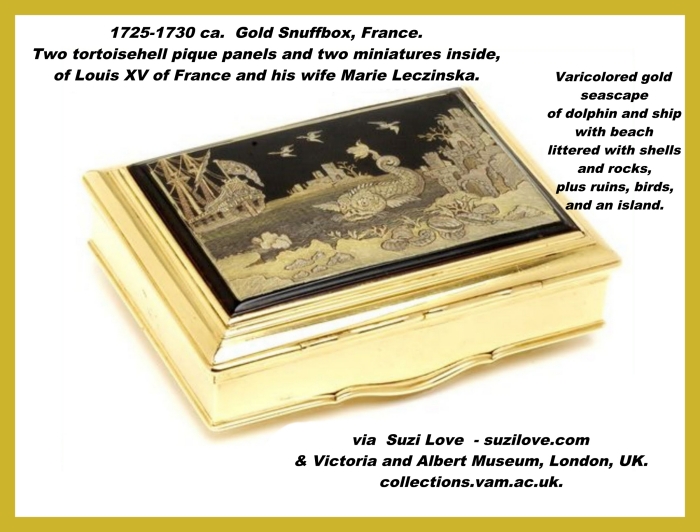
Varicolored gold seascape of dolphin and ship with beach littered with shells and rocks, plus ruins, birds,
and an island. Inside the box are miniature portraits of Louis XV of France and his wife Marie Leczinska. It has been suggested that the box commemorates the birth of the ‘dauphin’ Louis in 1729, the royal couple’s fourth child, and first son, heir to the throne. A few elements contradict this suggestion: the dolphin does not bear any regal symbol such as a crown, the marks that date the box indicate that it was initiated before the birth of Louis, when the arrival of a son was unknown.
It is most probable that these delicate panels, together with the miniature of Louis XV, date from 1725-1730 and have been associated later into this gold snuffbox, and a later miniature of Queen Marie Leczinska.The miniature of the king may have been painted by Jean-Baptiste Massé – he is recorded as supplying miniatures of the king for boxes intended as diplomatic gifts from 1720-26-, or by his lesser known contemporary Jean-Baptiste Ducanel.
The lid is hinged to reveal a miniature, under glass, of Marie Leczinska, queen of France, probably 19th century or heavily restored, wearing a cloak of blue embroidered with gold fleurs-de-lis and lined with ermine overa lace-trimmed dress of red embroidered with gold. In the base is a panel of tortoiseshell pique with a cornucopia of small shells, also hinged to reveal a contemporary miniature of Louis XV of France in armour, wearing a whitestock and the sash of the Order of the Holy Ghost. The gold box, probably early 19th century or later, has plain walls, reeded borders, and a double thumbpiece.
Sir Arthur Gilbert and his wife Rosalinde formed one of the world’s great decorative art collections, including silver, mosaics, enamelled portrait miniatures and gold boxes. Arthur Gilbert donated his extraordinary collection to Britain in 1996.
via Victoria and Albert Museum, London, UK. collections.vam.ac.uk.
Snuff Boxes: Decorative boxes of all types were prized, especially in the 18th Century when everything decorative and extravagant was in vogue and taking a pinch of snuff was fashionable. Snuff is made from ground or pulverized tobacco leaves, flavorings added, and then a pinch of snuff is placed on the back of the hand and sniffed.
1725-1730 ca. Gold Double-Opening Snuffbox With Miniature Portraits, France. #antiques #snuffbox #GeorgianEra #France. https://books2read.com/suziloveBoxesCases Share on X
1810 Man’s Suit and Girl’s Dress, Portugal. Man’s purple pleated silk jacket, vest, and breeches embroidered with silk threads. Girl: White silk tulle dress embroidered with silk threads and an overdress of yellow cotton satin. via National Costume Museum, Portugal. The sort of men’s formal clothing worn for court and typical girl’s dress as worn in Jane Austen’s times.


1817 November Morning Dress and Evening Dress, English. Morning Dress is a round dress of Jaconot muslin with back buttons, small collar open in front to display the throat, lower part of front with bias tucks, moderately full skirt finished around bottom with small tucks and deep flounce with bright rose ribbon. Rose velvet Spenser trimmed with white satin and rose silk, finished at throat with white satin puffings. Plain long sleeves, French style Leghorn bonnet trimmed with large rows of ribbon to match Spenser and tied under the chin, stand-up lace frill around throat, swansdown muff, straw kid sandals and gloves.
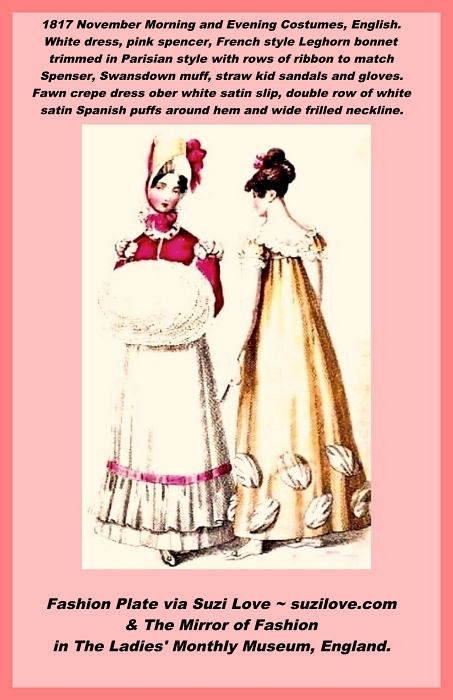
Evening dress of fawn crepe over a white satin slip, cut low around the bust, confined to waist by a narrow cestus of white satin, fastened in front by a brilliant clasp. Single fall of Mecklin lace on dress, very short full sleeve finished at bottom by a rouleau of white satin and narrow lace plait. Skirt trimmed with double row of white satin Spanish puffs, very full and in bias. Hair high, parted and curled on the forehead with garland of Provence roses. Pearl earrings and necklace, spangled crape fan, white kid gloves and white satin slippers. Fashion Plate via The Mirror of Fashion in The Ladies’ Monthly Museum, England.
1817 November Muslin Morning Dress and Crepe Evening Dress, English. #RegencyFashion #JaneAusten #FashionPlate https://books2read.com/SuziLoveFashionWomen1815-1819 Share on X
1810 Les Invisibles. By James Gillray. Two men walk towards each other, each with a lady hanging to each arm, all have their faces concealed by some part of their dress, hat, or collar, or both. One man has a round hat, with a fantastically curved brim projecting downwards. The other has a huge crescent-shaped cocked hat with the peaks dipping over face and back. Via British Museum, London, UK. britishmuseum.org (PD-Art)


1810 “A Bonnet Shop” By Thomas Rowlandson.A shopkeeper with a hat in each hand converses with an elderly woman wearing a similar hat. A child holding a rattle looks up at them at left, a plump woman wearing a bonnet sits at center, and a group of young women make bonnets in the background. Many groups of hats hang overhead in the shop. Via British Museum, London, UK. britishmuseum.org (PD-Art)

1815 Blue Dress Bodice, French. Layers of frills on dress back. Hairstyle and Various Bonnets as Jane Austen would have worn. Fashion Plate via Journal des Dames et des Modes, or Costume Parisien.

1811 Green Dress French. High waist with bow under the bust, Mamaluke sleeves as “a long full sleeve partitioned into five sections, each section being drawn and seamed to fit around the arm up sleeves, white collar lining, fashionable blue bonnet tied under the chin and wearing yellow shoes. The sort of fashionable outfit worn by women in Jane Austen’s times, or 1800s, or Regency Era. Fashion Plate via Journal des Dames et des Modes, or Costume Parisien.
Mamaluke Sleeves: Long full sleeves partitioned into five sections, each section being drawn and seamed to fit around the arm up.

1790-1800 ca. Men’s Riding Boots. Black leather with wide tan leather tops,
small heel and slightly rounded toes. via Los Angeles County Museum of Art, California, USA.
collections.lacma.org
