1830s Silk and Leather Shoes, Or Slippers, American. Flat black shoes with ankle ties and square toes. via Metropolitan Museum, NYC, U.S.A. metmuseum.org


1802 August. Two Ladies in Evening Dresses in the high-waisted, or Empire line, styles worn By Jane Austen. White dress with pink trim, pink fan, and pink plumed headdress. Aqua blue dress with white bodice and a blue trimmed evening headdress.
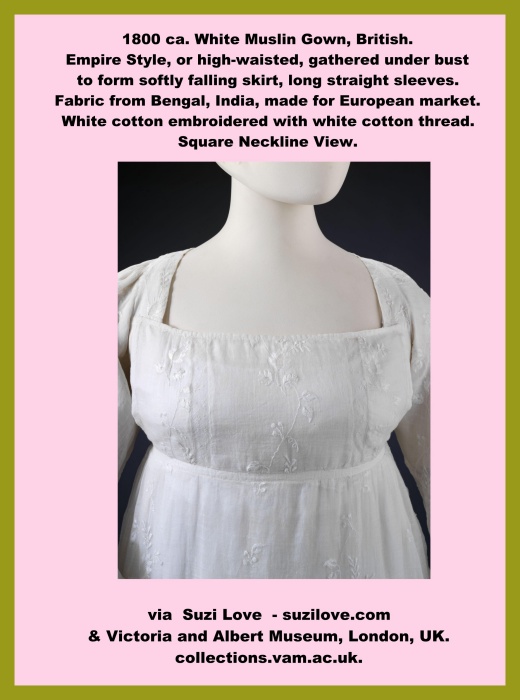
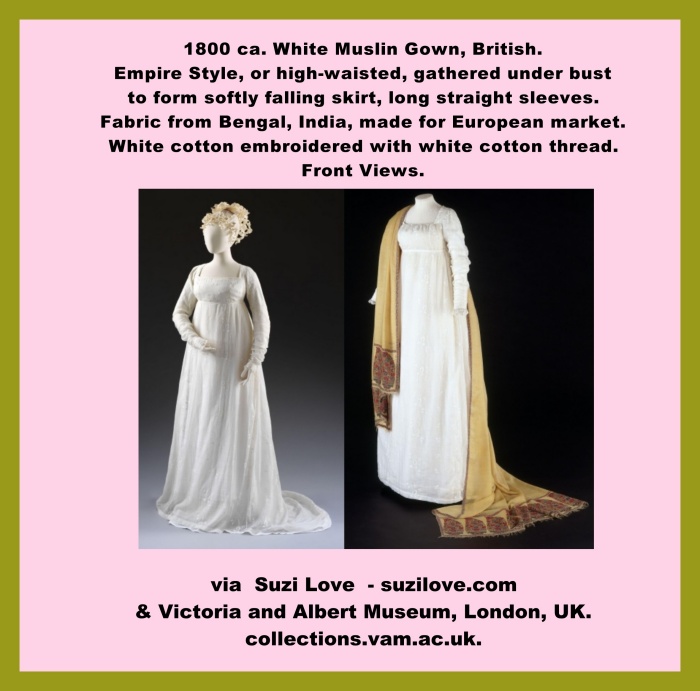
The Empire dress which evolved in the late 1790s began as a chemise shift gathered under the breasts and at the neck. Named after the First Empire in France, by 1800 Empire dresses had a very low décolleté, or neckline and a short narrow backed bodice attached to a separate skirt. Skirts started directly under the bust and flowed into the classical relaxed wide styles of Greece and Rome.
Definition Aigret, aigrette, egret: Plume of feathers or jeweled ornament in shape of feathers worn on head or hats. During the early 19th century, or Jane Austen’s lifetime, or during the years of the Bridgerton series, the favorite feathers were osprey and heron.


1821 December Green Promenade Dress, English. High waisted coat over white dress with ruffled collar, vertical front bows, short puffed sleeves over long straight sleeves, matching ruffled bonnet and yellow gloves. Fashion Plate via Rudolph Ackermann’s ‘The Repository of Arts’, London, U.K.


1812 -1813 Woman elaborately clothed and wearing a fichu, or neck ruffle, steps off the kerb into the street. She holds up her dress before stepping over the dirty Parisian gutter. French Cartoon Series Le Bon Genre Plate 54. Published by: Pierre La Mésangère. https://books2read.com/SuziLoveFashion1810-1814
Definition Fichu: Triangular piece of lace, muslin, or other cloth worn about the neck and cleavage to fill in a low bodice or neckline and preserve a lady’s modesty. From the French ‘thrown over’.


1819 Pink Merino Wool Redingote, French. Merino wool coat over a white dress with a high lace collar, military style buttons decoration and shoulder pads, matched with a black velour, or velvet, hat with a high front brim and lined with white satin. Military style shoulder pads and front buttons. It was fashionable at the time to wear military inspired clothing to show support of all the fighting men involved in the Napoleonic and other wars. The type of outfit young Regency Era ladies would have worn if they were out shopping on Bond Street, walking in a park, or taking a carriage ride through Hyde Park. Fashion Plate via Journal des Dames et des Modes, or Costume Parisien. Fashion Plate via Journal des Dames et des Modes, or Costume Parisien.
Definition Redingote Or Pelisse Or Walking Dress Or Coat: French word developed from English words, riding coat. Long fitted outdoor coat worn over other garments, especially light-weight muslin dresses, for warmth. Often left open at the front to show off the dress underneath. Sometimes cut away in front. Originally made with several capes and trimmed with large buttons. French fashion plates call these coats Redingotes and they are designed for women, men and children. English fashion plates call them a Pelisse, a walking dress, Promenade dress, or Carriage dress.

1819 Bridgerton or Jane Austen Style Pink Merino Wool Redingote, Or Coat, With Military Styling. #Bridgerton #JaneAusten #RegencyFashion #FashionPlate #French https://books2read.com/SuziLoveFashionWomen1815-1819

Music history from the 17th, 18th, and 19th Centuries. Pianos, pianofortes, harps, viols, violins played during Jane Austen’s times. Musical Instruments were so important in most of the more affluent households in history that large industries grew all around the world to manufacture instruments, musical accessories, and to print sheet music. Musical instruction and encouragement could be found everywhere and both young ladies and gentlemen were encouraged to have musical appreciation. And of course, playing music was on the list of social requirements for all young ladies desirous of becoming a wife and homemaker.
London became Europe’s leading centre for the manufacture of scientific instruments and this led to the manufacture of more musical instruments as well as factories developed and rail transport helped the faster distribution of goods to regional areas. One of the first places that music was used to tell stories and to share enjoyment was in Christmas music. Because music was such an integral part of households, music was always a feature in Magazines. There were advertisements everywhere for musical instruments for sale, for sheet music, and for music lessons. And of course, of most interest to the ladies were the hundreds of fashion plates included in magazines where people were depicted with their musical instruments.
books2read.com/suziloveMusicGeneral
books2read.com/suziloveMusicPiano
books2read.com/suziloveMusicViolins


1809 Cheltenham Summer Dress, English. Relaxed Empire style high-waisted green dress with long sleeves and red hem trim, long aqua blue draping scarf, wide brimmed hat and holding a red book. Fashion Plate via John Belle’s ‘La Belle Assemblee’, London.
Seaside clothing was very popular. High-waisted dresses, usually of white muslin, were loose and flowing for the summer heat but ladies could easily add colorful accessories, such as shawls, hats, and parasols. In the early 1800s, it was fashionable to parade along the shorefront or in parks, to see and be seen. These are the sort of ensembles that Jane Austen and her family and friends would have worn at seaside towns or at sea bathing resorts.
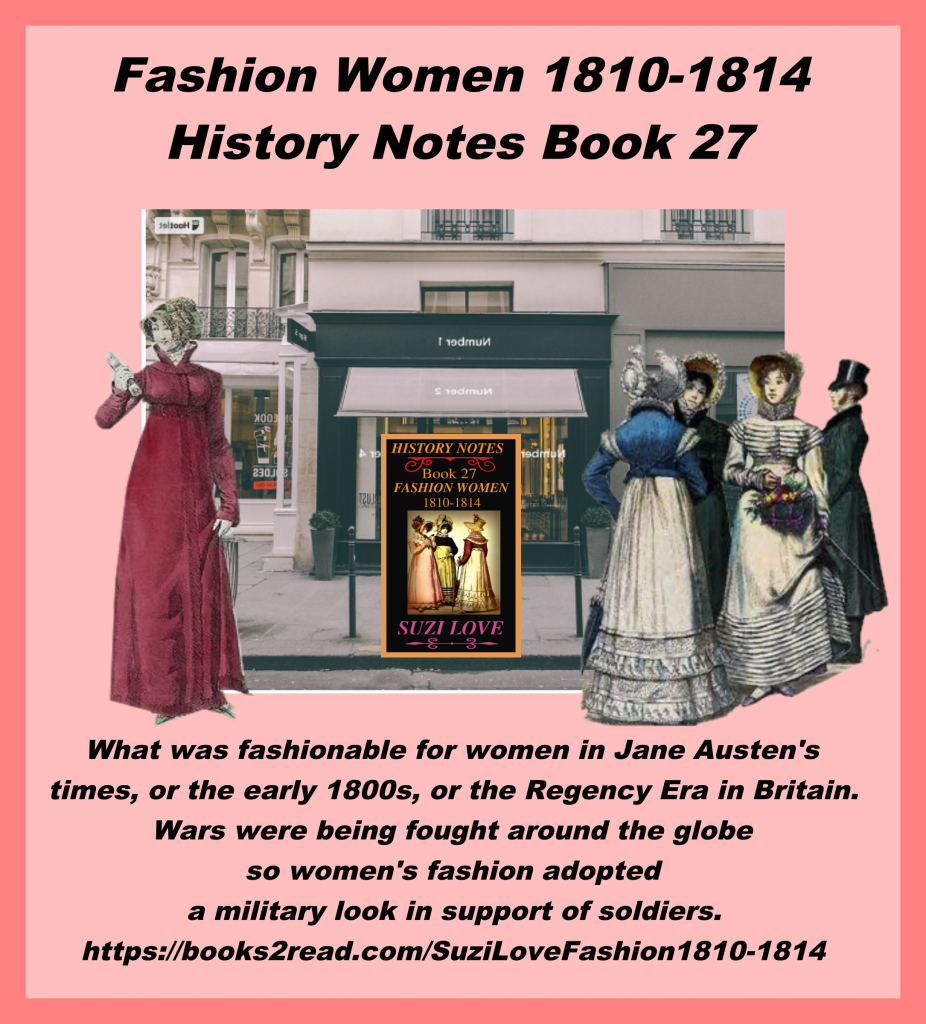
Fashion Women 1805-1809 History Notes Book 26 What did Jane Austen and friends wear? This book looks at early 1800s fashions, which were elegant and pretty with high waists and fabrics that were almost transparent. These Empire style gowns, named after Napoleon’s first Empress, became popular throughout Europe, and were then copied around the world. Colorful outwear was added to make an ensemble more attractive and warmer. https://books2read.com/SuziLoveFashionWomen1805-1809


1808 ca. Jane Austen style high-waisted muslin dress with bib front, British. High stomacher front, i.e. a bib front fastened with pins, and embroidered with clusters of flowers and leaves. Embroidery satin stitch, chain stitch and French knots. Dress of muslin, embroidered in wool with a design of flowers and leaves down the sleeves and across the front of the dress. The bodice back and side fronts are lined with linen and there are linen undersleeves. The front of the bodice is made up of a panel of bias-cut muslin, which is sewn onto the skirt rather like the bib of an apron so that it can be placed in position at the neck with pins. When the pins are removed the bib front falls away to reveal linen underflaps which fasten across the bust to give support. This type of bodice construction was common during this period in this style of dress and is known as the high stomacher front.
Embroidered with clusters of flowers and leaves and embroidery is worked in satin stitch, chain stitch and French knots, the design trails down across the front of the dress and around the scalloped hemline to simulate a draped tunic-style garment slit up the side seam. Front bodice has panel of bias-cut muslin sewn onto skirt like the bib of an apron so that it can be placed in position at the neck with pins. When the pins are removed the bib front falls away to reveal linen underflaps which fasten across the bust to give support. Bib front bodice construction was common in the Regency Era, or Jane Austen’s years, in this style of dress and is known as the high stomacher front. via Victoria and Albert Museum, London, U.K.


1804 December 2nd. Danish Ambassador’s Suit made for the crowning of Napoleon Bonaparte as emperor in Notre Dame Cathedral, Paris. Christopher Wilhelm Dreyer (1737-1810), attended the pompous event as a representative of the Danish diplomatic corps. Lavishly decorated clothes probably made for occasion but not used as Napoleon wanted special clothing worn. natmus.dk/historisk-viden