↓
 

Suzi Love

Making history fun, one year at a time.

Header_
  • Home
  • Newsletter
  • Pre order form
  • Shop
    • Cart
    • Checkout
    • My account
    • Refund and Returns Policy
  • Blog
  • BOOKS
    • History Events
    • Kelly’s Justice
    • Outback Arrival
    • Irresistible Aristocrats
    • History Notes
    • Scandalous Siblings
    • Love After Waterloo
    • Regency Life Series
  • Privacy Policy
  • EVENTS
Home » 1700s » Page 8 << 1 2 … 6 7 8 9 10 … 14 15 >>

Category Archives: 1700s

Post navigation

← Previous Post
Next Post→
Grosvenor_Brick row houses around Grosvenor Square, London.

Grosvenor Square, London, U.K. #BritishHistory #London #RegencyEra #GrosvenorSquare #QueenVictoria

Suzi Love Posted on March 17, 2026 by Suzi LoveJanuary 29, 2026

As some of my historical romance books are set in a house in Grosvenor Square, its history fascinates me. How about you? Do you love the history associated with Grosvenor Square?  The Jamison family in Embracing Scandal and Scenting Scandal live in Grosvenor Square.

Grosvenor Square - Pronounced ˈɡrovna’, is a large garden square in the exclusive Mayfair district and the centrepiece of the Mayfair property of the Duke of Westminster and takes its name from their surname, “Grosvenor”.

In 1710, Sir Richard Grosvenor obtained a licence to develop Grosvenor Square and the surrounding streets and development started around 1721. Grosvenor Square became one of the most fashionable residential addresses in London from its construction until the Second World War, with numerous leading members of the aristocracy in residence. The early houses had five or seven bays, basement, three main stories, and an attic. Colen Campbell produced a design for a palatial east side to the square featuring thirty Corinthian columns but this was not carried out and in the end most of the houses were built to individual designs. There were mews behind all four sides. Many houses were rebuilt later and acquired an extra storey. Number 23 (later 26) was rebuilt in 1773–74 for the 11th Earl of Derby by Robert Adam and shows how grandeur of effect and sophisticated planning might be achieved on a confined site. It was demolished and rebuilt again in the 1860s.

  • 1761 – Sir Richard Grosvenor, the 7th Baronet, was created Baron Grosvenor of Eaton in the County of Chester
  • 1784 – Became Viscount Belgrave and Earl Grosvenor under George III.  
  • 1831- At coronation of William IV, Robert Grosvenor, the 2nd Earl Grosvenor, became Marquess of Westminster
  • 1874 – Queen Victoria created the title  Duke of Westminster and bestowed it upon Hugh Grosvenor, 3rd Marquess of Westminster.
  • Current title holder is Gerald Grosvenor, 6th Duke of Westminster and his seat is at Eaton Hall, Cheshire The Dukedom and Marquessate are in the Peerage of the United Kingdom The rest are in the Peerage of Great Britain. The courtesy title of the eldest son and heir to the Duke is Earl Grosvenor.

Nearly all of the older houses were demolished during the 20th century and replaced with blocks of flats in a neo-Georgian style, hotels and embassies. The central garden was originally reserved for the occupants of the houses but is now a public park managed by The Royal Parks. Grosvenor Square. Grosvenor Square has been the traditional home of the official American presence in London since John Adams established the first American mission to the Court of St. James’s in 1785. Adams lived, from 1785 to 1788, in the house which still stands on the corner of Brook and Duke Streets. During World War II, Eisenhower established a military headquarters at 20 Grosvenor Square, and during this time the square was nicknamed “Eisenhower Platz”.

The former American Embassy of 1938–1960 on the square was purchased by the Canadian government and renamed Macdonald House. In 1960, a modern USA Embassy was built on the western side of Grosvenor Square and caused controversy in the mainly Georgian and neo-Georgian area. In 2008, the United States Government chose a site for a new embassy in the Nine Elms area, south of the River Thames with with relocation completed by 2016 or 2017. In October, 2009, English Heritage granted Grade II listed status to the building which means new owners will not be allowed to change the facade.

Grosvenor Square in Literature In Little Dorrit by Charles Dickens the Barnacles are said to live at “four Mews Street Grosvenor” which “was not absolutely Grosvenor Square itself but it was very near it”. Caroline Bingley makes a comment regarding the local dance in Pride and Prejudice ”We are a long way from Grosvenor Square, are we not, Mr Darcy”. It appears in the title of several novels including The Lonely Lady of Grosvenor Square by Mrs. Henry De La Pasture (1907) and The House in Grosvenor Square by Linore Rose Burkard (2009) In Oscar Wilde’s play Lady Windermere’s Fan, the Duchess of Berwick says, “I think on the whole that Grosvenor Square would be a more healthy place to reside in. There are lots of vulgar people live in Grosvenor Square, but at any rate there are no horrid kangaroos crawling about.”

Grosvenor_Bow Windows on a corner in Grosvenor Square.
Grosvenor_Brick row houses around Grosvenor Square, London.
Grosvenor Square via 1834 Mogg’s Strangers’ Guide To London. Via Google Books.
Grosvenor 1813 Grosvenor Square, North Side. Via Rudolph Ackermann’s The Repository Of Arts. 

Grosvenor_Brick row houses around Grosvenor Square, London.
Grosvenor_Modern Day Grosvenor Square park.
Grosvenor_1750 Grosvenor Square, Looking East.
Grosvenor 1800 ca. North Side of Grosvenor Square.
Grosvenor_22-23 Grosvenor Square. Setting for my Scandalous Siblings Series. 

Grosvenor_22 Grosvenor Square, London.
18th Century Grosvenor Grosvenor_ Square, East Side, Mayfair, London.
SS_D2D_ https://books2read.com/suziloveSS
Posted in 1700s, 1800s, 1900s, London, Regency Era, Suzi Love Images | Tagged art, British history, household, London, Regency London, Suzi Love Books, Suzi Love Images, Suzi Love Research, travel

18th – 19th Century Busks For Stays, Or Corsets, In Jane Austen and Bridgerton Times. #RegencyFashion #Corsets #JaneAusten #Bridgerton #HistoricalFashion

Suzi Love Posted on March 15, 2026 by Suzi LoveFebruary 21, 2026

Busks shaped and reinforced the centre front of stays, or corsets. They were made from whalebone, wood, and bone, and were often inscribed with names, dates, and symbols of love because they were positioned close to the heart. The corsets worn in Jane Austen’s later years and by women in Bridgerton times often had busks to stiffen the corset and support the breasts.

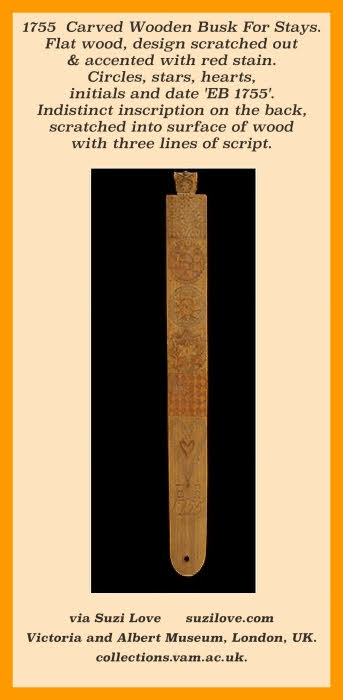
busk_1755 Wooden Busk For Stays, English. Flat piece of wood with design scratched or picked out, and accented with red stain. Design comprises of circles, stylized geometric stars, heart motifs, and the initials and date 'EB 1755'. Indistinct inscription on the back, scratched into the surface of the wood with three lines of script.
1755 Wooden Busk For Stays, English. Flat piece of wood with design scratched or picked out, and accented with red stain. Design comprises of circles, stylized geometric stars, heart motifs, and the initials and date ‘EB 1755’. Indistinct inscription on the back, scratched into the surface of the wood with three lines of script.
busk_1800-1840 ca. Scrimshaw Corset Busk, American. Designs are of a ship and the places the sailor visited. Sailors made these as gifts to be worn close to the heart by their loved ones. Dimensions (inches) 12.5 (L) , 1.3 (W). Dimensions (centimeters). 31.7 (L) , 3.3 (W) via Winterthur Museum Collection.
1800-1840 ca. Scrimshaw Corset Busk, American. Designs are of a ship and the places the sailor visited. Sailors made these as gifts to be worn close to the heart by their loved ones. Dimensions (inches) 12.5 (L) , 1.3 (W). Dimensions (centimeters). 31.7 (L) , 3.3 (W) via Winterthur Museum Collection.
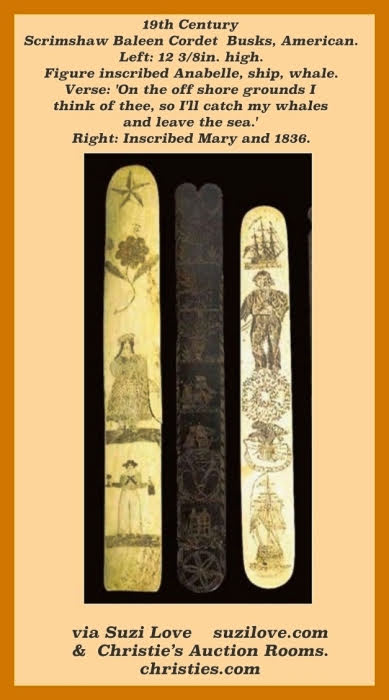
busk_19th Century. Scrimshaw Baleen Corset Busks, American. The first with figure inscribed Annabelle, ship, whale, and verse On the off shore grounds I think of thee, so I'll catch my whales and leave the sea; the second inscribed Mary and 1836 12 3/8in. high the longest. via Christie’s Auction Rooms.
19th Century. Scrimshaw Baleen Corset Busks, American. The first with figure inscribed Annabelle, ship, whale, and verse On the off shore grounds I think of thee, so I’ll catch my whales and leave the sea; the second inscribed Mary and 1836 12 3/8in. high the longest. via Christie’s Auction Rooms.
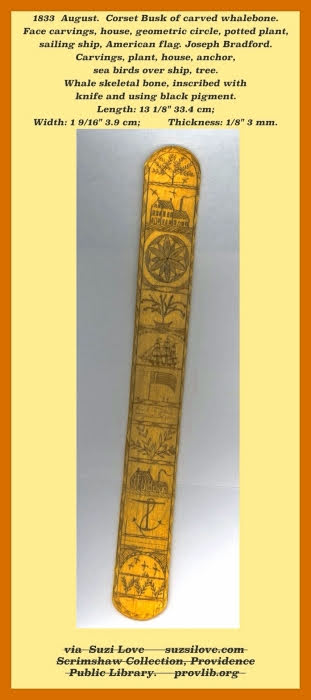
busk_1833 August. Corset Busk of carved whalebone. Face carvings, house, geometric circle, potted plant, sailing ship, American flag. Joseph Bradford. Carvings, plant, house, anchor, sea birds over ship, tree. Whale skeletal bone, inscribed with knife and using black pigment. Length: 13 1/8" 33.4 cm; Width: 1 9/16" 3.9 cm; Thickness: 1/8" 3 mm.
1833 August. Corset Busk of carved whalebone. Face carvings, house, geometric circle, potted plant, sailing ship, American flag. Joseph Bradford. Carvings, plant, house, anchor, sea birds over ship, tree. Whale skeletal bone, inscribed with knife and using black pigment. Length: 13 1/8″ 33.4 cm; Width: 1 9/16″ 3.9 cm; Thickness: 1/8″ 3 mm.
busk_Busks shaped and reinforced front of corsets. Made from whalebone, wood and bone. Often inscribed with names, dates and symbols of love because they were positioned close to the heart. Via Hereford Museum.
Busks shaped and reinforced front of corsets. Made from whalebone, wood and bone. Often inscribed with names, dates and symbols of love because they were positioned close to the heart. Via Hereford Museum.
busk_1771 Wooden Corset Busk, American. Carved Maple wood. Via Winterthur Museum.
1771 Wooden Corset Busk, American. Carved Maple wood. Via Winterthur Museum.
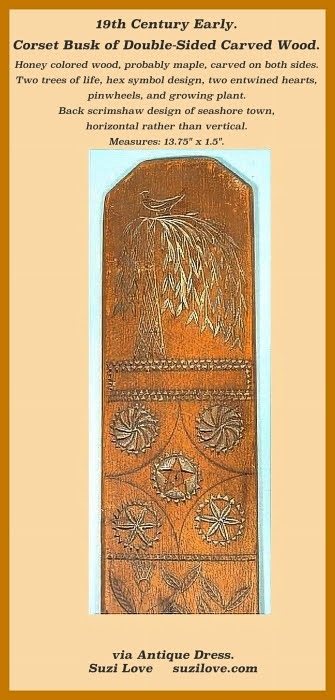
busk_19th Century Early. Corset Busk of Double-Sided Carved Wood. Honey colored wood, probably maple, carved on both sides. Two trees of life, hex symbol design, two entwined hearts, pinwheels, and growing plant. Back has delicate scrimshaw-look design of seashore town, chapel, homes, lighthouse and ships, horizontal rather than front vertical. Measures: 13.75" x 1.5". via Antique Dress.
19th Century Early. Corset Busk of Double-Sided Carved Wood. Honey colored wood, probably maple, carved on both sides. Two trees of life, hex symbol design, two entwined hearts, pinwheels, and growing plant. Back has delicate scrimshaw-look design of seashore town, chapel, homes, lighthouse and ships, horizontal rather than front vertical. Measures: 13.75″ x 1.5″. via Antique Dress.
busk_18th Century Wooden Busk for Stays, European. Via metmuseum.org
18th Century Wooden Busk for Stays, European. Via metmuseum.org
busk_18th Century Late - 19th Early Carved Maple Wood Busk, American. Spirals top & bottom, two hearts meet at center, "PC" carved on reverse. Worn by member of Robbins family, inherited by Ellen A. Stone. Via Fine Arts Museum Of Boston, USA.
18th Century Late – 19th Early Carved Maple Wood Busk, American. Spirals top & bottom, two hearts meet at center, “PC” carved on reverse. Worn by member of Robbins family, inherited by Ellen A. Stone. Via Fine Arts Museum Of Boston, USA.
https://books2read.com/SuziLoveCorsetBook14
Posted in 1700s, 1800s, 1800s women's fashion, Australia, Bridgerton, Canada, Corset, England, Europe, Georgian Era, Georgian Fashion, Jane Austen, Regency Era, Regency Fashion, Romantic Era, South Pacific, Suzi Love, U.S.A, underclothing | Tagged 1800s women's fashion, Bridgerton, Christie's Auction Rooms, Corset, Georgian Fashion, Jane Austen, Metropolitan Museum NYC, Museum Of Fine Arts, Regency Fashion, Romantic Era Fashion, Victoria and Albert Museum, Victorian fashion, Winterthur Museum

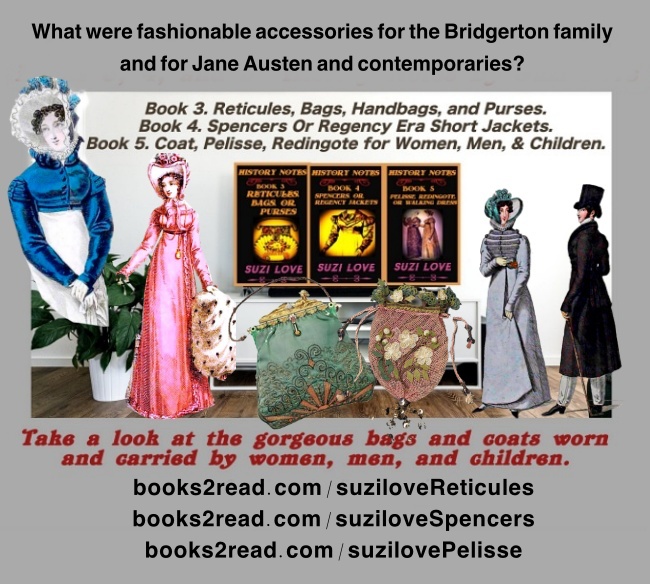
Fashion Must Haves In Bridgerton and Jane Austen Times: Reticules, Spencers, Redingotes. History Notes Series Books 3, 4, and 5. #Bridgerton #RegencyFashion #JaneAusten #GeorgianFashion #VictorianFashion

Suzi Love Posted on March 13, 2026 by Suzi LoveMarch 8, 2026
  • Fashion Must Haves In Jane Austen’s times: Reticules, Spencers, Redingotes. History Notes Books 3, 4, and 5 By Suzi Love.
  • books2read.com/suziloveReticules
  • books2read.com/suziloveSpencers
  • books2read.com/suzilovePelisse
Fashion Must Haves In Bridgerton and Jane Austen Times: Reticules, Spencers, Redingotes. History Notes Series Books 3, 4, and 5. #Bridgerton #RegencyFashion #JaneAusten #GeorgianFashion #VictorianFashion
Fashion Must Haves In Jane Austen’s Times: Reticules, Spencers, Redingotes. History Notes Series Books 3, 4, and 5.
  • Reticule Or Bag: Purse, often with a drawstring to pull closed and usually made of cloth or covered cardboard and often decorated with beading or embroidery. Carried by a woman during the Regency period to carry all their daily necessities. in the place of pockets.
  • Spencer: Short jacket, cropped at the waist, worn over a dress, or gown. Delicate and regency dresses provided so little protection from the cold, so over garments were essential for warmth, modesty and good health.
  • Pelisse Or redingote Or Walking Dress: Coat worn over clothing of both sexes for warmth and protection from the elements.
HN_3_PelisseRedingoteWalkingDress_universal http://books2read.com/suziloveReticules
D2D_RetailerBuyLink_HN_3 http://books2read.com/suziloveReticules
Posted in 1700s, 1700s Mens fashion, 1700s Womens Fashion, 1800s, 1800s Mens Fashions, 1800s women's fashion, 1900s, Coat or Pelisse Or Redingote, Decorative Item, Edwardian Era, England, Europe, fashion accessories, Georgian Era, Georgian Fashion, hats, History Notes, Jane Austen, Regency Era, Regency Fashion, Reticule or Bag, Romantic Era, Spencer, Suzi Love Books, Suzi Love Images, U.S.A, Victorian Era | Tagged 1800s women's fashion, Book 3, Book 4, Book 5, fashion accessories, History Notes, Jane Austen, Regency Fashion, reticule or bag, Spencer, Suzi Love Books
1750-155 ca. Writing Cabinet, Probably by Michael Kimmel, Germany. Veneered in kingwood, marquetry of mother-of-pearl, ivory and brass on pine, stained alder or birch. Mounted in gilt brass and with giltwood, carving of cypher of Augustus III. via Victoria and Albert Museum, London, UK. collections.vam.ac.uk.

1750-1755 Ca. Writing Cabinet Veneered In Kingwood With Marquetry Of Mother-Of-Pearl, Germany. #GeorgianEra #History #Antiques #Germany

Suzi Love Posted on March 7, 2026 by Suzi LoveFebruary 16, 2026

1750-155 ca. Writing Cabinet, Probably by Michael Kimmel, Germany. Veneered in kingwood, marquetry of mother-of-pearl, ivory and brass on pine, stained alder or birch. Mounted in gilt brass and with giltwood, carving of cypher of Augustus III. via suzilove.com Victoria and Albert Museum, London, UK. collections.vam.ac.uk.

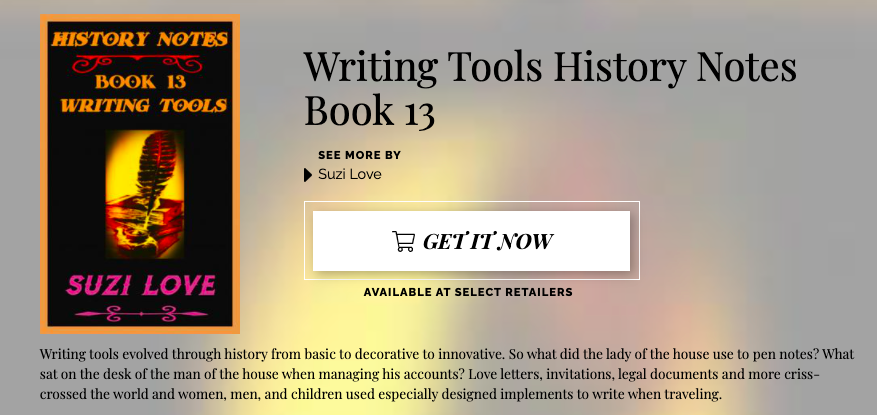
HN_13_D2D_WritingTools Book 13 What did the lady of the house use to pen notes? What sat on the desk of the man of the house when managing his accounts? #History #Nonfiction #travel books2read.com/SuziLoveWritingTools
Posted in 1700s, Decorative Item, Europe, furniture, Georgian Era, History, household, Writing Tools | Tagged 1700s Or Georgian Era, antiques, desk, europe, furniture, Germany, Victoria and Albert Museum, Writing Tools

1700 ca. Chess and Backgammon Box With Ivory Pieces, Augsburg. #GeorgianEra #antiques

Suzi Love Posted on March 6, 2026 by Suzi LoveJanuary 25, 2026

1700 ca. Chess and Backgammon Box, Augsburg. Decorated in violet wood veneer, ebony and ivory. Ivory checkers and chess pieces, hinges and push button lock in gilded brass, two horn goblets, two ivory dice, thirty-none checkers’ pawns stamped both sides with effigies of cities, Munich, Vienna, Nuremberg, Prague, Danzig, of kings and queens, Prussia, England, Scotland, Poland, and various scenes. Via AnticStore.com

1700 ca. Chess and Backgammon Box With Ivory Pieces, Augsburg. #GeorgianEra #antiques https://books2read.com/suziloveBoxesCases
HN_11_D2D_Craftsmen created containers of precious metals, leather, silks, and decorated them with jewels to make exquisite and expensive items as well as practical carrying cases. books2read.com/suziloveBoxesCases
Posted in 1700s, Box Or Container, Decorative Item, Europe, Georgian Era, History, household, Pastimes, Suzi Love Images | Tagged antiques, Box Or Container, decorative, games, household, pastimes, Suzi Love Images

Want To Know More About Men’s Fashion in the Late 1700s, Or Georgian Era? #GeorgianEra #BritishHistory #Nonfiction

Suzi Love Posted on February 26, 2026 by Suzi LoveFebruary 26, 2026

Want To Know More About Georgian Era Men’s Fashions? Try History Notes Book 2: Fashion Men 1700s Late. What was fashionable for men in the late 1700s? Extravagant colors and fabrics and outrageous styles. Take a look at their suits, hats, accessories and bedroom fashions.

Strictly speaking, the Georgian Era might include all the years that a ‘King George’ ruled in England, but for the purposes of this book the ‘Georgian Era’ is primarily the late 1700s when mad King George III ruled. His son became Prince Regent in the early 1800s, therefore creating the years known as the Regency, and became George IV on the death of his father.

  • The Georgian years officially ended with the death of King George IV in 1830.
  • George I ruled 1714-1727
  • George II ruled 1727-1760
  • George III ruled 1760-1820
  • George IV ruled 1820-1830
HN_2_What was fashionable for men in the late 1700s? Extravagant colors and fabrics and outrageous styles. Take a look at their suits, hats, accessories and bedroom fashions. books2read.com/suziloveFashMen1700s


HN_2_D2D_Fashion Men 1700s
HN_2_D2D_Fashion Men 1700s books2read.com/suziloveFashMen1700
Posted in 1700s, 1700s Mens fashion, bedroom fashion, cartoon, Coat or Pelisse Or Redingote, Corset, England, Europe, fashion accessories, Georgian Era, Georgian Fashion, hats, History Notes, London, pants, riding, Shirt, shoes, sports, Suit, Suzi Love Books, Suzi Love Images, U.S.A, underclothing, Vest or Waistcoat | Tagged 1700s Mens Fashion, 1700s Or Georgian Era, Book 2, boots, breeches, court clothing, fashion accessories, Fashion Plate, Georgian era, gloves, Hats And Hair, History Notes, pants, Redingote Or Pelisse Or Coat, Shoes, Suit, Suzi Love Books

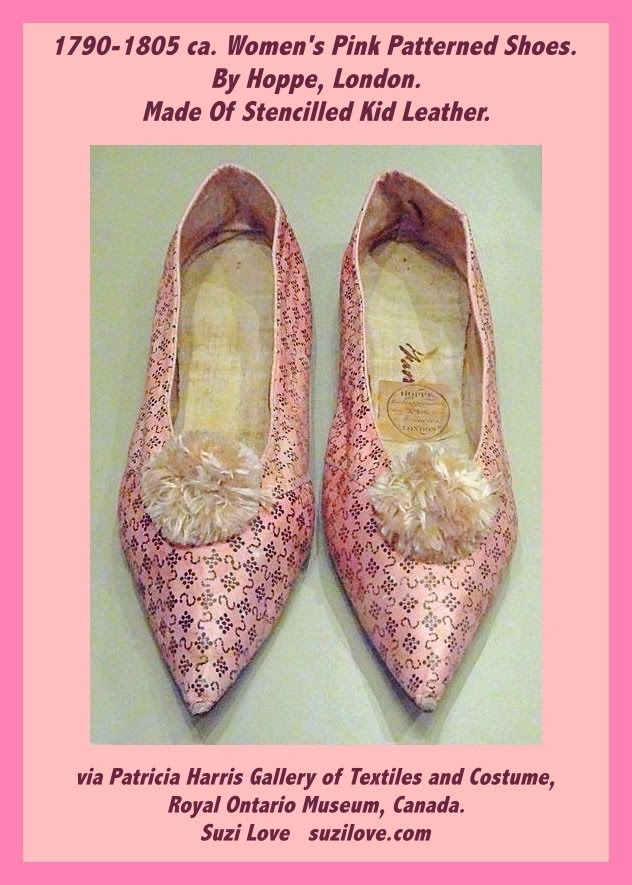
1790-1805 ca. Pink patterned kid leather shoes #RegencyEra #GeorgianEra #JaneAusten #Shoes

Suzi Love Posted on February 21, 2026 by Suzi LoveFebruary 19, 2026

1790-1805 ca. Women’s pink patterned kid leather shoes as worn by Jane Austen and other ladies in her times. Made by Hoppe, London, of stencilled kid leather.

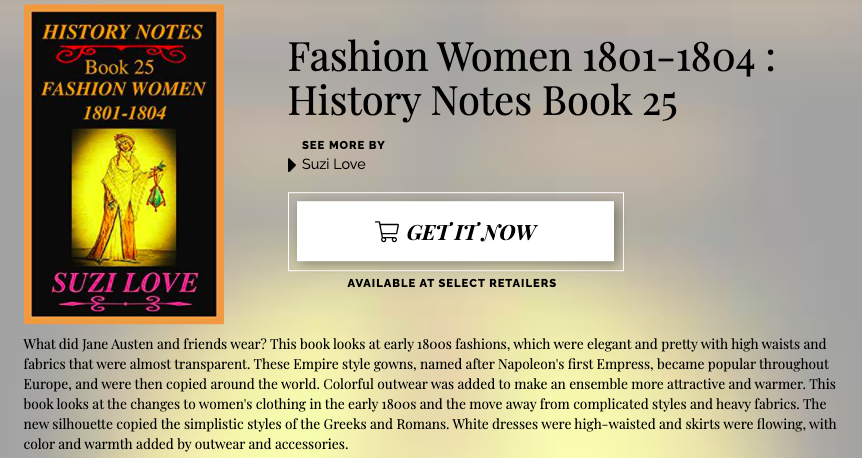
In Jane Austen’s years, fragile slippers were worn for balls and evening events but for walking sturdier shoes were needed, In the early 1800s, slippers were made of fabric such as satin or from leather, were flat or had a very small heel, slightly rounded toes and were laced up on the top. They were usually not made in right or left, but instead one shoe shape and in multiples so that when one slipper wore out, another was on hand to replace it.

1790-1805 ca. Women's Pink Patterned Shoes. By Hoppe, London. Stenciled kid leather. via suzilove.com & Patricia Harris Gallery of Textiles and Costume, Royal Ontario Museum, Canada.
HN_25_D2D_fashwomen1801-1804
https://books2read.com/SuziLoveFashionWomen1801-1804
HN_25_D2D_fashwomen1801-1804 https://books2read.com/SuziLoveFashionWomen1801-1804

Posted in 1700s, 1800s, 1800s women's fashion, England, Georgian Era, Georgian Fashion, Jane Austen, London, Regency Era, Regency Fashion, shoes, Suzi Love Images | Tagged 1700s Women's Fashion, 1800s women's fashion, Georgian Fashion, Jane Austen, London, Regency Fashion, Royal Ontario Museum Canada, Shoes, Suzi Love Images

1552 Onwards Covent Garden, London, England. #BritishHistory #London #CoventGarden

Suzi Love Posted on February 12, 2026 by Suzi LoveJanuary 30, 2026

Covent  Garden is within the London boroughs of Westminster and Camden, and the parliamentary constituencies of Cities of London and Westminster and Holborn and St Pancras. The district is divided by the main thoroughfare of Long Acre, north of which is given over to independent shops centred on Neal’s Yard and Seven Dials, while the south contains the central square with its street performers and most of the elegant buildings, theatres and entertainment facilities, including the Theatre Royal, Drury Lane, and the London Transport Museum.

In 1552, the land was seized by Henry VIII and granted to the Earls of Bedford. The 4th Earl  commissioned Inigo Jones to build fine houses to attract wealthy tenants. It was the first modern square in London, with Italian arcades and a flat, open space or piazza with low railings. This layout was copied in other new estates in London.

1555 John Russell, 1st Earl Of Bedford. By a follower of John Bettes. Given land of Covent Garden by Herny VIII after the dissolution of the Monasteries.
1650 The piazza of Covent Garden about 1650, as engraved by Wenceslaus Hollar. Courtesy University of Toronto.
1721-1789 ca. St. Paul's Church, Covent Garden, London, U.K. From between two arches of the plaza. Watercolor with grey wash. By Thomas Sandy. Via Suzi Love suzilove.com & British Museum, London, UK. britishmuseum.org
1721-1789 ca. St. Paul’s Church, Covent Garden, London, U.K. From between two arches of the plaza. Watercolor with grey wash. By Thomas Sandy. Via British Museum, London, UK. britishmuseum.org
1800s Early Covent Garden Market, London, U.K.

In 1654, an open-air fruit and vegetable market grew on the south side of the fashionable square but over time the market and the surrounding area fell into disrepute. Taverns, theatres, coffee-houses and brothels opened up, the gentry moved away, and rakes, wits and playwrights moved in.

By the 18th century Covent Garden had become a well-known red-light district, attracting notable prostitutes such as Betty Careless and Jane Douglas. Descriptions of the prostitutes and where to find them were provided by Harris’s List of Covent Garden Ladies, the “essential guide and accessory for any serious gentleman of pleasure”. 

Covent Garden’s market was always disorderly, the buildings in bad shape, and overcrowded with stalls, donkeys, carts, and peddlers. The small number of passageways into the piazza were small and with bottle necks of carts moving goods and market sellers fighting for right of way. The markets supplied fruits and vegetables, mostly homegrown but with imported goods increasing. Many sellers missed paying tolls for selling in the piazza or refused to pay them so the owner, the Earl of Bedford, took many people to court for not paying tolls. He realized the markets were in such poor condition that he couldn’t charge sellers until he improved them. In 1830, a new market hall was built with sections dividing the kind of goods sold which did improve things, but the markets remained chaotic. By 1890, people were again complaining about the narrow streets and congestion.

Covent Garden’s flower girls attracted attention by shouting:

“Two bundles a penny, primroses!”

“Sweet violets, penny a bunch!”

In 1851, Henry Mayhew wrote London Labour and the London Poor describing two types of flower girl. The young girls, or waifs, sold flowers to feed the family. The other type of flower girl stayed out late, doubled as prostitutes, and had bad reputations.

In 1913, Herbrand Russell, 11th Duke of Bedford agreed to sell the Covent Garden Estate for £2 million to the MP and land speculator Harry Mallaby-Deeley, who sold his option in 1918 to the Beecham family for £250,000.

1809 View Of the New Covent Garden Theatre, London. From Hart Street, showing the King's entrance. Watercolor drawn by James Winston. via British Museum.
1809 View Of the New Covent Garden Theatre, London. From Hart Street, showing the King’s entrance. Watercolor drawn by James Winston. via British Museum.
1811 Bird’s Eye View of Covent Garden Market, London, UK. Main fruit, flower and vegetable market in London in early 19th century. Began here in 1656 with few temporary stalls in back garden of home of Earl of Bedford. Charles II granted market lease and in 1678 bought by Adam Piggot and others who built permanent stalls. By 1811, smelly, dirty, and overcrowded. Engraver J. Bluck. After Augustus Charles Pugin and Thomas Rowlandson published by Ackermann. Via Suzi Love suzilove.com & British Museum, London, UK. britishmuseum.org
1811 Bird’s Eye View of Covent Garden Market, London, UK. Main fruit, flower and vegetable market in London in early 19th century. Began here in 1656 with few temporary stalls in back garden of home of Earl of Bedford. Charles II granted market lease and in 1678 bought by Adam Piggot and others who built permanent stalls. By 1811, smelly, dirty, and overcrowded. Engraver J. Bluck. After Augustus Charles Pugin and Thomas Rowlandson published by Ackermann. Via British Museum, London, UK. britishmuseum.org
1827 Covent Garden Market, Westminster, London, U.K.  By Frederick James Havell.
1827 Covent Garden Market, Westminster, London, U.K. By Frederick James Havell.

In 1830, Charles Fowler’s neo-classical building was erected to cover the market and as the market grew, the prostitutes moved on. The Floral Hall and Charter Market were added and the Jubilee Market in 1904.

1835 Covent Garden Watch House, London, UK. Next to the church of St. Paul's Church, Covent Garden. Two story white building with 'Watch House' painted on its upper floor is shown with a lively street scene in the foreground. via Museum of London.
1835 Covent Garden Watch House, London, UK. Next to the church of St. Paul’s Church, Covent Garden. Two story white building with ‘Watch House’ painted on its upper floor is shown with a lively street scene in the foreground. via Museum of London.
1852 J.M.W. Turner’s birthplace in Maiden Lane, Covent Garden. Brick terraced house at night with a figure in top hat walking past and two figures with a candlelight in the doorway_Watercolour with body color over graphite. Drawn by John Wykeham Archer.

In 1913,Herbrand Russell, 11th Duke of Bedford agreed to sell the Covent Garden Estate for £2 million to the MP and land speculator Harry Mallaby-Deeley, who sold his option in 1918 to the Beecham family for £250,000. By the end of the 1960s, traffic had become congested until in 1974 the market relocated to the New Covent Garden Market about three miles (5 km) south-west at Nine Elms. In 1980, the central building re-opened as a shopping centre and then became a tourist location with cafes, pubs, small shops, a craft market called the Apple Market, and another market in the Jubilee Hall.

RL_1_D2D_Regency Overview RetailerLinks
https://books2read.com/suziloveROver
RL_1_D2D_Regency Overview RetailerLinks https://books2read.com/suziloveROver
Posted in 1700s, 1800s, England, Food and Drink, Georgian Era, History, London, Regency Era, Romantic Era, Suzi Love Images, Victorian Era | Tagged 1700s Or Georgian Era, 1800s Or 19th Century, British history, British Museum, Covent Garden, Food, Georgian era, google books, London, Museum Of London, Regency London, Suzi Love Images, theatre, WikiMedia Commons | Leave a reply

18th Century Late Square Inkstand With Pounce Pot, Sheffield, England. #GeorgianEra #amwriting #BritishHistory

Suzi Love Posted on February 7, 2026 by Suzi LoveJanuary 16, 2026

18th Century Late. Inkstand, Sheffield, England. Square, resting on four ball feet, the top pierced with four circular holes into which fit two inkwells, a pounce box and a box for wafers. Silver inkstands appeared in Britain in 17th century and included pot, or well, for ink, plus another pot with pierced cover held ‘pounce’ or sand, which writers scattered over paper to fix ink. Wafers to seal finished letter and tray to hold pens or quills. collections.vam.ac.uk

18th Century Late. Inkstand, Sheffield, England. Square, resting on four ball feet, the top pierced with four circular holes into which fit two inkwells, a pounce box and a box for wafers. Silver inkstands appeared in Britain in 17th century and included pot, or well, for ink, plus another pot with pierced cover held ‘pounce’ or sand, which writers scattered over paper to fix ink. Wafers to seal finished letter and tray to hold pens or quills. collections.vam.ac.uk
HN_13_D2D_Writing Tools books2read.com/SuziLoveWritingTools
Posted in 1700s, Box Or Container, Decorative Item, England, Georgian Era, History, household, Suzi Love Images, Writing Tools | Tagged 1700s Or Georgian Era, antiques, Box Or Container, British history, decorative, England, household, Victoria and Albert Museum, Writing Tools

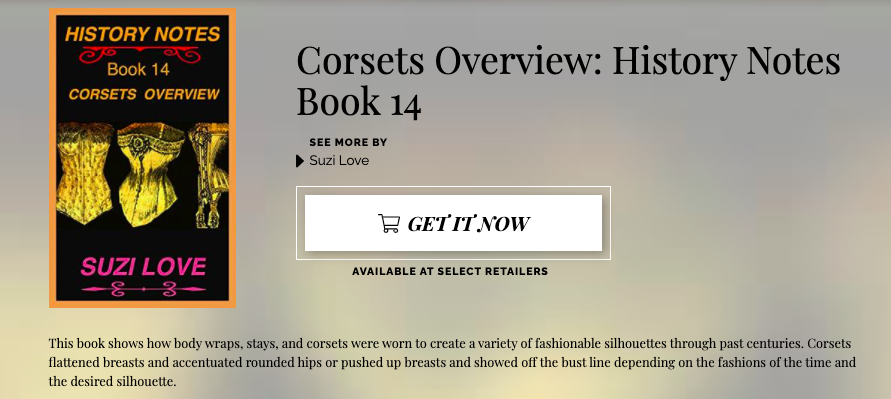
Do you love historical fashion? Treat yourself to a nonfiction Box Set on corsets, including Bridgerton and Jane Austen years. #Bridgerton #JaneAusten #Historicalfashion #Corset #nonfiction

Suzi Love Posted on February 6, 2026 by Suzi LoveJanuary 21, 2026

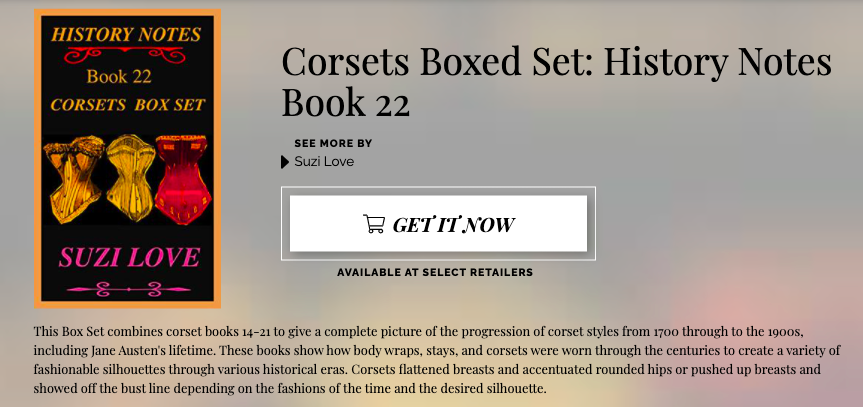
Box Set combining Corset books 14-21 to give a complete picture of the progression of corset styles from 1700 through to the 1900s, including Jane Austen’s lifetime. https://books2read.com/SuziLoveCorsetBook22

This Box Set combines corset books 14-21 to give a complete picture of the progression of corset styles from 1700 through to the 1900s, including Jane Austen’s lifetime and the Bridgerton years. These books show how body wraps, stays, and corsets were worn through the centuries to create a variety of fashionable silhouettes through various historical eras. Corsets flattened breasts and accentuated rounded hips or pushed up breasts and showed off the bust line depending on the fashions of the time and the desired silhouette.

HN_22_Corsets Box Set History Notes Book 22 This Box Set combines corset books 14-21 to give a complete picture of the progression of corset styles from 1700 through to the 1900s, including Jane Austen's lifetime. These books show how body wraps, stays, and corsets were worn through the centuries to create a variety of fashionable silhouettes through various historical eras. Corsets flattened breasts and accentuated rounded hips or pushed up breasts and showed off the bust line depending on the fashions of the time and the desired silhouette. Box Set combining Corset books 14-21 to give a complete picture of the progression of corset styles from 1700 through to the 1900s, including Jane Austen's lifetime. https://books2read.com/SuziLoveCorsetBook22
HN_22_D2D_Corset Box Set
https://books2read.com/SuziLoveCorsetBook22
HN_22_D2D_Corset Box Set
Posted in 1700s, 1700s Womens Fashion, 1800s, 1800s women's fashion, 1900s, Australia, Bridgerton, Canada, Children, Corset, Edwardian Era, England, Europe, France, Georgian Era, Georgian Fashion, History Notes, Jane Austen, London, Regency Era, Regency Fashion, Romantic Era, Suzi Love Books, U.S.A, underclothing, Victorian Era | Tagged 1700s Women's Fashion, 1800s women's fashion, Book 22, Bridgerton, Corset, fashion accessories, Fashion Plate, History Notes, Jane Austen, Regency Fashion, Romantic Era, Suzi Love Books, underclothing, Victorian fashion

Post navigation

← Previous Post
Next Post→

SUBSCRIBE TO SUZI LOVE'S NEWSLETTER.

Recent Posts

  • Do You Know What A Half Parure Is? 1806 Muslin Dress With Train, Shawl and Half Parure Jewelry Set. #RegencyFashion #JaneAusten #HistoricalFashion
  • Fashion Must Haves In Bridgerton and Jane Austen Times: Reticules, Spencers, Redingotes. History Notes Series Books 3, 4, and 5. #Bridgerton #RegencyFashion #JaneAusten
  • 1805 November Typical Jane Austen Fashions With Accessories, English. #Regency #Fashion #JaneAusten
  • 19th Century Ormolu and Tortoiseshell Inkstand, As Found in Bridgerton and Jane Austen Households. #Bridgerton #RegencyEra #JaneAusten
  • Reader or writer of Victorian Era books? Tightly Laced Corsets Gave Narrow Waists and Feminine Shape. History Notes Book 20 #Corsets #VictorianEra #FashionHistory

Recent Comments

  1. Suzi Love on Book Hooks: Petunia and the Pearl Diver. Petunia was too well spoken for a brothel worker. #Regencyromance #historicalromance #London #mfrw
  2. Bianca White on Book Hooks: Petunia and the Pearl Diver. Petunia was too well spoken for a brothel worker. #Regencyromance #historicalromance #London #mfrw
  3. Suzi Love on Book Hooks: Petunia and the Pearl Diver. Petunia was too well spoken for a brothel worker. #Regencyromance #historicalromance #London #mfrw
  4. Suzi Love on Book Hooks: Petunia and the Pearl Diver. Petunia was too well spoken for a brothel worker. #Regencyromance #historicalromance #London #mfrw
  5. Suzi Love on Book Hooks: Petunia and the Pearl Diver. Petunia was too well spoken for a brothel worker. #Regencyromance #historicalromance #London #mfrw

Login

  • Log in

Archives

  • November 2026
  • October 2026
  • September 2026
  • August 2026
  • July 2026
  • June 2026
  • May 2026
  • April 2026
  • March 2026
  • February 2026
  • January 2026
  • December 2025
  • November 2025
  • October 2025
  • September 2025
  • August 2025
  • July 2025
  • June 2025
  • May 2025
  • April 2025
  • March 2025
  • February 2025
  • January 2025
  • December 2024
  • November 2024
  • October 2024
  • September 2024
  • August 2024
  • July 2024
  • June 2024
  • May 2024
  • April 2024
  • March 2024
  • February 2024
  • January 2024
  • October 2023
  • September 2023
  • August 2023
  • June 2022
  • April 2022

Categories

  • 1700s
  • 1700s Mens fashion
  • 1700s Womens Fashion
  • 1800s
  • 1800s Mens Fashions
  • 1800s women's fashion
  • 1900s
  • art
  • Australia
  • Bath
  • bedroom fashion
  • Book Hooks
  • Box Or Container
  • Bridgerton
  • Bus Trips
  • Canada
  • Carriage
  • cartoon
  • Celebrity
  • Chatelaine
  • children
  • Children
  • Christmas
  • Coat or Pelisse Or Redingote
  • Contemporary
  • Corset
  • Couple
  • Customs & Manners
  • dancing
  • December Scandal
  • Decorative Item
  • Dress Or Robe
  • Easter
  • Edwardian Era
  • Embracing Scandal
  • England
  • Ester In Images
  • Europe
  • Events
  • Fashion
  • fashion accessories
  • Food and Drink
  • Four Times A Virgin
  • France
  • furniture
  • Georgian Era
  • Georgian Fashion
  • Google Books
  • Grand Tour
  • Group
  • hats
  • History
  • History Events
  • History Notes
  • History Of Christmases Past
  • household
  • Hygiene
  • Irresistible Aristocrats
  • Jane Austen
  • Keanu Reeves
  • Kellys Justice
  • Legal
  • London
  • Love After Waterloo
  • Loving Lady Katharine
  • medical
  • military
  • money
  • mourning
  • Music
  • Outback Arrival
  • pants
  • Pastimes
  • peerage
  • People
  • Petunia and Pearl Diver
  • Places
  • Pleasure House Ball
  • postal
  • Queensland
  • Quotations
  • Regency Era
  • Regency Fashion
  • Regency Life Series
  • Reticule or Bag
  • riding
  • Romantic Era
  • Royalty
  • Russia
  • Scandalous Siblings Series
  • Scenting Scandal
  • Self Publishing
  • sewing
  • Shirt
  • shoes
  • Shopping
  • South Pacific
  • Spencer
  • sports
  • Suit
  • Sunday Snippet
  • Suzi Love
  • Suzi Love Books
  • Suzi Love Images
  • Suzi Love Writing
  • Swain Cove
  • THe Viscount's Pleasure House
  • travel
  • U.S.A
  • underclothing
  • Vest or Waistcoat
  • Victorian Era
  • Victorian Fashion
  • weapons
  • weddings
  • Writing Tools

1800s men fashion 1800s women's fashion antiques Bridgerton British history Cartoons Corset cravat decorative Dress Or Gown England europe fashion accessories Fashion Plate France Georgian era Georgian Fashion gloves google books Hats And Hair historical romance History Notes household Jane Austen jewelry Journal des Dames et des Modes London Metropolitan Museum NYC pants Redingote Or Pelisse Or Coat Regency Era Regency Fashion Regency London reticule or bag riding Romantic Era sewing shawls Shoes Suzi Love Books Suzi Love Images Tailcoat The Repository Of Arts underclothing Vest or Waistcoat

©2026 - Suzi Love - Weaver Xtreme Theme Privacy Policy
↑